Abijah in the Bible: Meaning and the People Named Abijah
Abijah in the Bible: Meaning and the People Named Abijah
If you have encountered the name Abijah in a family tree, Bible passage, or church reading, you may wonder which person it describes. The name belongs to several different people, including a king of Judah, a son of Israel’s first northern king, and a priestly family connected with Zechariah, the father of John the Baptist.
Abijah means “Yahweh is my father”, using a Hebrew form of God’s personal name. It is sometimes spelled Abiah or rendered Abijam in connection with the Judean king. Since the Bible applies the name to more than one person, the surrounding passage is essential for identifying the right Abijah.
Quick answer: Abijah is both a biblical personal name and the name of a priestly division. The best-known Abijah was the second king of Judah, who reigned after Rehoboam and fought Jeroboam of Israel.
What the name Abijah means and how it is pronounced
Abijah comes from Hebrew elements commonly understood as “father” and “Yahweh”. Its meaning is usually given as “Yahweh is my father,” “the Lord is my father,” or “my father is Yahweh.” English Bibles may use different spellings because translators and traditions represent Hebrew names in different ways.
The name is generally pronounced uh-BYE-jah, although some readers say uh-BIJ-ah. The spelling Abiah represents the same or a closely related name in some translations. These variations do not necessarily indicate different people; the biblical passage determines the person being discussed.
Abijah is a name with a clear religious meaning rather than a description of someone’s personality. Its wording expresses a relationship with God, much like other biblical names that include a reference to the Lord. A person named Abijah is not automatically presented as faithful simply because the name has a positive meaning.
The name can refer to men and women in biblical genealogies and royal records, although the most prominent Abijah in Scripture is male. Readers should be careful not to assume that every occurrence refers to the king of Judah. Several people named Abijah appear in different periods and settings.
Abijah the king of Judah appears in 1 Kings 15 and 2 Chronicles 13.
Abijah, son of Jeroboam, appears in 1 Kings 14.
The priestly division of Abijah appears in 1 Chronicles 24 and Luke 1.
Abijah, the mother of King Hezekiah, appears in 2 Chronicles 29:1.
Other people with the name appear in genealogical and postexilic lists.
Who was Abijah, king of Judah?
The most prominent biblical figure named Abijah was the second king of Judah after the kingdom divided. He was the son of Rehoboam and the grandson of Solomon. His mother is identified in the royal accounts as Maacah, also called Micaiah in the parallel account in Chronicles, and connected with Abishalom or Absalom.
Abijah succeeded Rehoboam in Jerusalem and ruled Judah for three years. His reign followed the disastrous division of the united kingdom after Solomon’s death. Judah occupied the southern kingdom, while Jeroboam ruled the northern kingdom of Israel.
The account in 1 Kings 15 gives a brief evaluation of his reign. It says that Abijah continued the sins associated with his father’s rule and that his heart was not fully devoted to the Lord as David’s heart had been. At the same time, the passage recognizes that God preserved David’s dynasty in Jerusalem because of the divine promise to David.
2 Chronicles 13 provides a much longer account of Abijah’s conflict with Jeroboam. Before the battle, Abijah stood on Mount Zemaraim and addressed the forces of the northern kingdom. He appealed to God’s covenant with David, defended the temple worship in Jerusalem, and criticized Jeroboam’s religious system.
According to Chronicles, Jeroboam’s army surrounded Judah, placing Abijah’s forces in a dangerous position. Judah’s soldiers called out to the Lord, the priests sounded trumpets, and the Judean army prevailed. The chapter attributes the victory to God’s support for Judah rather than to Abijah’s military strength alone.
The two accounts emphasize different aspects of his reign. Kings stresses his incomplete faithfulness, while Chronicles highlights his public defense of the Jerusalem temple and the victory over Israel. These emphases can be read together: a king may make a correct public claim about worship while still receiving an unfavorable personal evaluation.
Reading tip: Do not treat 1 Kings 15 and 2 Chronicles 13 as interchangeable summaries. Kings gives a compressed royal evaluation, while Chronicles focuses on Abijah’s speech, the battle, and the temple-centered identity of Judah.
What Abijah’s war with Jeroboam reveals
Abijah’s speech was not merely a military address. It argued that Judah represented the continuation of David’s covenant kingdom, while Jeroboam’s northern kingdom had rejected the established priesthood and worship in Jerusalem. Abijah used religious and political claims together because the division of the kingdom affected both government and worship.
Jeroboam had established alternative worship centers at Bethel and Dan, along with a different priestly arrangement. Chronicles presents Abijah as contrasting those practices with the priests, Levites, sacrifices, and worship associated with the temple in Jerusalem. His argument was that Judah retained the divinely appointed order.
The passage does not portray Abijah as a flawless spiritual leader. In fact, the evaluation in Kings prevents readers from turning his speech into a complete endorsement of his character. The narrative can show God’s help in a particular event without declaring that every action of the human leader was righteous.
Chronicles reports very large troop numbers and battlefield losses in this conflict. Modern readers may notice that ancient military accounts often use numerical language in ways that are difficult to assess from the text alone. The central theological point of the chapter is that Judah was outmatched, appealed to God, and survived the confrontation.
After Abijah’s death, his son Asa became king. Asa is generally given a more favorable evaluation, especially for removing many forms of unauthorized worship. The transition from Abijah to Asa shows how the biblical writers distinguish the achievements and failures of successive kings rather than treating the dynasty as uniformly faithful or unfaithful.
Who was Abijah, the son of Jeroboam?
A different Abijah appears in 1 Kings 14 as a son of Jeroboam, the first king of the northern kingdom of Israel. This Abijah should not be confused with the Judean king who opposed Jeroboam in battle. The two men belonged to rival royal families and lived in the same broad period.
Jeroboam’s son became seriously ill, so Jeroboam sent his wife to ask the prophet Ahijah what would happen. She disguised herself before visiting the prophet, but Ahijah was told by God who she was and what she had come to ask.
The prophet delivered a judgment against Jeroboam’s household because of the king’s idolatry and his role in leading Israel away from proper worship. Yet the message made a specific distinction about Abijah: he alone among Jeroboam’s household was said to have something pleasing to the Lord.
Abijah died when his mother returned to the city. The prophet said that Israel would mourn him, because he was the only member of Jeroboam’s family who would receive an honorable burial. The narrative presents his death as both a personal loss and a sign of judgment on the royal house.
This account gives Abijah a very different profile from the Judean king. The Judean Abijah is a ruler criticized for incomplete devotion but associated with a military victory. Jeroboam’s son never becomes king and appears only in a short prophetic story, yet he receives a notably positive spiritual assessment.
Abijah of Judah: son of Rehoboam, king in Jerusalem, opponent of Jeroboam.
Abijah of Israel: son of Jeroboam, ill during his father’s reign, remembered favorably by the prophet Ahijah.
Main distinction: the first is a reigning king; the second is a royal son whose early death is described in 1 Kings 14.
What was the priestly division of Abijah?
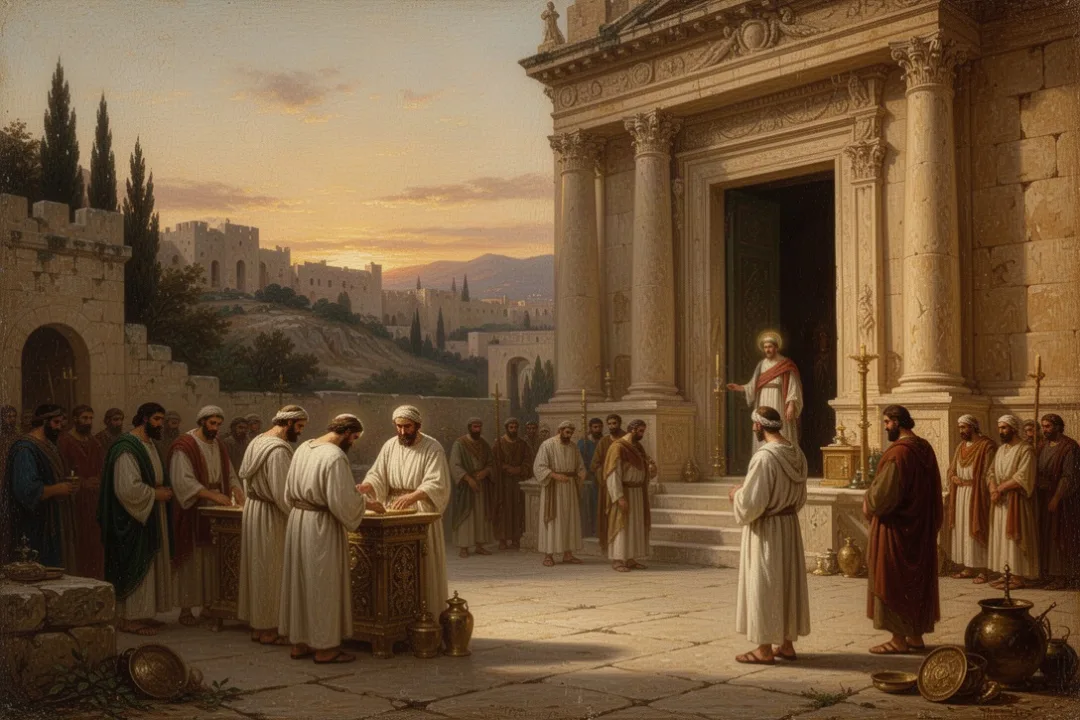
Abijah was also the name of one of the twenty-four priestly divisions organized during the reign of David. First Chronicles 24 describes the division of priestly families into scheduled groups for service at the temple. Abijah is listed as the eighth division.
The priestly divisions helped organize temple duties among many priestly families. Each group served according to an assigned order, allowing the responsibilities of worship to be shared rather than left to one family or one individual. The name therefore refers not only to a person but also to a continuing priestly household or course of service.
The division of Abijah becomes especially familiar through Luke 1:5. Zechariah, the priest who received the announcement concerning the birth of John the Baptist, belonged to the priestly division of Abijah. His wife Elizabeth was also from a priestly family, and Luke describes both of them as descendants of Aaron.
Zechariah was serving in the temple when an angel announced that Elizabeth would have a son. The son would become John the Baptist, the prophetic figure who prepared people for the public ministry of Jesus. The connection between Zechariah and the division of Abijah places the opening of Luke’s Gospel within Israel’s priestly and temple traditions.
The New Testament reference does not mean that Zechariah was the same person as any of the Old Testament figures named Abijah. Rather, it identifies his priestly lineage and service group. The name continued through the priestly family system and was still meaningful in the period described by Luke.
Later lists in Nehemiah also mention Abijah in connection with priests after the exile. These references show that the name could identify a priestly family or course across generations. Depending on the passage, “Abijah” may refer to the original ancestor, the family descended from him, or the group that carried the same designation.
Who else in the Bible was named Abijah?
Several additional people named Abijah appear in genealogies, royal records, and lists of religious leaders. These shorter references can be easy to overlook, but they help explain why a single definition of “Abijah” is not enough. The name was used across different tribes, generations, and social roles.
Abijah, the mother of Hezekiah
Second Chronicles 29:1 names Abijah as the mother of Hezekiah, one of Judah’s most highly regarded kings. She is identified as the daughter of Zechariah. Hezekiah later led major religious reforms, reopened and purified the temple, and encouraged worship centered on the Lord.
The parallel account in 2 Kings 18 uses the shorter form Abi for Hezekiah’s mother. Many readers understand Abi and Abijah to refer to the same woman, with the different forms reflecting the transmission and spelling of Hebrew names. She is one reason readers should not assume that Abijah always refers to a man.
Abijah in genealogical records
First Chronicles includes more than one person named Abijah in family records. One Abijah is listed among the descendants of Benjamin, while other references connect the name with priestly or Levitical families. These notices often provide little biography, but they preserve the identity of people whose importance lies in their place within a lineage.
Nehemiah also records a priest or priestly family called Abijah among the leaders associated with the postexilic community. In that setting, names helped establish legitimate descent, organize temple service, and identify representatives who participated in the renewed life of Jerusalem after the exile.
When reading a genealogy, focus on the names immediately before and after Abijah. The tribe, father’s name, office, and historical setting usually identify the person more reliably than the name itself. A genealogy may also use a shortened or alternate form, so comparison with parallel passages can be useful.
How to understand Abijah’s different biblical portraits
The various Abijah accounts highlight an important feature of biblical reading: the same name can belong to people with very different stories. One Abijah is a king, another is a child in a condemned royal house, another is a priestly ancestor, and another is the mother of a reforming king.
The name’s meaning provides background, but it does not settle the character of the person who bears it. The Judean king Abijah has a name that expresses devotion to God, yet Kings says his heart was not fully devoted. Jeroboam’s son is remembered favorably even though his story is brief and ends before he can accomplish public deeds.
Scripture also uses different narrative purposes for these figures. Royal books evaluate kings and their religious policies. Chronicles often emphasizes temple worship, Davidic identity, and the restoration of faithful practice. Genealogies establish family connections, while Luke’s opening chapter connects priestly service with the arrival of John the Baptist.
To identify an Abijah passage accurately, ask several simple questions:
Which book contains the name? First Kings, Second Chronicles, Luke, Nehemiah, and genealogical passages may point to different people.
Who is the person’s parent or spouse? Rehoboam, Jeroboam, Zechariah, and Hezekiah’s mother each lead to a different identification.
Is Abijah a person or a priestly division? Luke 1 uses the name to identify Zechariah’s priestly group.
What is the historical setting? The divided monarchy, the postexilic community, and the time of John the Baptist are separated by many centuries.
Does a parallel passage use another form? Abijam and Abi are examples of related forms that can appear in different translations or books.
For personal study, reading the full chapter around the name is more useful than relying on a name dictionary alone. The surrounding details—such as a father’s identity, a kingdom, a priestly assignment, or a prophetic message—usually make the intended Abijah clear.
Abijah remains a meaningful biblical name because it joins a personal identity with a declaration about God. Its most famous bearer, the king of Judah, illustrates the mixed record common in the books of the kings: political success and religious claims can exist alongside serious spiritual shortcomings. Other Abijahs remind readers that a short genealogy or priestly reference may preserve a distinct person and an important place in the biblical story.
Frequently asked questions
Is Abijah the same person as Abijam?
In the account of the Judean monarchy, Abijah and Abijam are generally understood to refer to the same king, the son of Rehoboam and father of Asa. First Kings uses Abijam in some passages, while Chronicles uses Abijah. The difference is usually treated as a variant form of the name rather than evidence of two separate kings.
Was Abijah a good king or a bad king?
The biblical evaluation is mixed rather than completely positive or negative. First Kings says Abijah continued the sins associated with his father and was not fully devoted to the Lord. Second Chronicles emphasizes his defense of temple worship and Judah’s victory over Jeroboam. Together, the accounts present a ruler with important public successes but significant spiritual shortcomings.
How is Abijah connected to John the Baptist?
Abijah was the name of the eighth priestly division established for temple service. Zechariah, John the Baptist’s father, belonged to that division, according to Luke 1:5. Abijah was not John’s ancestor in the immediate sense described there; the name identifies the priestly group to which Zechariah’s family was assigned.
Is Abijah a male or female name?
Abijah is used for both men and women in the Bible. The best-known examples are male, including the king of Judah and Jeroboam’s son, but Abijah is also the name of Hezekiah’s mother. The person’s family connections and the surrounding passage are needed to determine gender and identity.











Leave a Reply