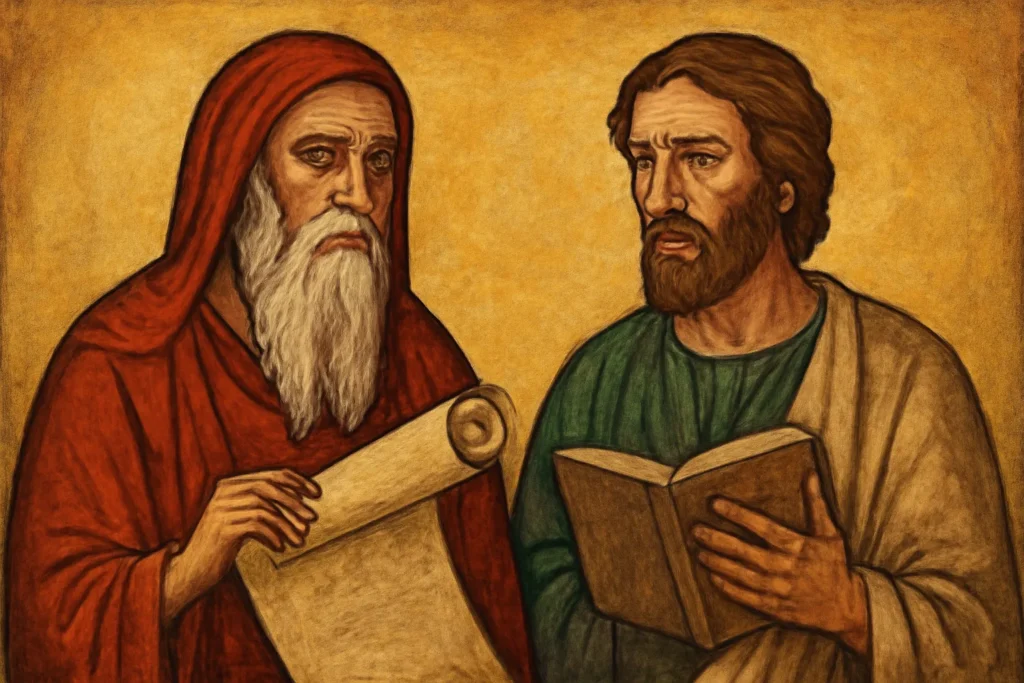
The two witnesses are among the most enduring mysteries and most discussed figures in the book of Revelation. Found in Revelation 11:3-12, they appear during the climactic period of the tribulation, prophesying and bearing supernatural authority for 1,260 days (often interpreted as three and a half years). Their ministry is marked by dramatic signs, including miracles that resemble the miracles of Old Testament prophets, opposition from the Beast, and a foretold moment of death, resurrection, and ascent to heaven. The question of who these witnesses are has sparked centuries of debate across Christian traditions, leading to a spectrum of identifications—from literal historical figures to symbolic representations of faithful witness. This article surveys the biblical text, the main identifications and arguments, and the broader end-time significance that scholars and theologians draw from this enigmatic duo.
The textual foundation: where the two witnesses stand in Revelation
The narrative surrounding the two witnesses unfolds in a highly symbolic, apocalyptic genre. Revelation 11 presents them as two olive trees and two lampstands that stand before the Lord of the earth, a motif echoing Old Testament images of instrumentality and witness (the olive trees and lampstands imagery is parallel to Zechariah 4). They are described as:
Clothed in sackcloth, representing a prophetic, suffering, or repentant posture.
Granted power to prophesy for 1,260 days, to shut heaven so that no rain falls, to turn waters into blood, and to smite the earth with plagues as often as they desire.
Protected by divine sanction even in the face of persecution, yet ultimately killed by the Beast from the abyss. Their bodies lie in the street for three and a half days, after which they are resurrected by God and ascend to heaven in a loud event witnessed by the people of the earth.
From the outset, the eternal stakes of their witness are clear: their testimony stands against the Beast and its political-religious power, and their end-time ministry functions as a counterpoint to the Beast’s domination, highlighting a cosmic drama in which truth-telling and endurance under persecution play a decisive role in God’s salvific plan.
Traditional identifications: who are the two witnesses?
Moses and Elijah: the classic pair
One of the oldest and most widespread identifications is that the two witnesses are Moses and Elijah. This pairing rests on several strands of argument:
Both figures are renowned prophets associated with powerful signs and miracles in the Old Testament—Moses with plagues and parting the Red Sea, Elijah with droughts and miracles like the contest on Mount Carmel.
There is a visible scriptural link to the appearance of Moses and Elijah at the Transfiguration in the Gospels, where Jesus is accompanied by two great prophets who embody the Law and the Prophets. This creates a canonical resonance suggesting a prophetic pairing appropriate for a climactic witness in Revelation.
Their deaths and subsequent glorification fit the cadence of Revelation’s pattern: a prophetic witness who faces mortal danger, followed by divine vindication and ascent.
Arguments against the Moses–Elijah identification include the lack of explicit textual evidence in Revelation that names them and the caution some readers take about retroactively applying Old Covenant figures to a radically New Covenant moment. Nevertheless, the traditional pairing remains persuasive for many readers because of its continuity with biblical narrative motifs and the kinds of miracles attributed to the witnesses.
Enoch and Elijah: the deathless pair
Another prominent (and compelling) proposal is that the witnesses are Enoch and Elijah, because both are associated in Scripture with not dying a natural death. Enoch is described in Genesis as someone who “walked with God” and was taken, so some interpret Revelation as selecting two witnesses who did not experience earthly death in the ordinary sense. Elijah, as the prophet who did not die but was taken up in a whirlwind (2 Kings 2), fits this motif. The logic proceeds like this:
The text’s emphasis on a prophetic ministry that ends with a dramatic, miraculous ascent mirrors the story of Enoch and Elijah, who both circumvented ordinary death in canonical narrative.
Elijah’s role in prophetic power and miracles echoes the witnesses’ advertised authority to perform signs and wonders.
Proponents argue that Revelation’s vision is less about who exactly, and more about the archetype of witness—prophecy that endures beyond death and counters the Beast’s tyranny.
Critics note that both Enoch and Elijah are not described as returning to earth in Revelation’s account, and Revelation itself presents the witnesses in a way that invites other interpretive readings beyond this pairing. Still, the Enoch–Elijah theory remains an intriguing option for readers drawn to the theme of undying witness and the continuity between Covenant and End-Time prophecy.
Apostolic figures: Peter and John
In some traditions, especially within certain symbolic or futurist readings, the two witnesses are identified as prominent Apostolic leaders or as symbolic stand-ins for the preaching mission of the church. Proponents argue that:
Their authoritative prophetic function mirrors the early church’s commission to bear witness to Jesus (the Great Commission).
Peter and John exemplify two dominant strands of early Christian leadership (the “keys” of Peter and the prophetic authority of John), which could be read symbolically as representing the wider functioning of witness in the Tribulation.
However, this identification is less common in traditional exegesis and is often treated as a symbolic or allegorical interpretation rather than a strict, literal identification. Critics point out that Revelation’s language about two olive trees and two lampstands emphasizes a composite witness rather than a literal pairing of known apostles.
Symbolic or non-literal interpretations
Many scholars and readers treat the two witnesses as symbolic rather than two named historical individuals. In this reading:
The witnesses represent the entire people of God who bear witness to Christ in a hostile world, both in the past and the present.
Their “prophecy” is not limited to speech but encompasses faithful preaching, ethical living, and steadfast endurance under persecution.
The miracles and the Beast’s persecution symbolize the ongoing conflict between truth and tyranny, with the witnesses representing the church’s prophetic function across eras.
This approach foregrounds the book’s insistence on the enduring nature of witness and the universality of the church’s mission, rather than binding the prophecy to two definite individuals. It also sidesteps the question of exact identity while preserving the theological core: faithful witness under pressure, culminating in divine vindication.
Other theories and considerations
Beyond these main identifications, other nuanced views exist:
Some suggest the two witnesses symbolize two prophetic offices within the church, such as prophetic and priestly leadership, or law and prophecy—echoing Old Testament patterns of dual offices bearing witness to God’s truth.
Another angle emphasizes the two witnesses as two prophetic movements across history—the faithful minority who oppose anti-Christian powers—rather than two specific people.
Some critics argue that Revelation’s rhetorical purpose is more about theological message than biographical identification; the real question is not who they are, but what they do and what their testimony means for the reader’s faith and ethical life.
End-time significance: what their ministry means for the Tribulation
The end-time significance of the two witnesses centers on a sequence of divine acts, cosmic signs, and political-religious dynamics that unfold in Revelation’s eschatology. Key elements include:
Prophesying for 1,260 days: This period situates the witnesses squarely within the three-and-a-half-year segment of tribulation, a time of intensifying conflict and divine testing for the earth’s inhabitants.
Miraculous power: The witnesses wield authority to shut heaven, turn waters to blood, and strike the earth with plagues—mirroring the judgments that plague Egypt in the Exodus narrative and echoing the authority given to Moses and Elijah (or the archetypal prophetic power) in other biblical texts.
Opposition by the Beast: The Beast from the abyss attacks them, defeats them momentarily, and then kills them as a public demonstration of power. This confrontation highlights the Beast’s willingness to suppress truth and persecute witness for political-religious ends.
Public display and vindication: After three and a half days, their bodies lie in the street, and then they are resurrected and ascend to heaven. The public nature of their death, the global witnessing of their resurrection, and the earthquake that follows magnify the drama of divine victory over evil and confirm the authenticity of their testimony.
Consequences for the world: The narrative implies that many on the earth witness these events and respond in fear and awe, leading to judgment and a turning point before the final cataclysm. The witnesses’ ministry thus functions as a crucial hinge in the story of God’s final intervention in history.
Theological perspectives: how different traditions read the two witnesses
Futurist readings
In classic futurist eschatology, the two witnesses are literal individuals who will appear in a future, global tribulation period. This approach treats Revelation as primarily predictive and expects a concrete fulfillment in history to come, with specific identities often linked to Moses and Elijah or other historic figures who will reappear to testify and perform miracles.
Preterists tend to interpret Revelation’s figures as symbolic representations of first-century witnesses or as representations of the church’s witness under Roman oppression. The two witnesses may symbolize the faithful, enduring testimony of early Christians who faced persecution and stood firm in the face of imperial power.
Historicist readings
Historicist readers often map Revelation’s prophetic figures onto a broad sweep of church history. The two witnesses could represent two enduring prophetic forces spanning centuries, or two specific movements within Christendom that testify to truth against oppressive powers at pivotal moments in history.
Idealist (eternal-symbolic) readings
Idealist interpreters view the two witnesses as timeless symbols of witness, not bound to a particular era or individuals. They emphasize the archetypal role of faithful witnesses—testifying, performing signs, suffering for righteousness, and ultimately receiving vindication—across the church’s ongoing struggle with evil.
What the two witnesses teach the contemporary reader
Even today, many Christians find in the story of the two witnesses a powerful template for handling crisis, persecution, and prophetic witness. Key lessons include:
Faithfulness under pressure: The witnesses continue to prophesy and to testify even when faced with death, reminding readers that steadfast witness often involves sacrifice.
Authority and dependence on God: Their miracles are not self-originating; they are granted by God, underscoring the dependence of prophetic mission on divine empowerment, not human skill alone.
Courage to proclaim truth: In the face of oppressive systems that resist truth, the witnesses model courage to speak boldly about God’s judgments and redemptive purposes.
Ultimate vindication: The narrative ends with their resurrection and ascent, signaling that God’s justice ultimately conquers evil and that faithful witness is never frustrate.
Hope for the persecuted: For believers who suffer for righteousness’ sake, the story provides a hopeful framework: suffering has a divine purpose, and final victory belongs to God.
Connecting imagery: the olive trees, the lampstands, and Zechariah
Revelation’s imagery of two olive trees and two lampstands is not incidental. This symbolism resonates with the prophetic apparatus of the Old Testament, particularly with Zechariah 4, where the vision depicts a golden menorah flanked by two olive trees supplying oil to illuminate the lampstand. In Revelation, these images convey:
A divine supply line for prophetic witness—God sustains the message and the messengers.
A unity of institutional role and divine empowerment—proclaiming truth while being sustained by the Spirit and by God’s oversight.
A contrast with oppressive forces—while the Beast seeks to thwart witness, the olive trees and lampstands symbolize a steadfast, Spirit-sustained witness that remains visible and potent in public life.
Readers often notice that Zechariah’s vision emphasizes the temple and the people serving God, while Revelation’s imagery expands this to the end-time context, where witness persists amid cosmic conflict. The cross-pertilization of Old Testament motifs helps readers see Revelation as a culmination of biblical witness rather than an isolated, novel invention.
Frequently asked questions about the two witnesses
Are the two witnesses two literal individuals or symbolic figures?
Both interpretations exist. Some readers hold that Revelation intends two actual people who will appear in a future tribulation. Others read them as symbolic of faithful witness or two prophetic movements within the church. The text’s imagery invites both readings, and the strongest claims tend to arise from the reader’s broader theological framework.
How long do the witnesses prophesy?
They prophesy for 1,260 days, which corresponds to the three-and-a-half-year period of tribulation in Revelation’s chronology. This duration places their ministry at the heart of the end-time crisis.
What powers do the witnesses have?
They wield miraculous authority—shutting heaven to prevent rain, turning water into blood, and striking the earth with plagues as often as they choose. These miracles align them with the function of prophetic messengers who demonstrate divine sovereignty and judgment.
What happens after they are killed?
Their bodies lie in the street for three and a half days, the whole world watching as nations celebrate or exchange gifts. Then God revives them, they rise, and ascend to heaven in full view of the onlookers. This climactic moment reinforces the message that truth and righteousness will ultimately prevail over evil.
What is the broader significance for believers today?
While the exact identity of the witnesses may be debated, the broader message remains clear: faithful testimony under pressure matters to God’s plan, ultimate vindication awaits the godly, and endurance in the face of hostility reflects a vital aspect of discipleship in a fallen world.
Conclusion: embracing the witness in Revelation
The tale of the two witnesses in Revelation embodies a dynamic and multi-faceted vision of prophetic ministry. Whether understood as two literal future individuals, as two symbolic figures representing the church’s enduring witness, or as two historic-prophetic archetypes, the narrative communicates several enduring truths: the inevitability of opposition to truth in a fallen world, the sovereignty of God who equips and vindicates His messengers, and the ultimate triumph of divine justice. The end-time significance of their ministry—prophecy, miracles, persecution, death, resurrection, and ascent—offers a thematic arc that resonates with the broader biblical story: the faithful will bear witness, God will judge, and righteousness will prevail through divine intervention. In reading Revelation’s two witnesses, readers are invited not only to speculate about identity but, more importantly, to contemplate the call to faithful witness in their own lives—speaking truth, embodying virtue, and trusting God in the face of hardship, until the final day when all things are made new.