Overview of the 23rd Psalm in the NRSV: Text, Meaning, and Reflections
What follows is a thorough exploration of Psalm 23 as found in the New Revised Standard Version (NRSV). Because the NRSV is a copyrighted translation, this article does not reproduce the full text of the psalm. Instead, you will find brief, under-90-character excerpts from the NRSV for reference, alongside a detailed discussion of its theology, imagery, structure, and practical applications for faith, worship, and daily life. If you wish to read the full psalm in the NRSV, please consult a licensed edition or a library copy. For comparison, you’ll also encounter notes about how the wording in the NRSV differs from traditional renderings such as the KJV.
In many Christian contexts, the 23rd psalm is cherished as a compact yet profound meditation on divine shepherding, pastoral care, and the journey of life under God’s gracious presence. This article treats the NRSV rendering as a lens through which to reflect on God’s guidance, provision, and faithfulness, while also considering historical context, literary form, and contemporary application.
Text: brief excerpts from the NRSV and a note on copyright
Because the NRSV is copyrighted, the full text cannot be reproduced here. Below are brief excerpts (each under 90 characters) to illustrate key moments in the psalm:
The Lord is my shepherd, I shall not want.
He makes me lie down in green pastures.
He leads me beside still waters.
Even though I walk through the darkest valley, I fear no evil.
For you are with me.
You prepare a table before me in the presence of my enemies.
Surely goodness and mercy shall follow me all the days of my life.
I shall dwell in the house of the Lord forever.
These short quotations highlight the trajectory of the psalm: from intimate trust in Yahweh as shepherd to intimate assurance of presence in danger, to a declaration of communal blessing and permanent divine hospitality. The song moves from personal shelter and nourishment to public table fellowship and eternal dwelling. The NRSV language preserves the sense of a living relationship with God that shapes identity, ethics, and hope.
Meaning: central themes and theological claims
The central claim of Psalm 23 in the NRSV is that the LORD acts as a compassionate caretaker who shepherds, restores, guides, protects, and blesses. Across its six compact verses, the psalm weaves together four intertwined threads: care (shepherding and nourishment), guidance (paths of righteousness), presence in danger, and blessing in the face of enemies, culminating in a confident statement of eternal dwelling with God. This combination invites readers to trust not only in God’s benevolence but in God’s fidelity through life’s varied terrain.
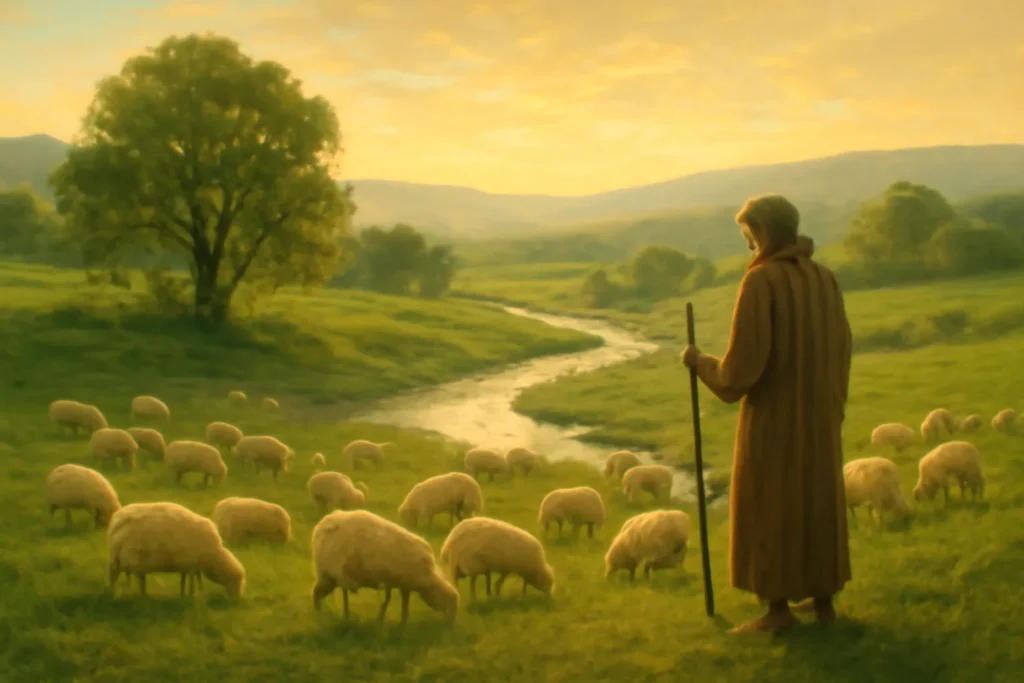
The Lord as shepherd establishes a personal, intimate relationship—the basis for security and trust. The imagery of the shepherd communicates care, knowledge of each sheep, and an active role in leading and protecting.
Provision and rest are highlighted through green pastures and still waters, signaling nourishment, restoration, and spiritual refreshment.
Restoration and guidance are framed as a divine action—restoration of the soul and leading in the "paths of righteousness" for God’s name’s sake, emphasizing vocation and integrity as communal witness.
Presence amid danger—the imagery shifts to a real fear factor: even in “the darkest valley,” the narrator is not abandoned; the divine presence, symbolized by the rod and staff, offers comfort and protection.
Invitation to feast—God’s blessing expands from private care to public hospitality: a table in the presence of enemies, anointing with oil, and an overflowing cup signify abundance, honor, and divine favor amid hostility.
Hopeful conclusion—the psalm closes with the assurance of goodness and mercy following the speaker throughout life, and a confident expectation of dwelling with the Lord forever.
In this light, the NRSV renders the psalm not merely as a private prayer but as a narrative of God’s faithfulness in history and a call to ethical living under divine companionship. The refrain-like structure—though not a formal refrain—emphasizes steady movement from nourishment to protection, from guidance to blessing, and finally to eternal remembrance and dwelling.
Imagery and symbolism: why shepherding, tables, oil, and cups?
Psalm 23 draws on a web of rural-agrarian imagery that would have been familiar in ancient Israel but continues to speak to readers today. The motifs recur in Scripture and in religious art because they embody practical realities of daily life while capturing deep metaphysical truths.
The shepherd figure conveys intimate knowledge of each sheep, a steady hand, and a protective presence. It underscores a relationship of trust and surrender to the One who tends the flock.
Green pastures and still waters symbolize nourishment and peace—not merely physical sustenance but a state of spiritual repose that comes with trust in divine care.
Paths of righteousness point toward moral integrity and a purposeful alignment with God’s character, “for his name’s sake” (a motive rooted in God’s own glory and faithfulness).
The valley of the shadow of death is a stark image of danger and vulnerability; yet the psalm asserts that God’s presence dispels fear and offers courage in the face of peril.
The rod and staff serve as practical tools of guidance and protection, but they also symbolize discipline and the reassurance that the shepherd’s care is both corrective and comforting.
The table set in the presence of enemies relocates the scene from sheepfold to banquet, implying social blessing, honor, and a counter-testimony to hostility.
Oil for the head signals blessing, hospitality, and ceremonial anointment—an emblem of being set apart and cared for in a generous way.
The cup that overflows conveys abundance and the overflow of blessings that accompany God’s favor.
Goodness and mercy—often paired as a divine pair—are not passive attributes but active realities that accompany the believer on all life’s days.
Dwelling in God’s house “forever” captures an ultimate longing: the lifelong trajectory of faithfulness culminating in eternal communion with God.
Structure and literary shape: how the psalm unfolds
Although compact, Psalm 23 has a discernible arc, moving from intimate personal relationship to public blessing and then to confident eschatological hope. This arc is often discussed in three broad movements, with a few subpoints to illuminate how the poetry models trust through changing circumstances.
Verse 1–3: Provision, guidance, and soul restoration
In these verses, the speaker’s primary relationship is with God as shepherd. The language emphasizes dependance on divine care for basic needs—“I shall not want”—and the experience of safety and rest in God's presence. Not only does the shepherd lead the speaker to green pastures and still waters, but there is also a personal experience of renewal—the soul is restored, and the path is chosen for God’s Name sake. The emphasis is not on personal achievement but on trust and fidelity in the Face of the One who sustains life.
Verse 4: Presence in danger and divine comfort
The mood shifts in the fourth verse to a more perilous setting—the darkest valley. Yet even there the speaker does not fear, because God’s presence dispels fear. The rod and staff—tools of guidance and protection—are active signs of care. The verse communicates that God’s companionship is not contingent on circumstance; rather, it provides courage, consolation, and a sense of safety amid fearsome realities.
Verse 5–6: Blessing, hospitality, and the journey to eternal home
From the intimate pastoral scene, the psalm broadens to a scene of abundant hospitality: a table prepared in the presence of opponents signals a public declaration of blessing and favor. Anointing with oil and an overflowing cup carry connotations of welcome, honor, and sustenance that persist in the face of conflict. The final verse anchors the entire journey in a forward-looking confidence: goodness and mercy follow the believer, and the promise of dwelling with the Lord forever centers the psalm on eternal communion.
Historical and cultural backdrop: why this imagery matters
The imagery of a shepherd, green pastures, and a banquet table arises from a pastoral, agrarian world in which daily life revolved around livestock, water sources, fields, and feasts. In ancient Israel, the shepherd’s care was a trusted emblem for leadership and covenant relationship. The psalm uses this familiar social framework to communicate a theological claim with universal resonance: the God who leads and feeds is present in fearsome times and generous in blessing. The shift from sheep to table wielded in the presence of enemies was particularly striking; it reframes blessing as a counter-narrative to hostility, asserting that divine sustenance outruns and outlasts threat. The final “forever” clause points toward a covenantal hope that endures beyond present difficulty and into the realm of eternal life.
Language and translation notes: NRSV’s distinctive choices
The NRSV is known for careful scholarship, inclusive language practices when applicable, and attention to preserving the sense of the original text in contemporary English. In Psalm 23, some notable features include:
Pastoral imagery retained to preserve the sense of God as caretaker and guide.
Graceful parallelism and rhythm that support meditation and liturgical use.
Exactness in phrasing that clarifies relationships: “the Lord” as divinity, “the shepherd” as caretaker and guide, and “paths of righteousness” as vocation and moral alignment.
Conservative theological tone that emphasizes God’s active presence, fidelity, and blessing without implying coercive force.
Translations like the NRSV often balance traditional theological language with modern clarity. In Psalm 23, this balance allows the psalm to be read aloud in worship, studied in classrooms, and reflected upon in personal prayer, making its themes accessible across generations while preserving the gravity of its imagery.
Applications: psalm 23 in worship, pastoral care, and daily life
Readers today turn to the NRSV version of this psalm for a variety of purposes. Here are some practical ways in which the Psalm 23 (NR SV) motif informs contemporary life.
Pastoral care: When guiding someone through loss, fear, or transition, the shepherd imagery offers language for comfort, presence, and steadfast companionship.
Public worship: The table imagery and anointing language can frame hospitality and blessing in congregational settings and rites of healing or ordination.
Personal devotion: The six-verse arc provides a structure for meditative practice, from gratitude for provision to trust in God’s ongoing presence and ultimate hope.
Ethical reflection: The call to walk in “righteousness” invites believers to align daily actions with a faithful life that bears witness to God’s name.
Grief and resilience: The assurance of God’s presence in the darkest valley offers a script for endurance, lament, and eventual hope.
Verse-by-verse reflections: a user-friendly guide to interpretation
Below is a structured guide that aligns with the psalm’s natural progression, offering questions and prompts for personal reflection, small-group study, or teaching contexts. Each section highlights a key image and its implications for faith and life.
Reflection A: God as shepherd and our daily bread
Think about the ways God as a shepherd has guided you recently. Where have you found rest and nourishment—not only for the body but for the soul? What would it mean to trust more deeply in God’s ability to provide and to lead
Reflection B: Green pastures and still waters as spaces of renewal
Consider the places and practices that restore your soul. Are there boundaries you need to set to inhabit more fully the restoration that God offers? How might you cultivate moments of peace in your day-to-day routine?
Reflection C: The valley and the rod—presence amid fear
When fear looms, what does it mean that the Lord is present with you? How can you invite God’s comfort into times of difficulty, confusion, or danger? In what ways can the community offer support in the face of danger?
Envision meals as acts of worship and solidarity. How does the image of a table set in the presence of enemies challenge you to respond with grace and generosity? What would it mean to experience the oil’s blessing and the cup’s abundance in your current context?
Reflection E: Goodness, mercy, and dwelling forever
Let the final movement widen your horizon: how do you respond to the truth that goodness and mercy accompany you all your days, culminating in an eternal home with God? How does this shape hope, gratitude, and mission?
Comparative notes: Psalm 23 in the NRSV versus other translations
Scholars and readers often compare Psalm 23 across translations to discern nuances in tone and emphasis. The NRSV tends to foreground precise language and a sense of covenant fidelity. In contrast:
The KJV often retains older diction and formal cadence, with lines that feel more poetic in traditional English. Some readers find it more musical for memorization and liturgy.
The NIV (New International Version) usually offers a balance between readability and accuracy, sometimes smoothing phrases for contemporary speech.
Public-domain translations like the KJV are accessible freely, while modern translations (including the NRSV) require licensing for full reproduction.
Whether you prefer the NRSV’s scholarly precision or the KJV’s majestic cadence, the essential themes—God’s care, presence, and hope—remain resonant across translations. For study, you may cross-reference multiple versions to gain a richer sense of nuance and emphasis.
Glossary and quick references
To aid understanding, here are brief definitions of some terms frequently used in discussions of Psalm 23 in the NRSV context:
Shepherd: A caregiver and guide who tends a flock; a metaphor for God’s intimate care and leadership.
Green pastures: A symbol of nourishment, safety, and rest; a setting where the soul is refreshed.
Still waters: A metaphor for quiet, restorative peace and spiritual renewal.
Paths of righteousness: Ethical living and faithful conduct aligned with God’s character for God’s reputation.
Valley of the shadow of death: A vivid image of danger and fear, contrasted by divine presence.
Rod and staff: Tools of guidance and protection; emblem of disciplined guidance that remains comforting.
Table in the presence of enemies: A countercultural act of blessing and feasting amid adversity.
Anointing with oil: Hospitality, honor, and ceremonial marking in biblical culture.
Cup overflows: Abundant blessing and generous care.
Goodness and mercy: Covenant faithfulness and steadfast love that accompany the believer.
House of the Lord forever: The ultimate dwelling in God’s presence for eternity.
Conclusion: the enduring message of the NRSV’s Psalm 23
The 23rd psalm, as rendered in the NRSV, offers a compact but powerful theology of God’s care, guidance, presence, and blessing—from the everyday to the eternal. Its imagery speaks in a language that is both intimate and universal: a shepherd who knows and tends the flock, a banquet that signals divine favor, and a promise of endless communion with God. For readers and worshippers, it remains a steady companion—an invitation to trust in a God who shepherds through every season, sustains the soul, and leads onward to a hopeful, eternal home.







Leave a Reply