Acacia wood is the principal wood God instructed Israel to use for the tabernacle and its furnishings. It appears throughout Exodus as the material for sacred objects carried through the wilderness, including the ark of the covenant, the table, the altars, and their poles.
Many English Bibles translate the Hebrew expression as acacia wood, while older translations often say shittim wood or shittah wood. The wording refers to a desert or semi-desert tree, but Scripture does not identify the exact modern botanical species with complete certainty.
The Hebrew term commonly translated as acacia is related to shittah, with shittim used as a plural form. In the King James Version, readers frequently see “shittim wood”; many newer translations render the same material as “acacia wood.” These are not two different biblical materials. They are different English renderings of the Hebrew terminology.
Acacias were suited to the dry regions associated with the wilderness journey. They could grow where larger, moisture-loving trees would have been difficult to find, making them a plausible source of usable timber for Israel’s portable sanctuary. The biblical text emphasizes what the wood was used for rather than giving a botanical description of the tree itself.
The exact species remains uncertain because the Bible does not provide enough details for modern botanists to make a conclusive identification. Several acacia species grow across the Sinai, Negev, Arabian Peninsula, and surrounding regions. For that reason, it is more accurate to say that the biblical term points to an acacia-like desert wood than to claim that every reference identifies one specific species recognized by modern science.
A useful distinction: The Bible clearly identifies the material as wood from the shittah or acacia family of terms, but it does not directly assign a symbolic meaning to the tree itself. Its significance comes primarily from how God directed Israel to use it.
Why acacia wood was practical for the wilderness tabernacle
The tabernacle was designed to move with Israel. Its furnishings had to be sturdy enough for repeated handling and transport, yet manageable enough for people to carry according to the instructions given to the Levites. Acacia wood provided a sensible material for this setting because it was available in dry country and was known for being tough and durable.
The wood was not left exposed on the most important furnishings. Exodus repeatedly describes wooden objects being overlaid with pure gold, while some altar surfaces were covered with bronze. The wood supplied strength and structure; the metal covering gave the objects their finished appearance and protected the surfaces during use.
This combination helps explain why the biblical instructions mention both the wood and the metal. The construction was neither merely decorative nor merely utilitarian. The wooden framework made the objects functional, while the precious metal distinguished them as items belonging to the worship of God.
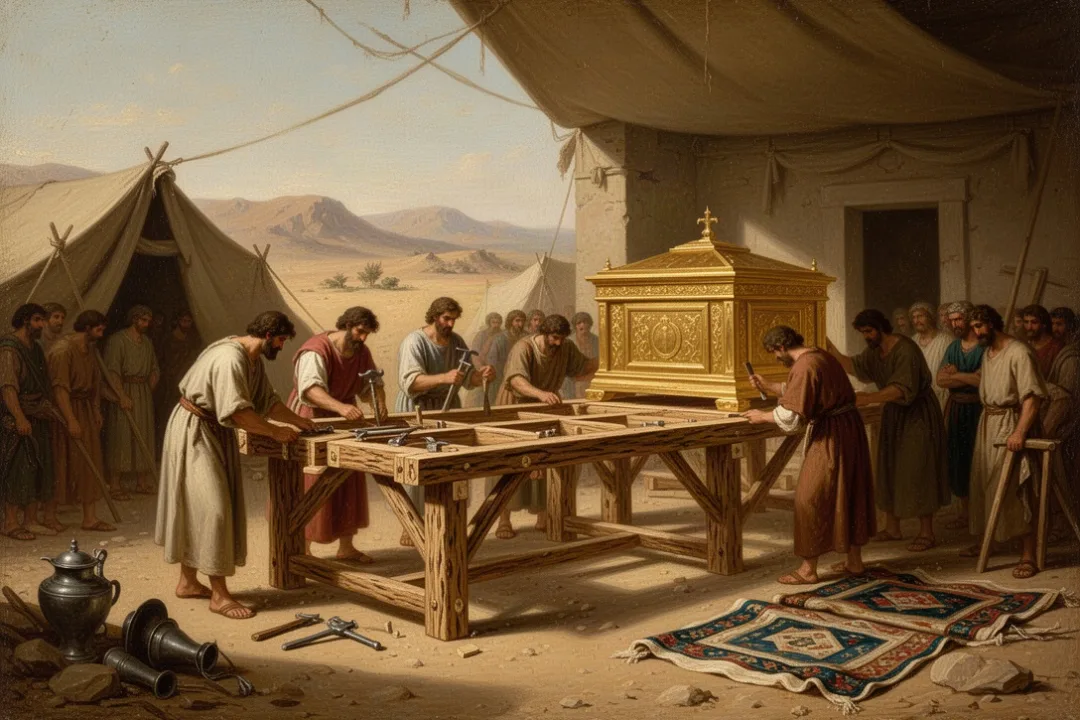
Acacia wood was also useful because it could be shaped into boards, frames, poles, boards, and beams. The tabernacle’s construction required many different forms, and Exodus describes the craftsmen making the parts according to measured instructions rather than improvising the design.
Acacia wood used for the ark of the covenant
The most famous use of acacia wood is the ark of the covenant. Exodus 25:10–22 describes a chest made of acacia wood, overlaid inside and outside with gold and fitted with a gold molding around its upper edge. Gold rings were attached to its corners so that poles could be inserted for carrying it.
The ark held the covenant testimony, later associated with the stone tablets of the law. Its cover, called the mercy seat in many English translations, was made of gold and included the cherubim. The biblical description presents the ark as the central sign of God’s covenant presence among Israel, not as a magical object or an idol.
Acacia wood therefore formed the durable inner structure of the ark, while gold marked the object as extraordinarily sacred. The poles were also made of acacia wood and overlaid with gold. Exodus 25:15 instructs that the poles were to remain in the ark’s rings, emphasizing that the ark was to be carried rather than handled casually.
Deuteronomy 10:1–5 gives another account connected with the ark. Moses describes making an ark of acacia wood and placing the stone tablets inside it. The passage connects the ark with the covenant words God gave Israel, reinforcing the relationship between the wooden chest and the continuing testimony of God’s commands.
Acacia wood in the table and other tabernacle furnishings
The table for the bread of the Presence was also made from acacia wood. Exodus 25:23–30 describes a table overlaid with gold, complete with a gold rim, rings, and carrying poles. The table held the bread placed before God as part of Israel’s appointed worship.
Like the ark, the table was both strong and portable. Its design included a raised border or rim, vessels for the service, and poles for transport. The use of the same basic wood for both objects shows that acacia was the standard structural material for major tabernacle furnishings, while their differing coverings and functions distinguished their roles.
The altar of burnt offering was made from acacia wood as well. Exodus 27:1–8 describes a large, square altar with projecting horns at its corners. Unlike the ark and the table, this altar was overlaid with bronze. Its utensils and carrying poles were also made for the practical demands of sacrifice and transport.
The altar of incense, described in Exodus 30:1–10, used acacia wood covered with gold. It stood before the inner sanctuary and was associated with the burning of fragrant incense. Its placement and function set it apart from the bronze altar in the courtyard, although both depended on the same sturdy wooden material.
Other acacia-wood objects included the poles for the furnishings and parts of the tabernacle structure. Exodus 37–38 records the construction of the ark, table, incense altar, bronze altar, and related equipment. These repeated references show that acacia was not a minor detail; it was central to the tabernacle’s construction.
Acacia wood in the tabernacle framework
Acacia wood was used not only for furniture but also for the boards or frames of the tabernacle walls. Exodus 26 describes upright boards made of acacia wood, along with crossbars and supporting elements. The boards were overlaid with gold and set into bases, creating a stable but dismantlable sanctuary.
This arrangement made the tabernacle a genuine portable structure. Israel could take it down, transport it, and set it up again as the nation moved through the wilderness. The materials had to withstand repeated assembly, disassembly, lifting, and carrying.
The construction also required careful organization. The tabernacle’s parts were assigned to the priests and Levites for covering, carrying, and setting up. The wooden framework was therefore part of a larger system of worship in which craftsmanship, transportation, priestly service, and reverence worked together.
Exodus 35–36 presents the people bringing materials for the sanctuary, including wood. Bezalel, Oholiab, and the skilled workers used the offerings to make what God had commanded. The narrative gives attention to accurate workmanship and faithful completion, rather than treating the physical materials as unimportant.
What the Bible says about acacia trees beyond the tabernacle
Acacia-related language appears outside the construction instructions. Abel-shittim, or “the acacia meadow,” was a place on the plains of Moab where Israel camped before crossing the Jordan, as recorded in Numbers 25:1 and other passages. The place name reflects the presence or association of acacia trees in that region.
Joshua 2:1 refers to Shittim as the location from which Joshua sent spies toward Jericho. The name is connected with the same Hebrew root used for the wood. In these passages, however, the focus is geography and Israel’s movement, not a special religious property of the tree.
Isaiah 41:19 includes acacia among the trees mentioned in a prophetic picture of God providing trees in a wilderness setting. The passage uses the transformation of barren land into a planted landscape to portray God’s power and care. Acacia is one item in that larger image of renewal.
These references should be kept separate from the tabernacle passages. A place named for acacias does not automatically carry the same meaning as an ark made of acacia wood. Context determines whether the word refers to a building material, a location, or part of prophetic imagery.
Does acacia wood have a specific spiritual symbolism?
The Bible gives acacia wood an important role, but it does not explicitly say, “acacia symbolizes” a particular spiritual quality. Many Christian teachers associate it with endurance, purity, or life in harsh conditions because the tree grows in dry environments and the wood was used for sacred objects. Those associations may be helpful for reflection, but they should be described as interpretation rather than direct biblical statements.
The clearest biblical emphasis is obedience to God’s instructions. Exodus describes the dimensions, materials, coverings, rings, poles, and construction methods in considerable detail. The repeated use of acacia wood demonstrates that ordinary physical materials could be dedicated to a holy purpose when used according to God’s covenant instructions.
Another reasonable observation concerns the relationship between hidden structure and visible glory. In the ark, table, and incense altar, acacia wood formed the underlying body while gold covered the surface. This can illustrate how the tabernacle’s objects combined practical strength with visible holiness, although the text does not turn that construction detail into a formal doctrine about human character.
The wood also points to the reality of worship in the wilderness. Israel’s worship was not detached from travel, weather, labor, and physical limitations. The sanctuary had to be built from available materials and moved through demanding terrain. Acacia wood served a sacred purpose without ceasing to be a practical construction material.
Common mistakes when interpreting acacia wood
Assuming the exact species is certain: The biblical term is clear enough to connect with acacia, but the precise modern species cannot be established with confidence from the text alone.
Assigning symbolism the Bible does not state: Durability and desert growth may suggest meaningful themes, but Scripture emphasizes the wood’s appointed use more directly than its symbolic qualities.
Confusing all references to shittim: Some passages refer to the wood, while others refer to Shittim as a geographical location.
Ignoring the metal coverings: The tabernacle objects were not simply raw wooden items. Gold and bronze were essential parts of their design and function.
Treating the ark as an object of magic: The ark represented God’s covenant presence, but biblical faith did not teach that the wood or chest had independent supernatural power.
Reading later traditions back into Exodus: Devotional interpretations can be valuable, but they should not be presented as though every detail appears explicitly in the original instructions.
For careful Bible study: Read the material references alongside the object’s purpose. Exodus 25–30 explains the instructions, while Exodus 35–38 records the craftsmanship and construction.
How to study acacia wood passages carefully
A useful study begins with the immediate context. When a verse mentions acacia wood, ask what is being made, who will use it, how it will be carried, and what covering or placement the passage describes. These questions keep the interpretation anchored in the text rather than in assumptions about the tree.
Next, compare several reliable Bible translations. Older versions may use shittim, while newer versions may use acacia. Seeing both forms can clarify that the different English words represent the same underlying biblical terminology.
It also helps to trace each object through the instructions and the construction account. For example, Exodus 25 describes the ark and table, Exodus 26 describes the tabernacle framework, Exodus 27 describes the bronze altar, and Exodus 30 describes the incense altar. Exodus 37–38 then records how those objects were made.
Identify the Hebrew term in the translation notes and check whether the passage refers to wood or a place name.
Read the surrounding instructions rather than isolating one phrase about the material.
Compare the object’s covering and function, such as gold for the ark or bronze for the courtyard altar.
Trace the object’s transportation requirements by noting rings, poles, bases, and carrying instructions.
Separate biblical teaching from devotional application so that personal reflection does not replace the passage’s original meaning.
What acacia wood teaches about worship and craftsmanship
The acacia references reveal that the biblical account values both spiritual purpose and skilled workmanship. The sanctuary was dedicated to God, but it still required accurate measuring, cutting, covering, joining, and transporting. Scripture does not treat craftsmanship as opposed to worship.
The workers used materials donated by the community and skills directed toward a shared purpose. Exodus 35 emphasizes willing offerings and capable workers. That combination suggests that worship involved generosity, competence, and careful attention to the instructions God had given.
The repeated mention of poles also highlights reverence. The sacred furnishings were made to be carried in an orderly manner, not dragged, handled casually, or adapted whenever convenient. The design communicated that holy things were to be approached according to God’s appointed arrangement.
Acacia wood therefore belongs to a larger biblical picture. God met Israel in a movable sanctuary built in a difficult environment, using materials that could withstand the journey. The wood’s importance lies not in a mystical property but in its place within covenant worship, skilled service, and faithful obedience.
Why acacia wood remains significant for Bible readers
Readers often ask about acacia wood because it appears so frequently in the tabernacle instructions. Its repetition draws attention to the physical reality of the sanctuary and shows how carefully the biblical text records the materials used in worship.
It also prevents an overly abstract reading of the wilderness story. Israel’s worship required wood, metal, fabric, tools, measurements, labor, and transportation. The presence of acacia wood reminds readers that biblical faith included tangible acts carried out by people in a real landscape.
At the same time, acacia wood should not be elevated beyond what Scripture says. The Bible does not command believers to seek acacia objects today, nor does it identify the material as inherently holy apart from its appointed use. Its importance comes from the role God assigned it in the tabernacle.
When read in context, acacia wood represents a meeting point between the ordinary and the sacred. A durable desert timber became part of the ark, the altars, the table, and the tabernacle structure. The text directs attention to God’s presence, covenant, worship, and the faithful work required to create a place set apart for him.
Frequently asked questions
Is acacia wood the same as shittim wood in the Bible?
Yes. “Shittim wood” is the wording found in several older English translations, while “acacia wood” is common in many modern translations. Both render Hebrew terms related to the shittah tree. The terms may describe the same general kind of desert timber, although the Bible does not establish one exact modern species.
Which biblical objects were made from acacia wood?
Acacia wood was used for the ark of the covenant, the table for the bread of the Presence, the incense altar, the bronze altar, carrying poles, and structural boards and crossbars of the tabernacle. These references are especially concentrated in Exodus 25–30 and the construction accounts in Exodus 35–38.
Does acacia wood symbolize Jesus in the Bible?
The Bible does not directly state that acacia wood symbolizes Jesus. Some Christian interpretations connect its durability, wilderness setting, or use beneath gold covering with themes about Christ, but those are devotional applications rather than explicit biblical explanations. The text itself focuses on the tabernacle, covenant worship, and obedience to God’s instructions.
Where can I read about acacia wood in Scripture?
Begin with Exodus 25–30 for the original instructions and Exodus 35–38 for the construction of the tabernacle furnishings. Deuteronomy 10:1–5 also mentions an acacia-wood ark. Numbers 25 and Joshua 2 refer to Shittim as a place, while Isaiah 41:19 includes acacia in a prophetic wilderness image.










Leave a Reply