Biblical wood refers to the trees and timber named or described in Scripture, including cedar, acacia, olive, oak, cypress, and several woods whose exact identities are debated. These materials were used for ships, houses, furniture, tools, idols, gates, and the tabernacle.
The Bible does not always use modern botanical names, and translations sometimes render the same ancient term differently. For that reason, the safest approach is to identify a wood by its biblical context and traditional interpretation, while recognizing that some species cannot be confirmed with certainty.
When people search for biblical wood, they may be looking for several related things. They may want to know which trees are mentioned in the Bible, what wood was used to build sacred objects, or what a particular tree represents in a biblical passage.
In Scripture, wood is both an ordinary material and a meaningful image. It can describe God’s provision in creation, the skill of builders and craftsmen, the wealth of kingdoms, or the danger of trusting in carved images. A single species may appear in practical, royal, agricultural, and religious settings.
Ancient writers also used tree names in a less scientific way than people commonly do today. A Hebrew word could refer to a broad group of trees, a regional variety, or a material known by its appearance and use. English Bible translations may therefore use terms such as fir, cypress, or juniper for words whose precise botanical equivalent is uncertain.
Important distinction: A biblical wood identification is not always a botanical certainty. When the original term is disputed, a careful explanation gives the leading possibilities instead of presenting one modern species as proven fact.
How to identify biblical wood step by step
You can study a wood mentioned in Scripture more accurately by following the surrounding evidence rather than relying on a plant name alone. These steps help separate clear identifications from reasonable but uncertain suggestions.
Read the whole passage. Determine whether the wood is being used for construction, fuel, carving, agriculture, trade, or poetic imagery.
Check the translation. Compare several reputable English translations because a tree name may vary from one version to another.
Consider the region. Ask whether the tree could grow in the Levant, the Arabian Peninsula, Egypt, Mesopotamia, or another location connected with the passage.
Examine the practical use. Large trees may have supplied beams, while durable or light wood may have been selected for ships, chests, doors, or carved objects.
Separate the wood from its symbolism. A passage may use a tree as a metaphor without assigning a permanent spiritual meaning to every mention of that species.
State uncertainty honestly. Some words, including the wood called “gopher” in the story of Noah, do not have a universally accepted modern identification.
This method is especially useful when studying ancient Hebrew tree names. A dictionary can provide possible meanings, but the passage itself often supplies the strongest clues. A wood described as imported by ship, used in royal paneling, or gathered from a desert region should be interpreted in light of that function.
Cedar represents strength, height, and royal splendor
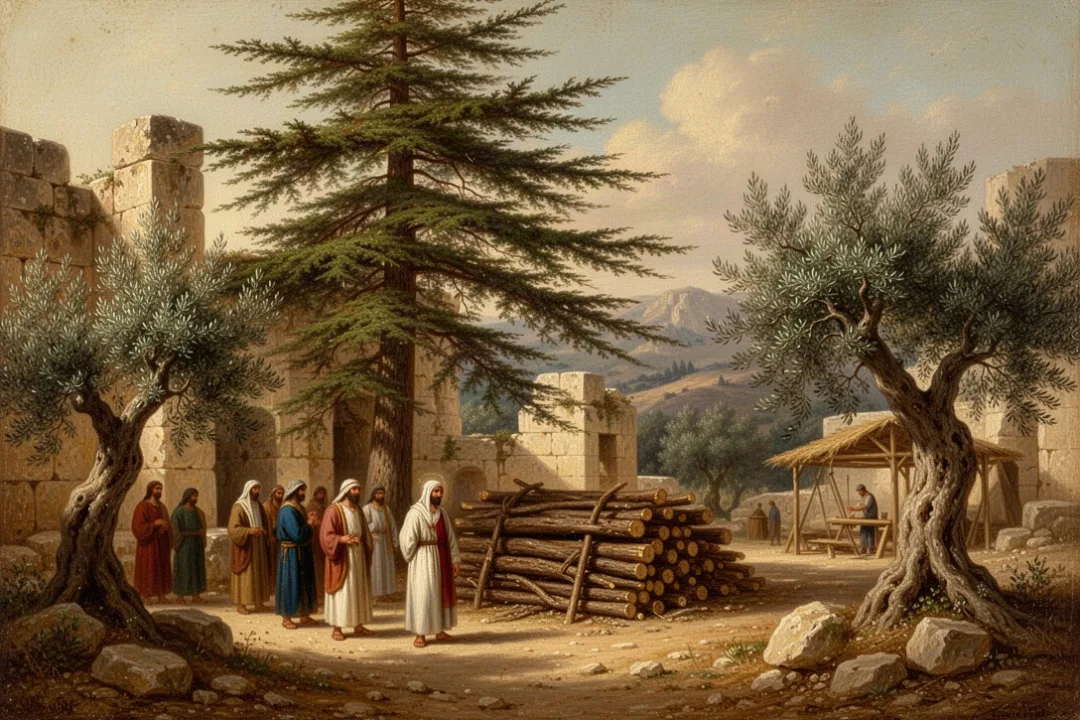
Cedar, usually associated with the cedar of Lebanon, is one of the best-known woods in the Bible. The trees were famous for their size, fragrance, durability, and value as building material. The biblical writers often connect them with Lebanon, where extensive forests once grew in the mountain ranges.
King Solomon obtained cedar from Lebanon for major building projects. Cedar was used in the construction of the temple, the royal palace, and other important structures described in 1 Kings 5–7. Its use communicated wealth and prestige because large, high-quality timber required organized labor, transport, and international trade.
Cedar also appears in poetry and prophecy. The Psalms compare the flourishing righteous person with a cedar of Lebanon, while other passages describe the cedar’s height as an image of human pride or political power. In these contexts, cedar can suggest stability and vitality, but it can also represent a proud kingdom that God is able to bring down.
The Bible’s reference to cedar is not limited to lumber. Cedar products and branches also appear in purification rituals, including the cleansing ceremony described in Leviticus 14. The exact ritual meaning is debated, but the passage shows that cedar had a place in both ordinary construction and ceremonial practice.
Acacia wood was central to the tabernacle
Acacia wood is especially important in the instructions for the tabernacle. The Hebrew term is commonly translated as acacia, and it likely refers to a hardy tree suited to dry environments. Acacia species grow in parts of the Sinai, the Negev, and surrounding regions, making this identification compatible with the wilderness setting.
The tabernacle’s ark, table, poles, altar, and other furnishings were made from acacia wood and then covered with gold in the items that required it. These instructions appear throughout Exodus 25–38. The wood provided a strong internal structure, while the gold covering marked the special status of the sacred objects.
Acacia is a useful example of how the Bible connects material quality with religious purpose. The text does not suggest that the wood itself was divine. Instead, ordinary natural material was selected, shaped, measured, and dedicated for worship according to God’s instructions.
Because acacia grows in dry areas and can have a twisted or thorny form, it is sometimes used in devotional writing as a picture of endurance in difficult conditions. That application may be meaningful, but it should be distinguished from the direct claims of the biblical passages, which focus mainly on the tabernacle’s design and construction.
Olive wood connects everyday life with sacred imagery
The olive tree was one of the most valuable trees in the biblical lands. Its fruit supplied oil for cooking, lamps, anointing, trade, and religious use. Olive wood was also available for practical work, although the Bible more often emphasizes the tree, fruit, and oil than the timber itself.
One clear reference appears in 1 Kings 6, where Solomon’s temple includes doors and carved elements made from olive wood. The passage describes olive wood alongside other high-value materials and presents it as suitable for substantial, finely worked architectural details.
Olive branches and trees also carry important imagery. The olive tree can represent peace, fruitfulness, continuity, and blessing, as seen in passages such as Psalm 52 and Zechariah 4. Paul’s discussion of an olive tree in Romans 11 uses the tree as an extended metaphor for God’s people and the relationship between Israel and Gentile believers.
That imagery comes from the olive tree’s role in the life of the ancient Mediterranean world. It was productive, long-lived, and capable of surviving difficult conditions. Still, not every reference to an olive tree should be turned into a symbolic code. Sometimes the Bible is simply describing a familiar and economically important plant.
Oak and terebinth trees mark important places
English Bibles often mention oak trees, but some passages may refer to a related large tree called a terebinth. The distinction between these terms is not always easy to preserve in translation. Both kinds of trees were prominent in the landscape and could serve as recognizable landmarks.
Several important events occur near an oak or terebinth. Abraham is associated with the great trees of Mamre in Genesis 13 and 18, and Deborah, Rebekah’s nurse, is buried beneath an oak in Genesis 35. Joshua sets up a memorial stone under an oak in Joshua 24, and Absalom’s hair becomes caught in the branches of a large tree during the battle described in 2 Samuel 18.
These trees often function as places of memory, burial, worship, judgment, or assembly. Their size and longevity made them natural landmarks in a landscape where permanent structures were not always available. A tree could identify a location for generations.
The prophets also use tall trees to challenge human arrogance. Isaiah and Ezekiel describe the fall of proud rulers and nations through images of large trees being cut down. The picture is powerful because a towering tree seems secure until a stronger force brings it to the ground.
Cypress, fir, and pine reflect translation challenges
Several biblical passages mention a coniferous or resinous wood that English translations render as fir, cypress, pine, or juniper. The underlying ancient terms do not always map neatly onto one modern species. Regional varieties, overlapping vocabulary, and differences between ancient and modern classification all contribute to the uncertainty.
In Isaiah 41, trees such as cedar, acacia, myrtle, and olive are mentioned in a promise about God providing trees in a wilderness setting. Other prophetic passages describe cypress, fir, or similar trees as signs of restoration and abundance. In Isaiah 60, trees associated with Lebanon are pictured as contributing to the beauty of God’s sanctuary.
Coniferous woods were valuable because they could be straight, workable, and suitable for beams or ships. Ezekiel 27, which describes the trading city of Tyre, lists different kinds of wood connected with shipbuilding and commercial wealth. The precise species may be debated, but the broader point is clear: wood was part of an international economy involving forests, craftsmen, ports, and merchants.
When a translation uses “fir,” it is best not to assume that the passage has identified a modern North American fir tree. The name may represent a related evergreen or a traditional translation choice. Study notes and Hebrew lexicons can help, but even specialist resources may present more than one possibility.
Gopher wood remains an unresolved biblical term
The wood used to build Noah’s ark is called gopher wood in Genesis 6:14. This is one of the most discussed unidentified materials in the Bible. No consensus establishes which modern tree the term describes.
Suggestions have included cypress, cedar, pine, and other durable woods. Some interpreters think the word could refer to a particular kind of timber; others have proposed that it describes a construction method or a type of woodwork rather than a species. None of these proposals can be stated as certain from the biblical text alone.
The passage focuses on the ark’s design, dimensions, compartments, and waterproofing, not on the botanical identity of the timber. That emphasis matters. The ark narrative presents obedience to God’s instructions and preservation through judgment as its main concerns, so identifying the species is an interesting secondary question rather than the central message.
Study tip: Treat “gopher wood” as an unresolved term. Avoid claims that the Bible definitively names cypress, cedar, or another species unless the source clearly labels that identification as a theory.
Almug and algum wood point to international trade
The Bible mentions almug wood and algum wood in accounts of Solomon’s wealth and building activity. The terms may represent the same or closely related imported wood, although the exact identification is uncertain. They are associated with shipments brought by sea and with high-value craftsmanship.
1 Kings 10 says that algum wood was used to make supports or steps for the temple and the royal palace, as well as musical instruments. The parallel account in 2 Chronicles 9 also presents the wood as unusually valuable and distinctive. Its rarity and imported status help explain why the text highlights it.
Proposals for the species have included sandalwood and other tropical hardwoods. The text itself does not settle the matter. What it does show is that the kingdom’s construction and artistic projects depended on long-distance commerce, skilled workers, and access to materials unavailable in the immediate region.
This makes algum wood significant even without a certain botanical label. It illustrates how biblical references to wood can reveal economic history. Timber was not merely gathered locally; it could be exchanged, transported by ship, and transformed into architecture or instruments that displayed royal wealth.
Wood was used for the tabernacle, temple, and ordinary homes
Biblical wood appears in sacred buildings, but its most common role was probably far more ordinary. People needed timber for roof beams, doors, yokes, tools, handles, furniture, fences, and fuel. The Bible often assumes this practical world rather than explaining every use in detail.
The tabernacle provides the clearest extended description of wooden construction. Acacia boards, bars, pillars, poles, and frames created a portable sanctuary. The design combined wood with woven materials, animal skins, metal, and precious coverings, showing how several crafts worked together.
The temple represented a more permanent and elaborate form of construction. Cedar, cypress or related woods, olive wood, and decorative carving appear in its descriptions. The building required timber prepared by specialists, transported through organized trade, and fitted with stone and metalwork.
Outside worship, biblical laws and narratives refer to wooden objects in daily life. A person might carry a wooden yoke, use a staff, sit beneath a tree, or burn wood for warmth and cooking. These ordinary references prevent a narrow reading in which every appearance of wood is automatically symbolic.
Carved wood can represent idolatry and misplaced trust
The Bible frequently criticizes the use of wood to make idols. Prophetic passages describe a person cutting down a tree, using part of it as fuel, and shaping the remainder into an object of worship. Isaiah 44 gives the most vivid example of this argument.
The issue is not that wood is inherently evil. The same natural material can heat a home, cook food, build a structure, or become an idol. The prophets expose the contradiction of treating a human-made object as a god while using the rest of the tree for ordinary purposes.
Jeremiah 10 similarly contrasts carved images with the living God. Such passages focus on the limits of human craftsmanship and the danger of transferring trust from the Creator to something created. The wood becomes a visible sign of misplaced dependence.
This theme also clarifies the difference between sacred craftsmanship and idolatry. The tabernacle and temple contained carefully made wooden objects, but those objects were not treated as independent gods. Their role was determined by God’s command and by the worship directed beyond the materials themselves.
Wood imagery can describe growth, judgment, and renewal
Beyond literal timber, trees and wood provide some of the Bible’s most memorable images. A planted tree can represent a person whose life is nourished by wise instruction, as in Psalm 1. A tree that produces fruit can picture visible character and the results of a person’s choices.
Cutting down a tree often conveys judgment, loss, or the end of a kingdom. In Daniel 4, a great tree represents royal power before it is cut down. Jesus uses tree and fruit imagery in the Gospels to connect a person’s inner condition with outward behavior, including the teaching in Matthew 7 and Luke 6.
At the same time, biblical tree imagery can express restoration and hope. Isaiah speaks of a shoot growing from a cut-down stump in Isaiah 11, presenting new life after apparent destruction. The image works because a tree can look dead while its roots still hold the possibility of renewed growth.
These metaphors should be read in context. Cedar does not always mean pride, olive does not always mean peace, and wood does not always mean human weakness. Biblical symbolism develops through individual passages, repeated themes, and the larger story rather than through a fixed dictionary in which every tree has only one meaning.
What biblical wood teaches about craftsmanship and stewardship
The passages about wood give a positive place to skill, measurement, design, and careful labor. Craftsmen cut, shape, carve, overlay, join, and transport materials. Their work supports worship, public life, trade, and household needs.
At the same time, the Bible presents forests and trees as part of God’s created order rather than an unlimited resource for human pride. Prophetic warnings against destructive kingdoms often use the image of forests being cut down. The natural world becomes a witness against rulers who assume that their strength will last forever.
For modern readers, this combination offers a balanced perspective. Wood can be valued for beauty and usefulness without being treated as sacred in itself. It can also be used responsibly, with attention to durability, origin, craftsmanship, and the long-term effects of consuming natural resources.
If you are choosing wood for a religious artwork, study project, or home object, the most historically responsible choice depends on the passage you are representing. Acacia is appropriate for a tabernacle-related design, cedar for a Lebanon or temple theme, and olive wood for scenes connected with Israel’s landscape. A substitute may be practical, but it should be labeled as an artistic approximation rather than an authenticated biblical material.
How to study a biblical wood reference responsibly
A good study combines the biblical text with language, geography, archaeology, and botany. No single source answers every question, particularly when an ancient word has a narrow attestation or has been translated in different ways.
Begin with the original passage and read nearby verses before consulting symbolic interpretations.
Compare translations to see whether the tree name changes between versions.
Check cross-references for other passages that use the same term or describe a similar material.
Look at historical geography to determine whether the proposed tree fits the climate and region.
Distinguish certainty levels by labeling an identification as clear, probable, possible, or unknown.
Apply symbolism carefully so that a poetic image is not turned into a universal rule.
It also helps to ask what the writer wants the reader to notice. In a building account, the focus may be material quality and skilled construction. In a prophecy, the wood may represent political power. In a narrative, a tree may simply provide a landmark or setting.
The strongest interpretation is usually the one that respects all three levels: the physical material, the historical setting, and the literary purpose. That approach keeps biblical wood from becoming either a purely technical subject or an excuse for unsupported symbolism.
Common questions about biblical wood identifications
Some wood names are well supported by context, while others remain open to debate. Cedar and acacia are relatively clear in their traditional associations, but gopher, algum, almug, and several evergreen terms require more caution.
Modern readers should also remember that biblical translations are interpretive. A familiar English tree name may be a reasonable equivalent rather than a precise botanical label. Consulting more than one translation and a reliable study resource can reveal where the evidence is firm and where it is not.
The larger biblical picture is consistent: trees and wood are gifts of creation used for shelter, worship, trade, art, and daily life. They can also become images of human pride, judgment, renewal, and dependence on God. Their meaning comes from the passage in which they appear.
Frequently asked questions
What is the most important wood in the Bible?
Acacia wood is among the most important because it was used extensively for the tabernacle’s structure and furnishings. Cedar is also highly significant because it appears in temple and palace construction and represents the wealth of Lebanon. The answer depends on whether you mean religious use, literary symbolism, or economic importance.
Is gopher wood the same as cypress?
The Bible does not identify gopher wood with cypress. Cypress is one proposed explanation, but cedar, pine, and other possibilities have also been suggested. Since the ancient term appears only in the account of Noah’s ark and its meaning is uncertain, “gopher wood” should be treated as an unresolved identification.
Does the Bible say that certain woods have magical or healing powers?
No. Scripture may attach symbolic meaning to trees, and some woods appear in purification rituals, but it does not teach that timber has automatic magical power. Biblical significance comes from God’s command, the use of an object, or the imagery of a passage—not from a hidden property in the wood itself.
Can olive wood be called biblical wood today?
Yes, olive wood comes from a tree clearly known in biblical lands and is mentioned in temple construction. However, a modern olive-wood item is not automatically ancient or connected to a biblical event. It is more accurate to describe it as wood from a biblically familiar species unless its historical origin has been documented.










Leave a Reply