After the order of Melchizedek: meaning and significance
After the order of Melchizedek: meaning and significance
The phrase “after the order of Melchizedek” means that Jesus serves as a priest according to a pattern different from the Levitical priesthood established through Moses. His priesthood is presented as royal, righteous, and lasting, not dependent on ancestry, temple succession, or repeated sacrifices.
The expression comes from Psalm 110:4 and is explained at length in Hebrews 5–7. Melchizedek appears briefly in Genesis 14 as both king of Salem and priest of God Most High. The New Testament uses that unusual combination to explain why Jesus can be both Messiah and eternal high priest.
In biblical language, “after the order of” means according to the likeness or pattern of. It does not necessarily describe a formal institution with membership rules, offices, and ceremonies. Instead, it identifies the kind of priesthood Jesus possesses and the biblical model that helps explain it.
Melchizedek’s appearance in Genesis is short but significant. He is called king of Salem and priest of God Most High. He blesses Abram, and Abram gives him a tenth of the recovered goods. Unlike the priests later appointed under the law of Moses, Melchizedek is not introduced through a family genealogy or connected to the tribe of Levi.
Psalm 110 then presents a future ruler whom God appoints as a priest forever, using Melchizedek as the comparison. Hebrews identifies that promised ruler with Jesus. The point is not that Jesus becomes a priest by copying every detail of Melchizedek’s life, but that Melchizedek provides a scriptural pattern for understanding Christ’s priesthood.
Core idea: Jesus is not a priest because he belongs to the tribe of Levi. He is priest because God appoints him in the enduring royal-priestly pattern associated with Melchizedek.
The biblical context behind the phrase
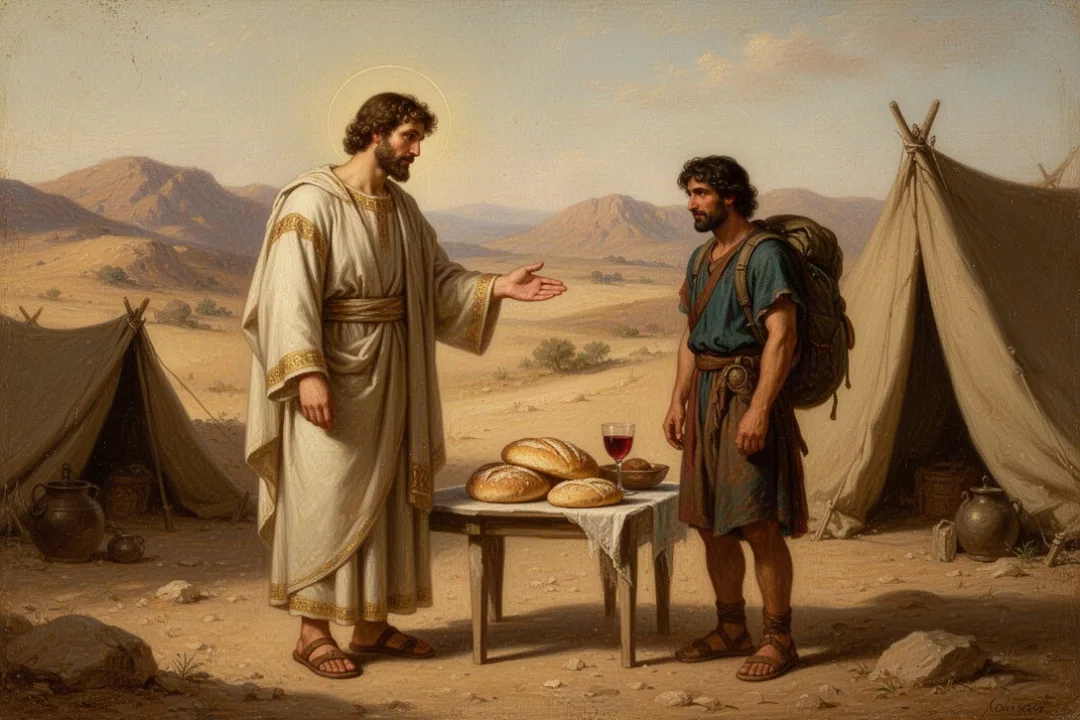
The first reference appears in Genesis 14:18–20. After Abram rescues his nephew Lot and defeats several kings, Melchizedek meets him with bread and wine. He blesses Abram in the name of God Most High, and Abram responds by giving him a tenth.
Genesis does not explain Melchizedek’s ancestry, priestly training, death, or succession. That silence matters later in Hebrews, but it should be read carefully. The passage does not explicitly say Melchizedek was supernatural or immortal. It simply gives no genealogical information about him within the narrative.
The second major reference is Psalm 110, a royal psalm traditionally associated with David. It describes a ruler who sits at God’s right hand and receives a permanent priestly appointment. The psalm joins two roles that were normally distinct in Israel: kingship and priesthood.
Under the Mosaic system, Israel’s priests came from the tribe of Levi, especially the family of Aaron. Israel’s kings came from the tribe of Judah, the tribe associated with David. Psalm 110 points toward a ruler who can hold priestly significance without being a Levitical priest.
The third major reference is Hebrews 5–7. Hebrews applies Psalm 110 to Jesus and argues that his priesthood is superior to the temporary priestly system because it is grounded in God’s appointment, confirmed by resurrection life, and connected to a sacrifice that does not need to be repeated.
How to understand the phrase step by step
Start with Melchizedek in Genesis 14. Notice that he is both king and priest, blesses Abram, and receives a tenth from him.
Read Psalm 110 as a promise. The psalm describes a coming ruler who will also be a priest permanently appointed by God.
Identify Jesus as the promised priest-king. Hebrews applies the psalm’s priestly promise to Jesus, whose resurrection establishes his continuing life.
Compare his priesthood with the Levitical system. Jesus’ priesthood does not depend on descent from Aaron or Levi and is not interrupted by death.
Connect priesthood with sacrifice. Jesus offers himself, rather than repeatedly offering animals, and his work is treated as sufficient for bringing believers to God.
Apply the result to Christian confidence. Hebrews presents Jesus as a living mediator who continually represents his people before God.
This sequence prevents a common misunderstanding. The phrase is not mainly a lesson about Melchizedek as an independent religious leader. Its purpose is to explain who Jesus is, why he can be called a priest, and why his priesthood has a permanent value.
Who Melchizedek was in Genesis
Melchizedek’s name is commonly understood as relating to king and righteousness, while Salem is associated with peace. Hebrews draws on these associations when describing him as a king of righteousness and king of peace. These descriptions support the theological comparison, although they do not replace the historical account in Genesis.
His meeting with Abram also establishes a striking relationship. Melchizedek blesses Abram, and Abram gives him a tenth. In the argument of Hebrews, the one who blesses is treated as greater than the one who receives the blessing. This supports the idea that Melchizedek occupies a position of significance even in relation to Abraham, the ancestor of Israel.
Melchizedek brings bread and wine to Abram. Christians have often connected these items with the Lord’s Supper, but Genesis itself does not state that this event established or symbolized that later Christian practice. The central point in Hebrews is Melchizedek’s priestly status and his relation to Abram, not a direct explanation of communion.
The text’s silence about Melchizedek’s family line is also important. Hebrews describes him as having no recorded father or mother and no recorded beginning or end of life. This does not have to mean that he literally had no parents or never died. Hebrews is using the way Genesis presents him—without genealogy or recorded death—as a fitting literary pattern for an eternal priesthood.
Why Psalm 110 matters to the meaning
Psalm 110 supplies the clearest statement that a priestly office resembling Melchizedek’s would belong to the coming ruler. The psalm does not describe an ordinary priest serving for a limited term. It presents a permanent divine appointment.
That promise addresses a problem created by Israel’s divided offices. A Davidic king normally did not become a Levitical priest, and a Levitical priest was not the Davidic king. The Melchizedek pattern allows Scripture to speak of one person who exercises both royal authority and priestly mediation.
Hebrews treats Psalm 110 as a direct prophecy about Jesus. Jesus is descended from David according to the New Testament’s messianic presentation, yet his priesthood does not rest on a claim to Aaronic ancestry. It rests on God’s oath and appointment.
The word “forever” is central. Levitical priests served for a time and died, so their work passed to successors. Jesus, by contrast, remains alive and therefore does not need a replacement. His priesthood is permanent because the priest himself is permanent.
How Jesus’ priesthood differs from the Levitical priesthood
The comparison in Hebrews is not meant to dismiss the Old Testament priesthood as meaningless. The Levitical system was given by God and served Israel by teaching about holiness, sacrifice, cleansing, and access to God. Hebrews argues that it was provisional and anticipatory, pointing beyond itself to Christ.
Several differences explain why the Melchizedek pattern is important:
Basis of appointment: Levitical priests served through tribal and family descent, while Jesus serves through God’s direct appointment.
Length of service: Levitical priests died and were replaced, while Jesus remains priest permanently.
Location of ministry: Levitical priests served in an earthly sanctuary, while Hebrews presents Jesus as ministering in the true heavenly presence of God.
Nature of offering: Levitical priests repeatedly offered animal sacrifices, while Jesus offers himself.
Result of ministry: The earlier sacrifices provided ritual access and purification within the covenant system, while Christ’s sacrifice provides lasting cleansing and reconciliation.
Scope of mediation: The Levitical priesthood belonged to Israel’s covenant order, while Jesus’ priestly work serves people from every nation who come to God through him.
The contrast should not be reduced to “old equals bad” and “new equals good.” The earlier priesthood had a genuine purpose, but it could not bring the final and complete access to God that Hebrews associates with Jesus. The Melchizedek priesthood represents the fulfilled reality toward which the earlier system pointed.
Important distinction: “After the order of Melchizedek” does not mean Christians should create a separate priestly class modeled on Melchizedek. In Hebrews, the phrase identifies Christ’s unique office and does not provide a procedure for appointing additional priests in the same order.
Why Hebrews connects priesthood with Jesus’ suffering
Hebrews presents Jesus as a priest who fully shares human experience without sharing human sin. His suffering, prayers, obedience, and death are not side issues; they show that he is able to represent suffering people before God with genuine understanding.
At the same time, Hebrews does not portray Jesus as merely sympathetic. He is the holy and exalted Son who has passed through death and entered God’s presence. His priesthood combines compassion with authority, so believers can approach God with confidence rather than fear.
The phrase first appears in Hebrews in a discussion of Jesus’ calling. Jesus did not seize the priestly role for himself. As the Son, he is appointed by God. Hebrews then connects his priestly status with his faithful suffering and obedience, showing that his ministry is both divinely authorized and personally experienced.
This connection matters for Christian theology. A mediator must truly represent the people, but also possess a sufficient standing before God. Jesus fulfills both sides: he identifies with humanity and remains the sinless Son appointed to serve as priest.
What “eternal priesthood” means for Christian faith
Jesus’ eternal priesthood means that his mediating work does not expire, weaken, or require a successor. Christians are not left searching for a new priest after Jesus’ death. His resurrection means that he continues to live and serve as the representative of those who belong to him.
Hebrews uses this truth to encourage perseverance. Believers may experience weakness, temptation, guilt, or uncertainty, but their access to God does not depend on their ability to maintain perfect spiritual performance. It depends on the living priest whom God has appointed.
The practical effects include:
Confidence in prayer: You can approach God through Christ rather than relying on personal merit.
Assurance of representation: Jesus is not a distant historical figure; he remains the living mediator of his people.
Freedom from repeated guilt offerings: His sacrifice is not treated as one attempt among many that must constantly be renewed.
Hope during weakness: His priestly role includes compassion for those who face temptation and suffering.
Stability in faith: The permanence of the priest provides a firm basis for continuing to trust God.
These applications do not mean that repentance, obedience, or confession are unnecessary. They mean that Christian repentance takes place within the security of Christ’s completed and continuing priestly work, not as an effort to persuade God to provide a mediator.
Does Melchizedek represent Jesus directly?
Christians have held more than one view about Melchizedek’s identity. Some interpret him as a historical king and priest who serves as a type, or foreshadowing, of Christ. Others have suggested that he was a pre-incarnate appearance of Christ. A third view treats him as a mysterious human figure whose presentation in Genesis becomes a useful scriptural pattern.
Hebrews clearly compares Jesus with Melchizedek, but it does not require every reader to identify the two persons as literally the same individual. The wording emphasizes likeness and priestly pattern. Jesus is the greater and final priest; Melchizedek’s role helps Scripture explain him.
The safest reading keeps the biblical emphasis in view. Melchizedek is important because the Old Testament presents him as a king-priest without a recorded genealogy, and Psalm 110 uses his priesthood to describe the coming Messiah. The text does not require speculation about hidden details that Genesis does not disclose.
What the phrase does not mean
Several interpretations go beyond what the passages say. Careful reading helps preserve the phrase’s actual meaning.
It does not mean Jesus was a Levite. His priesthood is specifically explained as different from the Levitical line.
It does not mean Melchizedek founded a continuing human denomination. Scripture does not describe such an organization.
It does not prove that Melchizedek was immortal. Genesis gives no death account, but silence in a genealogy is not the same as a statement of literal immortality.
It does not make every Christian a priest in the same sense as Jesus. The New Testament uses priestly language for believers in a broader, representative, and worship-related sense, but Christ’s unique mediating priesthood remains central.
It does not make animal sacrifices necessary for Christians. Hebrews presents Jesus’ self-offering as the decisive sacrifice.
It does not erase the value of the Old Testament. The earlier priesthood and sacrifices provide the categories Hebrews uses to explain Christ’s fulfillment.
These distinctions are especially useful when the phrase appears in discussions about church leadership, religious titles, or modern claims of priestly authority. The New Testament’s main concern is not establishing a human succession from Melchizedek. It is declaring the singular adequacy of Jesus.
How the phrase relates to sacrifice and atonement
A priest stands before God on behalf of others and brings offerings connected with sin, worship, and covenant relationship. Under the Mosaic law, this ministry involved repeated sacrifices because the priests themselves died and the offerings belonged to an ongoing system.
Hebrews presents Jesus as both priest and offering. He does not bring an animal from outside himself; he gives his own life. This makes his sacrifice personal, voluntary, and sufficient in a way the repeated animal offerings could not be.
The argument is not that the earlier sacrifices had no meaning. They expressed God’s holiness and provided a ritual structure for dealing with impurity and sin. Their repetition, however, showed that they were not the final solution. Christ’s once-for-all offering accomplishes what the earlier pattern anticipated.
Because Jesus lives forever, his sacrifice is joined to an unending priestly ministry. The cross is not repeated, and the risen Christ does not need to offer himself again. His continued priesthood means that the benefits of his completed work remain available to those who draw near to God through him.
Why the phrase matters when reading Hebrews
Hebrews can seem difficult because it assumes familiarity with Israel’s priests, sacrifices, covenant, sanctuary, and biblical history. The phrase “after the order of Melchizedek” functions as one of the book’s main interpretive keys. It explains how Jesus can be the promised Messiah and the true high priest even though he is not a descendant of Aaron.
When reading Hebrews 5–7, watch for several repeated themes:
Divine appointment: Jesus’ priesthood comes from God’s call, not personal ambition.
Permanent life: His resurrection makes his priesthood unlike that of mortal priests.
Superiority: The Melchizedek pattern is used to show that Christ’s priesthood is greater than the Levitical system.
Access to God: His ministry opens a confident way for believers to draw near.
Perseverance: His lasting priesthood encourages faithfulness during hardship.
Read in that setting, the phrase becomes more than a technical title. It is a declaration about Jesus’ identity, authority, sacrifice, and continuing ministry. It answers why Christians trust him as the unique mediator between God and humanity.
How different Christian traditions use the phrase
Most Christian traditions agree that the phrase refers to Christ’s unique and permanent priesthood. They may differ in how they describe ordained ministry, the Lord’s Supper, sacrifice, apostolic succession, and the relationship between Christ’s priesthood and the church’s ministers.
Some traditions emphasize that ordained clergy participate in Christ’s ministry in a sacramental way. Others stress that Christ alone is the high priest and that all believers share directly in access to God, while pastors and elders serve through teaching, shepherding, and oversight rather than through a separate Melchizedek priesthood.
These differences should not obscure the central biblical claim. No Christian minister replaces Jesus, extends his authority independently, or becomes a second eternal mediator. Every legitimate Christian understanding of ministry must account for the uniqueness and permanence of Christ’s priesthood.
The phrase therefore has both theological and pastoral importance. It protects the belief that salvation rests on Christ’s work rather than on a succession of human religious figures, while also reminding Christian communities to treat leadership as service under the authority of the living priest-king.
What “after the order of Melchizedek” means in one sentence
“After the order of Melchizedek” means that Jesus is God’s permanently appointed priest-king, whose authority does not come from Levi, whose life cannot be ended by death, and whose self-offering provides lasting access to God.
Melchizedek’s brief appearance supplies the pattern; Psalm 110 supplies the promise; Hebrews supplies the explanation. Together, these passages present Jesus as the final priest who fulfills the royal and priestly hope of Scripture.
Frequently asked questions
Why is Jesus called a priest if he was from the tribe of Judah?
Jesus’ priesthood does not depend on descent from Levi or Aaron. Hebrews explains that he serves through God’s appointment according to the pattern associated with Melchizedek, allowing him to be both the Davidic Messiah and the permanent priest who represents believers before God.
Was Melchizedek a pre-incarnate appearance of Jesus?
Some Christians hold that view, but it is not the only interpretation. Others understand Melchizedek as a historical king-priest whose presentation in Genesis foreshadows Christ. Hebrews strongly emphasizes the comparison between their priesthoods without requiring readers to identify the two figures as the same person.
What does Melchizedek’s blessing of Abraham signify?
It establishes Melchizedek as a figure of spiritual and priestly significance in relation to Abraham. Hebrews uses the fact that Melchizedek blesses Abraham, and receives a tenth from him, to argue that the priestly pattern represented by Melchizedek is greater than the later Levitical system descended from Abraham.
Does “after the order of Melchizedek” support modern claims to special priestly authority?
The biblical passages focus on Jesus’ unique priesthood, not on creating a human institution that continues Melchizedek’s office. Christian traditions may understand ordained ministry differently, but no human leader shares Christ’s eternal role as the final mediator and high priest.








Leave a Reply