Shem and Melchizedek may be the same person in some Jewish interpretations, but the Bible never directly identifies them. Shem is introduced as one of Noah’s sons, while Melchizedek appears much later as the king of Salem and priest of God Most High. The connection comes from later interpretation, especially the need to explain who Melchizedek was and how he could appear in Abraham’s lifetime.
The most careful answer is that the identification is a traditional interpretation, not an explicit biblical statement. Some Jewish commentators identify Melchizedek with Shem. Many Christian readers distinguish the two, while interpreting Melchizedek as a unique biblical figure who foreshadows Jesus Christ. The evidence and reasoning become clearer when the relevant passages are read in their own contexts.
Shem is one of Noah’s three sons, alongside Ham and Japheth. He appears in the account of the flood and the generations that follow it. Genesis presents him as an ancestor within the family line that eventually leads to Abraham, Isaac, Jacob, and the people of Israel.
After the flood, Noah’s family becomes the starting point for the repopulation of the earth. Genesis 9 describes an incident involving Noah and his sons, and Shem receives a particular blessing. Genesis 10 lists descendants connected with Shem, and Genesis 11 traces the line from Shem to Abram, later called Abraham.
This genealogy matters to the question because Shem could have been alive during Abraham’s lifetime according to the ages recorded in Genesis. The text gives Shem a long lifespan, and the genealogical sequence from Noah to Abraham allows interpreters to place him in the same broad historical period as Abraham.
That chronological possibility is the main foundation for identifying Shem with Melchizedek. If Melchizedek was an older surviving patriarch from Noah’s family, the encounter in Genesis 14 could be understood as a meeting between Abraham and Shem under another name or title.
Who Melchizedek is in Genesis 14
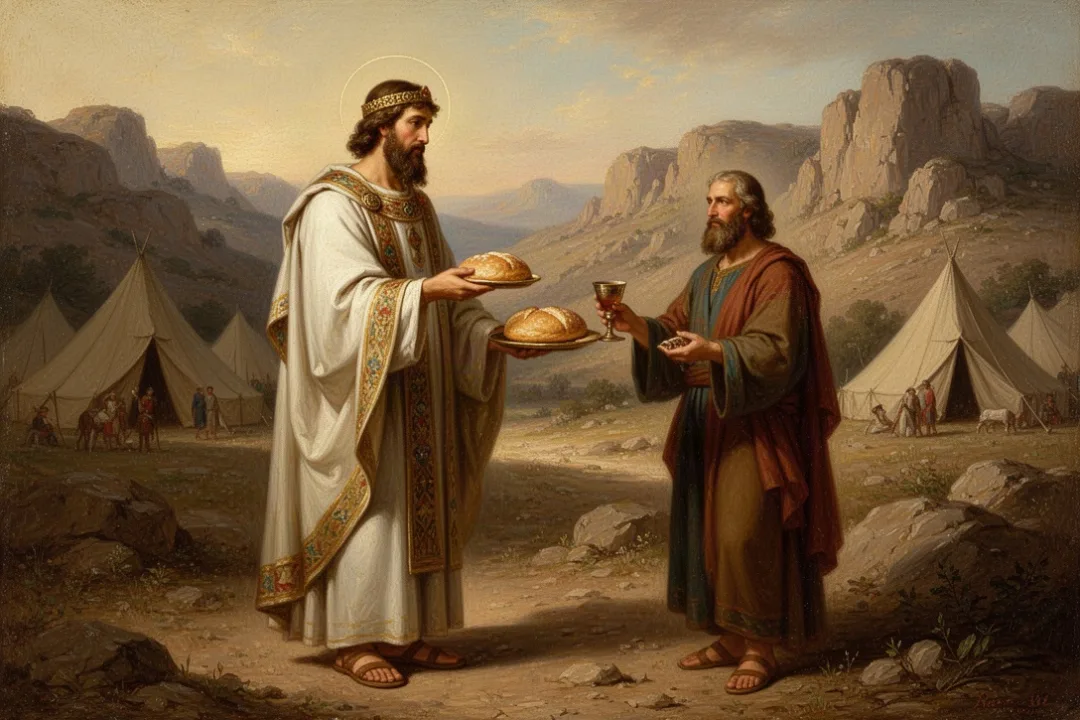
Melchizedek appears briefly in Genesis 14 after Abram rescues Lot and defeats a coalition of kings. He is described as the king of Salem and priest of God Most High. He brings bread and wine, blesses Abram, and receives a tenth of the recovered goods.
The scene is unusual because Melchizedek is not introduced through a genealogy. Genesis does not name his father, mother, birthplace, or descendants. The passage simply presents him as an established king and priest who recognizes the God of Abram.
Melchizedek’s name is commonly understood as connected with righteousness and kingship. “Salem” is often associated with Jerusalem, though interpreters have discussed the exact geographical meaning. The passage emphasizes his role rather than supplying the family history normally given for important biblical figures.
His blessing of Abram is also significant. Melchizedek blesses Abram in the name of the Creator and receives a tithe from him. In the narrative, this places Melchizedek in a position of spiritual honor, at least for this encounter, even though Abram is the central figure of the wider story.
Direct answer: Genesis 14 does not say “Melchizedek was Shem.” The identification depends on chronology, Jewish tradition, and interpretation of Melchizedek’s unusual lack of a recorded genealogy.
Why some Jewish traditions identify Shem with Melchizedek
Jewish interpretation developed the identification partly to connect an otherwise mysterious priest-king with a known figure from Genesis. Shem was a respected survivor of the flood and an ancestor within the line leading to Abraham. Associating him with Melchizedek gives the brief encounter a recognizable historical identity.
In rabbinic and medieval Jewish interpretation, Melchizedek is often identified as Shem. Rashi, commenting on Genesis 14, follows this interpretation. The reasoning fits the Genesis chronology: Shem could still have been living when Abram met the king of Salem.
This interpretation also helps explain how knowledge of the true God could be present outside Abram’s immediate household. Melchizedek’s title, “priest of God Most High,” is then understood as evidence that worship of the true God had not disappeared from the post-flood world before the calling of Abraham.
Some Jewish discussions also consider a subtle issue in the meeting. Melchizedek blesses Abram, but later traditions interpret the order of honor in different ways. One line of interpretation holds that Shem, though righteous, should have given way to Abram’s divinely appointed role. These discussions show that identifying Melchizedek as Shem does not eliminate every question; it creates additional ones about priesthood, blessing, and the development of Israel’s story.
The identification is therefore best described as a traditional exegetical solution. It is not presented as a direct statement in Genesis, and not every Jewish interpreter treats the identification as the only possible reading.
How the chronology allows Shem and Melchizedek to be the same person
Genesis gives Shem a lifespan of six hundred years. It also records the ages of several generations after Shem, including Arpachshad, Shelah, Eber, Peleg, Reu, Serug, Nahor, and Terah. Abram belongs to the next generation after Terah.
When readers add these ages according to the biblical genealogical account, Shem can plausibly still be alive when Abram meets Melchizedek. The text does not require Melchizedek to be a younger contemporary of Abram. An older patriarch could hold authority in Salem and serve as a priest.
Still, chronology only shows that the identification is possible. It does not prove that it happened. Biblical genealogies sometimes focus on theological or family relationships rather than providing a complete modern-style timeline, so calculations should not be treated as stronger evidence than the text itself allows.
The chronology also does not explain why Genesis would use the name Melchizedek rather than Shem. An interpreter may answer that Melchizedek is a royal name, title, or name associated with his office. But that remains an interpretation rather than something Genesis spells out.
What Psalm 110 adds to the discussion
Psalm 110 refers to a future royal figure who is described as a priest “according to the order of Melchizedek.” The psalm combines kingship and priesthood in a way that becomes important for later Jewish and Christian interpretation.
The phrase does not simply mean that the future ruler will belong to the same family line as Melchizedek. It can point to a pattern of priestly authority associated with Melchizedek: a priest who is also linked with kingship, blessing, and an enduring divine appointment.
For readers who identify Melchizedek with Shem, Psalm 110 can be read as referring back to the historical priest-king who met Abram. For Christian interpreters, the psalm becomes a prophecy about the Messiah, whose priesthood is understood as different from the Levitical priesthood established later under the law of Moses.
Psalm 110 does not name Shem. It names Melchizedek, which means that the psalm preserves Melchizedek’s identity as the important theological reference point. Even if someone accepts that Melchizedek was Shem, the psalm still focuses on what Melchizedek represents rather than on Shem’s genealogy.
How Hebrews interprets Melchizedek
The New Testament book of Hebrews gives the most extended biblical discussion of Melchizedek. Hebrews 5, 6, and 7 connect Melchizedek with Psalm 110 and use his appearance in Genesis to explain the priesthood of Jesus.
Hebrews describes Melchizedek as a king of righteousness and king of peace, drawing attention to the meaning associated with his name and the name Salem. It also says that he appears without a recorded father, mother, genealogy, beginning of days, or end of life. This language comes from the way Genesis presents him: the biblical narrative records no such details.
Hebrews does not say that Melchizedek was Shem. If the author intended to identify him with Shem, the text could have made that connection directly, but it does not. Instead, Hebrews uses the scriptural presentation of Melchizedek as a literary and theological pattern for Christ’s enduring priesthood.
That does not necessarily mean Hebrews claims Melchizedek literally had no parents or never died. The point is based on the scriptural record: Genesis gives no genealogy or account of his birth and death. Hebrews treats the silence of the text as significant for its argument.
Hebrews also contrasts Melchizedek’s priesthood with the Levitical priesthood. The priests descended from Levi served under a system tied to family lineage and repeated sacrifices. Jesus’ priesthood, according to Hebrews, is established through the divine oath expressed in Psalm 110 rather than through descent from Levi.
For this reason, many Christian traditions understand Melchizedek as a historical priest-king who prefigures Christ, not as Christ himself and not necessarily as Shem. Other Christian interpreters have accepted the Shem identification without treating it as central to Hebrews’ argument.
Why Genesis does not identify Melchizedek by name as Shem
The absence of an explicit identification is the strongest reason to avoid stating that Shem and Melchizedek are definitely the same person. Genesis names many people carefully and often supplies family relationships. In Melchizedek’s case, it gives title, location, action, and blessing, but no genealogy.
Several explanations are possible. The author may have intended Melchizedek to be an independent historical figure. The name may have functioned as a royal title. The lack of genealogy may have been deliberate because the narrative needed only to establish his role in the encounter with Abram.
Another possibility is that the omission prepares for later theological interpretation. Because Melchizedek’s beginning and end are not recorded, Psalm 110 and Hebrews can use him as a fitting image of a priesthood not grounded in the ordinary genealogical system.
None of these possibilities requires the reader to reject the Shem interpretation. They do show why tradition and textual statement should be kept separate. A responsible explanation can say that the identification is ancient and meaningful while also acknowledging that the biblical text leaves it unstated.
Important differences between Shem and Melchizedek in the biblical text
The two figures occupy different narrative roles. Shem belongs to the genealogical line of Noah and appears as an ancestor. Melchizedek appears as a king and priest who blesses Abram. Their roles overlap only if an interpreter connects them.
Shem is identified by family relationship, especially as a son of Noah and ancestor of later generations.
Melchizedek is identified by office, especially as king of Salem and priest of God Most High.
Shem is part of the genealogy leading toward Abram.
Melchizedek is presented in a single encounter with Abram.
Shem is named directly in Genesis.
Melchizedek is not connected to Shem by an explicit statement.
These differences do not disprove the identification. They explain why it is an interpretive conclusion rather than an obvious reading. The biblical authors may have wanted readers to notice Melchizedek’s office without reducing him to a genealogical footnote.
Common mistakes when explaining Shem and Melchizedek
The subject is often made more confusing by treating one interpretation as if every Jewish and Christian reader has always agreed with it. A careful explanation distinguishes what Scripture says, what later tradition says, and what a particular theological system concludes.
Do not say the Bible explicitly identifies them. It does not. Genesis never states that the king of Salem was Noah’s son Shem.
Do not claim chronology proves the case. Shem’s long lifespan makes the identification possible, but possibility is not proof.
Do not confuse Melchizedek with Jesus. Hebrews uses Melchizedek as a pattern for Christ’s priesthood; it does not simply state that Melchizedek was Jesus appearing in human form.
Do not assume “without genealogy” means literally parentless. In Hebrews, the phrase reflects the way Genesis records Melchizedek, not necessarily a claim that he had no biological parents.
Do not overlook the Jewish background. The Shem identification has strong roots in Jewish interpretation and should not be presented as a late Christian invention.
Do not treat “order of Melchizedek” as automatically meaning a family dynasty. The phrase can describe a kind or pattern of priesthood rather than a documented succession.
Best wording for a study note: “Some Jewish traditions identify Melchizedek with Shem, and the Genesis chronology allows that possibility. The biblical text itself does not make the identification explicit.”
How Jewish and Christian readings approach the question differently
Jewish readings often focus on the relationship between Melchizedek, Shem, Abraham, and the development of worship of God Most High. Identifying Melchizedek as Shem connects the priest-king with the righteous line preserved through Noah and explains his presence before the establishment of the Mosaic priesthood.
Christian readings often give greater weight to Psalm 110 and Hebrews 7. The central question becomes not simply “Who was Melchizedek historically?” but “What does Melchizedek’s priesthood show about the priesthood of Christ?” This approach can accept the traditional identification with Shem, reject it, or leave it undecided while still seeing Melchizedek as a type or foreshadowing of Jesus.
Some Christian teachers describe Melchizedek as a pre-incarnate appearance of Christ. That view is held in parts of Christian interpretation, but it is not the only Christian view. Other readers understand him as a human king and priest whose unusual presentation in Genesis serves a symbolic purpose in Hebrews.
The differences arise from different interpretive priorities. Jewish tradition may emphasize continuity from Noah to Abraham, while Christian theology emphasizes the contrast between the Levitical priesthood and Christ’s permanent priesthood. Both approaches recognize that Melchizedek’s brief appearance carries unusual significance.
What the bread, wine, blessing, and tithe signify
Genesis says that Melchizedek brought bread and wine when he met Abram. The passage does not explain these items in detail, so interpretations should avoid claiming more than the text supports. They may have served as provisions or as part of the king’s hospitality, and later Christian readers have connected them with broader sacramental themes.
Melchizedek then blesses Abram in the name of God Most High, identifying God as the maker of heaven and earth. The blessing recognizes that Abram’s victory ultimately depends on God. Abram responds by giving Melchizedek a tenth.
The exchange establishes a relationship of honor. Melchizedek blesses; Abram gives a tithe. Hebrews later uses this arrangement to argue that Melchizedek is presented as greater than Abram in the narrative. Since Levi descends from Abraham, Hebrews extends the argument to the Levitical priesthood.
If Melchizedek is Shem, the scene can be viewed as a meeting between an ancient patriarch and Abram. If they are distinct, it presents Abram honoring a priest-king outside his immediate family line. Either reading preserves the main narrative point: Melchizedek recognizes the same supreme God who called Abram.
How to study the passages without forcing an answer
Start with the passages in their biblical order rather than beginning with a later conclusion. Read Genesis 9–11 for Shem’s place in Noah’s family, Genesis 14 for Melchizedek’s meeting with Abram, Psalm 110 for the later royal-priestly reference, and Hebrews 5–7 for the Christian interpretation.
Ask what each passage directly says. Separate names, titles, actions, and genealogical details.
Mark what is omitted. Melchizedek’s missing genealogy is meaningful, but omission alone does not identify him as Shem.
Compare the purpose of each text. Genesis tells the encounter, Psalm 110 uses Melchizedek in royal poetry, and Hebrews develops a theological argument.
Distinguish identity from symbolism. A person can serve as a model or foreshadowing figure without being the same person as the figure later associated with him.
Consult tradition carefully. Jewish and Christian interpreters have offered several readings, and their explanations should be labeled as interpretations.
A useful conclusion for personal study is not necessarily a single definitive identity. You may reasonably say that Shem and Melchizedek are traditionally identified in some Jewish sources, that the chronology makes the identification possible, and that the Bible itself leaves the matter open.
What the question teaches about biblical interpretation
The question of Shem and Melchizedek illustrates how readers move from a short narrative to broader theological conclusions. A few details—Shem’s age, Melchizedek’s title, the missing genealogy, and the reference in Psalm 110—have generated centuries of interpretation.
It also shows why context matters. Melchizedek cannot be understood fully by looking only at Genesis 14, but later passages should not be used to erase what Genesis actually says. The most reliable approach lets each passage speak in its own setting before considering how the passages relate.
For many readers, the most significant point is not solving Melchizedek’s civil identity. It is recognizing the biblical theme of a priesthood associated with righteousness, peace, blessing, and divine appointment. Hebrews applies that theme to Jesus, while Jewish tradition connects the mysterious priest-king with Shem.
So, are Shem and Melchizedek the same person? They may be, according to an important Jewish tradition, but Scripture does not explicitly confirm it. Treating the identification as possible and traditional—rather than certain and universally accepted—gives the clearest account of the evidence.
Frequently asked questions
Why does Genesis not call Melchizedek Shem?
Genesis may be emphasizing Melchizedek’s role as king and priest rather than his family ancestry. The passage gives no explanation for the missing genealogy, so readers cannot know with certainty why the name Shem is absent. Later interpreters supplied the identification based mainly on chronology and tradition, not on a direct statement in Genesis.
Did Melchizedek live before Abraham?
Melchizedek meets Abram after Abram’s military victory in Genesis 14, so he was alive at the same time as Abraham. If Melchizedek was Shem, he would have been an exceptionally old man, since Genesis gives Shem a very long lifespan. The biblical chronology allows that possibility but does not require it.
Is Melchizedek a symbol of Jesus?
In Christian interpretation, Melchizedek is commonly understood as a pattern or foreshadowing of Jesus’ priesthood. Hebrews emphasizes his royal title, blessing, and lack of a recorded genealogy. It presents Christ’s priesthood as superior to the Levitical priesthood, but it does not plainly say that Melchizedek himself was Jesus.
What does “according to the order of Melchizedek” mean?
The phrase in Psalm 110 and Hebrews points to a priesthood associated with Melchizedek rather than with Levi’s family line. It highlights a divinely appointed priest who is also connected with kingship. In Hebrews, the phrase supports the claim that Jesus has a permanent priesthood established by God’s oath, not by descent from Aaron.











Leave a Reply