Angel Instrument: Origins, Types, and Practical Uses
Angel Instrument: Origins, Types, and Practical Uses
Throughout music history and religious imagination, a startling and persistent idea has persisted: there exists a celestial instrument or angel instrument that embodies purity, transcendence, and a bridge between the human and the divine. This article explores the origins of this concept, the types of instruments it evokes, and the practical uses these ideas have in art, education, therapy, and everyday creativity. By tracing myths, sacred texts, visual representations, and modern adaptations, we gain a richer understanding of how the notion of an angelic instrument has shaped culture—and how it can inspire contemporary practice without slipping into cliché.
The notion of an angel instrument arises at the intersection of mythology, religion, and art. It is a symbol that appears in multiple traditions, often to convey the idea that music is a conduit between heaven and earth. Below are key threads in the origins of this idea, spanning ancient myth, sacred texts, and later artistic representation.
In ancient myth and sacred scripture
Hebraic and Near Eastern traditions have produced enduring associations between celestial beings and musical forms. The kinnor (a type of lyre) and the nevel (a harp-like instrument) are among the oldest named instruments in the region, often linked to temple ritual and divine stimulation of the human heart. In some Jewish and Christian apocryphal texts, angelic choirs accompany instrumental music, suggesting that the heavens themselves are tuned to a particular pitch or timbre. In this sense, the angel instrument serves as a bridge between worshippers and the divine presence.
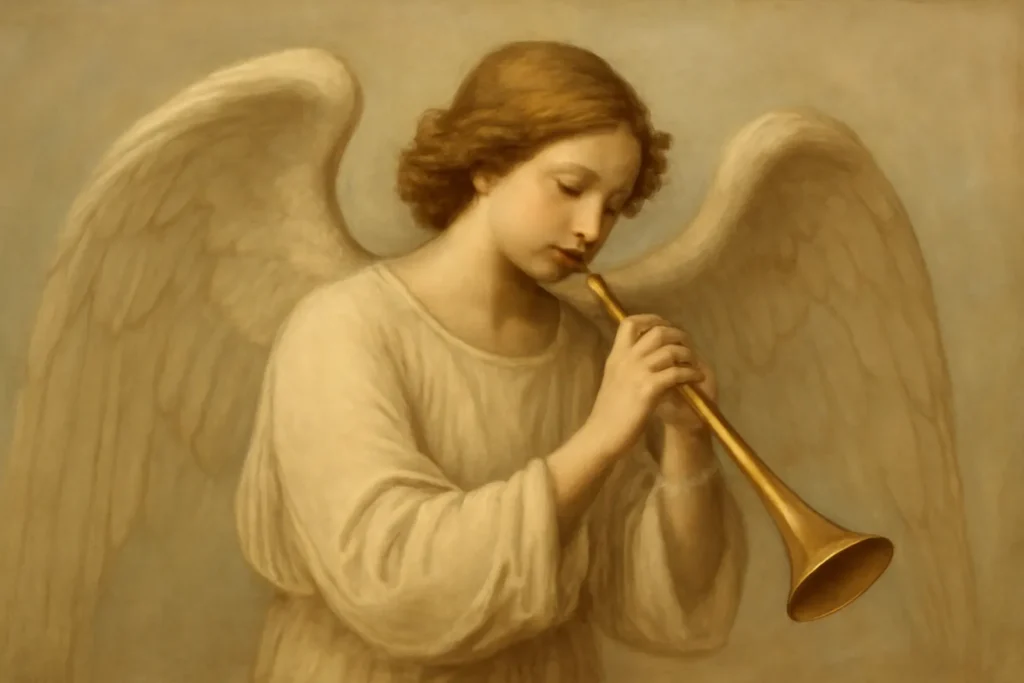
Trumpets and horn-like sounds recur as dramatic heralds in apocalyptic literature. The imagery of angels blowing trumpets or sounding celestial horns conveys judgments, announcements, and moments of cosmic shift. While not a single instrument, the trumpet of angels has become a powerful symbol for the idea that certain sounds carry authority beyond ordinary human expression.
Across various traditions, flutes and pipes are depicted in heavenly contexts as airy, ethereal voices. In some mythologies, the flute’s notes are said to enchant animals, awaken nature, or invite souls toward a higher plane. The angelic flute motif emphasizes grace, lightness, and an almost otherworldly sweetness that human players strain to reproduce.
Art, poetry, and the visual imagination
During the Medieval and Renaissance periods, painters and sculptors often depicted angels with instruments—harps, lyres, and sometimes small harps that appear delicately suspended in the air. These images helped worshippers imagine music as a gift from the divine. The concept of an angel instrument here is less about a single instrument and more about a symbolic ensemble that conveys harmony, purity, and otherworldly beauty.
In romantic literature and poetry, the idea of an angelic instrument emerges as a metaphor for music that transcends human limitations. Poets often describe music that seems to descend from above, as if the instrument itself carries a blessing or a revelation. The term “angel instrument” becomes a powerful shorthand for music that sounds as if it were not merely played by human hands but inspired by a higher source.
In visual culture, illustrations of heavenly choirs with gleaming strings or radiant trumpets reinforce the sense that certain sounds belong to the celestial order. The image of an angel’s harp or a radiant organ in church iconography continually renews the association between sacred sound and sacred form.
To respect the breadth of the idea, it is useful to categorize the angel instrument concept into several families. Each family evokes a set of tonal qualities and historical associations, while also inviting modern reinterpretation. Below are common types and how they function in tradition and contemporary practice. Throughout, we will use a variety of terms—angel instrument, angelic instrument, celestial instrument, and heavenly instrument—to reflect semantic breadth and avoid repetitive phrasing.
1) The harp and lyre family: the voice of angels in string tone
Harps are perhaps the most enduring association with celestial music. The instrument’s transparent resonance, sustain, and plural strings make it a natural symbol for heavenly benevolence. In many depictions, the harp of angels seems to float or hover, as if plucked by invisible hands.
Lyres and related plucked instruments evoke intimate, intimate beauty. In ancient and classical iconography, the lyre is commonly shown as a portable, celebratory instrument that accompanies poetry, ritual, and song. An angelic lyre is thus a compact emblem of music as a joy and a rite.
In modern practice, these sounding bodies have inspired harp-inspired sound design and electroacoustic hybrids, where the acoustic resonance is layered with process-based textures to create a sense of “angelic resonance.”
2) The trumpet and horn family: the voice of proclamation and grandeur
Trumpets and horn-like instruments symbolize announcement, judgment, and awe. The association with angels is persistent in apocalyptic literature and in sacred music that seeks to evoke reverence and majesty.
In contemporary music, a so-called angel trumpet can refer to bright, piercing brass lines or to synthesized brass-like timbres designed to cut through a mix with a sense of sacred authority.
3) The flute and pipe family: breath and lightness
Flutes and pipes convey a direct, airy, almost lyrical quality. The angelic flute motif emphasizes purity, clarity, and a lightness that feels closer to wind rather than to wood or metal.
In fiction and film scoring, a “celestial flute” might accompany a moment of revelation or gentle blessing, signaling the intrusion of the divine into the ordinary.
4) The organ and keyboard family: reverent space and orchestral breadth
The organ is a theater of sound—church organs, in particular, offer expansive, sustained tones that can imply vast, heavenly spaces. An image of the angelic organ is often used to communicate grandeur without overwhelming intimacy.
In modern multimedia, digital organs or samplers can simulate celestial architectures of sound for scenes that demand both gravity and serenity.
5) The kinnor, nevel, and related ancient instruments: historical roots
In Jewish musical heritage, the kinnor (harp-like) and nevel (psaltic harp) anchor a lineage of sacred sound that is sometimes framed as the instrument that angels might envy in their precision and beauty.
These ancient instruments connect the modern angel instrument concept to a long arc of ritual music, liturgy, and poetic memory.
6) Modern reinterpretations: electronic, hybrid, and imagined forms
The idea of a celestial instrument isn’t limited to acoustic forms. Contemporary composers and sound designers create “angelic” timbres using digital synthesis, granular processing, and sample libraries designed to evoke the sense of something higher, brighter, or purer than ordinary sound.
In film, video games, and immersive installations, designers often describe these sounds as “angelic drones,” “glorified pads,” or “heavenly resonances,” blurring the line between instrument type and sonic intention.
Practical Uses of the Angel Instrument Concept
Beyond the pages of myth and history, the idea of an angel instrument serves several concrete purposes in real-world practice. It can guide composition, performance, pedagogy, therapy, and storytelling. The following sections outline practical applications and give ideas for how to implement them in diverse contexts.
Spiritual pacing: Use a celestial timbre as a sonic cue for transitions in a ritual, guiding participants from contemplation to action or from darkness to light.
Focused listening: In meditative or contemplative settings, musicians or listeners attend to sustained tones associated with the angelic sound, training attention and reducing mental fragmentation.
Liturgical inclusion: Heritage-rich pieces that employ harps, kinnor-inspired plucked instruments, or brass-like tones can enrich worship without compromising tradition, creating moments of deliberate uplift.
Music education and ethnomusicology
Historical context: Teaching about the angel instrument concept helps students connect music theory with sacred literature, iconography, and historical practice.
Instrument families: By examining harp, lyre, trumpet, flute, and organ traditions, students learn about resonance, timbre, register, articulation, and performance practices across cultures.
Creative listening exercises: Students compare “angelic” timbres (acoustic harp vs. synthesized pad) and discuss how the same aesthetic—transcendence, serenity, awe—can be achieved with different tools.
Therapeutic and well-being contexts
Music therapy often leverages consonant, spacious textures. The notion of an angelic instrument can guide therapists toward selecting music that promotes calm, safety, and emotional release.
Sound healing communities sometimes use the symbol of divine or celestial tones to frame practices that emphasize breath synchronization, grounding, and inner balance.
Creative writing, storytelling, and performance
Symbolic device: Writers can deploy the image of an angel instrument as a motif for grace, mercy, or revelation within a narrative arc.
Stage and screen: Composers and sound designers can craft scenes around a “heavenly instrument” to communicate an otherworldly presence, offering audiences a sonic cue that transcends language.
World-building: In fantasy or science fiction, inventing a tangible celestial instrument with its own lore, physics, and playing technique enriches the texture of the imagined world.
Performance practice and composition
Motivic development: A composer might begin with a pure, sustained note or simple interval and gradually layer overtones to evoke a sense of ascent, like an angel instrument revealing itself over time.
Instrumentation choices: Even when using modern gear, labeling a sound as “angelic” can guide decisions about tessitura, envelope, reverb, and spatial placement in a mix to preserve the intended aura.
Hybrid ensembles: Combining traditional instruments with electronic textures can create “angelic” timbres that are both familiar and otherworldly, suitable for contemporary concert works.
Design, aesthetic, and sonic considerations
When designers, composers, or educators speak of an angel instrument, they often confront several practical questions: what timbre best conveys transcendence, what textural language fits the setting (church, concert hall, or multimedia), and how to balance familiarity with novelty. The following considerations help guide practical work while maintaining respect for cultural and spiritual contexts.
Timbre selection: The notion of the celestial sound commonly leans toward serene, pure, and resonant tones. Consider warm string timbres, soft brass, airy woodwinds, or synthetic pads with long release tails to evoke that sense of the ethereal.
Spatiality and reverb: Heavenly music often feels expansive. Reverb choices can simulate large, reverberant spaces (cathedrals, sanctuaries, or celestial halls) without overpowering the listener.
Intelligibility vs. mystery: The angelic tone is often appreciated when it remains slightly enigmatic. Balance clarity with subtle echoes or microtonal inflections to preserve a sense of wonder.
Context and sensitivity: When drawing on religious imagery, be mindful of cultural or communal meanings. The same sonic gesture can be perceived as sacred, decorative, or inappropriate depending on context. Always aim for respectful use and clear intent.
Variations on the Term: Expanding the Semantic Field
To broaden the discussion beyond a single label, it is helpful to employ several variations of the term that retain clear connections to the original idea while inviting new associations. Here are examples you can adapt in writing, teaching, or project briefs:
Angelical instrument or angelic instrument — emphasizes grace and purity in sound color.
Celestial instrument — foregrounds the heavenly domain and the sense of scale beyond human reach.
Heavenly instrument — a broad descriptor suitable for contemplative or devotional contexts.
Seraphic instrument — carries a specific literary flavor, drawing on the seraphim’s association with high rank and sublime music.
Angeltone device or angelic timbre — focuses on the perceptual quality of sound rather than the physical form.
Celestial strings — a phrase that foregrounds stringed instruments in a divine light.
Harps of heaven or harp of angels — traditional imagery that remains instantly recognizable.
Ethical and Cultural Considerations
As with any symbol that touches spirituality, it is essential to approach the angel instrument concept with care. While the imagery can inspire beauty and contemplation, it can also risk romanticizing or commodifying religious experiences. Here are some guiding principles for responsible use:
Respect for tradition: Acknowledge the historical and cultural roots of the imagery when drawing on it in teaching or creative work.
Cultural sensitivity: Recognize that different cultures have distinct musical traditions and interpretations of what constitutes “angelic” sound. Avoid stereotyping or superficial appropriation.
Clear intent: Be explicit about your aims. If a project uses sacred imagery, consider framing it as homage, study, or inclusive exploration rather than religious endorsement or critique.
Contextualization: When presenting music that evokes an angelic sound, provide listeners with context—historical background, stylistic notes, and the source of the imagery—so they can engage thoughtfully.
Conclusion: The Enduring Allure of the Angel Instrument
The angel instrument concept endures because it speaks to a longing that many people share: the sense that music can lift us beyond ordinary experience, connect us with something larger, and illuminate moments of beauty with a remembered or imagined radiance. Whether considered as a historical catalog of real instruments associated with heavenly imagery, as a metaphor for sound design in film and game scoring, or as a pedagogical tool in music education, the idea invites us to listen more deeply and to create with intention. By examining origins, recognizing diverse types, and implementing thoughtful practical uses, musicians, educators, writers, and designers can honor the complexity of this emblem while fostering inclusive, imaginative, and responsible work.
In the end, the angel instrument is less about a single physical object and more about an ideal: that certain sounds can carry grace, calm, and wonder across boundaries of culture, language, and time. Whether you encounter this idea in an ancient manuscript, a classical concert program, or a contemporary multimedia project, it invites you to consider how music can act as a bridge—between heaven and earth, between memory and invention, and between the human heart and the vast, luminous sky above.








Leave a Reply