The prayer commonly known as “Make me an instrument of your peace” has become one of the most recognizable lines in Christian devotion. It is read at weddings, recited in quiet corners, and spoken in sermons about mercy, forgiveness, and reconciliation. The appeal of this prayer lies not only in its elegant cadence but in its practical invitation: to align one’s thoughts, words, and actions with the work of peace. In a world marked by division, conflict, and fear, the idea of becoming an instrument of peace speaks to both personal transformation and social responsibility.
This article offers a thorough look at St. Francis’s prayer for peace—from its core meaning to its origins, along with practical guidance on how to pray it today. We will explore variations and translations, considerations about authorship, and ways to make the prayer a living practice rather than a mere line to be repeated. By tracing its themes—love, forgiveness, faith, and hope—we can better understand how this simple petition invites a deeper, missional spirituality that can be lived in daily life.
The prayer’s core message: What it asks of us
At the heart of the prayer is a radical reorientation: asking not for comfort or personal gain, but for the capacity to console rather than be consoled, to understand rather than be understood, and to love rather than be loved. This reversal is a hallmark of Christian moral imagination—moving from self-centered concerns to the needs and dignity of others. The succinct lines each offer a different facet of peace:
“Where there is hatred, let me sow love.” — The courage to respond to hostility with love and to cultivate reconciliation in places of animosity.
“Where there is injury, pardon.” — A readiness to forgive injuries, which liberates both giver and receiver from the burden of grievance.
“Where there is doubt, faith.” — Inviting trust in God, even amid uncertainty, as a foundation for hopeful action.
“Where there is despair, hope.” — The discipline of hope that sustains effort during dark times and motivates constructive action.
“Where there is darkness, light.” — The transformation of ignorance or fear into understanding and illumination.
“Where there is sadness, joy.” — Healing and consolation that can awaken resilience and renewed purpose.
Beyond these lines, the longer version adds a second, companion invitation: to be consoled less than to console, to be understood less than to understand, and to be loved less than to love. This reframing directs the heart outward and upward—that true peace emerges not from winning but from generosity, mercy, and fidelity to a higher good.
Origins and attributions: How the prayer came to be
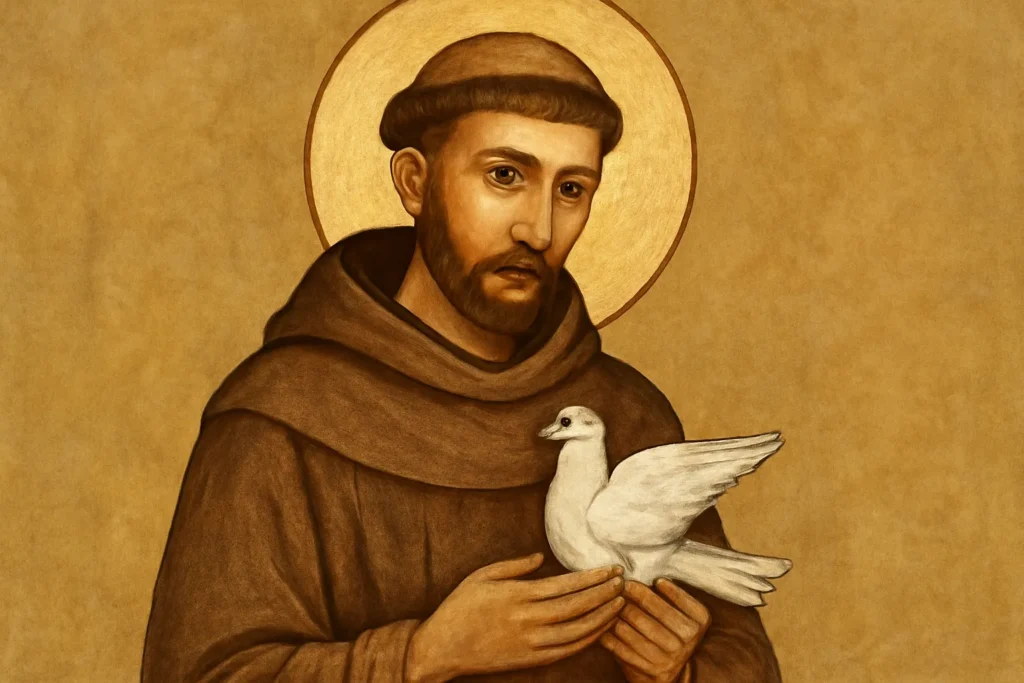
The prayer is widely associated with Saint Francis of Assisi, whose own life radiated the values of humility, poverty, and compassion. Yet the precise authorship and dating of the text are matters of debate among scholars and editors of devotional literature. Most scholars today would say that the familiar prayer does not appear in the surviving writings of St. Francis himself. It is not found in theCanonical works attributed to him, such as the Fioretti (The Little Flowers) or the Chronica of his era.
What is more widely accepted is that the prayer arose within Christian devotional culture in the 19th or 20th century, and it was later associated with Saint Francis because of its spirit and themes. The text entered popular usage through prayer cards, devotional booklets, and Catholic magazines, and it gained enormous circulation during the 20th century as a universal expression of peaceful, charitable living. In other words, the attribution to St. Francis reflects a lineage of Franciscan-inspired spirituality—humility, mercy, and a trust in divine providence—rather than a verifiable manuscript authored by the medieval saint.
For readers and students, this lineage matters less as a historical label and more as a pointer to a lived tradition of peace-making. The prayer’s moral emphasis aligns with the Franciscan values of poverty of spirit, charity, fraternity, and care for creation. When we encounter the text, we are invited to see it as a devotional compass—whether or not the exact words were penned by Saint Francis himself.
Language, translations, and variations: How the prayer travels
The core sentiments of the prayer travel well across cultures and languages, and as a result, there are numerous translations and paraphrase variants. Some people memorize a short form; others use the longer, more formal version. The English renderings themselves show subtle differences: some use “thy” or “thine” for the original “your,” influencing the tone; others opt for the modern “your.” Here are a few representative forms you might encounter:
Standard contemporary English: “Lord, make me an instrument of your peace. Where there is hatred, let me sow love; where there is injury, pardon; where there is doubt, faith; where










Leave a Reply