Areopagus: the hill, council, and biblical setting
Areopagus: the hill, council, and biblical setting
Areopagus refers both to a rocky hill in Athens and to the ancient council associated with it. The site became especially well known to Christians because Acts 17 describes the apostle Paul speaking there about the living God, resurrection, and the message of Jesus.
The name Areopagus comes from Greek words commonly understood as “Hill of Ares,” linking the place with Ares, the Greek god of war. The hill stands northwest of the Acropolis, near the Agora and the path leading toward the Acropolis complex. Its exposed limestone surface is modest in height, but its location gave it a commanding position in the center of ancient Athens.
The term can mean more than the physical hill. Areopagus also identified a council of prominent Athenians that met there, or was traditionally connected with the location. Ancient writers and modern historians therefore use the word in two related senses: the rocky landmark and the governing body that carried its name.
The council was one of the oldest institutions in Athens. Its membership traditionally included former archons, or senior magistrates, who joined the body after completing their public service. Because former archons usually came from the city’s elite, the council represented a group with substantial experience, social standing, and influence.
Its authority changed over time. During earlier periods, the Areopagus exercised broad power over public affairs, but democratic reforms reduced much of that authority. The reforms associated with Ephialtes in the fifth century BCE transferred many responsibilities to other democratic institutions, particularly the Assembly and popular courts.
Even after its political power narrowed, the council did not become irrelevant. It retained important functions connected with homicide cases, religious matters, and certain forms of moral or civic oversight. The exact scope of its work varied across different periods, so descriptions of the Areopagus should not treat it as a single unchanging institution.
Keep the two meanings together: when a source mentions the Areopagus, it may mean the Athenian hill, the council linked to that hill, or both. The surrounding context determines which sense is intended.
The hill’s significance came from more than its physical size. Athens was known throughout the Mediterranean as a center of philosophy, art, civic debate, and religious practice. A location near the city’s most important public spaces naturally became associated with questions of law, belief, public order, and the identity of the city itself.
How the Areopagus functioned as a council
The early Areopagus was not equivalent to a modern parliament or city council. It did not represent citizens through regular elections in the modern sense, and its membership was connected to the old aristocratic structure of Athens. Its authority grew out of tradition, reputation, and the prestige of former magistrates.
Before democratic reforms, the council had a broad role in supervising the city. It could influence public policy, examine the conduct of officials, and protect established customs. Athens later developed more participatory institutions, but the Areopagus continued to embody the city’s ancestral law and religious seriousness.
One of its clearest surviving responsibilities involved cases of intentional homicide. Greek religious thought treated bloodshed within the community as a matter with both legal and sacred consequences. A homicide trial was not simply a dispute between individuals; it could affect the moral balance of the city and the relationship between the community and its gods.
The council also had associations with religious offenses and conduct considered threatening to civic morality. Sources do not present a perfectly uniform picture of its jurisdiction across the centuries, but they do show that the Areopagus belonged to the area where law, religion, and public ethics overlapped.
Athens itself was governed by several institutions, including the Assembly, councils, magistrates, and popular courts. The Areopagus was only one part of this system. Its importance cannot be measured simply by asking whether it had the same powers as it did in an earlier period; its prestige could remain considerable even when its formal authority had been reduced.
That distinction helps explain why the word could carry such weight in the first century CE. A person brought before the Areopagus might be facing a formal legal proceeding, a public hearing, an intellectual examination, or a conversation before influential civic figures. The setting could be authoritative without functioning as a modern criminal court.
Earlier periods: the council held extensive political and judicial influence.
After democratic reforms: many powers moved to the Assembly and popular courts.
Later periods: the council remained associated with homicide, religion, public morality, and civic prestige.
In Acts 17: the setting raises questions about how Paul’s message was heard by Athenian intellectuals and authorities.
The Areopagus also represented a tension within Athenian political culture. Athens valued open discussion and intellectual inquiry, yet the city also guarded its religious traditions and civic identity. New teachings could attract interest while still causing concern if they appeared to challenge established beliefs.
Why the Areopagus matters in Acts 17
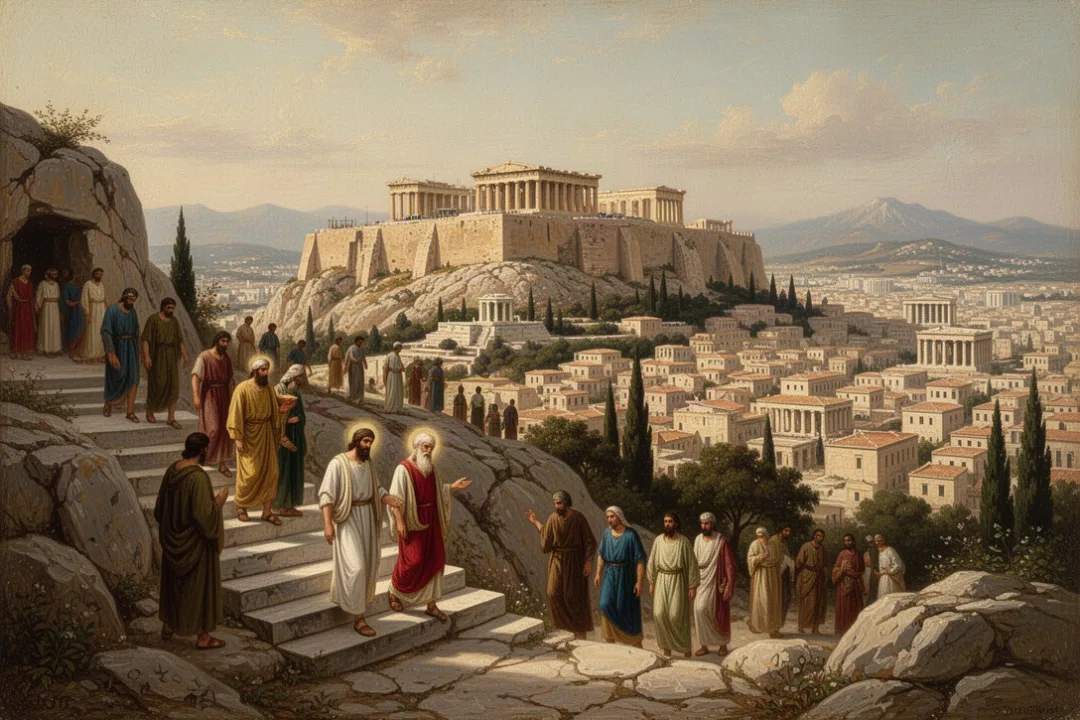
Acts 17 places Paul in Athens after he has been preaching in the city. The chapter describes him reasoning in the synagogue and speaking with people in the marketplace. Some philosophers, identified as Epicureans and Stoics, engage him in discussion, and others bring him to the Areopagus to hear more about the teaching he is presenting.
The passage says that Athenians and visitors spent much of their time discussing or hearing something new. That detail creates a picture of a city where public conversation and competing ideas were familiar parts of life. Paul’s message, however, was not treated as merely another philosophical theory, because it concerned God, worship, judgment, and resurrection.
The wording of Acts 17 has generated discussion about what exactly happened at the Areopagus. The Greek phrase can be understood as referring to the hill itself or to the council. The passage does not provide enough detail to settle every question about the formal status of the gathering.
Some readers understand Paul as appearing before the governing council. Others see a more informal setting in which philosophers and interested citizens brought him to the hill or to a public meeting place associated with the Areopagus. Both interpretations recognize that Paul was speaking before people connected with Athens’s intellectual and civic elite.
The chapter does not describe a conventional trial with charges, witnesses, and a verdict. Instead, Paul is asked to explain the “new teaching” that has attracted attention. The scene is better understood as a public examination or intellectual hearing than as a criminal prosecution, although the religious implications of his message made the exchange more serious than a casual conversation.
Acts 17:16–34 presents Paul’s speech. Rather than beginning with the Hebrew Scriptures, which would have been familiar ground in a synagogue, he starts from the religious world of his Athenian audience. He refers to their devotion, their objects of worship, and an altar dedicated to a deity described as unknown. He then uses those points to direct attention toward the God he proclaims.
Paul’s argument emphasizes that the creator of the world does not depend on temples, human craftsmanship, or offerings supplied as though God lacked anything. He presents humanity as dependent on God for life and existence. The speech also rejects the idea that divine nature can be adequately represented by images made from precious metals, stone, or human skill.
The address includes an appeal to turn away from ignorance and toward accountability before God. Acts 17:31 connects that accountability with a future judgment carried out through a person appointed by God, whom God has confirmed by raising him from the dead. The mention of resurrection divides the audience’s response.
Acts 17 portrays Paul beginning with his audience’s religious questions and leading them toward the identity of the God they did not yet know.
Some listeners mock the idea of resurrection, while others want to hear more. A few become followers, including Dionysius, described as a member of the Areopagus, and a woman named Damaris. The passage gives no extended account of what happened afterward, but it presents several different responses: rejection, curiosity, and belief.
Interpretive caution: Paul’s speech should not be reduced to a lesson in adapting Christianity to any audience. Acts 17 shows both cultural awareness and a direct challenge to idolatry, human self-sufficiency, and the refusal to face God’s judgment.
What Paul’s speech reveals about communication and belief
Paul’s approach in Athens is notable because he does not use exactly the same starting point in every setting. In a synagogue, he could appeal directly to Israel’s Scriptures and shared history. In Athens, he begins with observations about the city’s religious practices and with ideas that his listeners could recognize from their own surroundings.
That method is sometimes described as contextual communication. Paul does not affirm every Athenian belief, but he identifies a point of contact. The altar associated with an unknown god becomes an opening for explaining the God who made the world and cannot be contained by a shrine.
His speech also differs from a simplistic attack on Greek thought. Acts presents him as addressing people who care about ideas, public reasoning, and the nature of the divine. He does not flatter the audience into agreement, but neither does he assume that careful argument is unimportant. He works within a setting shaped by philosophical debate while announcing claims that philosophy alone cannot establish.
The speech contains several connected ideas:
God is the creator: the God Paul proclaims made the world and everything in it.
God is not confined: divine life does not depend on temples or human-made images.
Human beings depend on God: life, existence, and human history are presented as under God’s authority.
Idolatry is inadequate: created materials and artistic skill cannot fully represent the creator.
Repentance is required: ignorance does not remove moral responsibility.
Resurrection confirms God’s appointed judge: this claim becomes the speech’s decisive point of conflict.
Paul also refers to Greek poetic language about humanity’s relationship to the divine. Acts does not treat that reference as proof that Greek poets taught the complete Christian message. Instead, it shows Paul identifying a statement that can be redirected toward a biblical claim about human dependence on God.
The response at the Areopagus is mixed, which gives the scene a realistic texture. Public eloquence does not guarantee universal agreement. Some dismiss Paul, some postpone judgment, and some accept his message. The narrative leaves room for the fact that persuasion involves both clear communication and the hearer’s response.
The setting also highlights the difference between intellectual curiosity and faith. The Athenians are interested in hearing something new, but novelty by itself is not the same as commitment. Paul’s message moves beyond speculation about the divine and calls for a change in worship, conduct, and allegiance.
Where the Areopagus is located and what visitors can see
The Areopagus hill is located in central Athens, close to the Acropolis. A modern visitor can reach the rocky outcrop by following steps from the surrounding streets. The surface can be uneven and slippery, particularly when polished by many visitors or made wet by rain, so sturdy shoes and careful footing are sensible.
From the hill, you can see important parts of the ancient city, including the Acropolis, the surrounding urban area, and the direction of the ancient Agora. The view helps explain why the location mattered. It sat among the places where Athenians worshiped, governed, traded, taught, and gathered in public.
There is no intact ancient council building standing on the summit. The site is primarily an exposed rock formation with archaeological surroundings rather than a preserved chamber that allows visitors to reconstruct a complete meeting. Expectations are more accurate when the hill is treated as a historic landscape, not as a fully preserved courtroom.
Near the site, visitors can encounter remains and landmarks connected with the wider ancient Athenian center. The Areopagus is often visited together with the Acropolis and the Ancient Agora because these locations reveal different aspects of the city. The Acropolis emphasizes monumental religion, the Agora emphasizes civic and commercial life, and the Areopagus evokes legal, religious, and intellectual authority.
For a visit focused on Acts 17, it can help to read the passage before arriving and then observe the relationship between the hill and the city below. Paul’s speech takes place in a world of temples, public institutions, artistic images, and active debate. The physical view makes those references more concrete.
Practical considerations include the following:
Wear shoes with reliable traction because the rock can be smooth and irregular.
Allow time to look beyond the summit at the Acropolis and the Agora.
Visit in suitable weather, since much of the site is exposed to the sun and rain.
Check current access information before going, because opening arrangements and nearby archaeological-site rules can change.
Read Acts 17:16–34 alongside information about ancient Athens rather than assuming every detail of the modern site remains unchanged from Paul’s day.
The hill is significant even without dramatic ruins because its meaning comes from the larger city around it. Standing there connects several layers of history: the old Athenian council, the city’s democratic development, the philosophical culture of classical and Hellenistic Athens, and the Christian account of Paul’s public address.
How to understand the Areopagus today
The Areopagus remains useful as a case study in how places accumulate meaning. It began as a physical feature connected with a civic institution, but its significance expanded through law, religion, philosophy, literature, and Christian interpretation. The same word can therefore lead to different questions: Where was the hill? What powers did the council have? What happened in Acts 17? Why has the scene remained memorable?
For historians, the central challenge is separating evidence from later assumptions. The council’s authority changed over centuries, and the Acts account does not spell out every procedural detail of Paul’s appearance. Careful interpretation respects what the sources say while acknowledging where the evidence leaves room for debate.
For readers of the New Testament, the setting underscores the public nature of Paul’s mission. The gospel is not presented only in private religious spaces. In Athens, it enters a city shaped by public reasoning, established worship, and competing accounts of reality.
The Areopagus also shows why the Christian message could not be classified simply as another school of philosophy. Paul uses reasoning and engages philosophical listeners, but he announces a creator, calls for repentance, and centers his claim on resurrection. Those elements demand more than admiration for an interesting argument.
For travelers, the site offers a compact way to encounter Athens’s layered past. A short climb can place you near the remains of the ancient city while prompting questions about citizenship, justice, worship, authority, and belief. The bare rock is only part of what makes the Areopagus memorable; the surrounding history gives it its lasting force.
Frequently asked questions
Is the Areopagus the same as Mars Hill?
Yes. “Mars Hill” is the common English name traditionally used for the Areopagus, based on the Roman identification of Ares with Mars. The name may refer to the rocky hill in Athens or, depending on context, to the ancient council associated with it. In Acts 17, both possibilities matter because Paul speaks in a setting connected with Athens’s civic and intellectual authorities.
Was Paul formally tried at the Areopagus?
Acts 17 does not describe a standard criminal trial with a formal charge and verdict. Paul is brought before people who want to hear and assess his teaching. Some scholars understand this as a council hearing, while others favor a public discussion at or near the hill. The passage supports a serious public examination but does not establish every procedural detail.
What did the Areopagus council decide in Athens?
Its decisions depended on the historical period and the matter under consideration. The council’s powers were broad in earlier Athens but were reduced after democratic reforms. It retained responsibilities associated with homicide cases and certain religious or moral concerns. It was not a single unchanging body whose authority remained identical throughout Greek and Roman history.
Can you visit the Areopagus in Athens?
Yes. The rocky Areopagus is an accessible landmark near the Acropolis and Ancient Agora. Visitors can climb steps to the exposed summit and view major parts of central Athens. The surface can be smooth and uneven, so careful footwear helps. There is no complete ancient council chamber on the hill, and access conditions should be checked before visiting.









Leave a Reply