Crucifixion Location Golgotha: A Historical Overview
Crucifixion Location Golgotha: A Historical Overview
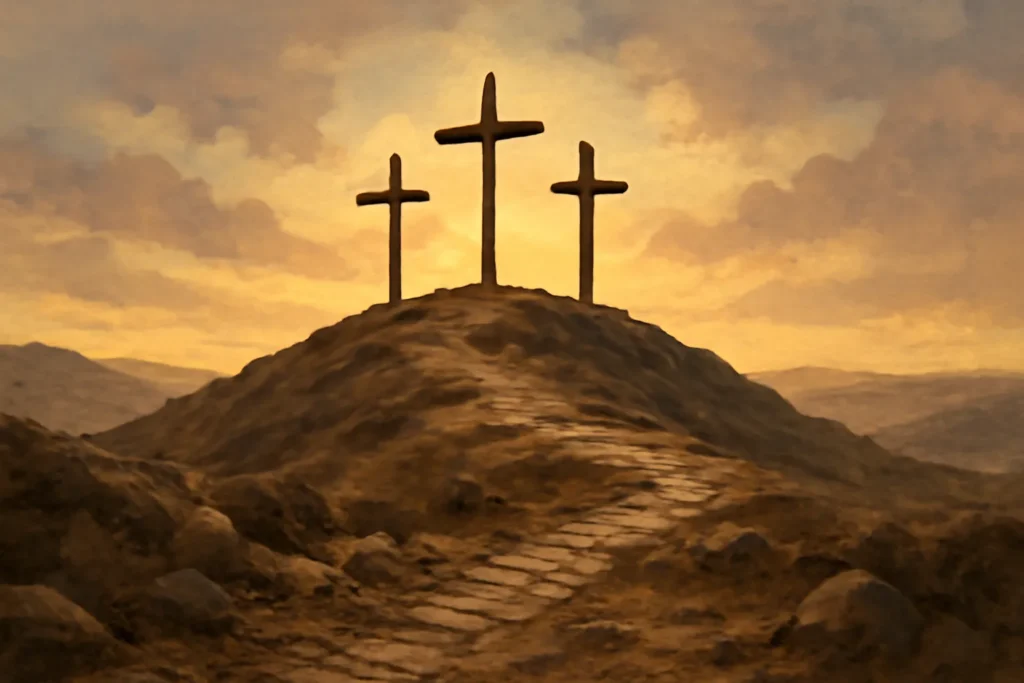
Golgotha, also known in Western Christian tradition as Calvary, stands as one of the most enduring symbols in the story of Jesus. The phrase Crucifixion Location Golgotha invites a mix of theology, archaeology, and historical geography. For centuries, scholars, believers, and travelers have asked where exactly this pivotal event took place, how the site came to be venerated, and what the name itself reveals about the landscape and culture of ancient Jerusalem. This article offers a comprehensive overview of the crucifixion location commonly identified with Golgotha, examining name origins, biblical references, topography, historical developments, competing theories, and the modern significance of the site.
The term Golgotha appears in the New Testament in a hybrid linguistic form that points to a linguistic intersection in Jerusalem’s ancient milieu. In the biblical languages—Hebrew and Aramaic—the hill is described using terms that convey the idea of a hill associated with skulls or death. In the Gospel accounts, the place is described as "the place called Golgotha," or as "the Place of the Skull." The exact wording varies slightly between the Greek texts, but the sense is persistent: the site bore a name associated with death and skulls, either by memory, symbol, or a visual cue in the landscape.
The term Calvary is a Latin rendering—calvaria—that became common in Western Christian tradition. In English, Calvary became a standard designation for the hill of the crucifixion and, by extension, for the narrative surrounding Jesus’ death. The English usage owes much to medieval and post-medieval religious writers who translated biblical language into vernacular forms that could be preached about, inscribed on monuments, or recited in liturgy.
Over time, the vocabulary of the location expanded to include variations such as Skull Hill or references to the landscape as seen by visitors. In scholarship and popular writing, scholars often distinguish among the toponymic layers: the ancient Hebrew/Aramaic name for the hill, the Greek New Testament renditions, and the Latin/vernacular terms that entered church history. All of these terms point to a single site with a powerful narrative weight, while also signaling the way language travels across cultures and eras when describing sacred geography.
Golgotha in biblical narratives
The crucifixion accounts in the Gospels
The crucifixion of Jesus is narrated in the four canonical Gospels, each offering a distinctive emphasis while converging on the core event and its location. Central to the story is the moment when Jesus is led to a hill outside the city walls to endure crucifixion, an execution method used by the Roman state.
Matthew and Mark describe the place as "Golgotha, which is called Place of a Skull," highlighting the naming and its significance within the narrative of rejection and suffering.
Luke speaks of the place as "the place that is called the Skull," reinforcing the symbolic and possibly literal association with skull imagery.
John emphasizes the geography by noting that Jesus was crucified near a city gate on a hill identified with the Skull, a location that would be well within the consciousness of first-century Jerusalem residents.
Across these accounts, the crucifixion location is not merely a backdrop; it functions as a powerful symbol of sacrifice, shame, and ultimate triumph. The repeated reference to a hill associated with death and skulls suggests a place that carried the memory of the deceased, a site appropriate for a public execution and for which early followers would seek to remember and reinterpret the event in liturgy, art, and preaching.
The biblical narrations also raise interpretive questions about space and proximity to the city. Outside the ancient walls, the hill would be visible from a distance, and the surrounding terrain—slope, rock, and roads—would shape both the experience of the crucifixion and the later veneration of the location. In later Christian memory, these features were consolidated into a single sacred geography: a hill outside the city, marked by a tomb and the crucified figure, and then integrated into a broader program of pilgrimage and sanctification.
Geography and topography: how the landscape shaped memory
Jerusalem’s hilly terrain and the placement of Golgotha
Jerusalem sits on a ridge of hills, with a landscape that includes several elevations near and around the historic core. The identification of a single hill as the Golgotha of the crucifixion hinges on both topographical description and devotional tradition. In the biblical era, the hill would have been situated just beyond the city walls, in the kind of setting where public executions were often staged near a thoroughfare, so that the punishment carried a visible warning to travelers and residents alike.
The landscape of the Holy City evolved over centuries, with walls expanding and shifting as the city grew, and sanctuaries rising where later medieval complexes would be built. The most enduring identification of Golgotha in Christian history is now the hill that stands within the precincts of the Church of the Holy Sepulchre in the Old City, a site that functions simultaneously as a place of burial, a place of prayer, and a locus of sacred memory. However, geography and topography also fed ongoing debates about whether this hill corresponds to the biblical Golgotha in its ancient form or whether the memory of the site shifted over time to other nearby elevations that lay outside older, larger walls.
In addition to the topographic questions, scholars consider how to interpret the phrase Place of the Skull. Some propose that the skulls of executed criminals might have been displayed on the hill as a grim reminder of capital punishment. Others suggest a symbolic link—perhaps the shape of the hill or a later cultural association with death—that was absorbed into a larger sacred narrative. The evidence does not settle every question, but it does illuminate how geography integrates with ritual memory to produce a site that could be distinguished, revered, and revisited by successive generations.
Early Christian tradition and the emergence of the site as a place of memory
From early worship to a recognized pilgrimage site
The earliest Christian communities treated the hill of execution not merely as a historical fact but as a locus of sacred memory. The crucifixion, burial, and resurrection formed a compact sequence that believers perceived as an act of salvation, accessible through contemplation at a location associated with each of these events. Over time, the memory of Golgotha evolved from a scattered oral tradition into a physical geography inside Jerusalem’s urban space.
As the church grew in the centuries after the crucifixion, Christians began to identify specific places where these events occurred and to venerate them. The cross and the tomb—both tied to the hill outside the ancient city—became central to Christian devotion. The memory of Golgotha was carried into liturgy, hagiography, and art, reinforcing a sense that the site was not only a historical marker but also a spiritual symbol that could be encountered through prayer, ritual, and the performance of the sacred narrative.
The association between Golgotha and a tomb took on added significance as the early church constructed spaces for worship near these sacred rock-cut places. In many Christian traditions, the tomb on Golgotha’s slopes or in the same vicinity became an anchor for the veneration of Jesus’ death and resurrection. This integration of narrative and space laid the groundwork for later church architecture and pilgrimage routes that would attract visitors from across the Mediterranean world and beyond.
From Constantine to the medieval period: the church and pilgrimage
The sanctuary that shaped a centuries-long tradition
A major turning point in Golgotha’s history came with the rise of imperial Christianity in the late antique world. The Empress Helena reportedly traveled to Jerusalem in the early 4th century under the auspices of Emperor Constantine to locate sites connected with Jesus’ life, death, and resurrection. According to tradition, Helena identified the location of the crucifixion and the tomb and sponsored the construction of sacred buildings to honor these places. This marked the transition from a largely oral, local memory to a recognized, monumental pilgrimage landscape.
The construction of the Church of the Holy Sepulchre during the 4th century became the most enduring symbol of this transformation. It united two of the central sacred spaces associated with the crucifixion and burial: Golgotha and the tomb itself. From that moment, travelers, pilgrims, and later conquerors approached the site as a destination that wedded doctrinal significance with architectural splendor. The church complex would be rebuilt and expanded multiple times in the medieval period, becoming a magnet for religious devotion, theology, and art.
Within centuries, the sacred geography of Jerusalem was deeply interwoven with Christian identity in both the Eastern and Western traditions. The sacramental life of the church, pilgrimage narratives, and devotional practices continued to refer to Golgotha as a key location, often invoked in liturgy, sermons, and iconography. The hill’s image—crucified savior above the city, near a grave—became a relentless symbol of divine love and human suffering that could be contemplated through ritual and contemplation.
Competing identifications and scholarly debates
Other proposals and the ongoing discussion
Despite the traditional identification of Golgotha with the hill inside the Church of the Holy Sepulchre, scholarly debate has persisted about the exact site of the crucifixion. Several competing identifications have been proposed over the centuries, each reflecting different interpretations of ancient texts, travel accounts, and topographical clues.
Garden Tomb and a nearby hill: In the 19th and 20th centuries, a site outside the Old City, sometimes marketed as the Garden Tomb, was proposed as an alternative Golgotha. Proponents emphasized its natural setting and tomb-like features, though it lacks some of the historical connections that anchor the traditional site in the Christian imagination.
Gordon’s Calvary (or Gordon’s Golgotha): Named after General Charles Gordon, who conducted inspections in the 19th century, this proposal posits a hill outside the ancient walls as the true Golgotha. Supporters argue that this location fits certain early writings about the site’s distance from the city and its visibility to passersby, though mainstream scholarship has remained cautious about relocating the site from its long-standing focal point.
Other hillocks and ridges near Jerusalem: Some proposals suggest alternative elevations in proximity to the Old City, attempting to reconcile the Gospel geography with archaeological and literary clues. These theories often reflect a broader question about how sacred memory can move over time while maintaining a credible link to historical events.
The debate is not merely academic; it shapes perceptions of sacred space, the authority of tradition, and the ways in which pilgrims encounter holy memory. While the Church of the Holy Sepulchre remains the most widely accepted and extensively venerated site associated with Golgotha in the Christian world, the existence of alternative theories demonstrates how interpretive frameworks—textual interpretation, historical geography, and devotional priorities—combine to keep the question alive in scholarly and popular discourse.
Archaeology, historiography, and the limits of certainty
Evidence, methods, and the challenges of sacred geography
Archaeology in Jerusalem presents a complex picture when it comes to Holy Sepulchre and Golgotha. The site sits within a densely layered urban landscape that has undergone repeated rebuilding, destruction, and renovation. Excavation within and around the Church of the Holy Sepulchre is constrained by the religious sensitivity of a site sacred to multiple faiths. Because of these constraints, large-scale, open-area excavations are limited, and much of what is known about Golgotha rests on a combination of historical sources, limited stratigraphic data, architectural analysis, and careful interpretation.
Historians and archaeologists study the broader urban topography of ancient Jerusalem—the edges of the city walls, gate orientations, and the routes people would have used to approach the city from surrounding countryside—to illuminate how a crucifixion site might have been perceived in antiquity. They also examine early Christian inscriptions, church plans, and art that reflect the memory of Golgotha and its association with the passion of Christ. In some cases, discoveries at the periphery of the church complex reveal tombs, ritual spaces, or rock-cut features that contribute to a richer picture of the sacred landscape.
The limits of certainty about Golgotha’s precise ancient position do not undermine its historical importance. The convergence of textual testimony, early liturgical practice, and long-standing devotional tradition creates a robust historical and cultural argument for the site’s central role in Christian memory. Yet scholars remain attentive to the complexities of urban change, religious competition, and the way memory can village at times in space as much as in time.
The vocabulary of the crucifixion site reflects a history of transmission across languages and centuries. The word Golgotha roots itself in the Aramaic or Hebrew milieu; the Greek New Testament later preserves the term in a form that would be read by early Christian communities. The Latin tradition—especially through the Vulgate—made Calvary a standard designation in Western Christianity. As Christian communities spread across Europe, the term Calvary entered common usage in sermons, hymnography, and devotional literature.
The shift from a local place name to a liturgical and doctrinal symbol demonstrates how terms evolve as religious culture expands. Words that once described a specific hill become lenses for interpreting a pivotal moment in salvation history. In contemporary usage, both Golgotha and Calvary are widely understood, though the preference for one term over the other can signal different historical or theological emphases.
Today, the traditional Golgotha—the hill that forms part of the Church of the Holy Sepulchre complex—continues to operate as a living monument. Pilgrims from around the world visit not only to recall the crucifixion but to engage with the broader narrative of Jesus’ passion, burial, and resurrection. The site also functions as a locus of ecumenical encounter, as Christian communities of diverse traditions share space within a building that is simultaneously a church, a tomb, and a shared memory.
In addition to religious worship, Golgotha has inspired a vast array of cultural expressions. Art, literature, music, and film have repeatedly returned to the image of the hill outside the ancient city, a symbol of sacrifice and hope. The narrative of the crucifixion, centered on the memory of the place, invites contemplation of themes such as justice, mercy, and redemption—universally resonant ideas that cross religious boundaries.
The modern pilgrimage experience often combines spiritual practice with historical inquiry. Visitors may follow guided paths around the church complex, hear accounts of Constantine-era renovations, and reflect on the layering of centuries of devotion that have shaped how Golgotha is perceived in different eras.
Visiting Golgotha today: practical notes for travelers and researchers
How to approach a site with deep history
Respect and sensitivity: Golgotha is a sacred site for multiple faiths. Visitors should observe quiet, respectful conduct, and follow local guidelines when entering the church precincts.
Dress and conduct: Modest dress is commonly expected, and photography policies may vary by chapel or area within the church complex.
Access and hours: The Church of the Holy Sepulchre has a long history of open hours but may adjust routines for religious observances or maintenance. Check current schedules before planning a visit.
Interpreting the space: A visit combines devotional significance with historical curiosity. Expect a layered experience that blends centuries of worship with modern religious practice.
Complementary sites nearby: For many pilgrims and scholars, the broader Old City offers additional connections to the passion narrative, including other churches, chapels, and historical sites linked to early Christian memory.
The crucifixion location commonly associated with Golgotha remains a focal point of Christian memory and a meaningful site for people of many faiths who study the history of Jerusalem. Whether one emphasizes its topographic character, its theological meaning, or its role in shaping pilgrimage traditions, Golgotha stands as a complex intersection of geography, belief, and cultural memory. The ongoing conversation about where precisely the crucifixion occurred should be understood not as a dispute that denies faith, but as a reflection of how sacred history is read, reinterpreted, and preserved across generations.
In closing, the historical overview of Golgotha—often called Calvary—reveals a site whose significance extends far beyond a single event. It is a place where geographic space, religious devotion, and historical memory meet. The enduring attention paid to Golgotha across continents, centuries, and communities testifies to a human longing to locate, remember, and interpret one of the most influential moments in world history. Whether approached as a historical question, a theological symbol, or a destination for personal reflection, the crucifixion location remains a vivid case study in how sacred space is created, preserved, and reimagined through time.







Leave a Reply