Mount of Calvary: Location, meaning, and biblical history
Mount of Calvary: Location, meaning, and biblical history
Mount of Calvary is the traditional Christian name for the place where Jesus was crucified. It is also called Golgotha, a name associated with the Aramaic expression for “place of the skull.” Most Christian tradition identifies Calvary with a rocky outcrop inside Jerusalem’s Church of the Holy Sepulchre, although the exact appearance and boundaries of the ancient site remain uncertain.
Calvary was probably not a high mountain in the modern sense. The name “mount” reflects its religious importance and the elevated rocky ground associated with the crucifixion. To understand the site, you need to consider the Gospel accounts, Jerusalem’s first-century landscape, Christian pilgrimage traditions, and the difference between historical evidence and later devotional language.
In Christian usage, Mount of Calvary refers to the place of Jesus’ crucifixion outside the walls of Jerusalem. The New Testament uses the name Golgotha rather than describing it as a large mountain. The Latin form, Calvaria, gave English its word “Calvary.”
The Gospel of Matthew, Mark, and John identify Golgotha as the place where Jesus was executed. Luke also describes the crucifixion but uses the phrase “the place called the Skull” in many English translations. These accounts place the event near Jerusalem and connect it with a tomb in which Jesus was later buried, though each Gospel emphasizes different details.
Calvary therefore has two related meanings. Geographically, it is a location associated with the crucifixion. Spiritually, it represents Jesus’ suffering, death, self-giving, and the Christian belief that his resurrection followed shortly afterward.
Important distinction: “Mount of Calvary” is a traditional devotional expression, not proof that the crucifixion took place on a tall mountain. The ancient site was more likely a rocky rise or exposed area near Jerusalem.
Where Mount of Calvary is believed to be
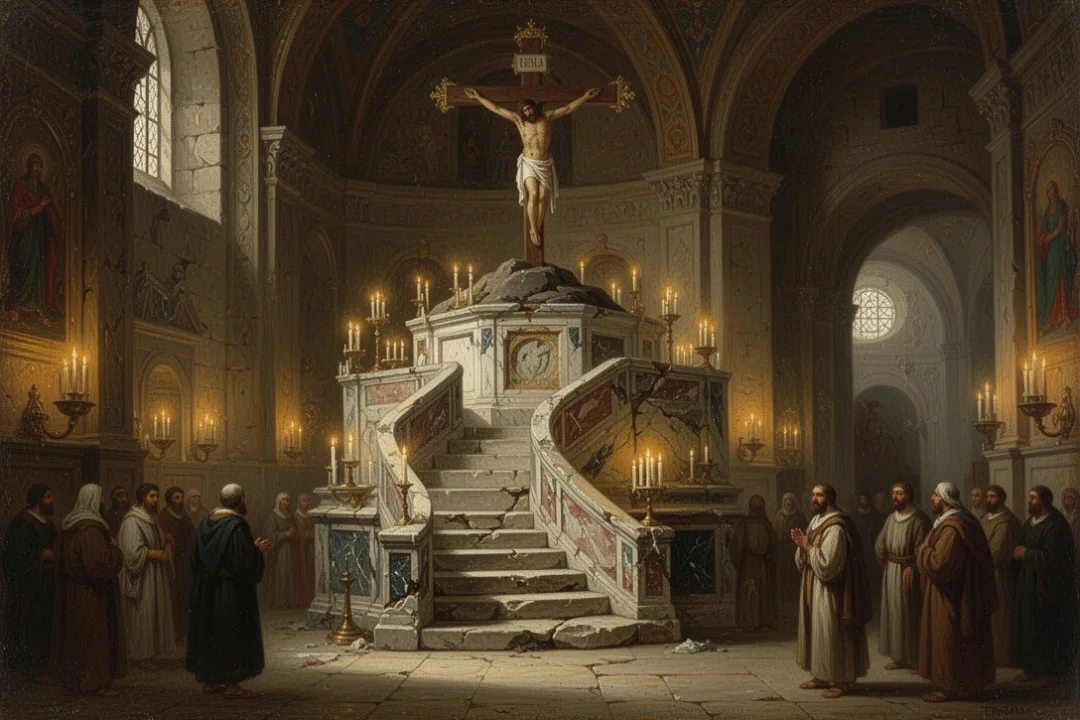
The traditional location of Calvary is within Jerusalem’s Church of the Holy Sepulchre, in the Christian Quarter of the Old City. The church stands over locations traditionally associated with both the crucifixion and Jesus’ burial. Inside, a raised chapel marks the rock traditionally identified as the place of the cross.
Visitors generally reach the traditional Calvary site by climbing a short, steep staircase inside the church. The upper area is divided into spaces associated with different Christian communities. Beneath an altar, a small opening allows pilgrims to touch or see part of the exposed bedrock that tradition connects with the cross.
The location may seem surprising because the church is now surrounded by dense city streets and religious buildings. Jerusalem’s walls and neighborhoods changed repeatedly after the first century. The modern setting does not show what the area looked like when Jesus was crucified.
Some Christians have preferred another proposed location, often called Gordon’s Calvary or the Garden Tomb area. This rocky escarpment lies north of the Old City and has features that some observers have interpreted as resembling a skull. Many Protestants have found the setting meaningful for worship, but the identification is not universally accepted and developed much later than the Holy Sepulchre tradition.
How to understand the location step by step
Several pieces of information help explain why the traditional site is taken seriously, even though absolute certainty is impossible. Consider the evidence in this order:
Start with the Gospel setting. Jesus was crucified outside Jerusalem, at a place known as Golgotha or the place of the Skull.
Look for a site near an ancient road. Roman executions were often public and visible, so a location outside the city near a route would fit the general historical setting.
Check the relationship to a tomb. The Gospel accounts connect the crucifixion site with a nearby burial place, which is significant when evaluating proposed locations.
Compare Jerusalem’s changing boundaries. A place outside the city in the first century could later stand inside the city after new walls and development were built.
Examine the early Christian memory. Christian communities continued to associate the area of the Holy Sepulchre with Jesus’ death and burial.
Separate evidence from tradition. A site can have a strong and ancient tradition without every detail of its present appearance being historically demonstrable.
This approach avoids two common errors. One error is assuming that a location must be rejected because the church now stands inside the Old City. The other is treating a traditional identification as if archaeology had proved every event occurred at the exact spot marked by a modern altar.
Why the Church of the Holy Sepulchre is connected with Calvary
The Church of the Holy Sepulchre is associated with several locations described or implied in the Passion narratives. Its traditional boundaries include Calvary, the place of Jesus’ burial, and the tomb connected with the resurrection. This concentration of sacred places explains why the church has been one of Christianity’s most important pilgrimage destinations for centuries.
In the first century, the area may have included abandoned quarry ground, rock-cut tombs, and open land outside Jerusalem’s walls. Quarrying could leave isolated rocky surfaces, while nearby tombs would fit the practice of burying the dead close to the city but outside its populated center. Over time, the landscape was altered by construction, destruction, and rebuilding.
Early Christians did not always have uninterrupted access to the site. Jerusalem experienced major political and religious changes, including the destruction of the city in the first century and later Roman building projects. A prominent Christian shrine was eventually established over the traditional locations, and later churches were built, damaged, and restored there.
The present church is therefore not a preserved first-century landscape. It is a layered building containing architectural remains from different periods. Its importance comes from the combination of local geography, ancient Christian memory, archaeological features, and centuries of worship.
What the Bible says about Golgotha
The four Gospels describe Jesus being taken to the place called Golgotha, where he was crucified with others. Matthew 27, Mark 15, Luke 23, and John 19 all relate the crucifixion, but they do not provide a modern map reference or a detailed description of the ground.
The Gospel of John explains the name as connected with the “place of the Skull.” The wording has led to several interpretations. It may have described the physical appearance of a rocky site, referred to a place associated with executions, or preserved a traditional place-name whose original meaning was not fully understood by later readers.
The Gospel accounts also mention people seeing the crucifixion from a distance, passersby, religious leaders, soldiers, and a nearby burial place. These details support the picture of a visible execution site beyond the settled center of Jerusalem. They do not, however, identify the precise modern coordinates of the hill.
For Christians, the biblical importance of Calvary is not based only on geography. The crucifixion is presented as the decisive event of Jesus’ earthly ministry. Different Christian traditions explain its meaning in different ways, but commonly emphasize forgiveness, reconciliation with God, obedience, sacrificial love, and the defeat of sin and death.
Why it is called a mount when it may have been a hill
The word “mount” often carries a symbolic meaning in Christian language. A mount is a place of revelation, encounter, suffering, or divine action, so calling Calvary a mount highlights the significance of the event rather than giving a precise geological description.
Many familiar biblical names use “mount” for elevated locations that would not be called mountains by modern travelers. In religious art and worship, Calvary is frequently shown as a distinct hill with three crosses. That image communicates the crucifixion vividly, but it should not be mistaken for a measured reconstruction of first-century Jerusalem.
The terrain around ancient Jerusalem was uneven, with ridges, valleys, quarries, and rocky rises. Even a modest elevation could have made a public execution visible. Roman authorities had a practical reason to place crucifixions where people could see them: the punishment was intended to intimidate and display imperial power.
“Mount Calvary” is thus best understood as a theological and traditional name for the crucifixion site. It does not require the location to resemble a large alpine peak or an isolated mountain outside the city.
How the traditional site differs from Gordon’s Calvary
The Holy Sepulchre and Gordon’s Calvary are the two locations most often discussed by visitors who want to identify the place of Jesus’ crucifixion. Both settings have religious significance, but they rest on different historical arguments and traditions.
The Church of the Holy Sepulchre: This is the older and more established Christian tradition. It lies within the Old City and contains a rocky elevation associated with Calvary and a tomb associated with Jesus’ burial.
Gordon’s Calvary: This is a rocky formation north of the Old City, near the Garden Tomb. Its appearance has encouraged the idea that it was the “place of the Skull,” and the garden setting allows for prayer and worship.
The surrounding archaeology: The Holy Sepulchre area has evidence of ancient quarrying and burial activity, while interpretations of the northern site depend heavily on how its rock features and tomb are dated.
The age of the tradition: The Holy Sepulchre identification reaches back much further in Christian history than the alternative identification connected with Gordon’s Calvary.
Choosing between them can depend on what question you are asking. If you want the location with the strongest historical Christian tradition, the Holy Sepulchre is generally the leading candidate. If you want a quiet setting for Protestant prayer and reflection, the Garden Tomb may be meaningful even if it is not the most likely historical location.
For visitors: You do not have to treat a pilgrimage site as certain in every detail to pray there sincerely. Respectful worship and careful historical judgment can exist together.
What the name Golgotha means
Golgotha is the name used in the Gospel accounts for the place of crucifixion. It is commonly explained as meaning “place of the skull,” though scholars have discussed the precise linguistic background and how the name was transmitted into Greek and Latin.
The phrase does not necessarily mean that skulls were scattered on the ground. Roman crucifixion sites could be associated with death and execution without becoming literal burial grounds for exposed bones. Jewish burial customs also complicate simplistic assumptions about how the site would have looked.
Some readers imagine that the site was named because a cliff resembled a human skull. That interpretation became especially popular because the northern rocky escarpment can look skull-like from certain angles. The Gospel wording alone does not prove that this was the reason for the name.
It is safer to say that Golgotha was a recognized place-name associated with death, execution, or a skull-like location. The biblical text preserves the name but does not provide enough information to settle every theory about its origin.
What Calvary means in Christian theology
Calvary stands at the center of Christian teaching about the Passion of Jesus. The word “Passion” refers to the suffering and death of Jesus, especially the events from his arrest through his crucifixion. When Christians speak of meditating on Calvary, they usually mean contemplating both the historical event and its spiritual meaning.
Different traditions use different theological language. Some emphasize Jesus’ sacrifice on behalf of humanity. Others focus on his victory over sin and death, his solidarity with suffering people, his perfect obedience, or the revelation of divine love. These approaches are not always expressed in identical terms, but they all treat the cross as central to Christian faith.
The crucifixion also connects Calvary with the Christian understanding of resurrection. The cross is not generally treated as an isolated tragedy. It is remembered alongside the empty tomb and the resurrection appearances described in the New Testament, so Christian worship often holds grief, hope, judgment, mercy, death, and new life together.
Calvary can also carry a personal meaning for worshipers. People may pray there or contemplate an image of the cross while grieving, seeking forgiveness, facing injustice, or trying to understand suffering. That personal use does not replace historical questions, but it explains why the name remains powerful far beyond the physical site in Jerusalem.
What a visit to Calvary is like today
A visit to the traditional Calvary site takes place inside a large, complex church rather than on an open hillside. The Church of the Holy Sepulchre is shared by several Christian communities, each with responsibilities and customs connected to different parts of the building. Services, processions, maintenance, and visitor access can vary by day and season.
The traditional rock of Calvary is located above the main floor of the church. A staircase leads to chapels and altars associated with the crucifixion. Pilgrims may wait in line to approach the place traditionally connected with the cross, while other visitors observe the architecture, mosaics, lamps, icons, and exposed stone.
The atmosphere can be crowded and intense, especially during major Christian festivals. Visitors should dress respectfully, follow posted guidance, avoid blocking worshipers, and check current access information before traveling. Photography rules and opening arrangements may change.
The Garden Tomb offers a different experience. It is an outdoor worship and visitor site with a garden, a rock-cut tomb, and views toward the rocky escarpment often called Gordon’s Calvary. It is not administered as the same shrine as the Holy Sepulchre, and its peaceful setting appeals to many pilgrims regardless of their position on the historical debate.
How to study Calvary without confusing tradition and proof
Questions about Calvary involve several kinds of evidence, and each has a different limit. The Bible gives the earliest Christian accounts of the crucifixion. Archaeology can reveal ancient roads, walls, quarries, tombs, and layers of construction. Historical tradition shows which places Christians identified and visited over time.
None of these categories should be used carelessly. A later church does not prove that every present feature existed in the first century. On the other hand, the presence of a church built centuries later does not automatically invalidate the tradition behind it.
Ask what the source actually claims. A Gospel may identify Golgotha but not describe its exact shape.
Distinguish the original landscape from the modern building. Urban growth and construction can completely change how a site appears.
Compare proposed locations using several factors. Consider ancient walls, burial practices, roads, quarrying, and the age of the tradition.
Allow for uncertainty where the evidence is incomplete. Faithful conviction does not require inventing details that the sources do not provide.
Notice the difference between devotional images and archaeology. Paintings, crosses, and hill-shaped shrines express belief and memory, not always exact topography.
This balanced approach is especially useful when reading travel guides or watching videos that claim to have identified the precise site. Claims based only on the appearance of a rock, the shape of a cliff, or a modern local name are weaker than arguments that combine geography, ancient history, archaeology, and the continuity of Christian tradition.
Why Mount of Calvary still matters to readers today
People search for Mount of Calvary for different reasons. Some want to plan a pilgrimage, others are studying the Bible, and many are trying to understand why the cross occupies such a central place in Christian worship. The answer includes a physical location, but it cannot be reduced to a tourist landmark.
Calvary links the biblical story to a real city with a complicated history. It invites questions about Roman punishment, Jewish burial customs, Jerusalem’s walls, early Christian memory, and the way sacred places are preserved through changing political and architectural conditions.
It also gives Christians a concrete place associated with Jesus’ death. Even those who cannot visit Jerusalem may use the name Calvary in prayer, hymns, paintings, Holy Week services, and personal reflection. The site’s significance comes from the event it represents: the crucifixion as remembered in the Gospels and interpreted at the center of Christian faith.
The most careful answer is therefore both specific and modest: Mount of Calvary is traditionally identified with the rocky elevation inside the Church of the Holy Sepulchre in Jerusalem. The exact first-century appearance and location cannot be reconstructed with complete certainty, but the site remains the oldest and most widely recognized Christian candidate for Golgotha.
Frequently asked questions
Is Mount Calvary the same place as Golgotha?
Yes. Calvary is the Latin-derived name commonly used in English, while Golgotha is the name found in the Gospel accounts. Both refer to the place associated with Jesus’ crucifixion outside Jerusalem. “Calvary” became especially common in Western Christian worship, art, preaching, and devotional writing.
Can you see the original cross at Mount Calvary?
No. The cross used in Jesus’ execution has not been preserved as an identifiable historical object. At the traditional site, an altar and religious artwork mark the rock associated with Calvary. These features support prayer and remembrance, but they are not the original cross or a complete reconstruction of the crucifixion scene.
Is Calvary inside or outside Jerusalem?
The traditional site is inside Jerusalem’s Old City today, but it may have been outside the city’s walls during Jesus’ lifetime. Jerusalem expanded and its walls changed over the centuries. This is one reason the present location of the Church of the Holy Sepulchre does not necessarily conflict with the Gospel description of a place outside the city.
Why do some Christians prefer the Garden Tomb?
Some Christians prefer the Garden Tomb because it offers an outdoor setting, a rock-cut tomb, and a nearby cliff that can resemble a skull. The site is peaceful and well suited to worship. Its identification with the biblical Calvary, however, is a later proposal and is less firmly rooted in ancient Christian tradition than the Holy Sepulchre.









Leave a Reply