When you read a psalm that moves from confusion to confidence, you may notice the heading “of Asaph” and wonder who that person was. Asaph was a Levite worship leader connected with King David’s tabernacle worship, a musician, a prophetic singer, and the name associated with a group of important biblical psalms.
The Bible presents Asaph as more than a performer. He helped lead Israel in public worship, preserved a tradition of sacred music, and gave voice to difficult questions about injustice, suffering, prosperity, and God’s faithfulness. His psalms show that honest lament and genuine faith can belong in the same prayer.
Asaph appears during the period when David organized worship around the ark of the covenant. He was a Levite, the tribe assigned special responsibilities connected with Israel’s tabernacle and later temple service. First Chronicles names him as the son of Berachiah and identifies him among the leading musicians appointed for worship.
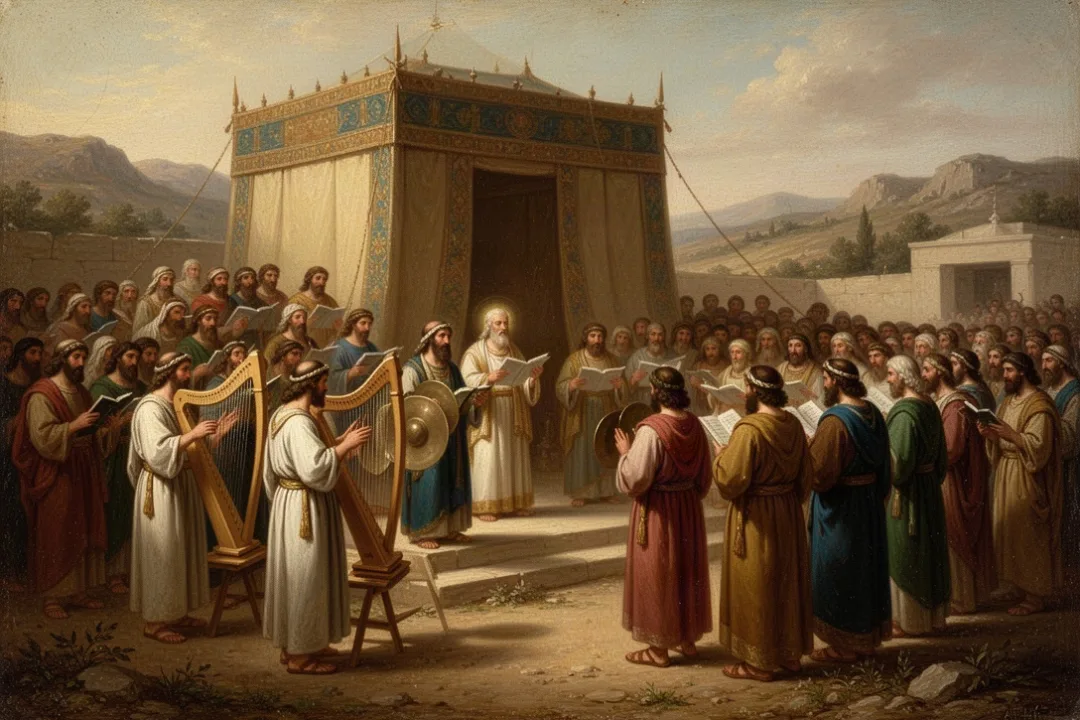
According to the biblical account, David assigned Asaph and other Levites to minister before the ark. Their duties included singing, playing instruments, and leading public praise. Asaph was not simply present in the worship assembly; he held a recognized leadership position among those responsible for helping the nation worship God.
First Chronicles describes Asaph alongside Heman and Jeduthun, who were prominent musical leaders. These men and their families served in organized groups, using instruments and songs in the worship of Israel. Their work shows that music was treated as a serious part of Israel’s spiritual life rather than as an occasional addition to religious ceremonies.
Important distinction: Asaph’s name refers both to a historical worship leader and to a later musical tradition associated with his family or school. A psalm labeled “of Asaph” may therefore reflect his own work, the work of his descendants, or a collection preserved under his name.
Asaph’s ministry continued beyond David’s lifetime. Later biblical passages connect the sons of Asaph with temple worship. Their presence in accounts of Israel’s worship and restoration suggests that Asaph’s influence became a continuing family and musical tradition.
His name also appears in the account of King Hezekiah’s religious reforms. When temple worship was renewed, the Levites sang praises using the words of David and Asaph the seer. This description calls Asaph a seer, a term that connects his musical ministry with spiritual insight and inspired proclamation.
What Asaph’s worship leadership involved
Asaph’s responsibilities likely included several connected tasks rather than one narrow role. The biblical descriptions point to a ministry that involved:
Leading singers and musicians in organized worship.
Performing before the ark and supporting national ceremonies.
Teaching or preserving songs used by Israel’s worshiping community.
Giving theological expression to praise, grief, confession, and trust.
Passing a musical and spiritual tradition to later generations.
This combination of music and spiritual instruction helps explain why the Asaph psalms often feel both personal and communal. They are not only private reflections. Many speak for the whole nation, remembering God’s acts, confessing Israel’s failures, or asking why a covenant people are suffering.
Which psalms are associated with Asaph
The Psalms identify a group of songs with Asaph’s name. These include Psalm 50 and Psalms 73 through 83. Together, they are commonly called the Asaph psalms. The headings connect them with Asaph, but the exact meaning of the phrase “of Asaph” can vary. It may indicate authorship, dedication, performance, collection, or membership in a continuing tradition.
Psalm 50 focuses on God’s judgment of empty religious practice. It challenges the assumption that sacrifices or outward ceremonies can substitute for genuine loyalty and thanksgiving. The psalm presents God as the judge of his people and calls them toward faithful worship rather than religious appearance.
Psalms 73 through 83 explore a wider range of concerns. Psalm 73 begins with the disturbing observation that arrogant and violent people can appear to prosper while faithful people suffer. The writer struggles with envy and confusion until worship changes his perspective and brings him into a clearer awareness of God’s presence and ultimate justice.
Other Asaph psalms remember Israel’s history and God’s repeated acts of mercy. Psalm 78 recounts the nation’s rebellion, forgetfulness, and repeated return to disobedience. Its purpose is not merely to list past failures. It teaches the community to remember God’s works and to instruct future generations.
Several of the psalms are communal laments. They describe national defeat, damaged sanctuaries, hostile enemies, or the apparent rejection of God’s people. Psalm 74 and Psalm 79 are examples of prayers that bring public catastrophe directly before God instead of hiding it behind polite language.
Psalm 80 uses the image of a vine to describe Israel as a people planted and cared for by God. The prayer asks God to restore and save his people. Psalm 81 combines celebration with a warning about Israel’s refusal to listen. Psalm 82 presents God’s judgment against unjust rulers, while Psalm 83 asks God to act against enemies threatening the community.
Major themes in the Asaph psalms
The apparent success of the wicked: Faithful people may struggle when injustice seems to prosper.
God’s holiness and judgment: Worship cannot be separated from moral integrity.
Memory and history: Recalling God’s past works strengthens present faith.
National suffering: The community can bring defeat, violence, and shame to God in prayer.
Restoration: Many prayers ask God to revive, rescue, or return to his people.
God’s presence: Nearness to God matters more than temporary circumstances.
Reading these psalms as a group reveals a distinctive voice. The Asaph tradition is willing to ask difficult questions while still addressing God as the covenant Lord of Israel. It does not treat doubt as the opposite of faith. Instead, it shows how confusion can be carried into worship and gradually reshaped by remembrance, presence, and trust.
Why Asaph’s psalms speak honestly about doubt and injustice
One reason readers continue to value Asaph is his refusal to pretend that faith removes every troubling question. In Psalm 73, the writer admits that his feet nearly slipped because he could not understand why the proud seemed secure. The problem is not presented as a detached philosophical puzzle. It affects his emotions, his view of God, and his sense of what it means to live faithfully.
The psalm’s movement matters. The writer first looks outward at other people’s apparent prosperity, then recognizes the damage that comparison is causing within him. He enters the sanctuary, where his understanding changes. The psalm does not claim that every painful circumstance immediately disappears. Instead, worship restores a larger vision of God’s justice and presence.
That pattern offers practical wisdom for readers who feel discouraged by unfair circumstances. Asaph does not advise ignoring evidence or silencing emotion. He brings his perception before God, reexamines it in the setting of worship, and remembers that present appearances do not tell the whole story.
A useful pattern for prayer: Name what seems unfair, describe how it is affecting you, remember what you know about God, and ask for wisdom instead of forcing a quick answer.
The Asaph psalms also show that public suffering deserves public language. When a nation faces invasion, humiliation, or destruction, the community needs more than private encouragement. These songs provide words for grief and protest while keeping the people oriented toward God as their defender and judge.
At the same time, the psalms do not reduce faith to emotional release. They repeatedly return to memory: what God did in the past, how God guided the ancestors, and how earlier generations saw divine power. Remembering is an act of resistance against despair because it prevents the present crisis from becoming the only truth a person can see.
Asaph’s writing also challenges shallow ideas about worship. Psalm 50 emphasizes that God does not need human offerings as though he were dependent on them. The proper response is thanksgiving, obedience, and trust. This does not make worship less important. It shows that worship must express a real relationship with God rather than merely maintain an external routine.
How Asaph’s legacy continued after David
Asaph’s importance did not end with the songs connected to his name. The Bible repeatedly refers to his descendants or musical associates as the sons of Asaph. They appear among the temple singers and among those who returned to Jerusalem after the exile. Their presence indicates that worship leadership was transmitted through an established tradition.
When the exiles returned under leaders such as Zerubbabel, lists of temple personnel included singers identified with Asaph. This detail matters because it shows continuity. Even after the destruction of Jerusalem and the temple, the community preserved the identity and responsibilities of its worship leaders.
The sons of Asaph also appear in the rebuilding and dedication of Jerusalem’s wall in the time of Nehemiah. Their involvement shows that music remained part of public restoration. Rebuilding the community was not limited to walls, administration, or defense. It also involved recovering the practices that expressed Israel’s identity before God.
Later, during Hezekiah’s reforms, Levites connected with Asaph participated in renewed temple worship. The reforms included cleansing the temple, restoring sacrifices, arranging musicians, and encouraging the people to worship. Asaph’s name therefore became associated with renewal after spiritual neglect.
This legacy offers a broader picture of biblical leadership. A person’s influence may continue through songs, students, family members, institutions, and shared practices. Asaph’s work was not remembered only because of a personal biography. It endured because the worshiping community continued to use and develop the tradition associated with him.
Asaph, authorship, and the meaning of a psalm heading
Readers sometimes ask whether Asaph personally wrote every psalm bearing his name. The safest answer is that the biblical headings associate those psalms with Asaph, but they do not give enough information to settle the authorship of every individual song in the modern sense.
Ancient communities used names in several ways. A name could identify the composer, the performer, the person to whom a song was entrusted, or the tradition in which it belonged. Because the Asaph psalms include reflections on events and conditions from later periods, many scholars understand “Asaph” as referring at least in part to a continuing school or guild of worshipers descended from or connected with the original leader.
That uncertainty does not weaken the psalms’ value. It highlights the communal nature of biblical worship. These songs were preserved, performed, adapted, and handed down so that later generations could pray with the same theological depth. The central question is not whether every line can be assigned to one individual, but how the tradition faithfully teaches people to approach God.
What Asaph teaches about worship and spiritual life
Asaph’s story connects several parts of faith that are often separated. He was a musician, but his work was also theological. He led public worship, yet his psalms gave language to deeply personal struggles. He celebrated God’s goodness while confronting national failure and apparent injustice.
His example suggests that worship should tell the truth. A worshiping community needs songs of praise, but it also needs prayers of grief, confession, protest, and hope. The Asaph psalms make room for all of these without treating them as unrelated forms of spirituality.
They also show why worship requires formation. Asaph’s concern with memory means that songs teach people how to interpret their lives. When a community repeatedly sings about God’s creation, rescue, judgment, mercy, and faithfulness, those truths become part of how it understands hardship and responsibility.
Asaph further demonstrates that spiritual leadership includes helping people face uncomfortable realities. He does not flatter the community or promise that faithful people will avoid pain. Instead, he calls attention to injustice, disobedience, forgetfulness, and the danger of relying on outward religion.
For personal prayer, you can use the pattern found throughout the Asaph psalms:
Describe the situation plainly. Say what you see, what happened, and why it troubles you.
Name the emotional effect. Confusion, envy, grief, anger, and fear can be brought honestly before God.
Recall God’s character and past works. Memory helps place the present crisis in a larger frame.
Ask for restored perspective. Pray for wisdom, justice, endurance, and a deeper awareness of God’s presence.
Choose faithful action. Let worship lead toward integrity, compassion, and obedience rather than passive frustration.
Asaph also reminds worship leaders that technical ability is not enough. Music can be skillful and still lack truth. His tradition joins artistic excellence with spiritual seriousness, asking songs to shape the hearts and understanding of the people who sing them.
His legacy remains especially useful when circumstances seem to contradict what you believe about God. The Asaph psalms do not offer a simple formula for explaining suffering. They offer something more durable: permission to speak honestly, a discipline of remembering, and confidence that God’s presence is not limited to seasons of visible success.
Asaph was therefore both a historical Levite and a lasting voice in Israel’s worship. His name represents a ministry of music, teaching, lament, and hope. Through the psalms associated with him, readers are invited to bring difficult questions into God’s presence without abandoning faith or pretending that injustice is acceptable.
Frequently asked questions
Was Asaph a prophet or a musician?
Asaph was primarily known as a Levite musician and worship leader, but 2 Chronicles also calls him a seer. That title suggests that his songs carried spiritual insight and proclaimed truth about God, worship, justice, and Israel’s condition. His ministry combined musical leadership with a prophetic concern for the community’s faithfulness.
How many Psalms are attributed to Asaph?
The Psalms traditionally associated with Asaph are Psalm 50 and Psalms 73 through 83, making twelve psalms altogether. The wording of the headings does not necessarily mean Asaph personally wrote every line. It may also refer to a musical guild, family, collection, or tradition connected with his name.
What is the main message of Psalm 73?
Psalm 73 addresses the confusion caused by seeing arrogant or wicked people prosper while faithful people suffer. The writer nearly loses confidence, but worship restores his perspective. He comes to value closeness to God above temporary prosperity and trusts that present appearances do not determine the final meaning of justice.
Where else does Asaph appear in the Bible?
Asaph appears in accounts of David’s worship organization, temple reforms under Hezekiah, and the restoration period after Israel’s exile. The “sons of Asaph” are identified as singers and temple servants. These references show that Asaph’s influence continued through a recognized family or musical tradition long after his original ministry.











Leave a Reply