Who is Korah in the Bible? His rebellion explained
Who is Korah in the Bible? His rebellion explained
When you read about Korah, you may wonder why someone from Israel’s own priestly family would oppose Moses and Aaron. The short answer is that Korah was a Levite who led a public challenge against the leadership God had established during Israel’s wilderness journey. His revolt is recorded mainly in Numbers 16, where it becomes a serious dispute about authority, holiness, and who had the right to serve before God.
Korah was not an outsider or an ordinary observer. He belonged to the family of Kohath, a respected branch of the tribe of Levi, and he had responsibilities connected with the tabernacle. His position gave him status, but his ambition appears to have made him dissatisfied with the limits God had assigned to him.
Short answer: Korah was Moses’ cousin and a Kohathite Levite who rebelled against Moses and Aaron, claiming that the whole community was holy and that they had taken too much authority. God judged the rebellion, but the Bible also says Korah’s sons survived and later served faithfully.
Korah’s family line is given in Exodus 6:18 and 6:21. He was the son of Izhar, the son of Kohath, the son of Levi. Since Moses and Aaron were also descendants of Levi through Kohath, Korah was part of the same extended family as Israel’s leaders. This family connection helps explain why his challenge was especially serious: he was opposing people from his own clan and leadership group.
Levi’s descendants were set apart for service connected with the tabernacle. The Kohathites carried some of the sacred furnishings when Israel traveled, although they were not permitted to look at or touch those objects casually. Numbers 4 describes their duties and restrictions. Korah therefore had a genuine ministry assignment, but it was not the same assignment given to Aaron and his sons, who served as priests.
The Bible presents Korah as the central figure in a rebellion that also involved Dathan and Abiram, descendants of Reuben, and 250 recognized community leaders. These groups may have had different complaints, but together they challenged Moses and Aaron. The account focuses on Korah because he was a Levite with a direct interest in the priestly authority held by Aaron.
Why Korah rebelled against Moses and Aaron
Korah’s accusation appears in Numbers 16:3. He and his supporters argued that the entire congregation was holy and that Moses and Aaron had elevated themselves above the people. The claim contained a partial truth: Israel was indeed called to be a holy people. The problem was that Korah used that truth to reject the particular roles God had assigned within the community.
The dispute was not simply about whether Israel belonged to God. It was about who could perform priestly duties and who had authority to lead the nation. Korah seems to have wanted a role beyond the one he had received. His words made the issue sound like equality and fairness, but the surrounding events show a desire to seize authority rather than faithfully carry out his existing responsibilities.
Dathan and Abiram added another complaint. They accused Moses of bringing the people out of a land of abundance only to make them suffer in the wilderness. They refused to meet Moses, describing his leadership as a failure. Their criticism reflected the wider frustration that had grown among the Israelites after repeated hardships and fearful reports about entering Canaan.
The rebellion therefore grew from several pressures:
Discontent with assigned roles: Korah wanted authority associated with priestly service, not only Levitical duties.
Resentment toward Moses: Dathan and Abiram challenged Moses’ leadership and questioned the direction of the exodus.
Public influence: The 250 leaders gave the movement credibility among the people.
Spiritual language: The rebels appealed to Israel’s holiness while resisting God’s appointed order.
Wilderness frustration: Ongoing hardship made the community vulnerable to accusations and division.
How Moses responded to Korah’s challenge
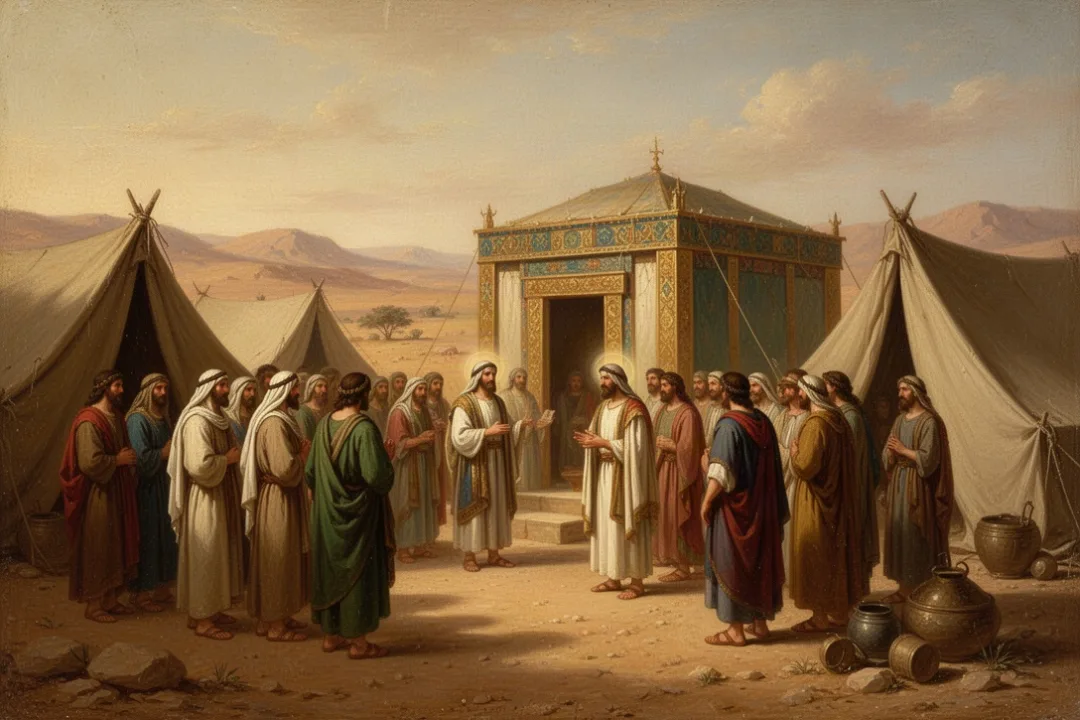
Moses did not answer Korah by simply appealing to his own personality or political position. Instead, he turned the matter toward God’s decision. He instructed Korah and the 250 leaders to take censers, place incense in them, and appear before the Lord. Aaron would also come with his censer. The test would reveal whom God had chosen for priestly service.
This response shows that Moses understood the conflict as a challenge to divine appointment, not merely a disagreement between coworkers. The issue could not be settled by popularity, family connections, or personal claims. It required God to identify the people authorized to approach him in the priestly role.
Moses also confronted Korah’s misuse of his existing position. In Numbers 16, Moses reminds him that the Levites had already been brought near to God and given a special service. Korah’s problem was not that he had been ignored. He had been entrusted with meaningful work, but he considered that work insufficient because he wanted the honor belonging to the priesthood.
The account gives a practical distinction between being chosen for service and seeking status for yourself. Korah was close to the tabernacle and close to the priestly family, but proximity did not give him permission to claim Aaron’s office. Sacred work still required obedience to the boundaries God had established.
What happened when Korah and the rebels were judged
After the challenge, Moses warned the people to move away from the tents of Korah, Dathan, and Abiram. The judgment was dramatic. The ground opened and swallowed Korah’s household, possessions, Dathan, and Abiram, along with those connected with their rebellion. The account presents this event as a direct sign that Moses had not acted on his own authority.
The 250 leaders who had brought incense were judged separately. Fire came from the Lord and consumed them. Their censers were then collected, hammered into metal plating, and used to cover the altar. According to Numbers 16, this memorial reminded Israel that unauthorized people must not approach the altar as priests.
The next day, the congregation complained against Moses and Aaron, blaming them for the deaths of the people. That response revealed how deeply the rebellion had affected the community. A plague then began among the people. Aaron took incense and stood between the living and the dead, making atonement for the people, and the plague stopped.
These episodes are connected. First, the rebellion challenged the appointed leadership. Then, the people questioned the judgment and became vulnerable to further punishment. Aaron’s action also contrasts with Korah’s ambition: Aaron used priestly authority to protect the people, not to compete for prestige.
Read the judgment carefully: Numbers 16 distinguishes between the fate of the rebels and the fate of Korah’s sons. Numbers 26:11 specifically says that Korah’s sons did not die. The text does not support the idea that every later descendant of Korah was destroyed.
Did Korah’s sons die with him?
This is one of the most common questions about Korah. Numbers 16 describes judgment falling on Korah and his household, but Numbers 26:11 states that the sons of Korah did not die. Later passages identify descendants of Korah serving in worship and temple duties. The Bible therefore presents a distinction between Korah’s rebellion and the faithfulness of at least some members of his family.
Several psalms are associated with the sons of Korah, including Psalms 42, 44–49, 84, 85, 87, and 88 according to their superscriptions. The exact historical circumstances of each psalm are not always clear, but these headings connect them with a worshiping group descended from Korah. Their role included singing, worship, and possibly other responsibilities in Israel’s sanctuary.
First Chronicles 6 traces Levite families and identifies Korahite groups among the descendants of Kohath. First Chronicles 9 describes Korahites as gatekeepers, and Second Chronicles 20:19 mentions descendants of the Korahites praising God. These references show that Korah’s family line continued to have a place in Israel’s religious life.
That detail adds an important balance to the story. A family’s history does not determine every descendant’s choices. Korah’s sons were not praised for repeating his rebellion; they were remembered for serving God. The Bible holds together two truths: Korah was responsible for his revolt, and his descendants could still choose faithful service.
How the Bible uses Korah’s story as a warning
Korah’s rebellion is mentioned beyond Numbers 16. In Numbers 26, the event helps explain why the family records were being preserved and why the sons of Korah were an exception to the destruction. Psalm 106:16–18 recalls the rebellion as an example of jealousy against Moses and Aaron. The passage connects the rebels’ pride with God’s judgment.
The New Testament also refers to Korah. Jude 11 lists “the rebellion of Korah” alongside other examples of people who rejected God’s ways for corrupt or self-serving purposes. The reference assumes that readers know Korah as a model of defiant ambition and resistance to rightful authority.
These references do not mean that every question or disagreement with a leader is sinful. Moses himself was not above correction, and the Bible records leaders being confronted at various times. Korah’s error was more specific: he turned dissatisfaction into a campaign for authority, claimed a sacred office God had not given him, and persuaded others to join him.
The story warns against several attitudes:
Envy disguised as principle: A person may use the language of fairness while secretly wanting another person’s position.
Contempt for ordinary service: Korah’s existing responsibilities were significant, but he treated them as beneath him.
Group pressure: A respected leader can draw others into a harmful cause.
Selective truth: Israel’s holiness was real, but Korah used that truth to deny God-given distinctions.
Resistance to correction: The rebels received warnings, yet continued toward confrontation.
What Korah’s role as a Levite helps explain
Understanding the Levites makes Korah’s complaint easier to follow. After the exodus, the tribe of Levi was set apart for duties related to worship and the tabernacle. Within the tribe, however, there were different families and responsibilities. The descendants of Aaron served as priests, while other Levites assisted with transportation, guarding, music, and practical care for the sanctuary.
Korah was a Kohathite. The Kohathites carried some of the most sacred furnishings when the tabernacle moved, but they did so under strict instructions. They did not automatically become priests. The closeness of their duties to the holy objects may have made Korah feel entitled to more authority, but responsibility near sacred things was not the same as permission to perform every sacred function.
This distinction appears throughout the Old Testament. God’s people were organized with different callings, offices, and duties. A role could be honorable without being identical to another role. Korah’s failure was not simply wanting to serve God; he refused to accept the form of service assigned to him.
For readers today, the principle can be applied carefully. Churches, families, workplaces, and communities all have different responsibilities. A person may rightly question wrongdoing, but faithful service does not require controlling every role. The story asks whether a desire for justice is actually rooted in concern for others or in resentment over not receiving recognition.
How Korah differs from other biblical people named Korah
The name Korah refers to more than one person in the Bible. The best-known Korah is the Levite who rebelled against Moses in Numbers 16, but Genesis 36:5 and 1 Chronicles 1:35 mention an Edomite Korah, a son of Eliphaz and grandson of Esau. This person belongs to a different family and historical line.
There is also a Korah listed among the descendants of Hebron in First Chronicles 2:43, depending on how the genealogy is read and translated. Biblical genealogies can use the same names in different families, so a reference to “Korah” should always be read in its surrounding context.
When people discuss “Korah’s rebellion,” they mean the Levite in Numbers 16. When the name appears in a genealogy connected with Esau or Edom, it refers to a different individual. Keeping these people separate prevents confusion when comparing passages.
What the sons of Korah teach about family and responsibility
The later prominence of the sons of Korah is not a minor detail. It shows that the Bible does not treat guilt as an automatic inheritance. Korah made a deliberate choice, but his sons were not condemned to repeat it. They served as worshipers, gatekeepers, and singers, and their name became associated with prayers and songs directed toward God.
The psalms connected with the sons of Korah often express longing for God’s presence, confidence in divine protection, reverence for the temple, and hope in God’s kingship. Their worship gives a striking contrast to their ancestor’s rebellion. Korah tried to seize holy authority; his descendants are remembered for leading people in humble praise.
This does not erase the seriousness of what Korah did. The Bible keeps his rebellion as a warning while also recognizing the faithfulness of his descendants. Both parts matter. Past failure can shape a family’s history without controlling its future, and faithful service can become part of a family’s legacy after a previous generation has acted wrongly.
What Korah’s rebellion means for readers today
Korah’s story is often summarized as a warning against pride, but the details make the warning more useful. Pride can appear as an open demand for power, but it can also appear as a comparison with someone else, a refusal to accept limits, or an insistence that your gift entitles you to another person’s role.
The story also encourages honest examination of motives. A complaint may sound spiritual while being driven by jealousy. A call for equality may conceal a desire for control. A person may even gather legitimate grievances around a fundamentally self-serving goal. Korah’s example shows why motives and actions must be considered together.
At the same time, this passage should not be used to silence every concern about leadership. Moses’ authority was established in a particular covenant setting, and modern leaders are not automatically beyond question. Healthy communities should distinguish between accountable correction and destructive self-promotion.
Useful questions for reflecting on the story include:
Am I dissatisfied because something is genuinely wrong, or because someone else has recognition I want?
Can I value an important responsibility even when it is not public or prestigious?
Am I persuading others to pursue a just solution, or recruiting them into my personal resentment?
Do I respect legitimate boundaries while seeking needed change?
Would my actions protect the community, as Aaron’s intercession did, or divide it for my own advantage?
Korah was a Levite with access to meaningful service, a place within Israel’s worshiping community, and the standing to influence other leaders. His tragedy was not lack of opportunity. It was his refusal to receive his role as a gift and his attempt to claim authority that had not been given to him.
The story ends up being more than a record of an ancient dispute. It explains why humility matters in spiritual leadership, why sacred responsibility cannot be separated from obedience, and why a person’s descendants are not automatically defined by an ancestor’s rebellion. Korah is remembered for challenging Moses and Aaron, but the sons of Korah are remembered for worship. Together, those details make the biblical account both a warning about ambition and a reminder that faithful choices remain possible.
Frequently asked questions
Was Korah related to Moses and Aaron?
Yes. Korah, Moses, and Aaron were all descendants of Kohath, one of Levi’s sons. Korah was the son of Izhar, while Moses and Aaron were sons of Amram. This made Korah part of the same extended Levite family, which helps explain why his challenge involved a conflict within Israel’s leadership and worship structure.
What exactly did Korah want?
Korah wanted authority associated with the priesthood, which belonged to Aaron and his sons. He argued that the entire congregation was holy and accused Moses and Aaron of taking too much authority. His complaint was not merely a request for better treatment; it challenged the boundaries God had established among the Levite families.
How did Korah die in the Bible?
Numbers 16 describes the ground opening and swallowing Korah and those associated with his rebellion. The same chapter separately says that fire consumed the 250 leaders who offered unauthorized incense. Numbers 26:11 clarifies that Korah’s sons did not die, so later descendants could serve among Israel’s worshipers and temple workers.
Are the sons of Korah connected with the Psalms?
Yes. Several psalms carry superscriptions identifying them with the sons of Korah, including Psalms 42, 44–49, 84, 85, 87, and 88. These descendants appear to have served as worshipers or musicians. Their association with songs of prayer and praise contrasts with Korah’s rebellion and illustrates their own faithful service.











Leave a Reply