Who was Levi in the Bible? His family, tribe, and legacy
Who was Levi in the Bible? His family, tribe, and legacy
When you read that someone was a Levite, you may wonder whether that person was one of the twelve tribes, a priest, or a particular man named Levi. The answer begins with Levi, the third son of Jacob and Leah, whose descendants became Israel’s tribe dedicated to worship and religious service. His story also helps explain the roles of priests, temple workers, and teachers of the Law.
The Bible mentions more than one person named Levi. The most prominent Levi is the son of Jacob, also called Israel, and the ancestor of the tribe of Levi. A later Levi appears in the New Testament as a tax collector whom Jesus called, and many Christians identify him with Matthew, although the Gospel texts do not explicitly state that they are the same person.
Levi was born into the family that would become the nation of Israel. His father was Jacob, later given the name Israel, and his mother was Leah. Genesis lists Levi as Leah’s third son, after Reuben and Simeon and before Judah, Issachar, and Zebulun.
Leah’s naming of Levi reflects her hope that Jacob would become more attached to her. The name is connected with the idea of joining or being attached, according to the explanation in Genesis 29:34. Leah had experienced pain because Jacob loved Rachel more than her, so the names she gave her sons often expressed her longing for acceptance within the marriage.
Levi’s brothers included several figures who became central to Israel’s story. Judah became the ancestor of the royal line associated with David, while Joseph became the father of the tribes of Ephraim and Manasseh. Levi’s descendants received a different calling: they were set apart for service connected with the tabernacle and later the temple.
Levi and Simeon took part in the violence at Shechem
Levi first appears as an active participant in the troubling story of Dinah, his sister. Genesis 34 describes how Shechem, a local ruler’s son, sexually violated Dinah. Shechem’s family then sought to arrange a marriage between him and Dinah, but Levi and his full brother Simeon responded with a deceptive plan.
They persuaded the men of the city to undergo circumcision, presenting it as a condition for intermarriage and peaceful relations. While the men were recovering, Simeon and Levi attacked the city and killed the males. They also took property, livestock, women, and children, an act that brought lasting criticism from Jacob.
The account does not present the assault on Dinah as insignificant. At the same time, it does not approve of the brothers’ retaliation. Their response used a sacred sign as part of a deception and expanded punishment far beyond the original offender. Jacob objected that their actions had endangered the entire family among neighboring peoples.
Near the end of his life, Jacob spoke about his sons in Genesis 49. His words concerning Simeon and Levi recalled their anger and violence and declared that their descendants would be scattered in Israel. This statement becomes especially meaningful later, because Levi’s descendants did not receive one large territorial region like Judah or Ephraim.
A necessary distinction: Levi’s later role in Israel’s worship does not erase the violence recorded in Genesis 34. The Bible presents both the family’s serious failure and the way God later assigned Levi’s descendants a distinct responsibility.
How Levi became the ancestor of a priestly tribe
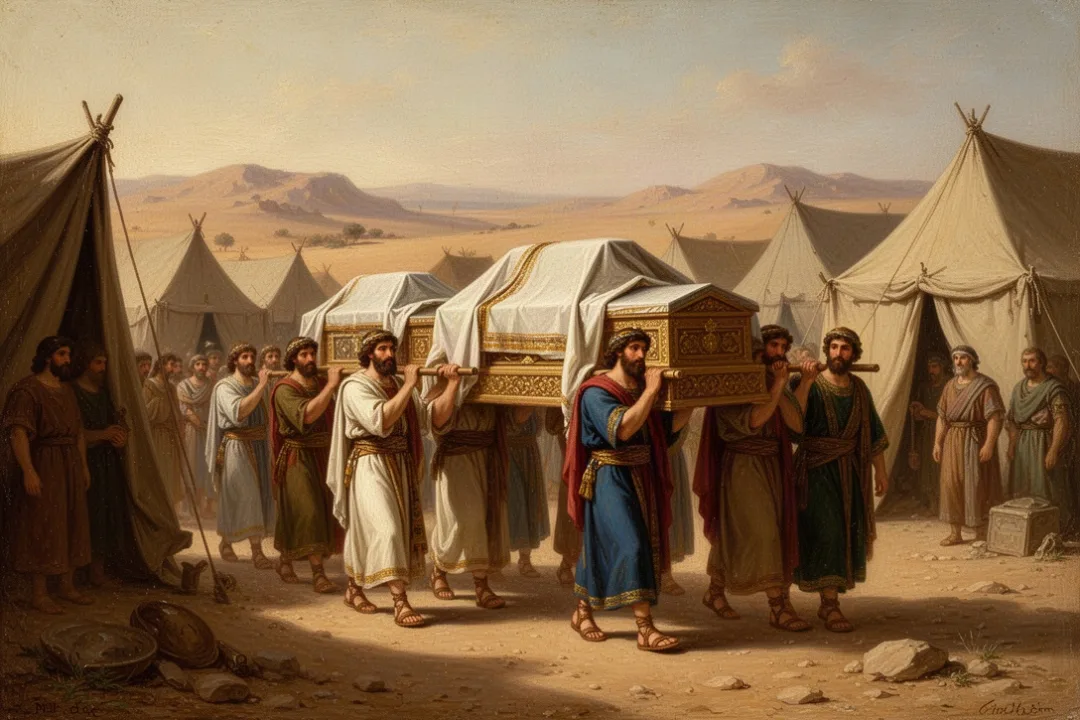
The tribe of Levi developed through Levi’s sons: Gershon, Kohath, and Merari. Their families were assigned different responsibilities connected with the tabernacle, the portable sanctuary Israel carried during its wilderness years. The Kohathite line became especially significant because Moses and Aaron descended from Kohath through Amram.
Aaron, Moses’ older brother, became Israel’s first high priest under the covenant given through Moses. Aaron’s sons served as priests, offering sacrifices and performing other duties at the sanctuary. This means that all priests were Levites, but not all Levites were priests.
That distinction matters when reading the Old Testament. A Levite could transport, guard, maintain, or assist with the tabernacle and temple without being authorized to perform every priestly function. The priesthood belonged specifically to the descendants of Aaron, while the wider tribe of Levi supported the worship system.
Numbers 3 describes the Levites as being taken in place of Israel’s firstborn. The explanation is tied to the firstborn being spared during the final plague in Egypt. Rather than every firstborn serving at the sanctuary, the Levites were assigned as a tribe to God’s service.
The tribe’s responsibilities changed as Israel’s worship center changed. During the wilderness period, Levites handled the tabernacle’s structure and furnishings according to their family groups. Once Israel settled in the land and the temple became the permanent center of worship, Levites served in areas such as singing, gatekeeping, teaching, administration, and assisting the priests.
What the Levites did in Israel’s worship
The Levites’ work was broad, but it was not simply a general label for religious leaders. Their duties were organized by family and period. Some responsibilities involved physical care of sacred objects, while others involved music, instruction, or practical administration.
Transporting the tabernacle: During Israel’s wilderness travels, Levite families carried and cared for designated parts of the sanctuary.
Guarding the sanctuary: Levites helped protect the tabernacle and later the temple, regulating access to sacred areas.
Assisting the priests: They supported Aaron’s descendants in the work of sacrifices and worship, though they did not all serve as priests.
Leading music: In the temple period, Levites were appointed as singers and musicians for public worship.
Teaching God’s law: Levites helped instruct the people in the covenant and its requirements.
Managing practical matters: Their responsibilities could include organizing contributions, maintaining facilities, and supporting temple administration.
First Chronicles and Second Chronicles give detailed examples of Levites serving as singers, gatekeepers, officials, and assistants. In the reforms of kings such as Hezekiah and Josiah, Levites played a major part in restoring worship according to the Law of Moses.
After the exile, the Levites continued to have an important role. Ezra and Nehemiah describe them helping teach the Law, supporting temple worship, and participating in the public renewal of the covenant. Their service was therefore not limited to the wilderness or to one specific building.
Why the tribe of Levi received cities instead of one territory
Unlike most tribes, Levi did not receive one continuous region as its inheritance. Numbers 18:20 presents God as the Levites’ inheritance, emphasizing their special service rather than agricultural ownership. This did not mean that individual Levites had nowhere to live or could not possess personal goods.
Joshua 21 records cities assigned to Levites throughout the territories of the other tribes. This arrangement placed religious workers among the wider population instead of isolating them in one district. It also made instruction and worship more accessible to Israelites living in different areas.
The Levite cities included cities of refuge, where a person who had unintentionally caused someone’s death could flee while receiving a legal hearing. These cities were not all exclusively occupied by Levites, but several were selected from the Levitical cities for this purpose.
Because the Levites were distributed among Israel, Jacob’s earlier statement about Levi being scattered took on a changed meaning. In Genesis, scattering is connected with judgment for violence. In Israel’s later structure, distribution throughout the land helped the Levites serve the whole nation.
How Levi’s story changed from judgment to service
The Bible does not describe Levi himself as a priest or present a detailed account of his personal religious life. His importance comes mainly through his descendants. That makes his story a useful example of how biblical family histories can include both failure and a later calling.
Jacob’s words in Genesis 49 are severe, but Moses later speaks positively about Levi in Deuteronomy 33. Moses praises Levi’s loyalty in a crisis and asks God to bless the tribe’s teaching and priestly service. Many readers connect this praise with the events at Mount Sinai after the people worshiped the golden calf.
In Exodus 32, Moses called for those who were loyal to the Lord to stand with him. The Levites responded and carried out judgment against those involved in the rebellion. The episode is morally difficult and should not be reduced to a simple model for ordinary religious behavior. Within the biblical narrative, however, it marks a moment when Levi’s descendants are associated with covenant loyalty.
The contrast between Genesis 49 and Deuteronomy 33 shows that Levi’s descendants were not trapped by the worst action associated with their ancestor. Their history included judgment, responsibility, correction, and service. Their later role did not make them flawless, but it did give their scattering a purpose within Israel’s life.
Levi, the Levites, and the priests are not identical terms
Several related words can create confusion. Levi is the name of Jacob’s son. A Levite is a member of the tribe descended from him. A priest is a Levite descended specifically from Aaron, the brother of Moses.
The New Testament sometimes mentions Levites in ways that assume this distinction. In Jesus’ parable of the Good Samaritan, both a priest and a Levite see an injured man on the road, but neither initially helps him. The story does not imply that every Levite was a priest; it names two different categories of temple-related religious personnel.
Jesus also criticized religious leaders who emphasized outward religious behavior while neglecting justice, mercy, and faithfulness. The New Testament’s concerns about priests and Levites should not be applied carelessly to every individual descendant of Levi. Biblical passages often address particular people, institutions, or behaviors rather than condemning an entire ethnic family.
Common mistakes when identifying Levi in the Bible
The name appears in more than one setting, so a few reading habits can prevent confusion. Pay attention to the family connections, the historical period, and the surrounding passage before deciding which Levi a verse means.
Do not assume every Levi is Jacob’s son. The New Testament uses Levi as the name of a tax collector associated with Jesus’ disciples.
Do not call every Levite a priest. Priests came from Aaron’s family within the wider tribe of Levi.
Do not treat Levi’s territory like Judah’s territory. The Levites received cities distributed among the other tribes rather than one unified tribal region.
Do not overlook Levi’s early failure. Genesis 34 is part of his story and helps explain Jacob’s later words about him.
Do not assume the Bible directly identifies Levi with Matthew. Mark and Luke name the tax collector Levi, while Matthew names a tax collector Matthew; traditional identification is strong, but the texts do not spell out the connection.
Do not confuse temple service with personal perfection. The Levites had an important calling, yet the Bible still records failures among Israel’s religious leaders.
Who was Levi, the tax collector Jesus called?
A different Levi appears in the Synoptic Gospels. Mark 2:14 and Luke 5:27 identify him as Levi son of Alphaeus, a tax collector sitting at his tax booth when Jesus called him. Levi responded by leaving his work and following Jesus.
Tax collectors worked within a system connected to Roman rule and could be viewed with suspicion by other Jews. Some collected more than required for personal profit, although the Gospel accounts do not accuse this particular Levi of extortion. His occupation alone explains why his call would have surprised people who expected religious teachers to avoid socially disreputable associates.
After Levi followed Jesus, Luke describes a large meal at his home or in connection with him, where tax collectors and others ate with Jesus and his disciples. Religious critics questioned why Jesus would associate with such people. Jesus answered by explaining that those who recognize their need are the ones who seek a physician, and that his mission called sinners to repentance.
Matthew 9:9 tells a similar calling story but gives the tax collector the name Matthew rather than Levi. Matthew is also listed among the twelve apostles. Because the stories are so similar, early Christian tradition commonly identifies Levi with Matthew. Still, the Gospel writers do not explicitly say, “Levi was also called Matthew,” so careful readers should distinguish what the text states from what tradition infers.
The tax collector Levi should not automatically be connected to the tribe of Levi simply because they share a name. The Gospel passages do not establish that he was a descendant of Jacob’s son Levi. A shared name does not prove a shared family line.
What Levi’s story means for reading the Bible
Levi’s story brings together several themes: family identity, judgment, service, and transformation across generations. The Bible does not portray ancestry as a simple guarantee of character. Levi came from a complicated family, and his descendants carried both the memory of his violence and a significant responsibility in Israel’s worship.
His story also shows why biblical roles need precise definitions. The Levites were not a separate religion from Israel, nor were they all priests. They were one tribe within Israel, set apart for duties that supported worship, teaching, justice, and community life.
The distribution of the Levites among Israel’s towns provides another important lesson. Their inheritance was connected to service rather than to a single block of land. The arrangement linked worship and instruction to ordinary communities throughout the nation.
For Christian readers, the call of the New Testament Levi adds a separate but related theme. Jesus’ invitation reached someone viewed as morally compromised because of his profession and social position. The Gospel story emphasizes not the man’s family name but his response to Jesus’ call and the change in direction that followed.
When you encounter the name Levi, start with the surrounding passage. If Genesis is discussing Jacob’s sons, Levi means the patriarch and ancestor of the tribe. If Numbers, Joshua, Chronicles, Ezra, or Nehemiah is in view, a Levite usually means a member of that tribe. If Mark or Luke describes a tax booth, the passage is referring to the later Levi whom Jesus called.
Where to read about Levi and his descendants
Several passages provide the clearest path through Levi’s story. Reading them in context is more helpful than relying on the name alone, because each section highlights a different stage in the development of Levi’s family and tribe.
Genesis 29:31-35: Read about Levi’s birth and Leah’s explanation of his name.
Genesis 34: Examine Levi and Simeon’s response to what happened to Dinah.
Genesis 49:1-7: Consider Jacob’s final words concerning Levi and Simeon.
Exodus 32: See the Levites’ response during the crisis involving the golden calf.
Numbers 3 and 18: Learn how the Levites were assigned to sanctuary service and supported by Israel’s offerings.
Joshua 21: See how Levitical cities were distributed throughout the land.
Mark 2:13-17 and Luke 5:27-32: Read about Jesus calling Levi, the tax collector.
Matthew 9:9-13: Compare the parallel account, which names the tax collector Matthew.
Taken together, these passages show why Levi cannot be reduced to one description. He was Jacob’s son, the ancestor of a dispersed tribe, and the source of a name used for a later tax collector. The tribe’s history moved from a painful beginning toward a structured role in Israel’s worship, while the New Testament Levi represents a separate person whose encounter with Jesus became part of the Gospel story.
Frequently asked questions
Was Levi one of the twelve tribes of Israel?
Yes. Levi was Jacob’s third son, and his descendants formed the tribe of Levi. Unlike most tribes, Levi did not receive one large territory. Levitical cities were distributed among the other tribes because Levites served throughout Israel. Their responsibilities included sanctuary service, teaching, music, guarding, and assisting the priests.
Was Moses a Levite?
Yes. Moses belonged to the tribe of Levi through his father, Amram, who descended from Kohath. Moses’ siblings Aaron and Miriam were also Levites. Aaron became the ancestor of Israel’s priests, while Moses served as Israel’s leader, lawgiver, and prophet rather than as the high priest.
Was Levi the same person as Matthew?
Mark and Luke call Jesus’ tax-collecting follower Levi, while Matthew’s Gospel gives a similar account using the name Matthew. Christian tradition commonly treats them as the same person, but the Gospel texts do not explicitly explain that Levi and Matthew were two names for one individual.
Why did Levites receive tithes?
The Levites did not receive a normal territorial inheritance like other tribes, because their assigned work centered on the tabernacle and temple. Tithes from the other Israelites supported them. Levites, in turn, gave a portion of what they received to the priests, as described in the Law of Moses.











Leave a Reply