Be Still for the Presence of the Lord: An Informative Overview
Be Still is a phrase that invites a deep, inward pause before God, and the hymn commonly rendered as “Be still, for the presence of the Lord is in this place” has become a familiar refrain in churches around the globe. In this article we explore the words, the meaning, and the history of this worship piece, with attention to how its language invites listeners into a posture of reverence, awe, and expectancy. While the full lyrics are protected by copyright, this article will highlight the core ideas, discuss the poetic and theological rhythm of the hymn, and examine how its message has travelled across denominations and cultures. We will also offer a brief excerpt to illuminate its opening mood, and provide guidance on how the hymn functions in corporate worship.
The enduring appeal of Be Still lies in its uncomplicated diction and its invitation to quiet. It does not demand elaborate theology on the surface; instead, it calls the believer to pause, to recognize the sacred presence in ordinary space, and to respond with worship. Over the decades, congregations have sung this hymn at the start of services, during moments of consecration, or as a reflective interlude before preaching. Its adaptability to different tunes and hymnals has contributed to its staying power, making it one of the most recognizable modern sacred texts that foreground silence as a form of active reverence.
Origins and History
The authorship of Be Still is often attributed to a Welsh hymnwriter named David Evans, though explicit, universally accepted biographical details are uncommon in popular hymnals. What scholars and hymnologists tend to agree on is that the text emerged in the mid-20th century and quickly found a home in many Protestant and Anglican hymnals, where its simple language and obvious devotional posture made it a natural choice for worship leaders seeking a moment of quiet before the corporate word of God. The hymn’s musical life has been varied as it has traveled across denominations: different tunes have been paired with the same or similar text, giving choirs and congregations a range of expressive options—from somber, contemplative settings to brighter, more uplifting renderings.
Important notes about its historical trajectory include:
Textual attribution: The lyric is commonly linked to a Welsh origin and is widely circulated in British and American hymnals under the same title.
Publication history: The hymn appeared in multiple hymnals across decades, often appearing in collections that emphasize quiet, devotional worship, prayerful reflection, and moments of sacred awe.
Cultural diffusion: As evangelical and ecumenical worship practices broadened, the hymn was adapted for use in contemporary services, youth gatherings, and parish-run prayer evenings, sustaining its relevance across generations.
Some scholars emphasize that the effectiveness of the hymn rests not only on the words themselves but on their place within the liturgy. The practice of “being still” before the Lord is a discipline that resonates with biblical calls to silence, contemplation, and reverent fear of the Holy One. In the spiritual life of many communities, its usage signals a shift from preparation to encounter—an invitation to participate in the unfolding mystery of God’s presence.
The Lyrics: Form, Structure, and a Brief Excerpt
While full lyrics cannot be reproduced here in their entirety due to copyright considerations, it is helpful to understand the typical structure and poetic movement of the hymn. The text generally unfolds in a liturgical cadence: a direct imperative to be quiet, followed by an assertion of God’s nearness, and finally an invitation to this nearness as a source of comfort, awe, and reverent praise. The language is concise and declarative, designed for easy congregational singing and memorization.
A brief excerpt (not the complete text) to illustrate the opening mood is provided here:
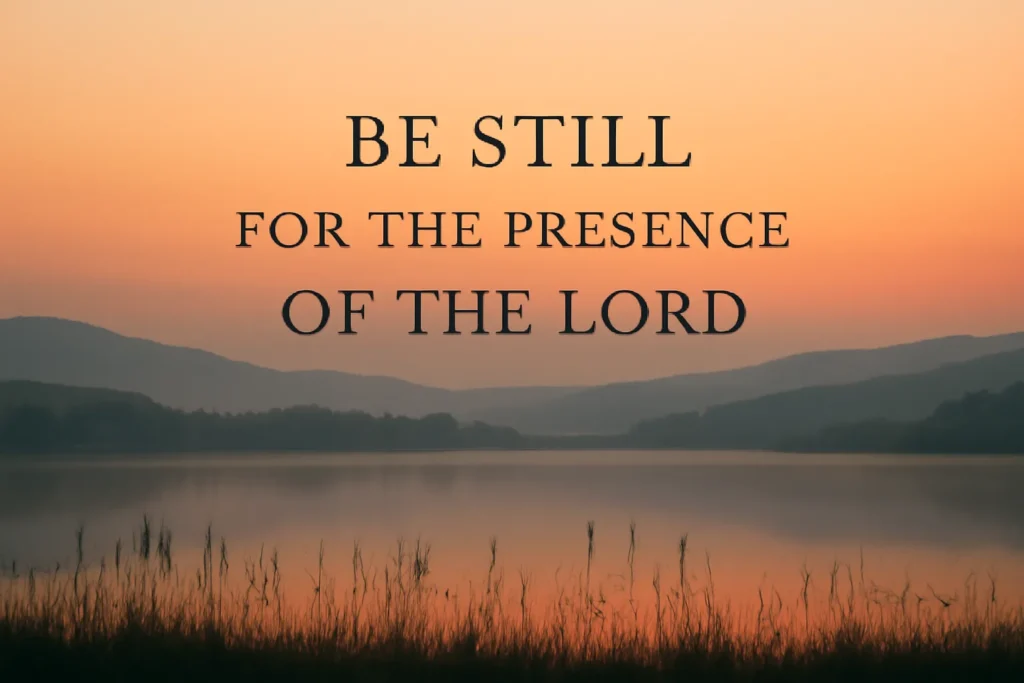
Be still, for the presence of the Lord is in this place.
This line captures the twofold movement that characterizes the hymn: a call to quiet and an assertion of divine presence. The phrase “presence of the Lord” functions as a theological anchor for the entire piece—God is not abstractly distant but actively present in the space where worshippers gather. The subsequent lines, in their various arrangements, typically reinforce the idea that the holy is among the worshiping assembly, transforming ordinary space into holy ground by virtue of God’s nearness.
From a literary perspective, the text relies on the rhetorical device of direct address. The speaker speaks to the congregation, and the congregation answers with a posture of silence, awe, and praise. This dialogic shape—imperative leading to response—helps cultivate a lived experience of worship: not merely a cognitive assent to doctrine, but a deliberate practice of consecration through quietness and reverent attention.
Poetic variation across hymnals means that some lines may be revised, expanded, or paraphrased by different editors, yet the core message remains intact: in this place, God is present, and that presence invites reverence, stillness, and worship. For readers who study the lyrics closely, attention is often given to imagery of sacred space, the idea of “emptying” the self before a holy God, and the assurance that God’s nearness can transform fear, anxiety, or distraction into worshipful contemplation.
Key phrases and their theological resonance
“Be still” – A call to silence as a spiritual discipline and a recognition that human noise and activity can obscure divine reality.
“the presence of the Lord” – An affirmation of God’s immanence, not only as distant sovereignty but as personal, relational reality in the gathered church.
“in this place” / “holy ground” – The claim that a particular setting becomes a theatre of encounter where the sacred is tangibly experienced.
Implied trust that worship is not solely drama or performance but encounter—an invitation to be formed by what one experiences in God’s nearness.
Meaning and Theology: What the Words Seek to Do
At the heart of the hymn is a robustly theocentric-awe-laden worldview. The words invite an encounter with the divine that is both intimate and transcendent. This is not a merely aesthetic experience; it is a theological act—recognizing God’s presence, responding with reverence, and allowing that presence to shape the mind, heart, and will.
Presence and proximity are central. In many Christian theologies, God is both transcendent and immanent. The hymn’s language foregrounds the immediacy of God’s nearness in worship, even in ordinary spaces. The idea that the Lord’s presence can render a space holy invites believers to treat their surroundings—sanctuaries, chapels, living rooms, or meeting halls—as consecrated environments where human beings meet the divine.
Silence as gift and discipline is another core theme. Silence is not mere absence of sound but a chosen posture that enables perception of spiritual realities. In many spiritual traditions, silence is a pathway to discernment, worship, and transformation. The hymn reframes silence as a positive act—an accompaniment to faith that makes room for God to speak, comfort, judge, or invite deeper trust.
The text also touches on humility before holiness. The sense that humans approach the divine in vulnerability aligns with biblical calls to “draw near to God” with reverence, and to acknowledge that the Holy One’s presence reveals what is true about ourselves—our need for grace, our longing for peace, and our longing for rest in the divine care.
Musical Setting and Arrangements
The hymn is acclaimed not just for its words but for its adaptability to a range of musical settings. The tune chosen by a church or choir can intensify the devotional mood or gently cradle the text in a lullaby-like cantabile, depending on the desired worship experience. The simplest arrangements often rely on a steady, reverent tempo that allows congregants to breathe with the text and to listen for the nuances of the divine presence being described.
Traditional hymn tunes that emphasize a straightforward, congregational singability, with a steady 4/4 or 3/4 meter and a calm, moderate tempo.
Contemporary settings using a piano or guitar-driven accompaniment that supports a reflective, intimate vocal line.
A cappella versions employed in more contemplative services, highlighting the prayerful nature of the text and the communal breath of the congregation.
Regardless of arrangement, the central musical principle remains: the music should serve the sense of sacred encounter. A restless or hurried tempo would clash with the text’s invitation to stillness; a slowing, spacious melodic contour tends to foster the intended atmosphere of reverence.
Usage in Worship: Liturgical Roles and Spiritual Impact
Across denominations, Be Still has found a place in a variety of worship contexts. It is often used as an opening ascent into prayer, a moment of quiet before the sermon, or a contemplative interlude after a time of confession and assurance. Its inclusive language and universal theme of God’s presence render it adaptable for different liturgical calendars and seasons, including Advent, Lent, and ordinary time.
Some of the typical uses include:
Opening the service to invite the congregation into a posture of attention and expectation.
Before preaching, to quiet the mind and prepare hearts to receive biblical teaching.
Post-communion reflections, offering a final moment to dwell in God’s presence after communion and gratitude.
Beyond its liturgical function, the hymn has become a cultural touchstone in many communities. Its language supports personal devotion outside formal worship, making it a common choice for prayer meetings, youth gatherings, and small-group settings where participants seek a shared moment of calm and divine proximity.
Variations and Global Reach
The universality of the hymn’s theme—recognizing the nearness of God and responding with reverence—has led to translations and adaptations in many languages. In global Christian communities, the core sentiment translates across cultures, even when idioms or images are adapted to local linguistic and theological contexts. Some translations retain the direct imperative voice, while others render the message in a more reflective, meditative cadence that honors the same aim: to cultivate a posture of stillness before the sanctity of God.
Different hymnals and publishers may present minor textual variants, but the refrain remains focused on a single, powerful idea: God is present here, now. This shared cadence across cultures contributes to the hymn’s enduring appeal, providing a common language for diverse congregants to express awe, trust, and worship in the same breath.
The motif of being still in the presence of God sits within a broader tapestry of biblical and devotional ideas. It resonates with Psalm 46:10, which exhorts “Be still, and know that I am God.” The juxtaposition of stillness with knowledge of God suggests that quiet does not imply passivity but an active recognition of divine sovereignty and grace. In this sense, Be Still shares spiritual kinship with hymns and prayers that pair adoration with contemplation, inviting worshippers to linger in the beauty and mystery of God’s nearness.
The hymn also interacts with other well-known lines about grounding in God. Phrases that evoke holy space, fear before the divine, and trust in God’s presence appear across Christian liturgy and devotional poetry. In exploring its place among these works, readers can see how a short hymn can catalyze long spiritual practice—an ordinary space transformed into a site of encounter through faithful listening and worship.
If you are planning a service or a reflection that uses this hymn, here are practical considerations to maximize its impact:
Set the intention: Begin with a short introduction explaining that the space is for encounter with God’s presence, not merely performance.
Choose an arrangement that suits your context: A slower, meditative arrangement may suit a candlelit evening service, while a gentle, hymn-like setting might fit a morning service in a traditional pew setting.
Pair with scripture or prayer: A brief reading about God’s nearness or a unison prayer of thanksgiving can deepen the experience of the song.
Avoid over-elaboration: Let the silence and the text’s core claim stand without excessive musical or spoken commentary; the stillness itself can be the sermon.
For choirs and instrumental ensembles, the hymn offers opportunities for dynamic contrast. A quiet opening verse can be followed by a slightly richer chorus, then a return to quietude, modeling the spiritual rhythm of “listening to God” and “responding in praise.”
The enduring value of Be Still lies in its invitation to acknowledge a sacred reality: that the presence of the Lord is not a distant doctrine but a present, personal, transformative reality. By encouraging a posture of stillness, reverence, and attentive worship, the hymn helps congregations align their hearts with the divine activity already at work in the gathering. It stands as a reminder that, even in a busy world saturated with noise, there is a space where God’s presence is real, where fear and anxiety can give way to trust, and where the soul can be led toward greater peace.
Whether sung in a centuries-old nave or a modern multi-use space, with a traditional tune or a contemporary arrangement, the hymn remains a practical discipline for believers. It teaches that sacred time is not merely about words spoken aloud, but about breath, stillness, and a genuine encounter with God. In that sense, the hymn’s timeless call—“Be still”—continues to be a beacon for worshippers who seek to know God more deeply in the moment and to carry that life-transforming presence into daily living.








Leave a Reply