Bible spikenard: meaning, uses, and biblical context
Bible spikenard: meaning, uses, and biblical context
Spikenard was a rare and expensive perfume made from a fragrant plant root, and the Bible presents it as a valuable sign of love, honor, and wholehearted devotion.
In biblical language, spikenard refers to an aromatic perfume commonly associated with nard, a fragrant substance derived from a plant in the valerian family. The perfume was valuable because its source likely grew far from Israel, in mountainous regions of South Asia, and had to be transported over long trade routes.
The exact composition of ancient spikenard cannot be confirmed with complete certainty. Many scholars connect it with Nardostachys jatamansi, often called Himalayan or Indian nard, but ancient perfumes could contain several ingredients, and the biblical word may describe either the plant extract or a prepared perfume made from it.
Spikenard appears in the Bible as both a luxury fragrance and a symbol of affectionate presence. It is mentioned in the Song of Solomon, where perfume helps express the attraction and intimacy between bride and bridegroom. In the Gospels, it becomes part of a costly act of devotion toward Jesus.
Most important distinction: The spikenard used to anoint Jesus in John 12 is not the same event as every other anointing story in the Gospels. John names Mary of Bethany and identifies the perfume as pure nard; the accounts in Matthew and Mark describe a related anointing, while Luke 7 presents a different scene.
Where spikenard appears in Scripture
The word or image associated with spikenard occurs in several important passages. Some English translations use “spikenard”, while others simply say “nard”. These passages fall into two broad settings: the love poetry of the Song of Solomon and the Gospel accounts of anointing.
Song of Solomon 1:12: Nard is part of the beloved’s fragrance while the king is at the table.
Song of Solomon 4:13-14: Nard is listed among the precious spices and perfumes associated with the bride’s garden.
Mark 14:3: An unnamed woman pours a jar of very costly pure nard over Jesus’ head at Bethany.
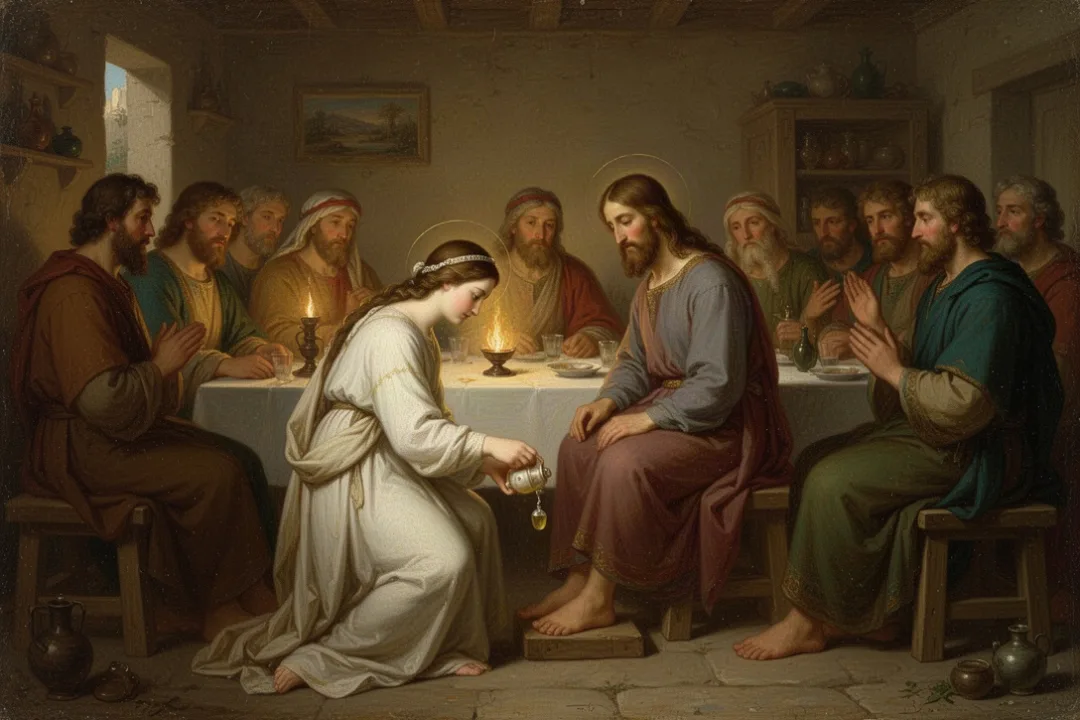
John 12:3: Mary of Bethany uses a large quantity of pure nard to anoint Jesus’ feet and wipes them with her hair.
Luke 7:36-50 also describes a woman bringing an alabaster container of perfume to Jesus. However, the passage does not identify the perfume as spikenard, and its setting and details differ from the anointing at Bethany. Treating every Gospel anointing account as one identical event can obscure what each writer emphasizes.
How to understand the biblical references step by step
Identify the passage. First determine whether the reference comes from the Song of Solomon or one of the Gospels.
Check the translation. A Bible may use “spikenard,” “nard,” or another phrase describing a fragrant ointment.
Notice the setting. A banquet, a garden, and an approaching burial each give the perfume a different emotional and symbolic force.
Observe the cost. The Gospel accounts stress that this was not an ordinary household scent but a highly valuable possession.
Separate the Gospel scenes. Mark and Matthew focus on anointing Jesus at Bethany, John names Mary and describes anointing his feet, and Luke records a different event.
Read the response. The reaction of the people around Jesus reveals how radically generous and meaningful the act appeared to them.
This approach prevents a common mistake: assuming that the word spikenard carries one fixed meaning in every passage. Its basic identity remains a fragrant, precious perfume, but its significance depends on the surrounding story.
Why spikenard was so expensive
Perfume in the ancient world was often made from plants, resins, oils, and spices that had to be harvested, processed, and carried over considerable distances. Nard was especially prized because its source plant grew in remote highland areas rather than in the ordinary agricultural fields surrounding Jerusalem.
In John 12, Judas Iscariot estimates the perfume’s value at three hundred denarii, roughly describing an amount comparable to a laborer’s wages for a substantial period. The point is not that the reader should calculate an exact modern dollar amount. The point is that Mary’s perfume represented a major store of wealth, not a small bottle purchased casually.
Mark 14 also describes the nard as very costly. The woman breaks the alabaster container and pours the perfume over Jesus’ head. Breaking the container may indicate that she intended to use the perfume completely rather than save part of it for another occasion, although the text’s central emphasis is the lavishness of her gift.
Perfume could function as a luxury, a social marker, a gift, or a practical preparation for the body. A valuable fragrance might be kept for a wedding, a burial, a formal meal, or an act of hospitality. That range of uses helps explain why the Gospel action carried such weight: the perfume could have been preserved, sold, or used in another important moment.
Spikenard in the Song of Solomon
The Song of Solomon uses nard within a poetic celebration of love, beauty, and desire. In Song of Solomon 1:12, the beloved’s fragrance is associated with nard while the king reclines at the table. The image is intimate and sensory, drawing attention to the atmosphere surrounding a cherished person.
Song of Solomon 4:13-14 places nard among a collection of rare spices and aromatic plants. The passage describes the beloved as a garden filled with valuable fragrances. The language is poetic rather than a technical recipe, so it should not be read as a precise list of ingredients for ancient perfume.
These references show that spikenard was recognized as something desirable and luxurious. The fragrance communicates more than cleanliness. It suggests delight, abundance, beauty, and personal affection. In the Song, scent helps express the power of attraction between the lovers.
Readers interpret the Song of Solomon in different ways. Some read it primarily as love poetry between a man and a woman. Others also see it as a picture of God’s covenant love or Christ’s love for the church. Whichever interpretive approach you use, the immediate imagery still matters: spikenard represents a costly and pleasing fragrance connected with intimate love.
Mary of Bethany’s use of spikenard in John 12
John 12 places the anointing at Bethany shortly before Jesus’ final entry into Jerusalem. Jesus is dining with people who know him, and Mary brings a costly quantity of pure nard. She anoints his feet and wipes them with her hair, after which the house is filled with the fragrance.
John’s details are deliberate. Mary does not merely offer a polite dab of perfume. She uses a generous amount, anoints Jesus’ feet, and performs an act of humility by wiping them with her hair. The spreading fragrance makes the private act visible to everyone in the room.
The story also includes criticism. Judas objects that the perfume could have been sold and the money given to the poor. Jesus responds by defending Mary’s action and connecting it with the day of his burial. His words do not cancel the responsibility to care for the poor; Scripture repeatedly commands such care. Instead, they identify the unique importance of this moment in his approaching death.
John’s account therefore gives spikenard several layers of meaning:
Love: Mary gives something precious to Jesus without holding back.
Humility: Anointing his feet and wiping them with her hair expresses lowly service.
Recognition: Her action honors Jesus in a way that suggests she understands the seriousness of what is coming.
Burial preparation: Jesus interprets the act in relation to his death and burial.
Memorial: He says that the woman’s act will be remembered wherever the gospel is proclaimed.
The perfume’s scent filling the house also creates a memorable contrast. The fragrance is physically present throughout the room, just as Mary’s devotion becomes impossible to ignore. John does not present the action as wasteful sentiment. He presents it as an act whose value must be understood in light of Jesus’ identity and impending death.
The anointing at Bethany in Mark and Matthew
Mark 14 describes a woman who enters a meal at Bethany with an alabaster jar of pure nard. She breaks the jar and pours the perfume over Jesus’ head. Some people present criticize the apparent waste and argue that the perfume could have been sold to help the poor.
Jesus praises the woman’s action and says that she has done what she could. He explains that she has anointed his body beforehand for burial. Mark also records Jesus’ statement that her deed will be remembered wherever the good news is proclaimed.
Matthew 26 presents a closely related account. It likewise describes a woman using an expensive ointment to anoint Jesus at Bethany, followed by criticism about the potential value of the perfume. Matthew emphasizes Jesus’ defense of the woman and the lasting remembrance of her act.
Mark and Matthew do not give her name. John identifies the woman as Mary of Bethany and describes the anointing of Jesus’ feet rather than focusing on his head. These accounts may be different presentations of the same event, with each Gospel selecting details that serve its own purpose. It is wise to recognize the strong similarities without forcing every detail into a single modern-style transcript.
Reading tip: The Gospel writers’ differences do not make the event meaningless. Read each account on its own terms, then compare the shared emphasis: a woman offers Jesus an extraordinarily valuable perfume, others object, and Jesus honors her sacrificial devotion.
How Luke 7 differs from the spikenard accounts
Luke 7 describes Jesus dining at the home of Simon the Pharisee. A woman known in the city as a sinner enters, weeps at Jesus’ feet, wets them with her tears, wipes them with her hair, kisses them, and applies perfume. Jesus uses the scene to teach about forgiveness and love.
Luke does not call the perfume spikenard. The woman’s identity, the host’s reaction, Jesus’ teaching, and the setting all differ from the Bethany accounts. The story may resemble John 12 because both include a woman, perfume, Jesus’ feet, hair, and a strong emotional response, but resemblance alone does not prove that they describe the same event.
Luke’s emphasis is the woman’s response to forgiveness and the contrast between her loving actions and Simon’s lack of hospitality. The perfume contributes to the scene, but it is not the central identification of the passage. When someone asks about bible spikenard, John 12 and Mark 14 are the clearest Gospel passages to examine first.
What “pure nard” means
The phrase pure nard highlights quality and value. It indicates that the perfume was not being presented as an ordinary, diluted, or inferior product. The wording may also suggest a recognized variety or grade of nard, although the precise ancient trade terminology is difficult to reconstruct.
“Pure” does not necessarily mean that the substance contained absolutely nothing else. Ancient perfumes were often prepared by combining aromatic materials with oils or other carriers. In the Gospel context, the phrase mainly communicates that the perfume was genuine, precious, and of high quality.
The Bible does not provide a complete manufacturing method. It does not tell us exactly how the nard was extracted, what oil carried it, or how long the fragrance lasted. Claims that present one modern recipe as the certain biblical formula go beyond what the text establishes.
Spikenard, anointing, and burial customs
Anointing with oil or perfume could express honor, refreshment, hospitality, healing, kingship, or preparation for burial. The meaning came from the setting and the person involved. A fragrance poured on a guest at a meal did not automatically have the same significance as an anointing connected with a king or a dead body.
In Mark 14 and John 12, Jesus connects the perfume with his burial. His interpretation gives the action a prophetic quality, even if the woman did not understand every detail of what was about to happen. She acts in the present, but Jesus reveals that her gift also points toward his death.
The large amount of perfume matters because burial preparations could involve spices and fragrant substances. John’s later burial account mentions spices used in Jesus’ burial, while the earlier anointing anticipates that event. The Gospels use scent as a quiet but powerful link between loving honor during Jesus’ life and care for his body after death.
What the story teaches about costly devotion
The central lesson is not that every faithful person must purchase expensive perfume. The story concerns the heart behind a gift, the recognition of Jesus’ worth, and the willingness to offer something valuable when love calls for action.
Mary’s gift is costly, personal, and visible. She does not offer what costs her nothing. At the same time, the Gospel accounts do not praise luxury for its own sake. The value of the perfume becomes meaningful because it is directed toward Jesus in a unique moment of service and honor.
The criticism in the room also raises a practical question: how should devotion relate to care for people in need? Jesus’ response shows that the issue cannot be reduced to a simple rule that one form of generosity always cancels another. Scripture supports care for the poor, but it also recognizes acts of worship and honor that cannot be measured only by financial efficiency.
For Christian readers, the passage can prompt several questions:
What valuable gifts, time, attention, or opportunities am I tempted to keep entirely for myself?
Do I judge another person’s devotion without understanding the meaning of the act?
Can I care for practical needs while also making room for worship and gratitude?
Am I willing to serve humbly, even when the service receives no public reward?
These applications should not be used to pressure people into reckless giving. The biblical story praises sincere devotion, not manipulation. A faithful response includes wisdom, generosity, and care for others rather than competition over who can make the most dramatic sacrifice.
What ancient spikenard may have looked and smelled like
Ancient nard was likely a fragrant oil or ointment with a strong, earthy, sweet, and somewhat musky aroma. Modern products labeled “spikenard” vary widely because they may use different plant species, extraction methods, and added ingredients. A present-day essential oil should not automatically be treated as identical to the perfume used in the biblical world.
The perfume was probably stored in a small vessel suitable for protecting valuable contents. The alabaster containers mentioned in the Gospel accounts were associated with ointments and perfumes. Their use helped preserve a costly product and made the container itself part of the presentation.
Descriptions of color, texture, and exact scent should be treated cautiously because the biblical texts emphasize value and action more than physical specifications. The most secure facts are that nard was fragrant, costly, and associated with special occasions.
Common questions about Bible spikenard
Is spikenard the same as anointing oil? Not necessarily. Spikenard was a particular fragrant perfume or aromatic ingredient, while “anointing oil” can refer broadly to oil used for religious, royal, medicinal, hospitable, or burial purposes. A spikenard perfume could be used in an anointing, but the terms are not interchangeable in every biblical passage.
Was Mary of Bethany the woman who used spikenard? John 12 explicitly identifies Mary of Bethany as the woman who anointed Jesus’ feet with costly pure nard. Mark 14 and Matthew 26 describe a closely related anointing at Bethany but do not name the woman. Luke 7 describes another woman and does not identify the perfume as nard.
Does spikenard symbolize the Holy Spirit? Some Christian teachers use fragrance as a metaphor for spiritual influence or devotion, but the Bible does not directly state that spikenard itself symbolizes the Holy Spirit. Its scriptural meanings arise from each passage’s setting, especially love in the Song of Solomon and costly honor toward Jesus in the Gospels.
Can modern spikenard oil be used to recreate the biblical perfume? Modern spikenard oil may resemble one ingredient associated with ancient nard, but it is not a guaranteed reconstruction of the biblical product. Ancient perfumes could be blended and prepared in ways that are no longer known. Use modern oils according to the product’s safety instructions, especially around skin, children, pets, and ingestion.
How to study spikenard in your own Bible reading
Begin by reading Song of Solomon 1:12 and 4:13-14 in several translations. Compare how each version renders spikenard, nard, and related fragrance language. Then read Mark 14, Matthew 26, John 12, and Luke 7 without assuming that every perfume scene is identical.
As you read, mark four details: who brings the perfume, where the act occurs, how others respond, and how Jesus interprets it. This simple comparison reveals the distinct emphasis of each passage.
Finally, keep the historical question and the spiritual application connected but separate. Historical study helps you understand why nard was costly and unusual. The text’s theological emphasis then asks what the act reveals about love, humility, honor, sacrifice, and the significance of Jesus’ death.
Frequently asked questions
What is spikenard called in modern Bible translations?
Many modern English Bibles use “nard” instead of “spikenard.” The difference usually reflects translation style rather than a completely different substance. Both terms point to a valuable aromatic perfume associated with a fragrant plant or extract. Checking several translations can help you see where the wording differs while preserving the same basic meaning.
Why did Mary pour perfume on Jesus’ feet?
John presents Mary’s action as an expression of profound honor and devotion. Anointing Jesus’ feet, wiping them with her hair, and using costly perfume showed humility and personal affection. Jesus also connected the act with his approaching burial, giving Mary’s gift significance beyond ordinary hospitality or personal sentiment.
Is spikenard mentioned in the Old Testament?
Yes. Spikenard, or nard, appears in the Song of Solomon, particularly in passages describing fragrance, beauty, and intimate love. These references do not describe Jesus’ anointing. They use the perfume as part of poetic imagery associated with a beloved person, a garden, and the atmosphere of a royal or romantic setting.
How should Christians apply the lesson of the spikenard story?
The story encourages sincere, humble, and thoughtful devotion rather than showy spending. It invites you to honor Christ with what is genuinely valuable—your time, attention, service, resources, and love—while continuing to care responsibly for people in need. The application should involve generosity and wisdom, not guilt or pressure.











Leave a Reply