For readers, students, pastors, and curious learners alike, navigating the landscape of bible translations can feel daunting. A single verse might exist in dozens of English versions, each produced with different goals, methods, and source texts. A well-constructed bible translation chart helps organize this diversity into a clear, usable reference. Such a chart does not replace careful study, but it does illuminate the trade-offs behind each version: how faithfully a translator adheres to the original languages, how readable the text is in modern English, and which manuscript sources underpin the wording you see on the page.
This article offers a comprehensive guide to understanding and using a translation comparison chart. It presents the major translation families, describes common translation approaches, and then provides mini-charts for the most widely used English translations. The goal is to equip readers with a practical framework for comparing versions side by side, so you can pick the right tool for your study, devotional reading, or preaching preparation.
What is a Bible Translation Chart?
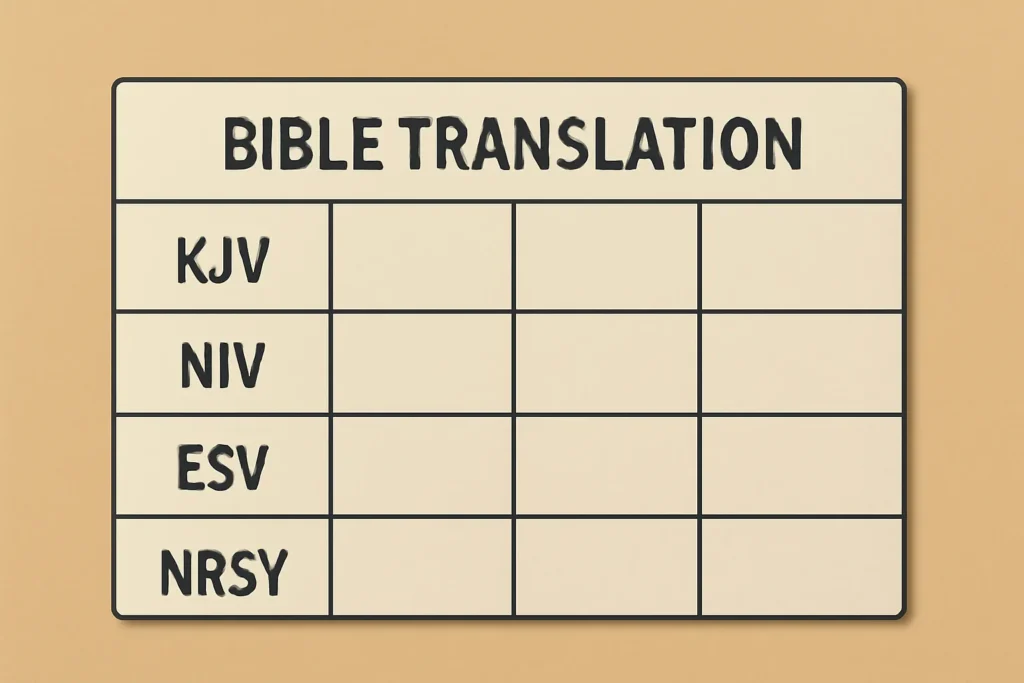
A bible translation chart is a reference tool that codifies, side by side, essential attributes of various English Bible translations. While there are many ways to present the information, a useful chart typically includes:
Name and date of the translation and any major revisions
Textual base (which Hebrew/Aramaic and Greek manuscripts were used)
Readability and style (modern language, archaic diction, etc.)
Audience and use cases (scholarly study, devotional reading, public liturgy, etc.)
Strengths and limitations (where it shines, where caution is advised)
Notable features (study notes, cross-references, gender-inclusive language, apparatus, etc.)
A robust translation chart also includes notes about manuscript history and the way translators handle difficult terms (for example, terms like righteousness, salvation, covenant, and faith). Understanding these elements helps readers interpret the text more accurately and responsibly.
How to Read and Use a Bible Translation Chart
Identify your purpose. Are you studying a passage closely, preparing a sermon, or reading devotionally? Different goals may favor different translation approaches.
Look at the translation approach. A formal-equivalence translation prioritizes word-for-word rendering and can be more precise for study. A dynamic-equivalence translation prioritizes thought-for-thought rendering and may read more smoothly but sometimes sacrifices literal closeness.
Check manuscript bases. Some translations rely on older Greek texts like the Textus Receptus; others rely on the critical text (Nestle-Aland/UBS). Some include the Septuagint or Latin bases for the Old Testament.
Consider readability. Modern translations tend to be more readable but may simplify or alter cadence and nuance. Compare a few lines across versions to gauge readability and precision.
Assess audience impact. A translation intended for congregational reading may prioritize smooth cadence, while a scholarly edition may provide extensive footnotes and textual apparatus.
Use in combination. Often the most fruitful approach is to consult a set of translations side by side for a given passage, using one as the baseline and another to illuminate interpretive questions.
Translation Approaches and Families
To interpret a translation chart effectively, it helps to distinguish the main translation philosophies and the families that arise from them. Here are the core approaches you are likely to encounter.
Goal: Preserve as much of the original grammar and vocabulary as possible.
Strengths: Precise rendering of wording, helpful for in-depth study of the original syntax; useful for word studies and cross-referencing terms.
Limitations: Often less natural in English; may require more effort to understand the flow or idiom of the text.
Typical readers: Students of the original languages, pastors preparing exegesis, scholars.
Dynamic Equivalence (Thought-for-Thought)
Goal: Convey the meaning of the original text in natural, contemporary English.
Strengths: Readability and accessibility; good for devotional reading and broad audiences.
Limitations: May gloss over subtle textual choices or the precise wording of the source language.
Typical readers: General readers, mass-evangelical audiences, public worship in modern vernacular.
Paraphrase
Goal: Communicate the text in highly natural, often paraphrastic English, emphasizing narrative flow over literal wording.
Strengths: Extremely approachable; excellent for first-time readers or long passages for meditation.
Limitations: Not ideal for precise textual analysis; can introduce interpretive bias through paraphrase choices.
Typical readers: Casual readers, youth audiences, readers seeking a devotional experience with drama and immediacy.
Optimal Equivalence (A Hybrid Approach)
Goal: Strive for a balance—retaining the semantic meaning and key idioms while maintaining readable English.
Strengths: Tries to combine accuracy with readability; often chosen for study bibles that aim for breadth and clarity.
Limitations: The middle ground can still feel uneven for any single verse; requires discernment.
Typical readers: Bible students who want reliability without excessive complexity.
Major English Bible Translations: Mini-Charts
The following mini-charts summarize several widely used English translations. Each entry is designed to function as a concise mini-translation chart or a stand-alone bible translation comparison chart you can skim when choosing a version for a particular purpose.
King James Version (KJV) — 1611 (Update history and textual base)
Translation approach: Formal equivalence with a slightly literary cadence preserved from the 17th century; late updates and modern spelling are common in modern printings.
Textual base: Masoretic Text for the Old Testament, Textus Receptus for the New Testament
Readability: Classic/archaic American English; readability improved in modern editions by spelling updates but still retains traditional cadence.
Audience and use: Historical study, literary appreciation, public liturgy in traditional settings; often used in churches with a historical preference.
Strengths: Magnificent literary quality; long-standing cultural and theological influence; strong in poetry and liturgical cadence.
Limitations: Archaic language can impede comprehension for new readers; some archaic renderings reflect older manuscript choices.
Notable features: Public-domain status in many regions; extensive tradition of memorization and quotation; important for textual allusions and sermon imagery.
New International Version (NIV) — first published 1978, revisions 1984, 2011
Translation approach: Dynamic equivalence with an emphasis on accessible modern English and readability while preserving core meanings.
Textual base: A broad critical text (including UBS/NA layers); uses a mix of older and newer manuscripts.
Readability: Highly readable; widely used for personal devotion, church services, and youth ministry.
Audience and use: Broad evangelical audience; widely used in schools, churches, and media; suitable for general study and public reading.
Strengths: Smooth, contemporary phrasing; strong balance between accuracy and readability; widely accepted in many denominations.
Limitations: Some argue that certain renderings reflect interpretive choices; not always ideal for close word-level study.
Notable features: Broad ecumenical involvement in translation committees; tends to be complemented by study notes and cross-references in study editions.
English Standard Version (ESV) — 2001; revisions ongoing
Translation approach: Formal equivalence with a focus on readability and literary quality; conservative textual choices.
Textual base: Critical texts for both Testaments; modern critical apparatus used in study editions.
Readability: Clear contemporary English with some traditional cadence; often feels precise without being stilted.
Audience and use: Scholarly study, preaching, and devotional reading with an emphasis on accuracy; popular among evangelical scholars.
Strengths: Strong alignment with textual scholarship; good balance between form and function; extensive cross-referencing and notes in many editions.
Limitations: Some translations may feel formal for casual readers; not as dynamic as some paraphrase-oriented versions.
Notable features: Notable for its typographic elegance and the inclusion of an explicit translation philosophy in many editions.
New American Standard Bible (NASB) — 1977; NASB95; NASB 2020 updates
Translation approach: Very strong formal equivalence; intended to be as literal as possible while remaining readable.
Textual base: Based on critical Greek/Hebrew texts with careful consideration of textual variants; updated to reflect newer scholarship in NASB 2020.
Readability: Generally readable but sometimes dense due to literal rendering; often used in academic and serious study contexts.
Audience and use: Seminary coursework, verse-by-verse study, and precise quotation in teaching and preaching.
Strengths: Excellent for word-level study; preserves English grammar that reflects original syntax; precise rendering helps with concordance work.
Limitations: Less natural in modern English in places; some readers may find the cadence stiff.
Notable features: Notable for its extensive cross-references and diagnostic notes in study editions.
Translation approach: Formal equivalence with a long Catholic translation tradition; early English translation from Latin Vulgate.
Textual base: Vulgate; later updates draw on Latin and Greek sources for some sections.
Readability: Antiquated English; can be challenging for modern readers but valued for historical significance.
Audience and use: Historical study, Catholic worship in certain communities, classical-linguistic interest.
Strengths: Rich historical resonance; foundational for many Protestant–Catholic scholarship discussions.
Limitations: Not in common use for contemporary devotion; language barriers for today’s readers.
Notable features: Pioneer in English Catholic Bible tradition; many modern Catholic versions reference or revise from this lineage.
How to Build Your Own Bible Translation Chart
A personalized translation chart can be a powerful study tool. Here are practical steps to create and use one effectively.
Choose a baseline set. Start with a core group of translations that you plan to compare regularly (for example, KJV, NIV, ESV, NASB, NRSV, CSB, NLT).
Define your criteria. Decide which attributes matter most for your purposes: translation approach, manuscript base, readability, notes, and intended audience.
Format for quick reference. Use a table or a structured list format that you can scan quickly. If you prefer text, create a template with consistent sections for each translation.
Record key distinctions. For each translation, note the primary base texts, the main translation philosophy, and any caveats that you have encountered in study or practice.
Include practical usage tips. Add a short field for typical use cases (e.g., "best for exegesis," "great for devotional reading," "suitable for liturgical use").
Update regularly. As editions are revised or new manuscripts become influential, update your chart to reflect current scholarly consensus and translation practice.
Interpreting the Chart: Practical Guidelines
When you consult a bible translation chart, keep these practical guidelines in mind:
Context matters: A translation’s effectiveness depends on the passage and its semantics. Narrative sections may read differently from poetry or prophetic literature.
Cross-check with study notes: Many translations come with study Bibles that provide textual notes, variant readings, and translation choices. Use the chart in tandem with notes for a fuller picture.
Avoid over-reliance on a single version: Each translation reflects particular interpretive decisions. Cross-referencing multiple translations helps avoid a one-dimensional reading.
Recognize denominational aims: Catholic, Protestant, and ecumenical translations sometimes differ in how they handle the canon and deuterocanonical books, as well as certain theological terms.
A well-constructed bible translation chart serves multiple practical roles.
Study preparation: Researchers and students use it to locate the most suitable base texts for textual criticism and linguistic analysis.
Teaching and preaching: Pastors compare versions to illuminate nuances in homilies or to anticipate questions from congregations.
Devotional reading: Readers looking for readability or literary quality can rely on dynamic-equivalence or paraphrase translations.
Cross-cultural engagement: Translations designed for different languages often inform how Bible passages are read in other linguistic contexts; the chart helps identify English equivalents for cross-cultural work.
A critical dimension of any translation chart is the way manuscript evidence is treated. The Manuscript basis often drives meaningful differences between translations.
Masoretic Text (Hebrew Old Testament) vs. critical Old Testament texts
Textus Receptus vs. critical Greek texts (Nestle-Aland/UBS) for the New Testament
Septuagint influence in some translations that rely on the Greek Old Testament
Apocrypha/Deuterocanonical books inclusion in Catholic and some Protestant editions, with variations in content
Understanding these textual bases helps readers appreciate why a translation renders a verse differently from one edition to another. In a translation chart, you may find a short note on the base text for each version, which clarifies choices that affect meaning, such as ambiguous Hebrew terms, idioms, or contested readings.
While translation charts are invaluable, they can mislead if used without nuance. Here are common pitfalls to avoid.
Assuming numerical precision: A chart may show a version as “more literal,” but no translation is perfectly word-for-word; languages differ in grammar and semantics.
Overinterpreting inclusivity notes: Inclusive language has a nuanced impact; it can illuminate gender justice in modern translations but may require further study in historical contexts.
Ignoring cultural-literary style: Some translations emphasize lyrical cadence or pastoral tone that serves worship or pedagogy even if it reduces literal precision.
Neglecting the value of notes: Some translations include apparatus or footnotes that explain variant readings; these notes are essential for serious study but can be overlooked if you focus only on the main text.
A bible translation chart is a living tool that helps readers understand the landscape of English Bible translations. It clarifies the trade-offs between readability, textual accuracy, and theological framing intrinsic to each edition. Whether you are embarking on a rigorous exegesis, preparing a sermon, or simply seeking a more comforting devotional experience, the chart provides a structured way to think about which translation best serves your current purpose.
Remember that no single version holds all the answers. The most fruitful approach combines a few translations—often a more literal version alongside a readable dynamic-equivalence edition—to gain both precision and accessibility. A well-designed translation chart makes these comparisons straightforward, helping you to cultivate a more informed and nuanced reading of Scripture.







Leave a Reply