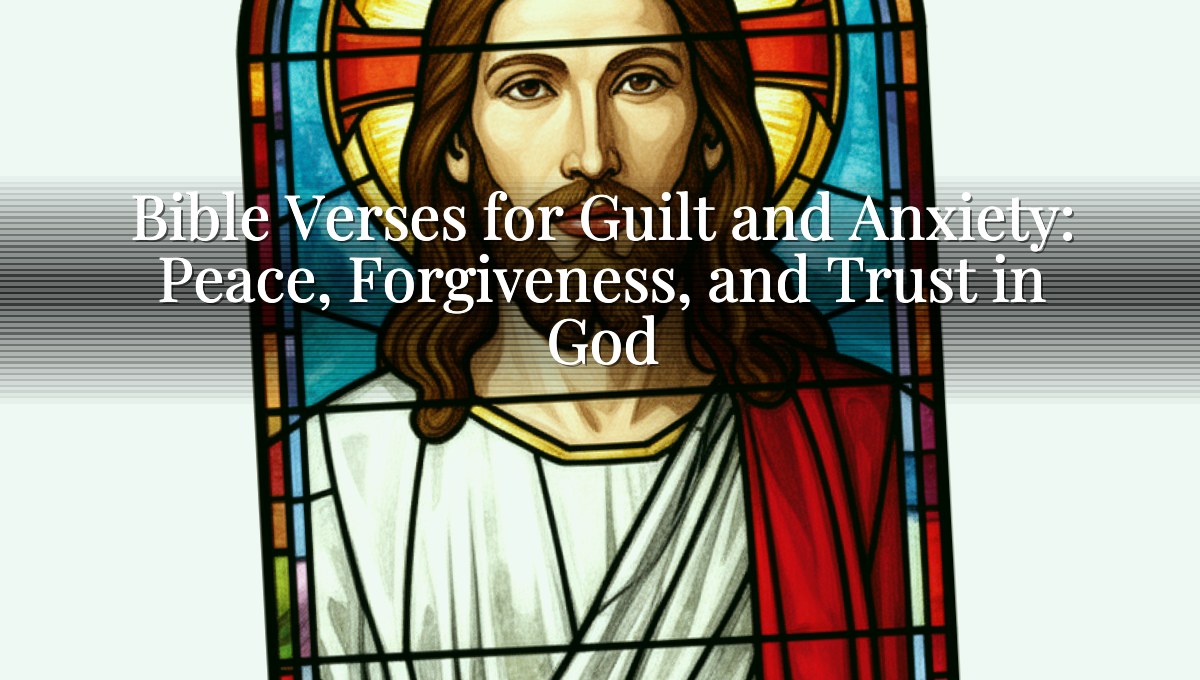
Bible Verses for Guilt and Anxiety: Peace, Forgiveness, and Trust in God
Quick Answer: If guilt and anxiety are weighing you down, lean on God’s promises. **Psalms 56:3-4** calls you to trust when fear rises. **Isaiah 41:10** reminds you that God is present and will strengthen you. And when guilt speaks loudly, **1 John 1:9** offers forgiveness and cleansing as you confess your sin.
Guilt and anxiety can feel like two loud voices competing for your attention—one pointing to what you’ve done, the other to what might happen. Yet God does not leave His people alone in those moments. Scripture can steady your mind, soften your heart, and return your trust to the Lord. In this devotion, we’ll focus on bible verses for guilt and anxiety that speak directly to fear, remind you of God’s nearness, and bring you to repentance with confidence. Psalms 56:3-4 teaches that even when you are afraid, you can choose trust. Isaiah 41:10 assures you that you are not dismayed because God is with you. And 1 John 1:9 gives real hope for the heavy burden of sin: confession is met with forgiveness and cleansing. Let these verses reshape your inner world with God’s peace.
At a Glance — Verses in This Article
Psalms 56:3-4
Isaiah 41:10
1 John 1:9
Bible Verses
Psalms 56:3-4 (King James Version)
“What time I am afraid, I will trust in thee. In God I will praise his word, in God I have put my trust; I will not fear what flesh can do unto me.”
This passage directly addresses fear and teaches a practical response: trust in God and refuse to be ruled by what others or circumstances can do.
Isaiah 41:10 (King James Version)
“Fear thou not; for I am with thee: be not dismayed; for I am thy God: I will strengthen thee; yea, I will help thee; yea, I will uphold thee with the right hand of my righteousness.”
This verse strengthens anxious believers by affirming God’s presence and help, replacing dread with confidence and support.
1 John 1:9 (King James Version)
“If we confess our sins, he is faithful and just to forgive us our sins, and to cleanse us from all unrighteousness.”
This verse offers a clear pathway through guilt by calling for confession, then promising forgiveness and cleansing from unrighteousness.
When fear rises: choose trust over panic
Anxiety often begins in the mind, but it quickly becomes a whole-body reaction—tightness, racing thoughts, and a sense that danger is near. When that happens, Psalms 56:3-4 gives a simple but powerful direction: “What time I am afraid, I will trust in thee.” The verse does not pretend fear will never come; it shows what you do *at the moment* fear shows up. Instead of arguing with the fear, you answer it with trust.
Notice the movement: “What time I am afraid… In God I will praise his word.” Trust and praise are not separate steps; praise becomes the expression of trust. Anxiety tries to make you focus on the worst-case scenario, but God invites you to focus on His word and His character. The Psalmist declares, “I will not fear what flesh can do unto me.” That doesn’t mean you ignore real threats; it means you refuse to give human power the final authority over your heart.
As you read these lines, let them become a script for your own prayer. When you feel fear climbing, you can respond aloud: “Lord, I am afraid, but I choose trust in You. I will praise Your word.” Over time, this repeated choice trains your nervous system and your spirit to remember where safety truly comes from.
This is also a mercy for guilt, because fear and guilt often feed each other. Anxiety can amplify the sense that you’re failing God, and guilt can make you afraid to approach Him. But Psalms 56:3-4 keeps turning your attention back to God, where truth and steadiness live.
God’s presence steadies the anxious heart
If fear is the storm, anxiety is often the weather system that keeps returning. It can make you feel alone even when you’re surrounded by people, and it can whisper, “No one can help.” Into that whisper, Isaiah 41:10 speaks with the calm authority of God Himself: “Fear thou not; for I am with thee: be not dismayed; for I am thy God.”
This verse doesn’t just give comfort—it identifies the reason anxiety cannot have the final say. The reason is not your circumstances improving first. The reason is that God is with you *right now*. When God says, “I will strengthen thee; yea, I will help thee; yea, I will uphold thee with the right hand of my righteousness,” He is promising active support. Strengthening implies you won’t have to carry everything alone. Helping implies you won’t be abandoned in your weakness. Upholding implies God will keep you from collapsing.
For someone burdened by guilt, this promise is especially healing. Guilt can convince you that God is far away because you’re not “good enough.” Yet Isaiah 41:10 anchors your identity: “I am thy God.” If God is your God, you are not cast off—you are being upheld.
When you feel anxious, try a slow, deliberate practice: read the verse slowly, then repeat the key phrases: “I am with thee.” “I am thy God.” “I will strengthen… I will help… I will uphold.” Let the words land deeper than thoughts. Anxiety may return, but God’s presence is not intermittent.
Together, these promises reshape fear into faith—turning “What if?” into “God is with me,” and “I can’t cope” into “He will uphold me.”
Guilt’s answer: confession, forgiveness, and cleansing
Unlike anxiety, which often looks toward the future, guilt tends to look backward—replaying choices, questioning motives, and searching for relief that never lasts. The longer guilt stays unaddressed, the more it can turn into condemnation: “You messed up, so God must be disappointed in you, and you’re stuck.” But God’s response is not only correction; it is cleansing.
1 John 1:9 gives both honesty and hope: “If we confess our sins, he is faithful and just to forgive us our sins, and to cleanse us from all unrighteousness.” There are three key movements here. First, confession: “If we confess our sins.” This means coming to God with truth, not hiding behind excuses. Second, God’s character: “he is faithful and just.” You can approach Him because He is reliable and right. Third, God’s outcome: forgiveness and cleansing. The verse doesn’t say, “Try to feel better.” It says God will forgive and cleanse.
For the anxious believer, this is crucial. Guilt can trigger anxiety by making you fear God’s judgment. Confession reroutes that fear. When you confess, you are not performing for acceptance—you are receiving forgiveness that God freely offers.
A practical way to apply this is to name your sin clearly and specifically before God. Don’t rush past it. Then claim the promise: God is faithful and just to forgive and cleanse. If thoughts of “But what if you don’t really mean it?” arise, answer them with scripture and prayer: God’s promise is not dependent on your emotional intensity; it rests on His faithfulness.
When guilt is heavy, remember that God’s forgiveness is not a temporary cover-up—it is a cleansing that restores your standing and your peace.
Daily habits to replace guilt and anxiety with God’s peace
To bring these verses into everyday life, focus on repeatable actions—not vague intentions. Here are three practical habits you can start today.
1) Create a “fear moment” response. When anxious thoughts spike, pause and speak Psalms 56:3-4 as a direct prayer: “What time I am afraid, I will trust in thee.” Then add praise: thank God for His word and His character. This turns fear into a cue to pray, not a signal to spiral.
2) Use God’s presence as your anchor. Set a short reminder in the morning or evening to read Isaiah 41:10 slowly. Ask yourself: “Where do I need strength, help, or being upheld today?” Then pray specifically for that area. Because God promises, you can request what He has promised.
3) Confess guilt without delay. If you become aware of sin, don’t let it ferment into self-condemnation. Come to God with honest confession, trusting the promise of 1 John 1:9. Pray something like: “Lord, I confess my sin. I receive Your forgiveness and cleansing.” After that, practice letting go—declare that you have brought it to God.
Over time, these habits train your heart. Anxiety becomes less dominant because you learn to respond with trust and praise. Guilt becomes less crushing because confession is met with forgiveness.
Key goal: keep returning to God’s word when feelings rise—because feelings change, but His promises stand.
Frequently Asked Questions
What bible verses for guilt and anxiety can I read when I feel condemned?
For condemnation, turn to 1 John 1:9. It shows that confession leads to forgiveness and cleansing: God is faithful and just. Instead of hiding, come to Him with truth and trust that He will cleanse you “from all unrighteousness.”
Are there Bible promises for anxious hearts when fear won’t leave?
Yes—Psalms 56:3-4 addresses fear directly and tells you what to do “what time I am afraid.” Isaiah 41:10 also reassures you that God is with you, strengthening and upholding you with His righteousness.
How do I use scripture for guilt and worry during a stressful day?
Pick one verse per moment: use Psalms 56:3-4 when fear spikes, Isaiah 41:10 when you feel overwhelmed, and 1 John 1:9 when you recognize sin. Read it slowly, pray it back to God, and then take one small faithful step.
What verses to calm fear and guilt without ignoring my responsibility?
These verses don’t excuse sin or deny real struggles. Psalms 56:3-4 teaches trust despite fear. Isaiah 41:10 strengthens you to face what’s ahead. And 1 John 1:9 gives a responsible response—confession—paired with forgiveness and cleansing.
A Short Prayer
Lord, when fear and guilt press in, teach me to trust You at the exact moment I’m afraid. Strengthen me and help me through Your presence, because I cannot uphold myself. Cleanse me as I confess my sins, and let Your forgiveness replace condemnation. Help me praise Your word even when my emotions feel loud. Thank You for giving hope that steadies my mind and restores my heart. In Jesus’ name, amen.
Key Takeaway: When fear rises, trust God’s word; when guilt appears, confess and receive His forgiveness and cleansing.

 Por Fernando Ortiz