Bible Verses That Contradict Each Other: A Guide to Reconciling Apparent Conflicts in Scripture
Bible Verses That Contradict Each Other: A Guide to Reconciling Apparent Conflicts in Scripture
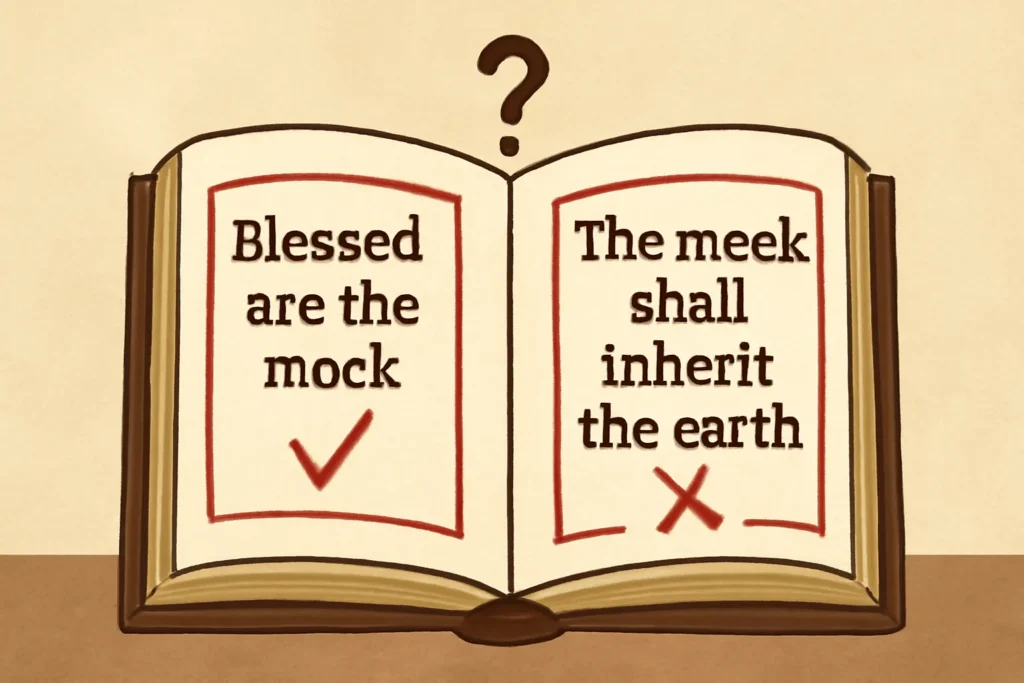
Across the centuries, readers have encountered passages that seem to pull in different directions. Some readers, pastors, and scholars describe these as apparent contradictions within Scripture. Others view them as opportunities to deepen understanding by examining the genre, context, language, and narrative arc of the biblical text. This article offers a practical guide to recognizing common patterns of seeming conflict, exploring representative pairings of verses that appear to contradict each other, and outlining principles for reconciliation that respect both the integrity of individual passages and the integrity of Scripture as a unified story.
Understanding Apparent Contradictions in Scripture
Before diving into specific pairings, it helps to establish a working framework. The Bible comprises many literary genres—historical narrative, poetry, wisdom literature, prophecy, epistles, and apocalyptic writing. Each of these genres has its own rules for language, imagery, and what is being communicated. When we encounter a passage that seems to contradict another, a few factors often explain the tension:
Scope and audience: A statement may address a particular situation or a particular group, while another statement speaks to a broader or different context.
Progressive revelation: Biblical authors might reveal truth gradually over time, culminating in a fuller picture in the New Testament or in Jesus' own teaching.
Original languages and translations: Nuances in Hebrew, Aramaic, and Greek can affect meaning; translation choices can obscure or illuminate differences.
Key terms with loaded meanings: Words like faith, works, law, or desire carry specific theological or ethical shades that differ by passage.
When Christians approach apparent contradictions, a methodical hermeneutic—the discipline of interpretation—helps. This involves looking at the immediate context, the broader canonical context, and the way a text has been read within the church over the centuries. This article surveys well-known pairings that often spark questions and then offers practical paths toward reconciliation.
Common Debates: Pairs of Verses That Seem to Contradict
Justification by Faith Versus Justification by Works
Paraphrased idea from Ephesians 2:8-9: Salvation is a gift from God received through faith; it is not earned by human works. Grace, not merit, is the basis of our rescue.
Paraphrased idea from James 2:17-24: A living faith is evidenced by deeds; justification is shown not merely by belief but by the way one acts, so faith without works is dead.
These two strands often feel contradictory because one emphasizes faith as the channel of salvation, while the other emphasizes the fruit of faith in action. The reconciliation offered by most traditional readings rests on a distinction between justification before God (a courtroom declaration grounded in Christ’s work and faith) and evidence of genuine faith (the ongoing transformation that produces good works). Grace and faith initiate salvation; works of love reveal that faith is real.
In practical terms, readers ask: How can faith alone justify us if deeds demonstrate faith? The answer often offered is this: Paul’s argument about justification before God (often through faith apart from works of the Law) is complemented by James’ emphasis on practical righteousness as the fruit of authentic faith. The two perspectives address different questions—“How are we made right with God?” and “What does a right relationship with God look like in life?”—without denying each other.
Prayer and God’s Will: When Prayers Seem to “Go Unanswered”
Paraphrase of Matthew 21:22: If you believe, you will receive whatever you ask for in prayer, provided it aligns with God’s will.
Paraphrase of James 4:3: You ask with wrong motives, and you don’t receive, because you ask with selfish intent.
Paraphrase of 1 John 5:14-15: If we ask anything according to God’s will, he hears us, and we may have confidence in receiving what we asked for.
The tension here is practical and theological. Some prayers seem to be granted in ways that feel unconditional; others seem clearly constrained by motives or by God’s broader plan. A coherent reading often recognizes that God invites bold prayer and loyalty to God’s will shapes responses. Prayer, in this view, is less a technique to bend God to one’s desire and more a practice that shapes the worshiper’s heart toward divine purposes.
Election and Free Will: Predestination and Human Choice
Paraphrase of Romans 9:15-18: God shows mercy where he wills, and hardens whom he wills; divine sovereignty governs salvation history.
Paraphrase of John 6:44: No one can come to Jesus unless the Father draws them; ultimate initiative lies with God.
Paraphrase of 1 Timothy 2:4: God desires all people to be saved and to come to a knowledge of the truth.
Paraphrase of Ephesians 1:4-5: God chose believers in Christ before the world’s creation, in love.
These verses invite careful nuance. The idea of sovereign election coexists with a palpable invitation to repentance and faith. A common reconciliatory approach is to distinguish between God’s decisive initiative in election and human responsibility to respond in faith. In this view, salvation remains a gift that begins with God’s call, while genuine faith expresses itself in consent to that call.
Eternal Punishment and Other Views of Judgment
Paraphrase of Matthew 25:46: The wicked will go away into eternal punishment; the righteous into eternal life.
Paraphrase of 2 Thessalonians 1:9: They will be punished with everlasting destruction away from the presence of the Lord.
Paraphrase of Luke 16:19-31 (the parable of the rich man and Lazarus): A stark contrast of fates after death, emphasizing awareness and consequences.
The debate here centers on whether “eternal punishment” implies conscious torment forever or a more annihilative form. Across Christian traditions, readers hold varied views, often anchored in broader biblical language about justice, mercy, and the finality of God’s purposes. A reconciled stance might note that biblical language uses human categories to describe an eternal reality; the precise inner experience of that reality remains a mystery beyond full human comprehension. In any case, the consistent thread is that God’s justice endures and that the Bible presents a decisive division between blessing and judgment.
Women in Ministry and Leadership
Paraphrase of 1 Corinthians 14:34-35: Women should remain silent in churches, as the churches are to be orderly in worship.
Paraphrase of 1 Timothy 2:11-12: Women should learn in quietness and full submission, not exercising authority over men; they should keep silent.
Examples in Scripture: Phoebe (Rom. 16:1-2) as a deacon; Priscilla and Aquila (Acts 18:26) instructing alongside men; Junia (Rom. 16:7) noted as notable in the apostles’ circle.
Interpretive tension arises from differing instructions across Paul’s letters and the historical-cultural context of the early church. Reconciliations often highlighted include distinguishing between authoritative teaching roles in specific congregational settings and broader participation in ministry. The presence of female leaders in several New Testament households and churches suggests a more nuanced practice than a simple universal prohibition. Readers may summarize the consensus as: core pastoral leadership often reflects cultural context, while gifts and callings for ministry appear in diverse forms across the New Testament narrative.
Paraphrase of Exodus 20:8-11: Remember the Sabbath day by keeping it holy; on the seventh day God rested from creation.
Paraphrase of Colossians 2:16-17: Do not let anyone judge you by what you eat or drink, or with regard to a Sabbath day; these are a shadow of what is to come.
Paraphrase of Romans 14:5-6: Some regard one day as more important than another; others see all days as equal.
Paraphrase of Galatians 4:9-11: You are observing special days again; you are turning back to weak and elemental forces.
Here the tension lies between commandment-era Sabbath laws and a New Covenant understanding in which Christians live under the liberty of Christ. Reconciliations stress the distinction between moral principles that reflect God’s character (such as rest, worship, holiness) and ceremonial practices that pointed forward to Christ and were fulfilled in him. The practical takeaway: the Sabbath principle remains, but its application evolves in the life of the Christian community, especially as it relates to communal worship, conscience, and cultural context.
Strategies for Reconciliation: How to Read Apparent Conflicts
Identify the genre of each passage and ask: Is this narrative, poetry, instruction, or prophecy? How does that genre shape what is being said?
Check the immediate and wider context: What comes before and after? How do surrounding verses help clarify meaning?
Pay attention to key terms: Words like justify, save, law, works, faith, desire have nuanced meanings in different books.
Consider audience and purpose: Paul writes to specific churches in a particular historical situation; the same letter may emphasize different aspects of truth for different communities.
Distinguish between doctrine and practice: Do two passages teach the same underlying doctrine in different contexts, or are they addressing distinct issues?
Use the whole counsel of Scripture: Interpret a difficult passage in light of the entire biblical witness, rather than isolating a single verse.
Practical Tools for Readers: A Step-By-Step Approach
When you encounter a potential contradiction, here is a practical workflow you can apply to your study:
Make a short paraphrase of each verse in your own words. Then compare what each says about the same issue.
Note key terms and how they are used elsewhere in Scripture. Look up the same terms in a concordance or Bible dictionary.
Look for cross-references within the same book and across other books that address the same topic.
Identify the literary context: Is the verse part of a parable, a proverb, or an exhortation? What is the intended takeaway?
Examine historical-cultural context: What issues prompted the writing? What practices were typical for the audience?
Seek multiple perspectives: Read trusted commentaries and scholarly articles that present varied interpretations.
Evaluate theological implications: How does a harmonized reading preserve the character of God, the gospel, and the integrity of the narrative arc?
Encouraging Examples: Texts That Invite Nuance Rather Than Silence
Readers sometimes fear that reconciliation means compromising truth. In reality, many passages invite a nuanced, layered understanding that honors both the text’s immediacy and its larger message. Consider the following examples, which illustrate how apparent contradictions can yield a richer biblical map when engaged thoughtfully:
Faith and obedience are not opposed but braided together in a life shaped by Christ. The Bible invites believers to trust God deeply while also living out that trust through acts of love, mercy, and justice.
God’s sovereignty and human responsibility function in a dance: God initiates, calls, and purposes, and humans respond in faith, repentance, and obedience. This dynamic is consistently presented without erasing either side.
Judgment and mercy stand side by side in many passages, reminding readers that God’s justice seeks the flourishing of his creation, while mercy opens a path for repentance and renewal.
Conclusion: Embracing a Faithful Path Through Apparent Dissonance
Apparent contradictions in Scripture are not merely obstacles to be solved; they can be invitations to a deeper engagement with the Bible’s complex and multifaceted witness. A thoughtful approach—one that honors genre, respects context, and employs a canon-wide perspective—allows readers to hold together seemingly conflicting verses in a way that is faithful, humble, and constructive. The Bible’s own trajectory—its creation, fall, redemption, and restoration—offers a coherent story that many scholars and believers see as culminating in Jesus Christ. In that sense, reconciling apparent conflicts is less about forcing uniformity on every sentence and more about discovering a consistent message: that God is good, that he longs for human flourishing, and that his word invites trust, obedience, and worship.
For readers who want to continue this journey, consider adopting a practical plan: select a couple of the most often-quoted contrast pairs, study them in light of their broader biblical contexts, compare how major translations render them, consult scholarly commentaries with diverse perspectives, and reflect on how a reconciled reading affects your understanding of God, yourself, and the world. The goal is not merely to solve every puzzle but to grow in awe and knowledge of the God who speaks through Scripture and who invites his people into a deeper, more faithful relationship with him.









Leave a Reply