Overview: What the Blood Moon Prophecy Bible Refers To
The phrase Blood Moon Prophecy Bible is a popular, though informal, way to describe a cluster of
belief claims that tie lunar eclipses—often described as blood moons because of their reddish
appearance—to events in biblical prophecy, particularly those related to the end times.
In contemporary discourse, authors and preachers like Mark Biltz and John Hagee have promoted the idea
that a sequence of four blood moons over a short period (a tetrad) aligned with certain Jewish holy days could signal
significant spiritual or geopolitical developments. This article examines what that claim means, where it came from, and how
it is debated within theology, astronomy, and popular culture.
It is important to distinguish between what the Bible explicitly states and how modern interpreters fashion
contemporary correspondences. The term blood moon prophecy is not a canonical or universally accepted label
within Christian theology. Instead, it is a modern, media-saturated way of describing a particular eschatological interpretation
that links natural phenomena with predicted prophetic events.
What is a Blood Moon and why does it look red?
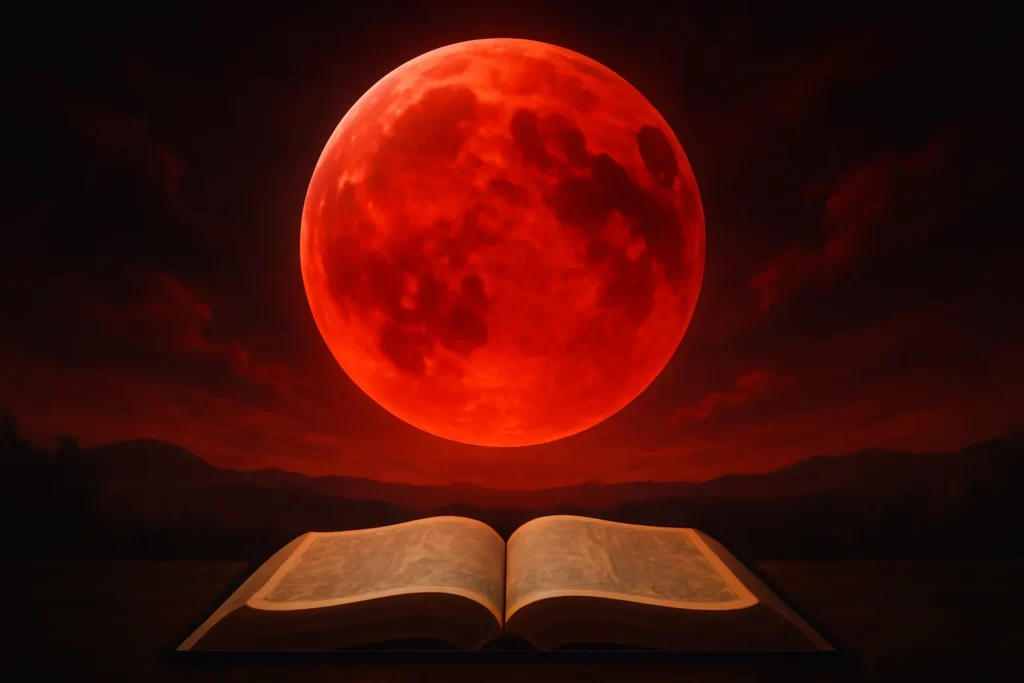
A blood moon is a common lay term for a lunar eclipse, a celestial alignment in which the
Moon passes through Earth's shadow. During a total lunar eclipse, the Moon may take on a reddish or coppery hue rather
to sunlight refracted by Earth's atmosphere. The light that does reach the Moon after filtering through Earth's atmosphere is tinged
by atmospheric particles, producing the characteristic reddish color.
From an astronomical perspective, a lunar eclipse is a predictable, well-understood event that has occurred
many times in human history. There is nothing inherently theological about the color itself; what makes it a matter of debate
is how people interpret the event within a religious framework.
Key terms to know
Lunar eclipse — the alignment that creates the reddish Moon.
Blood moon — a popular name for a Moon during a total lunar eclipse.
Tetrad — a sequence of four consecutive total lunar eclipses, each separated by about six months, with no partial eclipses in between.
Passover and Sukkot — two major Jewish festivals that proponents note sometimes align with blood moons.
The Origins of the Modern Blood Moon Prophecy
The contemporary cycle of claims about the blood moon phenomenon and its supposed prophetic significance largely
emerges from two influential voices in the late 2000s and early 2010s: Mark Biltz and John Hagee.
While they did not invent the idea of lunar eclipses themselves, they popularized the specific association between
tetrads, Jewish feast days, and end-times expectations.
Key figures and their claims
Mark Biltz — A pastor who popularized the term “blood moons” and argued that tetrads occurring on Passover and
Sukkot could be biblically significant. His 2008–2014 writings helped bring the topic into mainstream evangelical discourse.
John Hagee — The pastor of Cornerstone Church in San Antonio and author of Four Blood Moons. He framed the tetrad pattern
as a potential map for geopolitical and spiritual events tied to Israel and the nations.
The idea that a tetrad of blood moons on Jewish feast days might correlate with major world events is not an explicit
forecast found in the biblical text. Instead, it is a retrospective and interpretive framework that connects:
The biblical phrase about the moon turning to blood (a quotation that appears in Joel 2:31 and Acts 2:20),
Historical events concerning the Jewish people and the state of Israel,
Public interest in end-times prophecy and sensational media coverage.
The net effect of these origins is a recognizable media narrative: a pattern of four consecutive total lunar eclipses
coinciding with major Jewish holidays is presented as a signal. Critics note that such patterns have occurred in the past without the apocalyptic outcomes foretold by proponents.
The contemporary end-times debate around blood moons relies heavily on a particular reading of biblical passages like Joel 2:31 and Acts 2:20, where the imagery of the sun turning to darkness and the moon to blood appears.
However, there is widespread scholarly disagreement about how these verses should be applied to modern events, and whether they
predict specific occurrences tied to the political landscape of Israel.
What the Bible explicitly says (and does not say) about signs
Joel 2:31 — “The sun shall be turned to darkness and the moon to blood, before the great and terrible day of the Lord comes.”
Acts 2:20 — “The sun shall be turned to darkness and the moon to blood, before the great and glorious day of the Lord.”
Many theologians emphasize that these verses are eschatological and metaphorical, written in the genre and language of their time,
and not a dated, predictive calendar.
Critics argue that turning a biblical verse into a modern calendar prediction risks manipulating Scripture to fit a
pattern that is at best coincidental and at worst speculative. Proponents respond that, even if the exact date
may be uncertain, the occurrences of such signs could point to a broader sense of “signs of the times.” The disagreement
often centers on whether eschatology (the doctrine of the end times) should ever be anchored to astronomical events
or remain primarily a theological and spiritual expectation.
Three important interpretive questions
Is there a direct causal link? — Do astronomical events cause or predict the events described in biblical prophecy, or are they only symbols?
What counts as a “sign”? — Is a sign a precise date, a general season, or an alignment of geopolitical trends with biblical language?
How should we weigh historical context? — How do events in the ancient Near East and modern geopolitics affect our reading of biblical language?
Within scholarship, the majority view among many mainstream theologians is cautious: while biblical signs can carry moral and spiritual
meaning, they should not be treated as precise predictive instruments for contemporary timing. In contrast, some evangelical writers
maintain a pre-millennial or dispensational framework that sees current events as fulfillments of prophetic patterns.
This divergence is a central part of the end-times debate.
End-Times Debate: Skeptics, Theologians, and Believers
The dialogue surrounding the blood moon prophecy draws in diverse voices, including academic theologians,
biblical historians, astronomers, and lay readers curious about prophecy. The key fault lines in the debate typically include:
Historical-critical vs. devotional approaches — How do scholars balance textual analysis with faith claims?
Scientific scrutiny vs. prophetic optimism — Do astronomical patterns have predictive power, or are they natural events misread as signals?
Messianic expectations — How do end-times expectations influence the interpretation of current events?
The end-times debate is not merely about dates; it concerns how communities understand the relationship between heaven and earth,
how they interpret sacred texts, and how they respond to public interest and fear surrounding global events. Proponents might emphasize
spiritual alertness and discernment, while critics urge caution against sensationalism and calendar-driven predictions.
Common criticisms and counterpoints
Statistical caution — Astronomical patterns such as tetrads occur with some regularity, and coincidences happen with human interpretation.
Historical examples — Similar claims have arisen in different eras without the predicted outcomes materializing.
Scriptural hermeneutics — A growing number of scholars argue for a more nuanced approach to prophetic literature, emphasizing metaphor, genre, and historical context.
Despite disagreements, the conversation has shaped how some communities understand prophecy, ethics, and eschatology. It has also influenced
how people read current events through a prophetic lens, prompting both discernment and, in some cases, alarm.
Case Study: The 2014–2015 Blood Moon Tetrad
Perhaps the best-known modern example associated with this topic is the 2014–2015 tetrad, a sequence of four total lunar
eclipses occurring at roughly six-month intervals. Proponents highlighted the alignment with Jewish feast days—Passover and Sukkot—across
two consecutive years. They suggested that such a pattern could mark a turning point in world history, particularly relating to Israel and broader geopolitical developments.
The media attention around this tetrad was substantial, leading to widespread speculation about biblical significance and impending
catastrophe. However, scientists, astronomers, and many theologians argued that there is no empirical basis for predicting specific events
from the eclipses. NASA and other space agencies explicitly noted that lunar eclipses, while beautiful and scientifically interesting,
do not constitute a reliable method for forecasting political or spiritual milestones.
In retrospect, while some political events did occur in the broader timeframe, there was no singular, world-shaking crisis tied to the
blood moon tetrad. Critics point to this as an important lesson about correlation versus causation: a sequence of natural events can be
memorable and meaningful for believers without indicating a precise prophetic fulfillment.
What this case teaches about interpretation
Correlation does not equal causation — Even if two events occur during a tetrad, it does not prove a prophetic link.
Self-correcting narratives — After periods of heightened attention, explanations often shift toward broader spiritual significance rather than concrete predictions.
Public discourse effects — Media attention can amplify a pattern beyond its evidentiary weight, shaping belief more than fact.
The Astronomy Perspective: What Science Adds to the Conversation
From an astronomical perspective, a blood moon is a natural consequence of the geometry of the Earth, Moon, and Sun. A few
basic facts help listeners separate astonishment from prophecy:
Tetrads occur—by chance—when four total lunar eclipses happen in a row over a period of about two years. They are not exceedingly rare in the long run.
Predictability — Astronomers can forecast lunar eclipses decades in advance with remarkable precision.
Color — The reddish appearance is caused by sunlight refracted through Earth's atmosphere and filtered by aerosols and dust.
The inclusion of astronomical data in a religious conversation is valuable because it grounds the discussion in observable reality. Yet
science does not provide a mechanism for predicting or validating specific prophetic events. When people interpret a natural phenomenon
as a sign, they are engaging in a form of theological interpretation that sits at the intersection of faith, culture, and science.
For readers who want to evaluate claims responsibly, consider:
Source reliability — Who is making the claim, and what is their track record for accuracy?
Exegetical grounding — Do the biblical verses cited truly point to a calendar-based prophecy in the present day?
Contextual analysis — How do historical events, geopolitical developments, and spiritual themes line up with the claim?
The blood moon prophecy discourse has shaped broader conversations about prophecy, media literacy, and
how people respond to uncertain futures. Some readers were drawn to the drama and immediacy of the messages, while others felt
uneasy about the risks of sensationalism. The cultural footprint includes:
Publications and television programs that explore biblical prophecy and its contemporary relevance.
Increased interest in astronomy and the science of lunar eclipses among lay audiences.
Dialogue within churches and faith communities about how to interpret prophetic language responsibly.
It is not uncommon for prophecy-themed narratives to become vehicles for moral exhortation, social critique, or political
commentary. In the case of blood moons, some writers emphasize moral vigilance and spiritual renewal, while others exhort a more cautious
approach to extraordinary claims that blend faith with current events.
If you encounter discussions about the Blood Moon Prophecy Bible or related ideas, here are practical steps to engage
thoughtfully:
Check the source — Look for primary sources, not only headlines or social media posts. See what the authors actually claim.
Differentiate astronomy from theology — Understand what is an observable astronomical event versus what is interpreted as prophetic significance.
Look for biblical exegesis — Do claims engage in careful interpretation of key verses, considering literary genre and historical context?
Be mindful of amplification — Stories can gain momentum as they spread; verify dates and events with independent, reputable sources.
Assess the historical pattern — Are similar patterns presented with evidence, or are they singled out and selected after the fact?
Favor humility and caution — End-times predictions have a track record of shifting or being revised; a cautious approach is prudent.
A balanced reading respects the theological concerns and the natural realities at stake. It acknowledges the human desire to find meaning
in extraordinary events while resisting the impulse to treat uncertain predictions as certainties.
Conclusion: What We Can Learn from the Blood Moon Conversation
The modern discussion around the blood moon prophecy and its biblical ties reveals how faith communities negotiate
meaning in the face of ambiguous world events. The term Blood Moon Prophecy Bible signals a larger cultural pattern: people
seek signs, interpret natural phenomena through a spiritual lens, and weigh biblical language against contemporary concerns.
From a scholarly standpoint, there are several takeaways:
The biblical text is rich and multi-layered; it calls for careful exegesis rather than calendar-based forecasting.
Modern claims are often shaped by popular authors and media narratives, not by canonical theological consensus.
Understanding astronomy helps separate awe-inspiring natural events from prophetic interpretation.
Healthy skepticism, coupled with thoughtful faith, can coexist: believers may reflect on signs while avoiding deterministic predictions.
Whether you approach this topic as a student of theology, a student of astronomy, or simply a curious reader, the conversation invites
a deeper engagement with questions about how we read sacred texts, how we understand natural phenomena, and how communities discern
meaning in a complex world. The enduring lesson is not that eclipses are inherently prophetic, but that humans continually search for
significance in the skies and seek to map that significance onto life’s most urgent questions.






Leave a Reply