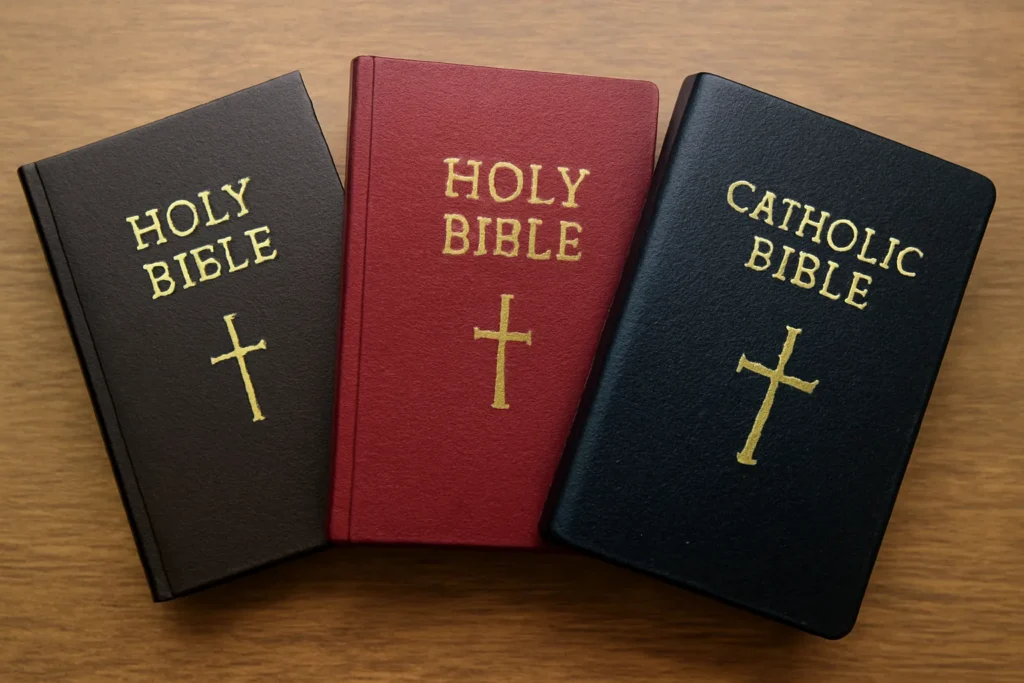
A Catholic Bible is more than a single edition or translation. It is a collection of sacred texts assembled in a way that reflects the Catholic Church’s long-standing
traditions, liturgical life, and theological emphases. While many people use the phrase “Catholic Bible” to refer to any Bible used by Catholics, in practice it denotes a Bible that includes the Deuterocanonical books (often called the deuterocanon) and follows a canon that aligns with the Catholic tradition. This guide will help you understand the major editions, translations, and study resources commonly encountered by readers, students, and worshippers.
Whether you are seeking a translation for personal devotion, a study Bible with helpful notes, or a version suitable for liturgical reading, recognizing the differences between Catholic Bibles and other Christian Bibles will help you choose the right edition for your needs. In Catholic practice, Scripture is not only a book to read; it is a text to be prayed, studied, and proclaimed in God’s word within the community of faith.
What Makes a Catholic Bible Catholic
At the heart of every Catholic Bible edition is its canon—the list of inspired books recognized by the Church. The Catholic canon includes the Old Testament books that Protestants typically term “Apocrypha” plus several books and additions found in the Book of Daniel and the Book of Esther that are accepted by the Catholic tradition.
The Canon and the Deuterocanon
The Deuterocanonical books—such as Tobit, Judith, Wisdom, Sirach (Ecclesiasticus), Baruch, 1 and 2 Maccabees, and additions to Esther and Daniel—are included in Catholic Bibles but not in most Protestant Bibles. Catholic editions present these works as part of the Old Testament and treat them as integral to the biblical narrative and to Catholic doctrine in several passages.
The Latin Tradition and the Nova Vulgata
The traditional reference text for the Catholic Church is the Latin Vulgate, which remains a baseline for translation and interpretation. The modern standard Latin edition used in Roman Catholic scholarship and liturgy is the Nova Vulgata, published in the late 20th century. Many Catholic Bibles translate from the Nova Vulgata or reference it for cross-checking. Knowing this helps readers understand why some Catholic translations align closely with the Latin and why Latin phrasing can influence English renderings.
The Magisterium and Translation Philosophy
The Magisterium—the teaching office of the Church—has an essential role in ensuring that translations remain faithful to the core beliefs of Catholic faith and tradition. This does not mean every Catholic Bible reads the exact same, but it does mean that reputable Catholic translations strive for accuracy, readability, and fidelity to the Church’s understanding of Scripture.
Editions and Canons: A Roadmap through Catholic Scripture
When people talk about editions of the Catholic Bible, they are often referring to the combination of a translation, accompanying study helps, and whether the edition is designed for private reading, academic study, or liturgical use. Below is a broad overview of the important families of Catholic Bible editions.
The Latin Foundation: Nova Vulgata
The Nova Vulgata remains the official Latin edition used by the Roman Church. It serves as the standard for official texts and is often consulted by translators. Many English-language Catholic Bibles cite the Nova Vulgata as a reference point for translation decisions, even when the primary text is in English or another language.
Popular English-Language Catholic Editions
In English, several well-known Catholic Bible editions are widely used in parishes, schools, and homes. Each has its own strengths, whether in formal accuracy, literary quality, or helpful study aids.
New American Bible, Revised Edition (NABRE) — A primary Catholic translation in the United States, widely used for Mass readings in the United States and commonly stocked in parish libraries.
New American Bible (NAB) — The original, earlier edition that preceded the NABRE, still used in some contexts and older programs.
Revised Standard Version Catholic Edition (RSV-CE) — A traditional translation valued for its balance of accuracy and literary quality; the Catholic Edition reflects the Church’s readings.
New Jerusalem Bible (NJB) — Known for its literary style and suite of study notes; commonly used in English-speaking countries outside the U.S. as well.
Jerusalem Bible (JB) — An earlier English Catholic edition that influenced many subsequent Catholic translations; often prized for its cadence and readability.
Douay-Rheims Bible (DRB) — A classic English translation directly tied to the Latin Vulgate, with a traditional and formal tone favored by some readers.
Douay-Rheims Catholic Edition (D-RCE) — A later Catholic edition of the DR text, sometimes updated for modern readers.
Some Catholics prefer bilingual editions that pair English with Latin or other languages, making it easier to compare the Nova Vulgata with the vernacular translation.
Study Bibles and Catholic Reference Editions
Beyond plain text, many Catholic study Bibles include helpful features such as maps, timelines, cross-references, concordances, and commentary written from a Catholic perspective. These study Bibles are invaluable for deeper theological study, homiletic preparation, and classroom use.
Ignatius Catholic Study Bible (NT and OT) — Known for its concise, evangelically oriented notes grounded in Catholic tradition.
Saint Benedict Press and other publishers offer Catholic study editions with catechetical notes and glossaries.
Concordances and word studies that focus on theological terms common in Catholic interpretation.
Digital, Print, and Hybrid Formats
Today, readers can choose between traditional print editions, digital formats (eBooks and apps), or hybrid resources that combine printed volumes with online access. Each format serves different needs—quiet personal prayer, academic study, or classroom instruction.
Print editions with slipcased covers, durable bindings, and lay-flat designs for easy reading.
eBook versions compatible with tablets and e-readers for on-the-go reading.
Apps and online platforms that offer searchability, bookmarking, and cross-referencing across multiple Catholic translations.
Translations Used in Catholic Bibles: A Closer Look
The backbone of any Catholic Bible is its translation approach. Catholic translations often emphasize accuracy to the original languages (Septuagint, Hebrew Bible, and the Greek New Testament) while preserving the Church’s doctrinal and devotional sensibilities.
Formal Equivalence vs. Dynamic Equivalence
Translations can be broadly categorized as formal equivalence (word-for-word) or dynamic equivalence (thought-for-thought). Catholic editors frequently aim for a balance between readability and fidelity to the original texts. Some editions lean more formal, providing a precise rendering of the text, while others offer smoother, more readable English that may paraphrase some phrases to capture meaning in contemporary language.
The Role of Deuterocanonical Books in Translations
In Catholic Bibles, the Deuterocanonical books are present as an integral part of the Old Testament. Translators must decide how to render passages that appear in the Apocrypha or in additions to Daniel and Esther. This can affect punctuation, verse numbering, and cross-references, which is why some editions differ slightly in layout and text.
Latin-Influenced Translations
Translations like the Nova Vulgata influence many Catholic English versions. When translators consult the Latin text, they aim to capture nuances that may not be immediately obvious in the source language. This cross-language effort helps ensure theological consistency across the Church’s global reading.
Popular Catholic Bible Editions for Readers and Researchers
Whether you are a student, a pastor, or a lay reader, several Catholic Bible editions are especially popular for their balance of authority, readability, and helpful features.
New American Bible, Revised Edition (NABRE)
The NABRE is widely used in American Catholic liturgy and education. It includes extensive study notes, cross-references, and a layout designed for frequent reading. It is often the translation most people encounter in Catholic parishes and catechesis.
New Jerusalem Bible (NJB) and Jerusalem Bible (JB)
The NJB is noted for its literary style and comprehensive introductions and footnotes. The JB and its English successors have influenced many readers who appreciate a reading experience that emphasizes rhythm and readability.
Revised Standard Version Catholic Edition (RSV-CE)
The RSV-CE is respected for its literary quality and fidelity to ancient manuscripts. The Catholic Edition reflects careful editorial oversight and alignment with Catholic interpretation.
Douay-Rheims Bible (DRB) and Douay-Rheims Catholic Edition (D-RCE)
The DRB represents a classic English Catholic translation rooted in the Latin Vulgate. It is often preferred by readers who value traditional phrasing and theological cadence. The D-RCE offers modern updates while preserving the distinctive DRD voice.
Study Resources and Tools for Catholic Scripture
For those who want to study Scripture deeply, there are many study resources designed to illuminate the text, explain historical context, and connect biblical passages to Catholic doctrine.
A Catholic study Bible provides notes that reflect Catholic interpretation, often citing Church Fathers, ecumenical councils, and papal teaching where relevant. Look for editions with introductions for each book, maps, glossary entries, and cross-references that tie Old and New Testament passages to liturgical readings.
Dictionaries, Encyclopedias, and Lexicons
A solid Catholic Bible dictionary or encyclopedia can help you understand historical contexts, key terms like kenosis, logos, and mystery, and the development of Catholic doctrine as it relates to Scripture.
Commentaries from Catholic Scholars
Commentary by Catholic theologians—whether published in separate volumes or integrated into study Bibles—offers explanations of difficult passages, doctrinal considerations, and orderly exegesis that respects the Catholic tradition.
Liturgical Resources and Cross-References
For those preparing homilies or praying with the Mass readings, lectionaries and cross-referenced Scripture helps align personal reading with the Church's worship life. Some study editions link Mass readings with corresponding passages in the Bible, enhancing devotional practice.
Digital and Print Formats: Finding the Right Medium
The modern Catholic reader has access to multiple formats. Each medium serves slightly different needs—devotional reading, academic research, or public ministry.
Print Editions
A sturdy print edition with a readable typeface, durable binding, and clear pagination is ideal for home libraries and parish classrooms. Some editions include ribbon markers, attached bookmarks, and slipcases for long-term storage.
Digital Editions and Apps
Digital editions and apps offer search functionality, bookmark features, and cross-translation comparison. For mobile reading, you may want offline access, synchronized notes, and accessibility options. Popular platforms include eBook formats compatible with tablets, and apps that provide daily reading plans and guided reflections.
Audio Bibles and Podcasts
For auditory learners or daily commutes, audio versions of Catholic translations—often produced with careful narration and optional commentary—can be especially helpful. Some resources offer guided readings aligned with the liturgical calendar.
Choosing a Catholic Bible: Practical Guidelines
Selecting the right Catholic Bible edition depends on your goals, preferences, and context. Here are practical factors to consider.
Intended Use
If your primary goal is liturgical reading, the NABRE is often the most suitable due to its ubiquity in U.S. parishes. If you want a more literary reading experience for personal devotion, the NJB or RSV-CE might be appealing. For academic study or traditional readings, the DRB or NABRE study editions can be excellent choices.
Language and Readability
Some readers prefer a more formal tone, while others need contemporary language. Consider
readability levels and the extent of footnotes, introductions, and cross-references when evaluating a translation.
Deuterocanonical Content
If you need a complete Catholic canon, ensure the edition includes the Deuterocanonical books and the liturgical Book of Psalms as used in Catholic practice. Some Protestant-era Bibles omit these additions, so verify the edition’s contents before purchasing for study or worship.
If you want more than just the text, seek study Bibles with helpful notes, concordances, maps, timelines, and glossary entries. Those features can greatly enhance understanding of historical context, symbolism, and doctrinal nuance.
The Lectionary, the Bible, and Worship
In Catholic practice, Scripture is celebrated and applied through both the Bible and the liturgical lectionary. The Mass readings come from a specially arranged cycle that differs from a plain, unstructured reading of the full Bible. Understanding this distinction helps readers:
Realize that the lectionary selects certain passages for particular Sundays and liturgical seasons.
Recognize that a Catholic reader’s personal study may include many passages not scheduled for Mass.
Appreciate that a good Catholic study Bible often provides cross-references to the Mass readings, aiding contemplation and prayer.
For worship life, many parishes rely on the NABRE or other approved liturgical texts. In personal devotion, readers may explore the broader biblical panorama available in editions that include the Deuterocanon and the full Old Testament.
Here are concise answers to common questions people ask when exploring Catholic scripture resources.
Are Catholic Bibles different from Protestant Bibles? Yes, primarily in the canon. Catholic Bibles include the Deuterocanonical books and follow a canon consistent with Catholic teaching.
What is the Nova Vulgata? It is the standard Latin Bible text used by the Catholic Church; many English translations reference or align with it for accuracy.
Which translation should I start with? It depends on your goals. For liturgical use, NABRE is common in the U.S.; for study, RSV-CE or NJB may provide helpful notes and literary quality.
Do Catholic Bibles include the Apocrypha? In Catholic usage, yes—these books are part of the canon and appear in the Old Testament of Catholic editions.
Are study Bibles worth it? For many readers, yes. Study Bibles offer context, footnotes, and cross-references that deepen understanding and application of Scripture.
Conclusion: Building a Personal Library of Catholic Scripture
A thoughtful approach to selecting Catholic Bible editions combines clarity of language, fidelity to tradition, and useful study resources. Whether you are preparing sermons, teaching catechism, or simply cultivating a habit of daily meditation, the right edition can support your spiritual growth and your understanding of God’s word. Remember that the Bible speaks within a lived faith community, and your choice of translation, edition, and study tools should serve you in that shared journey.
In the end, the goal is not only to read the text but to encounter the living Word of God. By exploring different Catholic Bible editions, you can discover a reading experience that resonates with your heart, strengthens your faith, and equips you to share the hope of the Gospel with others.








Leave a Reply