Catholic Prayers for Cancer Patients: Comfort and Strength
Facing cancer is a profound challenge that touches every part of a person’s life—body, mind, and spirit. In Catholic tradition, prayer is a companion on that journey, offering comfort, strength, and a sense of intimate connection with God, the Church, and the community of saints. This article explores a range of Catholic prayers and devotional practices that are especially meaningful for cancer patients, their families, and caregivers. It highlights how prayers can shape daily life, inspire perseverance, and help people find meaning even in times of fear and uncertainty. While medical treatment remains essential, the spiritual resources of prayer can nourish the heart, renew hope, and remind patients that they are never alone in their suffering.
The Catholic approach to illness recognizes the sacred dignity of every person and the possibility of grace amid pain. Prayers for cancer patients are not a single formula but a living tradition that includes short invocations, intercessory prayers to saints, the Rosary, liturgical prayers, Scripture-based reflections, and the practice of sacramental life. In this article you will find practical guidance, variations of well-known Catholic prayers, and ideas for making prayer a steady source of peace, resilience, and trust during treatment, recovery, or palliative care.
Understanding the role of prayer in illness
Prayer in the Catholic tradition serves many purposes when someone faces cancer. It can be a way to:
console the afflicted and acknowledge pain as a real part of the human condition;
seal a sense of community by inviting family, friends, and parish communities to join in intercession;
reorient perspective toward hope, meaning, and the possibility of growth through suffering;
seek healing and strength, while recognizing that healing may come in ways beyond physical cure, including spiritual and emotional renewal;
offer comfort to caregivers who carry the burden of care and worry for their loved ones.
Catholic prayers to ease distress are not a denial of pain; rather, they are a way to enter into the mystery of suffering with faith, trusting in God’s providence while remaining honest about fear, grief, and fatigue. The practice of prayer can create a rhythm that anchors daily life, even on difficult days, and can foster a sense of hopeful endurance rooted in God’s love.
Classic Catholic prayers for comfort
The following sections present a selection of well-known prayers and devotional practices that are particularly approachable for cancer patients. Each entry includes a short note on its focus and a suggested way to use it in daily life.
The Our Father
The Lord’s Prayer is a foundational prayer in Catholic devotion. A compact, powerful invocation, it invites trust in God’s plan and daily provision. A small excerpt often used for consolation is:
“Our Father, who art in heaven, hallowed be thy name; thy kingdom come; thy will be done on earth as it is in heaven.”
Use: Repeat slowly during moments of anxiety; let each petition—“thy will be done” and “give us this day our daily bread”—settle the heart and remind the patient that they are held in God’s care. For those who are able to recite the full prayer, it can be said aloud with a caregiver or whispered in solitude as a steady rhythm of prayer.
The Hail Mary
The Hail Mary is a tender petition for Mary’s motherly intercession. A brief invocation for comfort is:
“Hail Mary, full of grace; the Lord is with thee. Blessed art thou among women, and blessed is the fruit of thy womb, Jesus.”
Use: In moments of fear or fatigue, say the Hail Mary with a slow, steady pace, inviting Mary to wrap the patient in maternal care. It can be said privately or with family, and it pairs well with the Rosary as a meditative peak of consolation.
Short invocations to Jesus and the Sacred Heart
Short, repeated invocations that center faith in Christ can be especially comforting. Consider a simple version:
“Jesus, I trust in You.”
Use: Repeat in times of pain or fear, or integrate into a short moment of breathing before a treatment. This succinct phrase is the heart of the Divine Mercy and broader Catholic trust in Jesus’ ongoing care.
Prayer to the Intercession of Mary
Prayers to Mary asking for strength and protection can bring a sense of gentleness and companionship. A concise form is:
“Mary, Mother of God, be with me in this hour; help me to bear this cross with courage and hope.”
Use: Print or place near the bed as a bedside prayer, or recite during a quiet moment with a caregiver at the patient’s side.
Prayer to St. Peregrine for cancer
St. Peregrine Laziosi is widely venerated as a patron saint for those with cancer. A traditional request asks for healing, courage, and perseverance through illness. A common form of this intercession is a short petition such as:
“St. Peregrine, pray for me, a sick person, in this time of pain and fear.”
Use: Light a candle, offer a moment of silence, and invoke St. Peregrine’s intercession while reflecting on endurance and the hope that comes from faith.
Other handy short prayers
There are many compact prayers that families use as momentary anchors during a difficult day. Some commonly shared lines include:
“May your will be done, Lord.” A quiet reminder of surrender and trust.
“Be with me, Lord, in this hour.” A simple invocation for presence and companionship.
“Grant me strength for today.” An appeal for daily resilience in treatment and recovery.
Prayers for healing, strength, and perseverance
Cancer often demands extraordinary inner strength. The Catholic tradition offers numerous prayers specifically oriented toward healing, endurance, and steadfast trust in God’s care.
Healing prayers and invocations
A healing prayer might be framed as a petition for restoration of health and peace of mind. A representative example is:
“Merciful God, you know the pain we bear. If it is your will, heal this body so that my life may praise you with renewed strength. Comfort my heart and give me courage for each day.”
Use: Read aloud with a caregiver at a bedside or during a quiet moment of reflection after a medical appointment.
Prayers for endurance during treatment
Treatments can be exhausting. A prayer focused on endurance can be a steady companion:
“Lord Jesus, grant me endurance for today’s journey. Light my way, steady my pace, and keep me in your peace.”
Use: Use before or after chemotherapy sessions, radiation, or surgery as a reminder that endurance is a gift from God and a path toward healing or peace.
Prayer to the Sacred Heart for comfort
The devotion to the Sacred Heart emphasizes the boundless love of Christ for every person, especially the sufferer. A concise prayer is:
“O Jesus, meek and humble of heart, make my heart like yours.”
Use: Combine with a moment of breath prayer, letting the heart-contemplation anchor the patient in compassionate care.
Divine Mercy and trust in God
The Divine Mercy prayer tradition invites us to trust in Christ’s mercy and to pray for healing, mercy, and conversion. A briefer form to recite is:
“Jesus, I trust in You.”
Use: Repeat during the day in short bursts—on waking, after meals, or before sleep—to sustain a sense of mercy, hope, and calm.
Prayer to St. Jude and to other patrons
For patients facing particularly difficult medical news or uncertain prognosis, intercessory prayers to St. Jude (the patron of impossible cases) or to other chosen patrons can offer spiritual solidarity. A typical intention might be:
“St. Jude, help us persevere in faith when healing seems elusive, and inspire steps toward peace and acceptance.”
Use: Place a card with the prayer near the patient’s bed or keep it in a prayer journal as a reminder of the wider communion of saints praying on behalf of the family.
Prayers from the Rosary with a healing focus
The Rosary is a centerpiece of Catholic devotion. While originally structured around the life of Christ and Mary, it can be prayed with healing intentions by meditating on specific mysteries and inviting God’s mercy into the healing journey.
Suggestions:
Reflect on the Joyful Mystery of the Nativity, focusing on God’s gift of life in the face of illness.
Consider the Sorrowful Mysteries as a meditation on suffering united with Christ’s own passion, asking for strength to endure pain with dignity.
Use the Glorious Mysteries to recall the promise of resurrection and the hope of eternal life.
Use: The Rosary can be prayed alone or with a caregiver, friend, or family member. For patients who tire easily, recite a decade at a time and take rest breaks as needed.
Prayers for families and caregivers
The care of a loved one with cancer requires practical and emotional support. Catholic prayers can help caregivers manage stress, maintain compassion, and stay present with the person in treatment.
Prayer for caregivers
A short caregiver prayer might read:
“God of mercy, grant me patience, gentleness, and steadfastness as I walk with my loved one through treatment. Help me to listen, to bear burdens, and to be a steady sign of your love.”
Use: Keep a copy in a caregiver’s journal or prayer card; read it aloud at the start or end of the day as a reminder of God’s presence and grace.
Family intercession prayers
Families can pray together, inviting the whole household to lay their concerns before God. A simple format is:
“Lord, we entrust our loved one to your care. If healing is your will, grant it; if not, grant grace, courage, and peace for the days ahead.”
Use: Gather at a common time, such as before meals or at the end of the day, to share intentions and pray as a unit.
Liturgical and devotional resources for families
Families may incorporate additional devotional aids that are compatible with Catholic practice:
Litany of the Saints or other litanies that call on the protection and intercession of saints.
Sacred Music such as hymns and sacred songs that bring peace and healing through beauty.
Blessed objects (rosaries, medals, or icons) that are blessed and placed near the patient’s bed.
Liturgical prayers and devotions for cancer patients
Beyond personal supplication, the Catholic Church’s liturgical life offers formal prayers and rituals that speak to healing, hope, and consolation. While not every patient will receive every sacrament or devotion, understanding these options can help families and clinicians discuss spiritual care in a respectful and informed way.
The Anointing of the Sick
This sacrament is a source of grace for those facing severe illness, pain, or the risk of death. It is not a “magic cure,” but a way for the Church to ask for healing and strength, forgiveness of sins, and comfort from the Holy Spirit.
If available, this sacrament can be administered by a priest in coordination with medical care. It is appropriate for anyone whose health is seriously impaired by illness or the emotional burden of cancer treatment.
Reconciliation (Confession) and the Eucharist
Regular participation in Reconciliation and the Eucharist can be especially consoling during illness. Confession offers spiritual healing, while Holy Communion nourishes the soul and strengthens unity with Christ.
Even when physical access is challenging, many parishes offer opportunities for spiritual care, including emergency sacramental care or home visits for patients unable to attend church.
Litanies and contemplative prayers
The Church’s tradition of litanies—invocations of the saints, angels, and divine attributes—can be a powerful source of solace. For example, the Litany of the Saints asks for intercession from a cloud of witnesses, while the Litany of the Sacred Heart centers on Jesus’ compassionate love.
Use: Use litanies in a quiet family prayer time, asking for intercession for the patient, for caregivers, and for doctors and nurses who provide care.
The Rosary offers a structured, meditative approach that can be especially soothing in illness. The rhythm of the beads, the repetition of prayers, and the contemplative focus on the life of Christ and the care of Mary provide a reliable way to calm the mind and sustain faith.
Focus areas for healing intentions:
Joyful mysteries with an emphasis on the gift of life and God’s plan for healing.
Sorrowful mysteries as a way to journey with Christ through suffering and to seek consolation and strength.
Glorious mysteries as a reminder of the victory of grace and the promise of eternal life.
For patients who choose to pray the Rosary, it is common to begin with the sign of the cross, the Apostles’ Creed, the Our Father, and then a series of Hail Marys with meditations on each mystery. The Rosary can be adapted to shorter formats—one decade at a time or even a single mystery—depending on energy levels and medical routines.
Scripture-based prayers and meditations
Scripture is a constant source of comfort in Catholic spirituality. Short verses or passages can be memorized or placed on a card by the bedside to read during treatment days.
Psalm 23 (The Lord is my shepherd) for trust and comfort in dark valleys.
Isaiah 41:10 (“So do not fear, for I am with you; do not be dismayed, for I am your God.”) for strength and courage.
Matthew 11:28-30 (Come to me, all you who are weary) for rest and relief from burdens.
Prayers can be formed by paraphrasing these verses into personal petitions, such as:
“Lord, you invite the weary to come to you. I come now, trusting that you share my burden and give peace that surpasses understanding.”
How to create a personal prayer routine
A routine helps transform faith into a steady source of hope and resilience. Here are practical ways to build a daily prayer routine tailored to cancer patients.
Morning intention: Begin the day with a brief prayer focusing on endurance, healing, or acceptance, depending on the patient’s state.
Midday pause: Take a few minutes between treatments or after a doctor’s visit to recenter yourself in prayer or quiet reflection.
Evening gratitude: End the day by listing three things for which you are grateful, inviting God’s mercy into the night.
Rosary or brief litany: Incorporate a short prayer routine such as one decade of the Rosary or a single litany, when energy allows.
Prayer journal: Keep a journal to record intentions, answered prayers, and moments of grace, which can become a lasting source of encouragement.
Creating a prayer space
A dedicated space, even if small, can become a haven for prayer. Consider a corner with:
A small crucifix or image of Mary
A rosary or prayer beads
A candle (if safe and appropriate) or a soft light
Printed prayers or a pocket-sized prayer book
Visual cues, such as a blessed object or a simple plant, can make the space inviting and comforting, encouraging regular use.
When to seek spiritual support
Prayer is a personal practice, but Catholic healthcare and parish communities can offer additional support during cancer treatment. If you or a loved one are facing spiritual distress, these options may help:
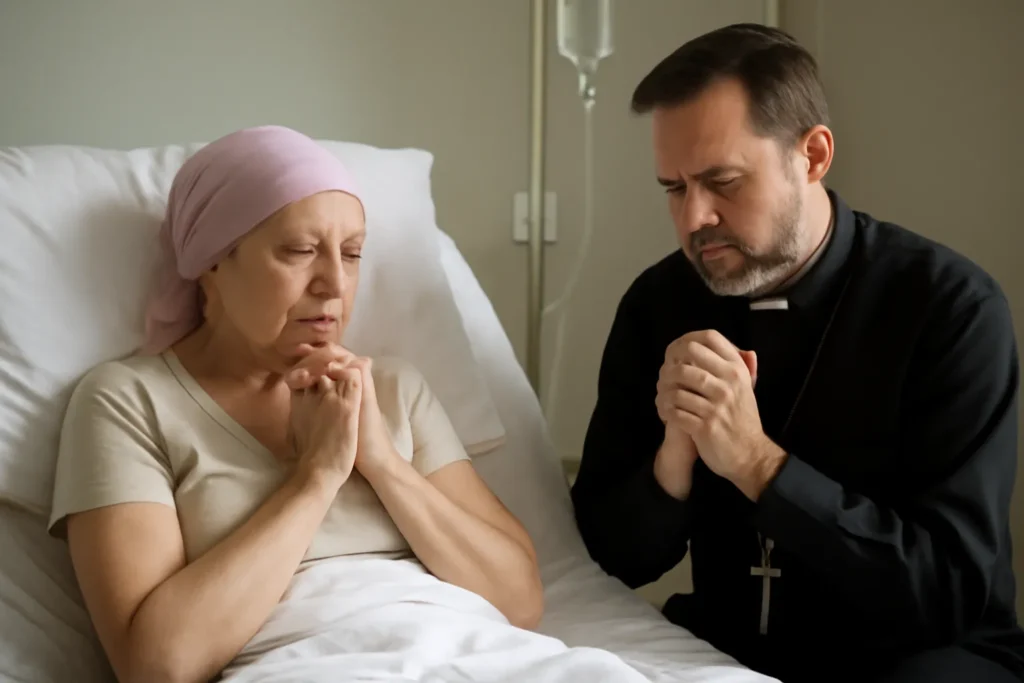
Speak with a parish priest or a hospital chaplain about sacramental care, blessing, or confession.
Join a parish prayer group or a patient support circle that prays for healing and comfort.
Ask about parish-based rosary groups or devotional societies that can visit or pray remotely.
It is important to remember that spiritual care is a complement to medical treatment. If mental or emotional difficulties arise, seek guidance from healthcare professionals in addition to spiritual support.
Embracing hope and community
The Catholic tradition teaches that faith communities are not distant observers but active participants in the journey through illness. The prayers, rituals, and devotions described above can be shared with family and friends, inviting them to join in intercession and support. A sense of community helps reassure patients that they are surrounded by people who care deeply, who lift their concerns to God, and who stand with them in practical and spiritual ways.
For some, hope is renewed not just by a medical beacon but by a moment of grace—a reminder that suffering has meaning within the larger story of God’s love for creation. In Catholic tradition, even hard days can become occasions for a deeper trust that God walks with every patient, every caregiver, and every member of the circle of care.
A practical note: prayers as a companion, not a substitute
It is important to recognize that prayer is a resource for the heart, not a substitute for medical care. While prayer can bring peace, courage, and spiritual healing, it should be integrated with evidence-based medical treatment, emotional support, and appropriate palliative or curative care as advised by healthcare professionals.
If you are exploring Catholic prayers for a loved one with cancer, consider working with a chaplain or parish priest to tailor a spiritual plan that respects the patient’s beliefs, energy levels, and medical circumstances. A compassionate approach may include combining prayers with practical actions—sending flowers, arranging visits, sharing comforting music, or providing a quiet space for reflection.
Final reflections: embracing the journey with faith
The experience of cancer is unpredictable, often demanding the best of our physical, emotional, and spiritual resources. Catholic prayers for cancer patients—whether through the Our Father, the Hail Mary, the intercession of the saints, the healing prayers described here, or the solace of the Rosary—offer a lifeline of faith. They help patients remember that they are beloved, valued, and not alone in their struggle. They also invite families and caregivers into a shared prayer life that can sustain hope, deepen compassion, and bring a sense of peace even in difficult days.
If you are starting or renewing a practice of prayer for a cancer patient, consider the following practical steps:
Choose a few reliable prayers that resonate with the patient’s heart and beliefs.
Create a small, accessible prayer space that invites regular use.
Establish a simple routine that aligns with medical appointments and energy levels.
Involve family and friends in intercessory prayers to strengthen communal support.
Consult with a priest or chaplain about sacramental opportunities and spiritual care options.
In the end, the goal is not merely to achieve a outcome but to cultivate steadfast faith, quiet hope, and compassionate presence throughout the journey. The Catholic prayers and devotions outlined in this article are offered as tools to help patients find comfort and strength, to heal the soul as well as the body, and to walk with grace through whatever comes next.








Leave a Reply