Cleansing of the temple: Meaning and Bible accounts
Cleansing of the temple: Meaning and Bible accounts
Have you ever wondered why Jesus, usually portrayed as gentle and patient, drove merchants and animals from the temple? The cleansing of the temple is one of the most forceful scenes in the Gospels, and it can seem surprising until you examine what the temple represented, what was happening there, and why Jesus acted publicly.
Jesus was not objecting to worship, sacrifice, or every form of buying and selling. The temple was the center of Jewish worship, and pilgrims often needed animals for sacrifice and currency exchange. His action challenged the way a sacred place had become associated with commercial activity, exclusion, and spiritual corruption. He called the temple a house of prayer and condemned its use as a place for robbers, drawing attention to the gap between religious appearance and faithfulness to God.
Where the cleansing of the temple appears in the Gospels
The event appears in all four Gospels, but the accounts are arranged in two different ways. Matthew 21:12-17, Mark 11:15-19, and Luke 19:45-48 place the temple action during Jesus’ final visit to Jerusalem, shortly before his crucifixion. John 2:13-22 places a similar event near the beginning of Jesus’ public ministry.
That difference has led to two main interpretations. Some readers believe the Gospels describe one cleansing, remembered or arranged differently by the Gospel writers. Others believe Jesus cleansed the temple twice: once early in his ministry and again near its end. The text itself does not settle the question for every reader, so it is best to acknowledge both possibilities rather than force certainty where the accounts differ.
The accounts share several central details:
Jesus enters the temple area and confronts people involved in selling and exchanging.
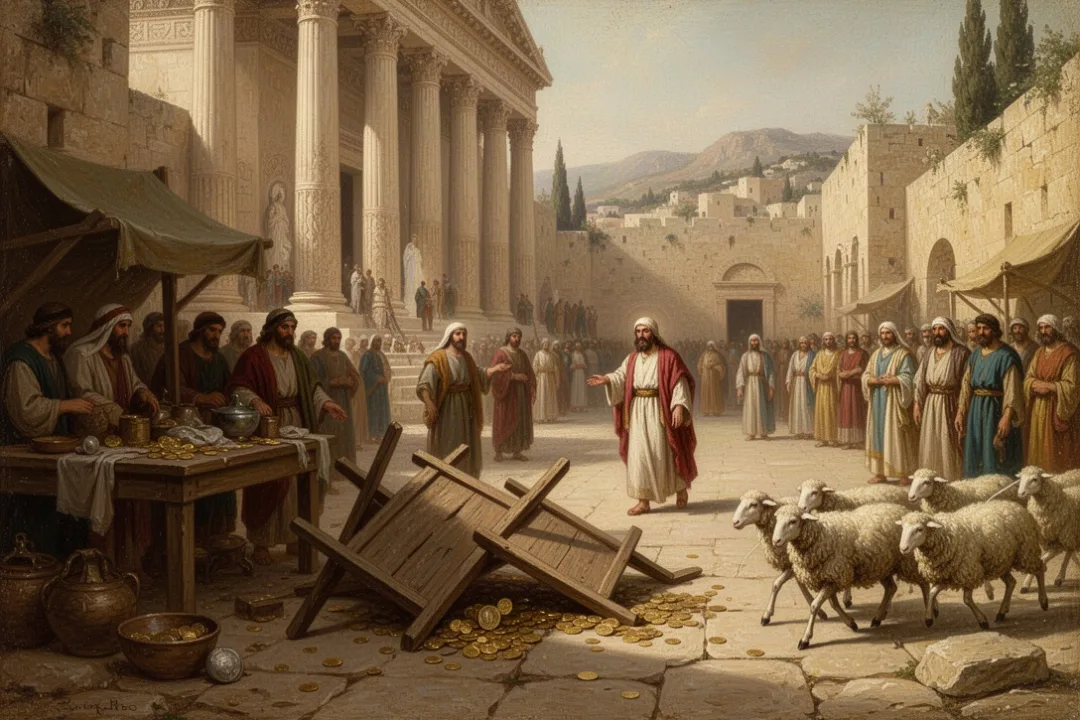
He disrupts the activity by driving out those who were buying and selling, overturning tables, or preventing people from carrying merchandise through the temple courts.
He appeals to the temple’s purpose as a place of prayer and worship.
Religious leaders challenge his authority, while the Gospel writers connect the event with Jesus’ identity and mission.
John’s account includes details that do not appear in the same form in the Synoptic Gospels. Jesus makes a whip of cords, drives out sheep and cattle, pours out coins, and overturns tables. John also records a saying about destroying “this temple” and raising it in three days; the Gospel explains that Jesus was referring to his body, not promising to rebuild the physical building in three days.
Matthew, Mark, and Luke emphasize the temple as a place that should serve prayer. Mark also records Jesus’ criticism of a system that harmed vulnerable people while maintaining a religious appearance. Luke highlights Jesus teaching in the temple afterward, showing that the action was not an isolated outburst but part of his broader public challenge to the temple leadership.
Reading the accounts together: The Gospel writers emphasize different details, but they agree on the central point: Jesus confronted the misuse of sacred space and acted with authority over the temple’s purpose.
What Jesus was confronting in the temple courts
The temple in Jerusalem was not simply a meetinghouse. It was the place associated with Israel’s sacrifices, priesthood, festivals, and prayers. Jewish people traveled there from across the land and from communities beyond it. The temple courts therefore had to support a large number of pilgrims, especially during festivals such as Passover.
Visitors needed acceptable animals for sacrifice, including birds or larger livestock depending on the offering. They also needed to exchange foreign or unsuitable coins for currency accepted for the temple contribution. The presence of sellers and money changers was not automatically proof of wrongdoing. In practical terms, these services could help pilgrims worship according to the requirements of the law.
The problem was the way those activities occupied and shaped the sacred space. The Synoptic Gospels place the scene in the temple courts, often understood as the outer area where Gentiles could also come to pray. If trade filled that space, people who were not Jewish had less access to the worship of Israel’s God. Jesus’ criticism therefore concerns more than clutter or noise; it concerns the temple’s mission to be a place where people could seek God.
Jesus’ words connect the temple with the language of prayer for all nations, drawing on Isaiah 56:7. He also refers to the temple as a “den of robbers,” echoing Jeremiah 7:11. Rather than reproducing those passages word for word, the idea can be stated this way: God’s people were treating the temple as a refuge that concealed injustice, even though God had already warned that worship could not protect them from the consequences of evil.
The word robbers is significant. It may suggest more than ordinary theft at a marketplace. In Jeremiah’s setting, people committed violence and injustice, then acted as if worship at the temple made them safe from judgment. Jesus applies that prophetic pattern to his own time: religious activity had become a cover for behavior that contradicted God’s character.
The Gospels do not provide a complete price list or describe every business practice in the temple. They also do not say that every merchant was personally dishonest. Claims that Jesus was condemning all commerce, every money exchange, or the legitimate sale of sacrificial animals go beyond what the texts directly state. The focus is on misused worship and corrupt priorities, not on a blanket rejection of practical arrangements.
Several features make the scene especially serious:
Sacred space was being redirected from prayer toward activity that served financial and institutional interests.
People who came to worship, including those with limited resources, could be exposed to pressure or exploitation.
The temple system could appear religious while failing to reflect mercy, justice, and openness to God.
The people responsible for protecting worship were challenged by someone acting outside the established leadership structure.
Jesus’ action also recalls the Old Testament prophets. Prophets sometimes used vivid public actions to communicate God’s judgment. Their purpose was not spectacle for its own sake. A dramatic sign made an invisible spiritual problem visible. By interrupting temple activity, Jesus turned the temple itself into a sign: the institution claiming to bring people near to God was in need of judgment and renewal.
Why the cleansing of the temple mattered to Jesus’ mission
The temple action is closely connected to Jesus’ announcement of God’s kingdom. He did not merely ask for better management or quieter worship. He challenged the religious order’s claim to represent God faithfully. His action raised a fundamental question: Who has the right to define true worship, and what does God desire from the people who worship?
In the Synoptic accounts, the cleansing occurs as Jesus enters Jerusalem during the final phase of his ministry. The timing matters because tension between Jesus and the temple authorities is already increasing. After the action, leaders look for a way to destroy him, while crowds are attracted to his teaching. The incident becomes part of the conflict that leads to his arrest and death.
Jesus’ authority is central to the story. He does not present himself as a temple employee, priest, or ordinary reformer appointed by the leadership. He enters, acts, teaches, and interprets the temple’s purpose as someone with a direct commission from God. The leaders’ later questions about his authority are therefore not a side issue. They are the natural response to a public challenge from someone who has no official institutional role.
John’s Gospel makes the connection even more direct. When Jesus speaks about the temple being destroyed and raised in three days, the Gospel identifies the temple with his body. This does not mean the physical temple was unimportant in Jewish faith. It means that Jesus presents himself as the decisive meeting place between God and humanity. God’s presence and saving work are no longer understood only through the building in Jerusalem.
That claim helps explain why the cleansing can feel larger than a protest against dishonest business. The action is both prophetic judgment and a sign of Jesus’ identity. He judges the temple system while presenting himself as the one toward whom the temple’s worship points. Sacrifice, priesthood, prayer, and God’s dwelling place are all viewed through his mission.
Christians have traditionally connected this event with Jesus’ death and resurrection. The destruction and raising language in John points beyond the immediate confrontation to the resurrection. Jesus’ body, not the temple building, becomes the central sign of God’s presence. This interpretation does not erase the historical temple; it explains how the Gospel understands its meaning in light of Jesus.
The action also carries a warning for religious leaders. The temple was supposed to direct people toward God, but leadership could turn it into a system that protected status and revenue. Jesus’ conflict with the leaders shows that religious authority is accountable. A respected institution can still need correction when it burdens people, excludes them, or hides injustice behind sacred language.
The cleansing is therefore not best reduced to “Jesus got angry.” Anger is present, but it is directed by a moral purpose. His action exposes a contradiction: a place dedicated to prayer has become associated with practices that prevent prayer, and a community claiming covenant faithfulness has failed to embody justice. The force of the scene comes from that contradiction.
What “a house of prayer” and “den of robbers” mean
The phrase house of prayer describes the temple according to its intended purpose. Prayer here is not limited to private words spoken quietly. It represents worship, dependence on God, repentance, thanksgiving, and the gathering of people who seek God’s presence. A house of prayer should make room for sincere approach to God rather than place unnecessary barriers in the way.
That purpose was especially important for outsiders. Isaiah 56 presents a vision in which foreigners who hold fast to God are welcomed in worship. Jesus’ use of this theme suggests that the temple’s failure affected more than the Jewish people already participating in its system. The court associated with Gentile prayer had become the setting for activity that undermined the temple’s calling to welcome the nations.
The phrase den of robbers points toward protected wrongdoing. A robber’s den is not where robbery occurs; it is where robbers retreat after committing violence. Jesus’ language therefore evokes the idea of people using the temple as a place of religious security while continuing practices that God condemns. The issue is hypocrisy: seeking shelter in worship without allowing worship to change conduct.
This prophetic meaning explains why the cleansing should not be treated as a simple lesson about keeping church buildings tidy. Cleanliness and order may matter, but they are not the heart of the passage. The deeper concern is whether religious spaces and leaders help people draw near to God or use faith to serve power, profit, and self-protection.
The passage raises several questions that remain relevant to communities of faith:
Does worship welcome people who are seeking God, or does it mainly serve insiders?
Are financial practices transparent, fair, and accountable?
Do leaders protect vulnerable people, or do they protect an institution’s reputation?
Does teaching about God lead to mercy and justice, or merely provide a religious image?
Are sacred activities being used to excuse conduct that contradicts the message being preached?
These questions should be applied carefully. The cleansing of the temple is first a historical event involving Jesus, Jerusalem, and the temple system of his time. It should not be used casually to justify uncontrolled anger, vandalism, harassment, or accusations against people without evidence. Jesus’ authority in the Gospel scene is unique, and his prophetic action cannot simply be copied as a license for personal retaliation.
A practical distinction: The passage calls for courageous opposition to exploitation and hypocrisy, but it does not turn personal rage into righteous judgment. Accountability should be truthful, proportionate, and aimed at protecting people and restoring faithful worship.
How the temple cleansing applies to Christian faith today
For Christians, the first application is inward. Paul describes believers collectively as God’s temple in 1 Corinthians 3:16-17 and 1 Corinthians 6:19-20 uses temple language for the individual body. Those passages do not make the modern church building identical to the Jerusalem temple, but they do invite Christians to ask whether their lives are being devoted to God or occupied by competing loyalties.
That does not mean every personal struggle is equivalent to the temple corruption Jesus confronted. It does mean that Christian worship cannot be separated from the way people use their bodies, money, authority, and relationships. A person may participate in religious activity while keeping greed, contempt, or injustice protected from examination. The temple story challenges that divided life.
The second application concerns congregations and ministries. Churches need money, buildings, staff, and practical systems. The Gospel accounts do not require Christian communities to eliminate all financial activity. They do require communities to examine whether money supports ministry or quietly becomes the ministry’s controlling purpose.
Healthy practices include:
Clear financial accountability, with responsible oversight and honest communication.
Fair treatment of employees, volunteers, donors, and people receiving assistance.
Protection for children, vulnerable adults, and anyone reporting misconduct.
Worship that remains accessible rather than being shaped mainly by status or purchasing power.
Leadership willing to accept correction instead of treating criticism as disloyalty.
The third application concerns welcome. Jesus’ reference to prayer for all nations challenges communities to consider who can participate fully. Accessibility is not only about a building’s physical design. It can include language, social expectations, pricing, cultural habits, treatment of visitors, and whether people who lack money or influence are treated with dignity.
The fourth application is the relationship between worship and justice. The prophets repeatedly joined devotion to the treatment of neighbors. Jesus does the same in the temple. Prayer is not a replacement for justice, and public religious activity cannot compensate for exploiting people. Genuine worship should make a community more truthful, merciful, and willing to repair harm.
There is also a personal lesson about discernment. Jesus did not accept sacred claims at face value. He examined what a religious institution actually produced. Christians can do likewise without becoming cynical about every church, pastor, or ministry. The proper response is neither blind trust nor automatic suspicion, but careful evaluation by truth, character, and treatment of people.
When a community discovers corruption, the cleansing story supports decisive action, but wisdom is still necessary. Gather reliable facts, listen to those affected, follow appropriate reporting processes, and seek independent oversight where needed. Forgiveness does not mean ignoring danger, and reconciliation cannot be genuine while abuse or exploitation remains protected.
The event also offers hope. Jesus’ judgment is not aimed at destruction for its own sake. The temple is meant to become what it was called to be: a place of prayer. In Christian interpretation, Jesus himself becomes the center of access to God, and his resurrection opens the way to a new understanding of worship. The goal is not merely to remove corrupt activity but to restore the relationship between worship, holiness, welcome, and justice.
Questions the cleansing of the temple helps answer
Was Jesus condemning all buying and selling?
No. The Gospels do not present every seller or money changer as equally guilty, and they do not say that practical arrangements for pilgrims were inherently wrong. Jesus condemned the misuse of the temple and the corruption associated with it. The central issue was that activity connected with worship had displaced prayer and could reflect exploitation, exclusion, or institutional hypocrisy.
Why did Jesus overturn tables instead of simply teaching?
The physical action functioned as a prophetic sign. Like the symbolic actions of Old Testament prophets, it made the spiritual problem visible and forced people to confront it publicly. Jesus also taught afterward, so the action and the teaching belong together. The event communicated judgment, while his words explained that the temple’s purpose had been contradicted.
Did the cleansing happen once or twice?
The Synoptic Gospels place the event near the end of Jesus’ ministry, while John places a similar event near the beginning. Some interpreters understand the difference as distinct chronological arrangements of one event; others believe Jesus acted in the temple twice. Since the Gospel accounts emphasize different theological purposes, readers should recognize the difference without claiming more certainty than the texts provide.
What should Christians do when a church becomes corrupt?
They should respond with truth, protection, and accountable action rather than gossip or personal revenge. Document credible concerns, use appropriate church or civil reporting channels, support people who have been harmed, and seek independent help when leaders cannot investigate themselves. The temple story calls for confronting exploitation, but it does not excuse reckless accusations or uncontrolled anger.
Frequently asked questions
What is the cleansing of the temple?
The cleansing of the temple is Jesus’ public disruption of buying and selling in the Jerusalem temple courts. The Gospel accounts present it as a prophetic action against the misuse of sacred space, religious hypocrisy, and practices that interfered with prayer. Jesus’ concern was not simply noise or commerce, but the failure to honor the temple’s purpose and welcome people seeking God.
Where is the cleansing of the temple found in the Bible?
It appears in Matthew 21:12-17, Mark 11:15-19, Luke 19:45-48, and John 2:13-22. Matthew, Mark, and Luke place it near the end of Jesus’ ministry. John places a similar account near the beginning. This difference has led interpreters to debate whether the Gospels describe one event arranged differently or two separate temple actions.
What does the cleansing of the temple teach about anger?
The event shows that anger can be morally serious when it responds to exploitation and dishonored worship, but it does not make every angry reaction righteous. Jesus’ action served a prophetic purpose and was accompanied by teaching. Christians should not use it to defend impulsive aggression, vandalism, or personal revenge. Truthful, proportionate accountability better reflects the passage’s concern for justice.
Does the cleansing of the temple apply to churches today?
It can challenge churches to examine whether worship remains centered on God, prayer, welcome, justice, and care for vulnerable people. The passage does not prohibit every financial activity connected with ministry, since congregations need practical resources. It does warn against allowing money, status, or institutional self-protection to displace worship or conceal harm.










Leave a Reply