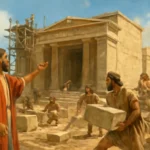
To understand the significance of Herod's Temple in Jerusalem, one must start with the broader history of the city and its sacred precincts. The site had long been the heart of Jewish worship since the biblical-era Temple on the mount, which stood as the primary locus for sacrifices, prayers, and social gathering during pilgrimage seasons. After the destruction of the First Temple by the Babylonians in the 6th century BCE, the Persian and later the Hellenistic periods saw a rebuilt sanctuary that served as the center of Jewish devotion. The completion of the Second Temple in 516 BCE established a focus for communal life, ritual leadership, and national memory. Yet by the late decades of the 1st century BCE, the political landscape changed dramatically as Herod the Great—the Roman client king who pursued legitimacy through monumental building projects—embarked on a sweeping renovation and expansion of the temple complex.
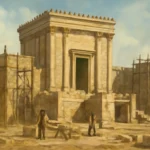
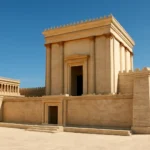
This transformation produced a version of the sanctuary commonly referred to as Herod's Temple or the Herodian Temple, a grand hybrid of religious symbolism and political statement. The project aimed to elevate Jerusalem’s sacred precincts to fit a city that would host large crowds during festival seasons and that could symbolically project loyalty to Rome while reinforcing the king’s authority at home. The result was not merely a larger building but an entire architectural program that reshaped the topography of the Temple Mount and the surrounding precincts. The temple complex, often described in later sources as a vast precinct, became one of the most celebrated and debated structures of the ancient world.
In historical memory, Herod's Temple stood as the apex of the Second Temple era—a period defined by a functioning sacrificial system, a dynamic priestly hierarchy, and a vivid sense of national identity bound to the holy city. When the Romans destroyed the sanctuary in 70 CE during the siege of Jerusalem, the physical center of Jewish worship shifted, and Jewish life began to reorganize around rabbinic leadership and synagogues rather than a centralized temple cult. The fall of the temple marked a turning point in Jewish history and left a lasting imprint on Christian and Islamic traditions as well, each of which engaged with the site in distinct ways across centuries.
In discussing the historical arc of the temple complex, it is essential to distinguish between the religious purpose of the sanctuary and the political aims that accompanied its renovations. The temple precincts were always a stage upon which liturgical rituals, civic identity, and imperial prestige intersected. The Temple Mount thus functioned as a sacred geography whose meaning extended beyond ritual slaughter to become a symbol of covenantal relationship, national aspiration, and contested sovereignty. The story of Herod's Temple, then, is as much about architecture and ritual as it is about kingship, diplomacy, and memory.
Key dates associated with the project: the late 20s BCE to approximately 19 BCE for completion of the main rebuilding, with ongoing enhancements thereafter.
The destruction of the temple by Roman forces in 70 CE, a watershed event in Jewish history.
Continuing reverberations in rabbinic literature, Christian writings, and later Islamic tradition.
The architectural program of the late Second Temple period, culminating in the Herodian phase, reflected a blend of classical Hellenistic influence and distinctive Jewish religious concerns. The project transformed an urban space into a monumental complex designed to accommodate vast crowds, ritual activities, and ceremonial processions. The outer features of the temple precincts—courts, gates, and colonnades—were as much about processional movement and social order as about the inner sanctum where sacred rites occurred.
Key components of the temple complex
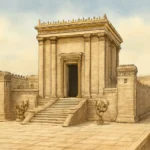
Temple building (Hekal) and the central sanctuary, which housed the holy place and, within the inner sanctum, the Holy of Holies as the most sacred chamber of the site.
The Holy Place (Kodesh) and the Holy of Holies (Kodesh HaKodashim), accessible only to the priests on designated days and during certain rites.
The porch and vestibule that served as transitional spaces between the courtyards and the inner sanctuary.
The surrounding courts—the Court of the Gentiles, the Court of the Women, the Court of Israel, and the Court of the Priests—each with specific ritual and social functions.
The Royal Stoa and other monumental colonnades that lined the large platform, providing space for assembly, teaching, and commerce related to festival activity.
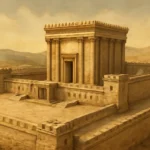
The expansive Temple Mount platform, whose reinforcement and enlargement created a vast precinct capable of accommodating large crowds during annual pilgrimages.
Significant gate complex and entrances that controlled access to different parts of the precinct, complementing the ritual hierarchy that structured temple life.
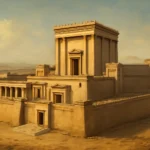
Architects and artisans employed on this project integrated decorative elements, structural mastery, and ceremonial symbolism. While the exact architectural plans are known primarily from ancient writers and later rabbinic descriptions, archaeological remains—such as portions of the Western Wall—offer tangible echoes of the robustness and grandeur of the Herodian construction. The use of white stone, precise stone-cutting, and, in some exterior surfaces, gold plating on certain features are among the details that contribute to the lasting memory of the site’s splendor.
Layout and movement within the temple complex
The spatial ordering of the precincts reflected a hierarchy of access. The outermost area, the Court of the Gentiles, allowed non-Jews to approach to a limited degree and served as a place of commerce and exchange during festival seasons. Progression inward moved toward the Court of the Women, where worshipers could participate in offerings and observe certain rites. The inner reaches—accessible to priests and certain qualified individuals—led to the Court of Israel and ultimately to the Court of the Priests near the sanctuary itself. This architectural arrangement reinforced the sacred boundaries of ritual life, while facilitating the administrative and ceremonial routines that characterized temple service.
Religious Function and Daily Life in the Temple Complex
The temple in Jerusalem functioned as the center of the Jewish sacrificial system, a hub for liturgical observance, and a focal point for communal identity. The Second Temple sanctuary hosted daily offerings, special festival sacrifices, and a stream of pilgrims who traveled from across the ancient world to participate in rites during Passover, Shavuot, and Sukkot. Within this framework, the role of the priestly class—particularly the Levites and the priestly families—was central in performing sacrifices, maintaining ritual purity, and guiding the ceremonial calendar. The temple’s rituals shaped daily life, social interaction, and political allegiance in ways that resonated through generations.
Daily offerings included morning and evening sacrifices, accompanied by music and liturgical recitations.
Festival pilgrimages during Passover, Shavuot, and Sukkot drew thousands to the temple precincts, turning the site into a dynamic stage for national identity.
Cleansing and preparation rites, priestly duties, and attention to ritual impurity were ongoing concerns that governed temple routines.
Special rites associated with cleansing, purification pools, and ceremonial washing complemented the sacrificial program.
In broader religious terms, the temple was imagined as the visible interface between the people and the divine. Its sanctuaries and courts served as a stage for prayer, confession, and corporate worship, even as the institution of sacrifice anchored the covenantal relationship through the ritual economy. The architecture and ritual life of Herod's Temple together created a powerful symbol of continuity with past generations and a tangible expression of communal aspiration during a tumultuous historical era.
Significance in Judaism, Christianity, and Later Traditions
The destruction of the temple is a watershed event in Jewish history, marking the end of a particular era of centralized worship and the beginning of rabbinic leadership that reshaped religious life around synagogues, study, and prayer. In Judaism, the site came to symbolize longing for restoration and messianic expectation, while the memory of the temple’s rituals influenced later liturgical poetry, law, and interpretation. The Herodian Temple also left a profound mark on Christian thought, where the temple figures in the Gospels as a setting for Jesus’ teachings, cleansing of the Temple, and prophetic pronouncements about the city’s future. In Christian tradition, the temple sometimes functions as a sign of end-times in the eschatological discourse, while in other contexts it is read as a historical backdrop to the life of Jesus and the early Christian movement.
In Islamic historiography, the Temple Mount became known as a contested sacred precinct in later centuries, where the Dome of the Rock and the Al-Aqsa Mosque were constructed on the same elevated site revered in the Jewish tradition. The layered history of the site underscores how a single sacred space can acquire multiple meanings across civilizations. The memory of the old sanctuary remains a central element of Jewish liturgical imagination, reflected in prayers that recall the Temple’s rituals and in hopes for future restoration. Simultaneously, Christian tradition has long engaged with the temple as a place of spiritual symbolism and narrative weight in the life of Jesus and the early church.
Archaeology, Textual Evidence, and Legacy
For scholars, the study of Herod's Temple relies on a blend of ancient textual sources and the material remnants that survive into modern times. The principal ancient accounts include the writings of Flavius Josephus, whose two major works—the Antiquities of the Jews and the War of the Jews—provide eyewitness-like descriptions of the temple’s size, splendor, and eventual destruction. In addition, the rabbinic corpus—especially the Mishnah and the Talmud—offers a later but essential portrait of temple architecture, ritual order, and the laws governing sacrificial service. The tractate Middot, for example, provides a late antique, systematic description of the temple precincts, drawing on older traditions to map out its layout and ceremonial sequence.
Archaeological evidence associated with the Herodian program is fragmentary but meaningful. The enduring Western Wall (the retaining wall that supports the Temple Mount) is a visible, tangible trace of the ancient platform’s scale. Excavations in the broader area—the City of David and other nearby sites—have yielded inscriptions, architectural fragments, and geomorphological data that illuminate the engineering challenges and aesthetic ambitions of the era. While no complete model of the temple complex survives, the combination of literary testimony and physical remains allows researchers to reconstruct a credible sense of the sanctuary’s grandeur, the order of its courts, and the public rhythms that would have defined the lives of those who worshiped there.
The long-standing fascination with the temple has generated a durable legacy in art, literature, and public memory. The description of Herod’s Temple in sources ranging from classical histories to rabbinic texts informs modern historical fiction, scholarly monographs, and documentary projects. The multi-faceted significance of the site arises from its function as a religious altar, a political stage, and a symbol that transcends a single tradition. For many readers, the story of the temple remains a compelling case study in how architecture can encode religious meaning and how a single place can become a touchstone for a community’s past, present, and future hopes.
Modern Reflections and the Temple’s Enduring Influence
In contemporary discourse, the legacy of the ancient sanctuary on the Temple Mount continues to shape discussions about history, archaeology, and diplomacy. The site’s towering symbolic capital means that debates about archaeology, access, and governance often intersect with political realities in the region. The modern proportions of the area—the coexistence of religious, national, and cultural claims—reflect a complex continuum that stretches back to the era of Herod the Great and the Roman Empire. The enduring memory of Herod's Temple remains a touchstone in Jewish memory and a recurring reference point in Christian and Islamic literary and artistic traditions.
For readers and researchers, the temple’s story invites exploration of several themes:
The relationship between religious authority and political power in ancient cities.
The ways that monumental architecture can function as a political statement and a religious instrument.
The role of sacred spaces in shaping community identity over long periods of time.
The interplay between textual descriptions and archaeological evidence in reconstructing historical sites.
Today, when scholars speak of the temple precincts on the Mount, they do so with an awareness that the physical ruins are only part of a layered memory. The Second Temple era—and its culminating expansion under Herod—offers a rich field for investigation into how ancient societies organized worship, governance, and social life around a single, preeminent sanctuary. The enduring fascination with this chapter of Jerusalem’s history reflects how sacred architecture can become a lasting symbol of a culture’s ambitions, anxieties, and aspirations for generations to come.





Leave a Reply