Complete Bible with all books: a clear book-by-book guide
Complete Bible with all books: a clear book-by-book guide
If you are looking for a complete Bible with all books, the standard Protestant Bible contains 66 books: 39 in the Old Testament and 27 in the New Testament. These books include history, poetry, prophecy, the Gospels, letters, and apocalyptic writing.
The Bible is not one book written in a single style. It is a collection of writings produced across many centuries, centered on God’s relationship with humanity and, for Christians, fulfilled in the life, death, and resurrection of Jesus Christ. Catholic and Orthodox Bibles include additional books, so the exact contents depend on the Christian tradition you are using.
The following list gives the complete Protestant Bible from Genesis through Revelation. The order is shared by most widely used Protestant translations, including the King James Version, New International Version, English Standard Version, Christian Standard Bible, and New American Standard Bible.
The 39 books of the Old Testament
The Old Testament, also called the Hebrew Bible in Jewish contexts, records creation, the history of Israel, the law, wisdom literature, and messages from the prophets. Christians read it as the first major part of the Bible and as the background to the New Testament.
Genesis — Creation, the fall of humanity, the flood, and the beginnings of Israel through Abraham, Isaac, Jacob, and Joseph.
Exodus — Israel’s rescue from Egypt, the covenant at Mount Sinai, the Ten Commandments, and the construction of the tabernacle.
Leviticus — Laws about worship, sacrifices, priests, purity, holiness, and life within Israel’s covenant.
Numbers — Israel’s wilderness years, censuses, rebellion, judgment, and preparation to enter the promised land.
Deuteronomy — Moses’ speeches reviewing the law and preparing the next generation to live in the land.
Joshua — Israel’s entry into Canaan, the division of the land, and Joshua’s leadership after Moses.
Judges — Repeated cycles of Israel’s disobedience, oppression, repentance, and deliverance through various judges.
Ruth — A story of loyalty, redemption, and God’s providence involving Ruth, Naomi, and Boaz.
1 Samuel — Samuel’s leadership, Saul’s reign, and David’s rise as Israel’s chosen king.
2 Samuel — David’s reign, military victories, covenant promises, family troubles, and national consequences.
1 Kings — Solomon’s reign and temple, followed by the divided kingdom and the ministry of Elijah.
2 Kings — The decline and exile of Israel and Judah, including the ministries of Elijah and Elisha.
1 Chronicles — Genealogies and a retelling of Israel’s history with special attention to David and worship.
2 Chronicles — Judah’s kings, the temple, reform movements, national failure, exile, and return.
Ezra — The return from exile, rebuilding the temple, and renewed attention to the law.
Nehemiah — The rebuilding of Jerusalem’s walls and spiritual reforms among the returned exiles.
Esther — How Esther and Mordecai helped preserve the Jewish people in the Persian Empire.
Job — A poetic exploration of suffering, human limitations, faithfulness, and God’s wisdom.
Psalms — Songs and prayers expressing praise, grief, trust, confession, thanksgiving, and hope.
Proverbs — Practical wisdom about speech, work, relationships, discipline, justice, and reverence for God.
Ecclesiastes — Reflections on mortality, work, pleasure, wisdom, and the limits of life “under the sun.”
Song of Solomon — Love poetry celebrating desire, affection, beauty, and commitment.
Isaiah — Prophetic warnings, promises of restoration, the holiness of God, and visions Christians connect with the Messiah.
Jeremiah — Warnings before Jerusalem’s fall, calls to repentance, grief over judgment, and promises of a new covenant.
Lamentations — Poems mourning Jerusalem’s destruction while still seeking mercy and hope.
Ezekiel — Visions, symbolic actions, judgment, restoration, and promises of renewed spiritual life.
Daniel — Stories of faithfulness in exile and visions concerning kingdoms, judgment, and God’s lasting rule.
Hosea — A prophetic picture of Israel’s unfaithfulness and God’s persistent covenant love.
Joel — A locust disaster becomes a setting for calls to repentance and promises concerning God’s Spirit and future judgment.
Amos — A strong condemnation of exploitation, religious hypocrisy, and injustice toward the poor.
Obadiah — Judgment against Edom and a promise concerning the restoration of God’s people.
Jonah — A reluctant prophet learns about God’s compassion toward the people of Nineveh.
Micah — Condemnation of corrupt leaders, a call for justice, and promises of restoration and a future ruler.
Nahum — A prophetic announcement of Nineveh’s downfall after its violence and oppression.
Habakkuk — A conversation with God about injustice, violence, and how faith responds when evil appears to prevail.
Zephaniah — Warnings about the day of the Lord followed by promises of purification and restoration.
Haggai — Encouragement for the returned exiles to rebuild the temple and reorder their priorities.
Zechariah — Visions of restoration, hope for Jerusalem, and future themes that Christians associate with the Messiah.
Malachi — A challenge to careless worship and covenant unfaithfulness, along with hope for God’s coming messenger.
The 27 books of the New Testament
The New Testament begins with the life and ministry of Jesus and continues with the growth of the early church. Its books explain Christian beliefs, address practical questions in local congregations, and point readers toward faithful living and future hope.
Matthew — Jesus’ life and teaching, presented with strong connections to Israel’s Scriptures and the kingdom of heaven.
Mark — A fast-moving account emphasizing Jesus’ actions, authority, suffering, death, and resurrection.
Luke — An orderly account highlighting Jesus’ compassion, prayer, concern for outsiders, and saving mission.
John — A reflective Gospel presenting Jesus’ identity, signs, teaching, death, and resurrection as the source of life.
Acts — The spread of the gospel from Jerusalem through the Roman world, including the work of Peter, Paul, and other believers.
Romans — Paul’s detailed explanation of sin, grace, faith, righteousness, Israel, Christian ethics, and life in the Spirit.
1 Corinthians — Guidance for a divided church dealing with worship, spiritual gifts, sexual ethics, love, and resurrection.
2 Corinthians — Paul explains Christian ministry, weakness, reconciliation, generosity, and his relationship with the Corinthian church.
Galatians — A defense of salvation by faith and a warning against making Gentile believers adopt the requirements of the Mosaic law.
Ephesians — Teaching about salvation, the unity of believers, the church, spiritual maturity, and Christian conduct.
Philippians — Encouragement toward joy, humility, unity, perseverance, and confidence in Christ amid hardship.
Colossians — A presentation of Christ’s supremacy and guidance for living with a renewed identity.
1 Thessalonians — Encouragement in persecution, instruction about holy living, and hope concerning Christ’s return.
2 Thessalonians — Clarification about the day of the Lord and a call to steady, responsible faithfulness.
1 Timothy — Instructions about church leadership, worship, teaching, care for people, and personal example.
2 Timothy — Paul’s final encouragement to remain faithful, endure hardship, and guard the apostolic message.
Titus — Guidance about church leaders, sound teaching, good conduct, and practical Christian service.
Philemon — A short appeal for reconciliation involving Paul, Philemon, and Onesimus.
Hebrews — A sustained argument that Jesus is superior to earlier priests, sacrifices, and covenant arrangements.
James — Practical teaching about trials, speech, wisdom, favoritism, works, prayer, and active faith.
1 Peter — Hope and holy living for Christians facing suffering and social pressure.
2 Peter — A warning about false teachers and an encouragement to grow in Christian character while awaiting God’s promises.
1 John — Assurance, truth about Jesus, obedience, love, and discernment concerning false teaching.
2 John — A brief letter encouraging love and warning believers not to support deceptive teaching.
3 John — A message about hospitality, faithful service, and conflict within a Christian community.
Jude — A call to defend the faith against corrupt teachers while showing appropriate mercy.
Revelation — Symbolic visions of judgment, spiritual conflict, Christ’s victory, and the renewal of creation.
Quick answer: The Protestant Bible has 66 books, divided into 39 Old Testament books and 27 New Testament books. The first five are Genesis through Deuteronomy, and the final book is Revelation.
How the Bible’s books are grouped
Knowing the Bible’s major sections makes the full collection easier to remember. The groupings describe the type and purpose of the writings, although some books combine more than one literary style.
The Pentateuch: Genesis, Exodus, Leviticus, Numbers, and Deuteronomy. These five books establish the creation story, Israel’s origins, the covenant, and the law.
Historical books: Joshua through Esther. They trace Israel’s settlement, judges, kings, exile, and partial restoration.
Wisdom and poetry: Job through Song of Solomon. These books explore worship, suffering, wise living, mortality, and love.
Major Prophets: Isaiah, Jeremiah, Lamentations, Ezekiel, and Daniel. “Major” refers mainly to length, not greater importance.
Minor Prophets: Hosea through Malachi. These 12 shorter prophetic books address judgment, injustice, repentance, restoration, and hope.
Gospels: Matthew, Mark, Luke, and John. Each presents Jesus’ ministry from a distinct perspective.
Church history: Acts. This book continues Luke’s account and describes the early Christian mission.
Paul’s letters: Romans through Philemon. These letters address churches and individuals about belief, conduct, leadership, and community life.
General letters: Hebrews through Jude. They come from several Christian leaders and address perseverance, holiness, suffering, truth, and love.
Apocalyptic writing: Revelation. Its visions use vivid symbols to communicate judgment, perseverance, and hope.
The labels major prophet and minor prophet can be misleading if they sound like a ranking. The terms traditionally describe the relative length of the books. A short book such as Micah or Habakkuk can address themes as significant as those found in Isaiah or Jeremiah.
What “complete Bible” means in different Christian traditions
“Complete Bible” does not mean exactly the same collection for every Christian denomination. Protestant churches generally recognize 66 books. The Catholic Bible contains 73 books, including seven additional Old Testament books known as the deuterocanonical books, along with additions to Esther and Daniel.
The Catholic books commonly included beyond the Protestant Old Testament are Tobit, Judith, 1 Maccabees, 2 Maccabees, Wisdom, Sirach, and Baruch. Catholic editions also include expanded sections in Esther and Daniel. These writings are part of the Old Testament used in Catholic worship and teaching.
Eastern Orthodox churches may include additional books beyond the Catholic collection, although the exact contents can vary among Orthodox traditions. Examples may include 1 Esdras, the Prayer of Manasseh, Psalm 151, and 3 Maccabees. Some editions also treat other writings differently, so readers should check the table of contents of a specific Orthodox Bible.
Jewish editions of the Hebrew Bible contain the same core books as the Protestant Old Testament, but the books are arranged and counted differently. For example, books that Protestants count separately may be combined in the Jewish arrangement. The names and order of sections also differ, with the Torah, Prophets, and Writings forming the traditional structure.
Check the edition before you count the books. A Bible labeled Catholic, Orthodox, Protestant, Jewish, or interdenominational may have a different table of contents. The translation and the canon are related but not identical questions.
How to read all the books without losing the larger story
Reading the Bible straight through from Genesis to Revelation is possible, but the changing genres can make the experience difficult. A plan that combines narrative books with poetry, prophecy, and the New Testament often gives you a clearer sense of the Bible’s main storyline.
Begin with Luke and Acts. These connected books provide a substantial account of Jesus’ ministry and the early church.
Read Genesis and Exodus. They establish creation, human rebellion, the patriarchs, Israel’s rescue, and the covenant.
Read selected wisdom books. Psalms offers prayer and worship, Proverbs gives practical wisdom, and Job addresses suffering and trust.
Read the remaining historical books. Joshua through Esther explain Israel’s national story, including the monarchy, division, exile, and return.
Read the letters alongside the story of Acts. Romans through Jude show how early Christians understood Jesus and organized their communities.
Return to the prophets. Isaiah through Malachi make more sense when you understand the political and spiritual circumstances they address.
Finish with Revelation carefully. Read it as a symbolic work of Christian hope, paying attention to its links with earlier biblical themes.
Another approach is to read one book at a time in canonical order while keeping a simple record of people, places, promises, conflicts, and repeated themes. You do not need to solve every difficult passage before moving forward. Mark questions and return to them after gaining more context.
What to look for as you read the complete Bible
The Bible contains many individual stories, but several themes connect the books. The first is creation and human responsibility. Genesis presents the world as created by God and describes the fracture introduced by human sin. Later books repeatedly address the consequences of rebellion and the possibility of restoration.
A second theme is covenant. God’s relationships with Noah, Abraham, Israel, David, and the people described in the prophets are expressed through promises and obligations. The New Testament presents Jesus as central to a new covenant and interprets his death and resurrection as decisive acts in God’s saving work.
A third theme is the presence of God. The tabernacle and temple represent God’s presence among Israel. The Gospels present Jesus as the central meeting point between God and humanity, while later New Testament writings describe the church and individual believers in relation to God’s Spirit.
A fourth theme is justice and mercy. The prophets repeatedly criticize dishonest business, abuse of power, exploitation of the poor, and religious practice disconnected from righteous conduct. The New Testament continues this concern through teachings about love, generosity, reconciliation, humility, and care for vulnerable people.
Finally, the Bible develops a theme of hope beyond present suffering. That hope appears in different forms: return from exile, restoration of Jerusalem, resurrection, the reign of Christ, judgment of evil, and renewal of creation. The details are not always presented in the same way, so each passage should be read in its own literary and historical setting.
How to choose a complete Bible edition
A Bible’s translation affects how easily you understand its wording, but it does not usually determine whether the Protestant collection has 66 books. When choosing an edition, consider the language level, study features, physical format, and tradition behind the notes.
For clear contemporary English: consider translations written in accessible modern language, while comparing difficult passages across more than one edition.
For close study: choose a Bible with cross-references, historical notes, maps, introductions, and explanations of manuscript or translation issues.
For public reading: look for natural rhythm, readable paragraph formatting, and a translation your audience can follow aloud.
For Catholic reading: select a Catholic edition containing the deuterocanonical books and notes that reflect Catholic interpretation.
For Orthodox reading: use an edition recommended by your local parish or jurisdiction because the accepted collection and preferred translation can differ.
For comparing translations: use the same passage in two or three editions, paying attention to wording, footnotes, and paragraph structure.
A study Bible can be helpful, but its notes are not part of the biblical text. Read the biblical passage first, then consult the notes for historical background, cross-references, definitions, and interpretive options. This habit helps you distinguish what the text says from one editor’s explanation of it.
Why the books appear in different orders
The Protestant order is not the only arrangement Christians have used. The Hebrew Bible has a different order that places the books into the Torah, Prophets, and Writings. This arrangement changes how the collection ends and can emphasize a different movement through Israel’s Scriptures.
Some ancient Christian manuscripts and church traditions also arranged books differently. The order of the four Gospels, Paul’s letters, or the general letters may vary in historical sources, even though the individual books remain recognizable. Modern Bibles usually follow a stable order so readers can find passages easily.
Book order can shape interpretation, but it does not change the content of the books themselves. When a cross-reference points to a passage, use the book name, chapter, and verse rather than relying only on its position in the Bible.
How chapter and verse references work
Bible references normally use the book name, chapter number, and verse number. For example, “John 3:16” identifies the sixteenth verse of the third chapter of John. A range such as “Romans 5:1–5” points to verses 1 through 5, while “Matthew 5:3, 6, 10” identifies separate verses in the same chapter.
Chapters and verses were added later to make the Bible easier to locate; they were not part of the earliest manuscripts in the modern format. Because of that, you should read a verse within its surrounding paragraph and chapter. A single sentence can be misunderstood when separated from the argument or story around it.
Some translations use different verse numbering in particular passages, especially when ancient textual traditions divide a verse differently. A study Bible’s footnotes can help explain these differences. They do not necessarily mean that a whole passage is missing; often the variation concerns numbering or manuscript evidence.
Questions to ask when a passage is difficult
When a book feels confusing, begin with basic context rather than searching immediately for a symbolic explanation. Identify the speaker, audience, setting, problem, and type of writing. A poem should not be read exactly like a legal instruction, and a vision should not automatically be treated like a newspaper report.
Who wrote or presented the material? The book may identify its author, speaker, or prophetic messenger, but not every question has a universally agreed answer.
Who first received it? Israel in the wilderness, exiles in Babylon, a first-century church, and a general Christian audience would hear the same words differently.
What problem does the passage address? Many letters respond to specific disputes, fears, moral failures, or false teachings.
What comes before and after it? The surrounding context often clarifies whether a statement is instruction, poetry, irony, narrative description, or promise.
How does the passage use earlier Scripture? New Testament writers frequently refer to or interpret Old Testament themes and passages.
Responsible reading also allows room for unresolved questions. Christians may agree that a book belongs in the Bible while disagreeing about authorship, chronology, symbolism, or the precise meaning of a difficult section. Consulting a trusted pastor, priest, rabbi, professor, or reputable study resource can add context without replacing your own careful reading.
A simple way to keep track of all 66 books
If memorizing the entire list is your goal, learn it in sections rather than as one long sequence. Start with the five books of Moses, then the historical books, poetry, prophets, Gospels, Acts, letters, and Revelation. Reciting each group aloud and writing the names from memory can make the order more familiar.
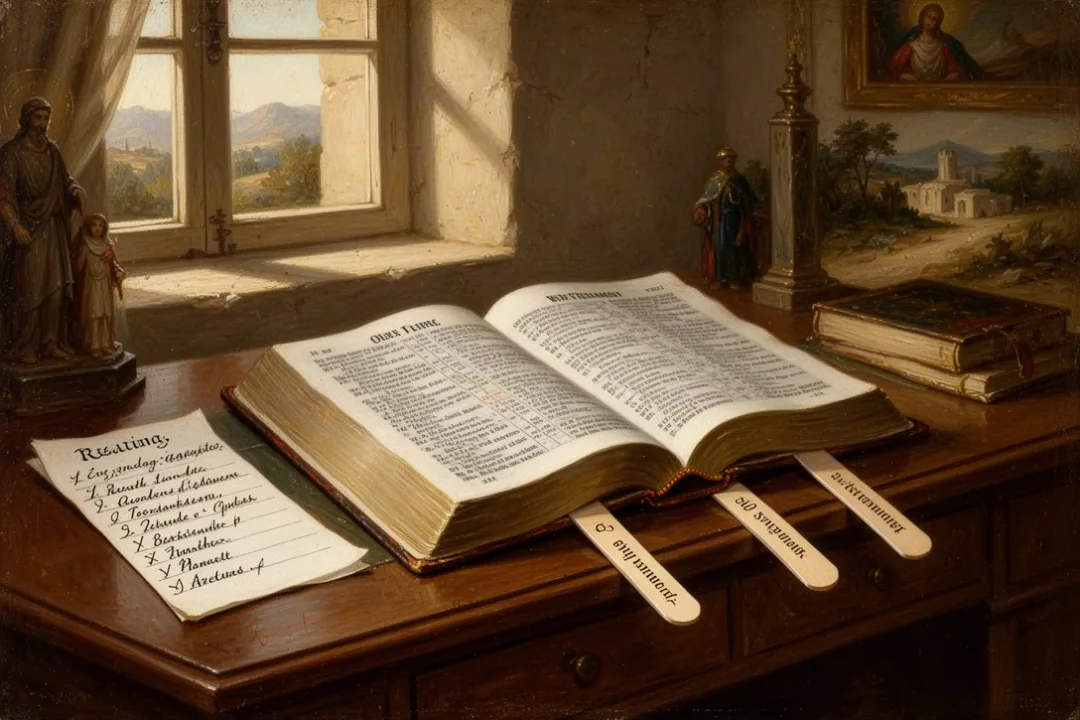
You can also create a reading checklist with three columns: book, date read, and main theme. Keep the theme brief, such as “exodus,” “wisdom,” “exile,” “faith,” or “church mission.” This turns a long reading project into manageable units and helps you remember how the books relate to one another.
The most useful goal is not merely to finish a list. Read slowly enough to recognize the Bible’s changing genres, historical settings, and major themes. A complete Bible includes books that comfort, challenge, instruct, warn, question, and offer hope; reading them together gives you a fuller understanding than isolated favorite passages can provide.
Frequently asked questions
How many books are in the complete Bible?
The Protestant Bible contains 66 books: 39 in the Old Testament and 27 in the New Testament. Catholic Bibles generally contain 73 books, while Orthodox editions may include additional books and vary by tradition. The number depends on which Christian canon and edition you are using, so check the table of contents rather than assuming every Bible has the same collection.
What are the first and last books of the Bible?
Genesis is the first book in the standard Protestant Bible, and Revelation is the last. Genesis presents creation, humanity’s early history, and the beginnings of Israel. Revelation uses symbolic visions to address judgment, perseverance, Christ’s victory, and the renewal of creation. Other biblical traditions may arrange some books differently, but Genesis and Revelation commonly appear at these positions in Christian Bibles.
Should I read the Bible from Genesis to Revelation?
You can read it in canonical order, but many people find a mixed plan easier. Starting with Luke and Acts gives you a connected account of Jesus and the early church, while Genesis and Exodus establish the foundational story. Psalms, Proverbs, and selected letters can be read alongside historical books to provide variety and context.
Are the Apocrypha part of the complete Bible?
The answer depends on the tradition. Catholic Bibles include the deuterocanonical books, which Protestants usually call the Apocrypha and do not include in their Old Testament. Some Anglican and Lutheran editions print these books in a separate section. Orthodox churches may include an even broader collection. The term “complete” should therefore be understood in relation to a specific canon.







Leave a Reply