When you open a Bible and see pages labeled Genesis, Matthew, or Romans, you may wonder why the books are arranged that way. Is the Bible organized in the order events happened, by author, or simply by length?
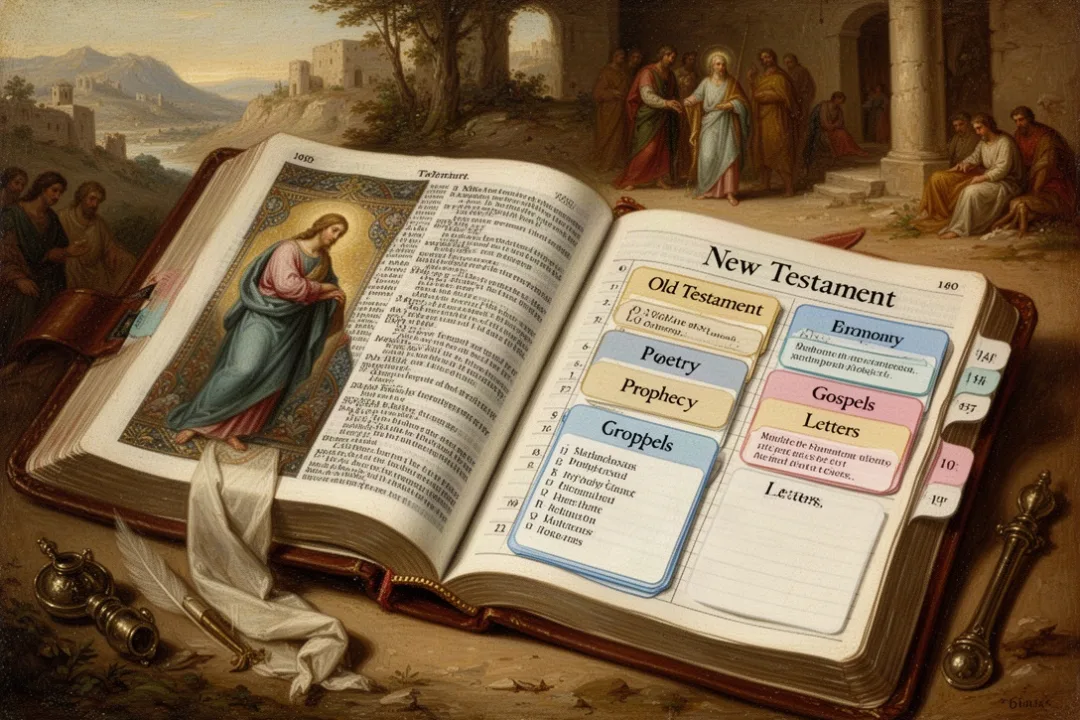
The short answer is that the Bible is organized as a collection of books grouped first into major sections, then into individual books, chapters, and verses. The standard Protestant Bible contains 66 books divided into the Old Testament and New Testament. Other Christian traditions use different collections and arrangements, while the Jewish Bible has its own structure and sequence.
The order is mainly shaped by religious tradition, literary type, and historical use, not by a strict timeline. Understanding that structure makes it easier to find a passage, recognize the kind of writing you are reading, and choose a reading plan that makes sense.
Most Christian Bibles are divided into the Old Testament and the New Testament. “Testament” refers to a covenant, or a binding relationship established by God. The Old Testament describes God’s relationship with Israel and includes the story, laws, poetry, wisdom, and prophetic messages connected with that covenant.
The New Testament focuses on Jesus Christ, the early Christian movement, and the church’s teaching. It begins with four accounts of Jesus’ life, continues with the growth of the early church, and ends with letters and apocalyptic visions that address Christian hope and perseverance.
Christians generally read the two testaments as connected, but the connection is understood in different ways among denominations. The New Testament frequently refers back to the Old Testament, while the Old Testament was written long before the events described in the New Testament.
Old Testament: creation, Israel’s history, covenant laws, worship, wisdom, poetry, and prophetic writing.
New Testament: Jesus’ life and teachings, his death and resurrection, the early church, Christian instruction, and future hope.
The boundary between the testaments is not a complete break. Themes such as creation, sin, covenant, sacrifice, justice, mercy, kingship, and restoration appear across both sections. Still, each testament has its own historical setting and collection of books.
How the Old Testament is arranged
In most Protestant Bibles, the Old Testament contains 39 books. These books are grouped into four broad categories: the Pentateuch, historical books, poetry and wisdom literature, and the major and minor prophets.
The Pentateuch tells the story of beginnings and covenant law
The first five books are called the Pentateuch, a word meaning “five books.” They are also known as the Torah, especially in Jewish contexts. The books are Genesis, Exodus, Leviticus, Numbers, and Deuteronomy.
Genesis presents creation, the earliest human stories, the flood, and the beginnings of the families connected with Israel. Exodus describes Israel’s escape from Egypt, the covenant at Mount Sinai, and instructions for worship. Leviticus concentrates on rituals, holiness, priests, sacrifices, and community responsibilities.
Numbers follows Israel through the wilderness and includes censuses, complaints, laws, and preparations for entering the promised land. Deuteronomy presents a series of speeches associated with Moses, restating the law and calling the people to remain faithful.
These books are placed first because they establish many of the Bible’s central people, events, laws, and theological ideas. They are not arranged as a modern legal code alone; they combine narrative, law, genealogy, poetry, speeches, and ritual instruction.
The historical books follow Israel’s story
After the Pentateuch, Protestant Bibles place books that narrate Israel’s history. This section begins with Joshua, Judges, Ruth, and the books of Samuel and Kings. It then includes Chronicles, Ezra, Nehemiah, and Esther.
These books describe the entry into Canaan, the period of regional leaders known as judges, the rise of the monarchy, and the reigns of kings such as David and Solomon. They also describe the division of the kingdom, military defeat, exile, and the return of some Jewish communities to Jerusalem.
The historical books do not present history in exactly the same way as a modern textbook. Their narratives often explain events through covenant faithfulness, injustice, worship, and leadership. A king’s political success is not always treated as proof of moral success, and national disaster is frequently interpreted through the people’s relationship with God.
Ruth and Esther are shorter narratives set within or near the broad period covered by the historical books. Their placement helps readers encounter them alongside Israel’s wider story, although their exact chronological settings are discussed by scholars.
Poetry and wisdom books explore worship and human experience
The next group is commonly called the poetry and wisdom books. It includes Job, Psalms, Proverbs, Ecclesiastes, and Song of Solomon, followed in many Protestant Bibles by the longer prophetic section.
Job wrestles with suffering, justice, and the limits of human understanding. Psalms is a collection of prayers and songs that express praise, fear, grief, thanksgiving, confession, and trust. Proverbs offers short teachings about wise and foolish choices, speech, work, money, relationships, and character.
Ecclesiastes reflects on the apparent uncertainty and fleeting nature of life. Song of Solomon, also called Song of Songs, uses poetic language to celebrate love and desire. These books are not meant to be read as one continuous story. Each uses a different form to examine faith, suffering, wisdom, worship, or love.
The prophets are divided into major and minor books
The final Old Testament group in a Protestant Bible contains the prophets. The terms major prophets and minor prophets refer primarily to the length of the books, not to the importance of their messages.
The major prophets include Isaiah, Jeremiah, Lamentations, Ezekiel, and Daniel. The minor prophets include twelve shorter books, beginning with Hosea and ending with Malachi. Depending on the book, prophetic writing may contain warnings, visions, symbolic actions, poetry, promises of restoration, and criticism of injustice or empty religious practice.
Prophets often spoke to particular political and religious circumstances. They addressed kings, priests, wealthy landowners, foreign powers, and ordinary communities. Their messages are easier to understand when you ask what crisis or behavior the prophet was addressing rather than treating every passage as a prediction detached from its original setting.
How the New Testament is arranged
The New Testament contains 27 books in the Protestant tradition. Its arrangement begins with the four Gospels, followed by Acts, the letters, and Revelation. This order reflects the central place of Jesus’ life and the development of the early Christian church.
The four Gospels present four accounts of Jesus
Matthew, Mark, Luke, and John are called the Gospels. The word means good news. Each Gospel describes Jesus’ ministry, teachings, death, and resurrection, but each has its own style, selection of events, and theological emphasis.
Matthew, Mark, and Luke are often called the Synoptic Gospels because they share many scenes and can be read side by side. John has a noticeably different structure and style, with longer conversations and distinctive imagery. The four books are not arranged as one combined biography; they are four separate accounts presented together.
Matthew appears first partly because it forms a bridge between the Old and New Testaments and repeatedly connects Jesus’ story with Israel’s Scriptures. Mark is shorter and often moves quickly through Jesus’ public ministry. Luke emphasizes an orderly narrative, concern for outsiders, and the work of the Holy Spirit. John uses distinctive signs and extended teaching to present Jesus’ identity and mission.
Acts describes the early church’s expansion
Acts follows the Gospels and continues the story after Jesus’ resurrection and ascension. It describes the coming of the Holy Spirit, the preaching of the apostles, the growth of Christian communities, and the movement of the message from Jerusalem toward the wider Roman world.
Acts is closely connected with Luke because both books are traditionally associated with the same author and share a continuing narrative. The book includes speeches, travel stories, conflicts, arrests, conversions, and decisions about how Jewish and non-Jewish believers should live together.
It is not simply a complete history of every early Christian community. Instead, it follows selected people and events, with particular attention to figures such as Peter and Paul and to the widening geographic reach of the movement.
The letters explain Christian belief and practice
Most of the remaining New Testament books are letters, or epistles. They address churches or individuals about worship, ethics, disagreements, leadership, suffering, Christian identity, and the meaning of Jesus’ death and resurrection.
Paul’s letters appear first in many Bibles, beginning with Romans and continuing through Philemon. They are generally arranged by length, with longer letters placed before shorter ones, rather than in the order they were written. Hebrews follows Paul’s letters in many Protestant Bibles, although its authorship has been debated for centuries.
The letters known as the General Epistles include James, 1 and 2 Peter, 1, 2, and 3 John, and Jude. They are associated with different early Christian leaders and are arranged according to traditional usage, not as a precise timeline of composition.
Reading a letter requires attention to its original audience. A passage addressing a specific dispute may not function like a universal proverb. Look for the issue being discussed, the people receiving the letter, and the larger argument around the paragraph before applying a teaching to your own situation.
Revelation uses symbolic and apocalyptic language
Revelation stands at the end of the New Testament. It contains letters to churches, visions, symbolic figures, heavenly scenes, judgments, and images of final renewal. Its style is often described as apocalyptic because it communicates through visions and vivid symbols about conflict, judgment, endurance, and hope.
Its final position gives the Christian Bible a dramatic literary shape: creation appears near the beginning, and renewed creation appears near the end. Revelation should not be read as though every image were a simple newspaper-style prediction. Its symbols draw on earlier biblical books, especially prophetic and apocalyptic passages.
Why different Bibles have different numbers of books
When people ask how the Bible is organized, they may notice that one Bible has 66 books while another has 73 or more. This difference comes from the canon, the collection of books a religious tradition recognizes as Scripture.
The Jewish Bible, called the Tanakh, contains 24 books in its traditional arrangement. Many of these correspond to the same writings found in the Protestant Old Testament, but some books that Protestants count separately are grouped together in the Jewish arrangement. The order also differs: the Tanakh is organized as Torah, Prophets, and Writings.
Most Protestant Bibles contain 39 Old Testament books and 27 New Testament books, for a total of 66. Catholic Bibles generally contain 46 Old Testament books and 27 New Testament books, for a total of 73. The additional Old Testament books are often called the Deuterocanonical books in Catholic usage.
Eastern Orthodox churches use Old Testament collections that can differ from both Protestant and Catholic Bibles. The exact number and ordering may vary among Orthodox traditions. Some editions also place additional writings in separate sections, so the table of contents of a particular Bible is the best guide.
Check the table of contents first: Differences in book count do not mean that every page is arranged randomly. They reflect the canon and tradition of the edition you are using.
The New Testament collection is shared by the major Christian traditions, although translations, notes, and ordering details can differ. The main variation appears in the Old Testament or Hebrew Bible collection and in the way certain books are grouped.
Why the books are not arranged in chronological order
The Bible’s table of contents is not a complete timeline. For example, a prophetic book may address events that occurred during the period described in Kings or Chronicles, yet the prophet appears later because the books are grouped by genre. Psalms includes material connected with different periods, and the letters are not placed according to the sequence of Paul’s travels.
A chronological reading plan may place books beside the historical periods they relate to. It may also divide the Gospels into parallel scenes or arrange the letters near events in Acts. Such plans can be useful, but they are interpretive tools created by readers rather than the standard arrangement printed in most Bibles.
The traditional order serves a different purpose. It lets readers move from foundational stories and laws to history, poetry, prophecy, Jesus’ ministry, the early church, letters, and final visions. Knowing that purpose prevents a common mistake: assuming that a book’s location proves exactly when it was written or when every event occurred.
How chapters and verses make passages easy to find
Each biblical book is divided into chapters, and each chapter is divided into verses. These numbers were added later to make reading, teaching, comparison, and discussion easier. They are reference tools, not part of the original manuscripts in the same format.
A reference such as John 3:16 identifies the book, chapter, and verse. The first part, John, is the book. The number 3 is the chapter, and 16 is the verse. A range such as Romans 12:1–2 means chapter 12, verses 1 through 2.
References can include several verses, separate passages, or an entire chapter. For example, Psalm 23 refers to all of Psalm 23, while Matthew 5:3–12 identifies a specific range. A semicolon usually separates references from different chapters or books, depending on the citation style being used.
Chapter and verse divisions are helpful, but they can interrupt the flow of an argument or story. A verse may be only one sentence or part of a sentence, and its meaning can depend on surrounding paragraphs. Read the whole paragraph, scene, or poem before drawing a conclusion from a single numbered line.
Practical tips for finding and reading a Bible passage
You do not need to memorize the entire table of contents to use a Bible confidently. A few habits make navigation much easier, especially when you are switching between print editions, study Bibles, apps, or different Christian traditions.
Use the table of contents: Check the page number for the book before searching through the main text.
Learn the broad sections: Remember the sequence of law, history, poetry, prophets, Gospels, Acts, letters, and Revelation.
Read the reference carefully: Distinguish a chapter number from a verse number, especially in books with similar names.
Check the edition: Confirm whether your Bible includes books such as Tobit, Judith, or 1 and 2 Maccabees.
Read beyond one verse: Include the surrounding paragraph and consider the speaker, audience, and literary form.
Compare translations thoughtfully: Different wording can clarify meaning, but the translation’s notes and tradition also affect how a passage is presented.
Book names can also cause confusion. “1 Samuel” and “2 Samuel,” for example, are two parts of a larger historical work. “1 Corinthians” and “2 Corinthians” are separate letters associated with the church in Corinth. Short books such as Jude or Philemon can be difficult to locate, so an alphabetical index or search feature can help.
Common mistakes when using the Bible’s organization
Many reading difficulties come from treating every book as though it had the same purpose. A poem is not read exactly like a law code, a proverb is not a promise guaranteeing a particular result, and a symbolic vision is not automatically a literal description of future events.
Assuming the order is chronological: The table of contents groups books by tradition and type as well as by broad narrative movement.
Ignoring genre: Poetry, prophecy, narrative, wisdom, letters, and apocalyptic writing use different forms of communication.
Taking a verse out of context: A short quotation may leave out the paragraph’s argument or the story’s situation.
Confusing similarly named books: Samuel, Kings, Chronicles, Corinthians, and Thessalonians each have multiple books.
Assuming every Bible has the same contents: Catholic, Orthodox, Protestant, and Jewish editions do not use identical canons.
Reading only isolated passages: Themes often become clearer when you follow an entire book or a connected section.
A useful reading question: Before asking what a passage means for you, ask what kind of writing it is, who first received it, and what problem or purpose it addresses.
Cross-references can help you see connections, but they should not replace careful reading. A note may point to a similar word, event, or theme without claiming that the two passages mean exactly the same thing. Treat study notes as guidance, then examine the passages themselves.
How to choose a reading order that fits your purpose
The printed order is a reasonable place to begin, but it is not the only useful approach. If you want to understand the central Christian story, you might start with one Gospel, read Acts, and then explore selected letters. This gives you a narrative foundation before you encounter more specialized arguments.
If you want to follow the Old Testament story, begin with Genesis and continue through the historical books, using the prophets alongside the periods they address when a reliable study guide explains those connections. If you want prayer and reflection, Psalms can be read independently, while Proverbs works well in short sections.
A book-by-book approach is usually better than opening at random each day. Choose a manageable section, read it in context, and write down unfamiliar names, locations, repeated ideas, and questions. Study notes, maps, cross-references, and an accurate introduction to each book can provide useful background without replacing the text.
Different reading orders answer different needs:
For the central Christian story: begin with a Gospel, then read Acts.
For the Bible’s broad storyline: read Genesis, selected historical books, a Gospel, Acts, and Revelation.
For wisdom and prayer: read Psalms, Proverbs, Job, or Ecclesiastes in small portions.
For Christian teaching: read a letter from beginning to end instead of collecting individual verses.
For historical context: pair prophetic books with study notes about the kingdoms, exile, or return periods they address.
The organization of the Bible becomes much less intimidating once you separate three questions: which books are included, how those books are grouped, and where a passage is located within a book. With those layers in mind, a reference such as Isaiah 6:1 or Mark 4:35 becomes a clear address rather than a mysterious code.
Frequently asked questions
Is the Bible one book or many books?
The Bible is one collection of sacred writings made up of many individual books. Those books were written in different forms and historical settings, including narrative, law, poetry, prophecy, biography-like Gospel accounts, letters, and apocalyptic visions. Their shared place in a canon connects them, but each book should still be read according to its own purpose and literary style.
Which book comes first in the Bible?
Genesis comes first in most Jewish and Christian Bibles. It introduces creation, humanity’s early story, and the ancestors of Israel. The first book in the New Testament is Matthew. In the Jewish Bible, Genesis is also first because it begins the Torah, although the complete collection uses a different number of books and a different overall order from most Christian editions.
Why are some Bible books numbered with 1 and 2?
Numbering separates related books that were once treated as parts of a larger work or that share a title and subject. Examples include 1 and 2 Samuel, 1 and 2 Kings, and 1 and 2 Corinthians. The numbering helps readers identify the specific volume or letter being cited, but it does not necessarily mean the two books were written at the same time.
What is the easiest Bible organization to memorize?
Start with the largest sections rather than trying to memorize every title at once: law, history, poetry and wisdom, prophets, Gospels, Acts, letters, and Revelation. Then learn a few anchor books, such as Genesis, Psalms, Isaiah, Matthew, John, Acts, Romans, and Revelation. A Bible’s table of contents is always a legitimate navigation aid.







Leave a Reply