Trying to find a particular book of the Bible can be surprisingly confusing: does Micah come before or after Nahum, and where does Acts fit among the Gospels? The standard Protestant Bible contains 66 books, arranged in two major sections: the Old Testament and the New Testament. The Old Testament has 39 books, while the New Testament has 27.
The lists below give the books in their usual order and group them by type. That arrangement helps you locate a book quickly and gives you a basic sense of what each part of the Bible contains. Catholic and Orthodox Bibles include additional books or sections, so the number and order can differ by tradition.
The Old Testament begins with the creation account and the history of Israel, then moves through poetry, wisdom literature, and prophetic writings. In the Hebrew Bible, these same writings are organized differently, but most English Christian Bibles use the sequence below.
Genesis
Exodus
Leviticus
Numbers
Deuteronomy
Joshua
Judges
Ruth
1 Samuel
2 Samuel
1 Kings
2 Kings
1 Chronicles
2 Chronicles
Ezra
Nehemiah
Esther
Job
Psalms
Proverbs
Ecclesiastes
Song of Solomon
Isaiah
Jeremiah
Lamentations
Ezekiel
Daniel
Hosea
Joel
Amos
Obadiah
Jonah
Micah
Nahum
Habakkuk
Zephaniah
Haggai
Zechariah
Malachi
The first five books are called the Pentateuch, a word meaning “five books.” They are also known as the Torah in Jewish tradition. These books describe creation, the ancestors of Israel, the Exodus from Egypt, the covenant at Sinai, Israel’s wilderness years, and the laws and teachings given through Moses.
The next group presents Israel’s story in the land. Joshua describes the Israelites’ entry into Canaan, while Judges recounts a repeated cycle of rebellion, oppression, and deliverance. Ruth is a short family story set during the period of the judges, and 1 and 2 Samuel follow the rise of Samuel, Saul, and David.
1 and 2 Kings continue the history through Israel’s monarchy, division, and exile. 1 and 2 Chronicles retell much of that history with particular attention to David, the temple, and the kingdom of Judah. Ezra and Nehemiah describe the return from exile and the rebuilding of Jerusalem’s temple and walls, while Esther tells how a Jewish woman became central to the rescue of her people in Persia.
The 27 books of the New Testament in order
The New Testament focuses on Jesus Christ, the beginning and growth of the Christian church, and the teaching of Jesus’ apostles. It contains four Gospels, one historical narrative, letters addressed to churches and individuals, and one prophetic book.
Matthew
Mark
Luke
John
Acts
Romans
1 Corinthians
2 Corinthians
Galatians
Ephesians
Philippians
Colossians
1 Thessalonians
2 Thessalonians
1 Timothy
2 Timothy
Titus
Philemon
Hebrews
James
1 Peter
2 Peter
1 John
2 John
3 John
Jude
Revelation
Matthew, Mark, Luke, and John are called the Gospels because they announce the good news about Jesus. Each Gospel has a distinct presentation and selection of events. Matthew often emphasizes Jesus’ relationship to Israel’s Scriptures, Mark gives a fast-moving account of Jesus’ ministry, Luke highlights God’s mercy and the work of the Holy Spirit, and John uses a more reflective style focused on Jesus’ identity and mission.
Acts is closely connected to Luke and describes the spread of the Christian message from Jerusalem into the wider Roman world. The book introduces major leaders such as Peter and Paul and shows how local congregations formed in different cities.
The remaining New Testament books are mostly letters. Paul’s letters address congregations or individuals, offering teaching and practical guidance for Christian communities. Hebrews, James, 1 and 2 Peter, 1–3 John, and Jude are often called the General Epistles because they are associated with different leaders and are not all addressed to one specific church. Revelation uses prophetic and symbolic imagery to address faithfulness, judgment, and hope.
Quick reference: The standard Protestant Bible has 66 books: 39 in the Old Testament and 27 in the New Testament. The New Testament always begins with Matthew and ends with Revelation in common English editions.
How the books are grouped by genre
The Bible’s order is not simply one long timeline. Books are also arranged by literary type, which explains why a historical book may be followed by poetry or prophecy rather than by the next event chronologically. Knowing the genres can help you read each book with appropriate expectations.
The Law or Pentateuch
The first five books are Genesis, Exodus, Leviticus, Numbers, and Deuteronomy. Together they establish the central stories, covenant themes, worship practices, and laws that shape the rest of the Old Testament. Genesis covers beginnings and the patriarchs; Exodus centers on deliverance from Egypt and the covenant; Leviticus presents priestly and ceremonial instructions; Numbers follows Israel in the wilderness; and Deuteronomy records Moses’ teachings before Israel enters the promised land.
Historical books
The Old Testament historical books are Joshua through Esther. They cover Israel’s settlement in Canaan, the judges, the united and divided monarchies, the exile, and the return. These narratives include political events, military conflicts, family decisions, worship reforms, and failures of leadership. They are not arranged as a modern history textbook, so parallel accounts may emphasize different details and purposes.
In the New Testament, Acts is the main historical narrative. It follows the earliest Christian communities after Jesus’ resurrection and describes the movement’s expansion from Jerusalem to other regions. The letters that follow often connect with the situations of churches mentioned in Acts, although the books are arranged primarily by length and category rather than by the exact dates when they were written.
Poetry and wisdom books
The wisdom section usually includes Job, Psalms, Proverbs, Ecclesiastes, and Song of Solomon. These books explore suffering, worship, wise conduct, mortality, love, work, justice, and the meaning of life. Their forms vary: Psalms are songs and prayers, Proverbs presents short teachings, Job uses dialogue and poetry, Ecclesiastes reflects on life’s limits, and Song of Solomon uses poetic language about love.
Poetry should not always be read in the same way as a narrative or a legal instruction. Images, parallel lines, metaphors, and emotional language are central to these books. A reader may find Psalms useful for prayer, Proverbs for practical reflection, and Job or Ecclesiastes for wrestling with difficult questions rather than seeking a quick answer.
The Prophets
The prophetic books are divided in many English Bibles into Major Prophets and Minor Prophets. “Major” and “minor” refer mainly to the length of the books, not to their importance. Isaiah, Jeremiah, Lamentations, Ezekiel, and Daniel are generally called the Major Prophets, while Hosea through Malachi are known as the Twelve Minor Prophets.
Prophets often confronted injustice, idolatry, exploitation, and unfaithfulness. They also spoke about judgment, restoration, God’s covenant, and future hope. Historical setting matters when reading them: many prophetic messages addressed particular kings, nations, wars, exiles, or religious practices. The books may move between immediate circumstances and promises reaching beyond the prophet’s own period.
Gospels, letters, and apocalyptic writing
The New Testament genres are easier to recognize. The Gospels are theological biographies of Jesus, Acts is narrative history, and the letters respond to belief and conduct within early Christian communities. Revelation is apocalyptic literature, a symbolic style that uses visions, angels, beasts, numbers, and dramatic scenes to communicate its message.
Law: Genesis through Deuteronomy.
History: Joshua through Esther, plus Acts.
Poetry and wisdom: Job through Song of Solomon.
Prophecy: Isaiah through Malachi, and Revelation in the New Testament.
Gospels: Matthew, Mark, Luke, and John.
Letters: Romans through Jude, with Hebrews included among the New Testament epistles.
Why Bible versions have different book lists
If you compare Bibles from different Christian traditions, you may see different totals. The Protestant Bible contains 66 books. The Catholic Bible contains 73 books, including seven additional books commonly called the Deuterocanonical books: Tobit, Judith, 1 Maccabees, 2 Maccabees, Wisdom, Sirach, and Baruch. Catholic editions also include additions to Esther and Daniel.
Many Eastern Orthodox Bibles contain those books and may include additional works or passages, depending on the church and edition. The names and arrangement can also vary. For example, a book called 1 Esdras in one tradition may be numbered differently in another, so a reader should check the table of contents in a specific edition before assuming that every Bible uses the same numbering.
These differences do not usually mean that one publisher accidentally omitted pages. They reflect different canon traditions—the recognized collections of sacred books used by particular Jewish and Christian communities. The Protestant Old Testament generally follows the 39-book arrangement familiar in English Bibles, while the Catholic and Orthodox traditions preserve additional writings that Protestants usually place in a separate category or do not include.
The Hebrew Bible also has a different structure from the Christian Old Testament. Its books are grouped into the Torah, the Prophets, and the Writings, often represented by the term Tanakh. The content substantially overlaps with the Protestant Old Testament, but the number of books differs because several writings counted separately in Christian Bibles are combined in the Jewish arrangement.
Check your edition: If a reading plan, sermon, or study guide refers to a book you cannot find, look at your Bible’s contents page and translation notes. Differences may involve canon, naming, numbering, or a book’s placement.
How to find a book and understand its name
Bible references normally use the book name, chapter number, and verse number. For example, “John 3:16” points to the Gospel of John, chapter 3, verse 16. A reference such as “1 Peter 2:9–12” means the first letter of Peter, chapter 2, verses 9 through 12.
Numbers before a name distinguish books with related titles. The pairs 1 and 2 Samuel, 1 and 2 Kings, 1 and 2 Chronicles, 1 and 2 Corinthians, 1 and 2 Thessalonians, 1 and 2 Timothy, 1 and 2 Peter, and 1, 2, and 3 John are separate books. Some editions use Roman numerals, such as “I Samuel,” while others spell out “First Samuel.”
Book abbreviations are not completely standardized. Gen. commonly means Genesis, Ps. means Psalms, Isa. means Isaiah, and Matt. means Matthew, but a study Bible may use a different abbreviation. When a reference is unfamiliar, identify the book first, then locate the chapter and verse.
Find the book in the table of contents. This is often faster than scrolling through a digital Bible.
Locate the chapter number. Large numbers within the text usually mark chapters.
Locate the verse number. Smaller numbers identify individual verses.
Read the surrounding passage. A single verse can be difficult to understand without its paragraph or chapter.
Some editions use headings, cross-references, maps, and study notes, but these additions are not part of the biblical text itself. Chapter and verse divisions are useful for finding passages, yet they were added to the biblical manuscripts later than the original compositions. A paragraph may continue across a chapter break, so avoid treating every number as a complete change of subject.
A practical order for reading the Bible
You do not have to read every book from Genesis to Revelation to begin understanding the Bible. Reading straight through can show the broad structure, but some readers benefit from starting with a Gospel and then moving to Acts. This introduces Jesus’ life and teaching before you encounter the letters written to early Christian communities.
A simple starting sequence is Luke, Acts, Genesis, Exodus, Psalms, Proverbs, and Romans. Luke and Acts form a connected narrative, Genesis and Exodus establish major Old Testament themes, Psalms provides prayers and songs, Proverbs offers practical wisdom, and Romans presents a sustained explanation of central Christian beliefs. This is a reading suggestion, not a required order.
For a chronological approach, remember that the books are not arranged in exact historical sequence. Job’s setting, for example, is often associated with an early period, although the book’s date of composition is debated. Several prophets ministered during the periods described in Kings and Chronicles, and many New Testament letters were written while the events of Acts were unfolding.
For the story of Jesus: read Mark for a concise account or Luke followed by Acts for a connected narrative.
For prayer and worship: begin with selected Psalms and read slowly rather than trying to finish many chapters at once.
For practical wisdom: read Proverbs in small sections and compare repeated themes about speech, work, money, and relationships.
For the Bible’s overall storyline: read Genesis, Exodus, Joshua, selected historical books, one Gospel, Acts, and Revelation with attention to recurring themes.
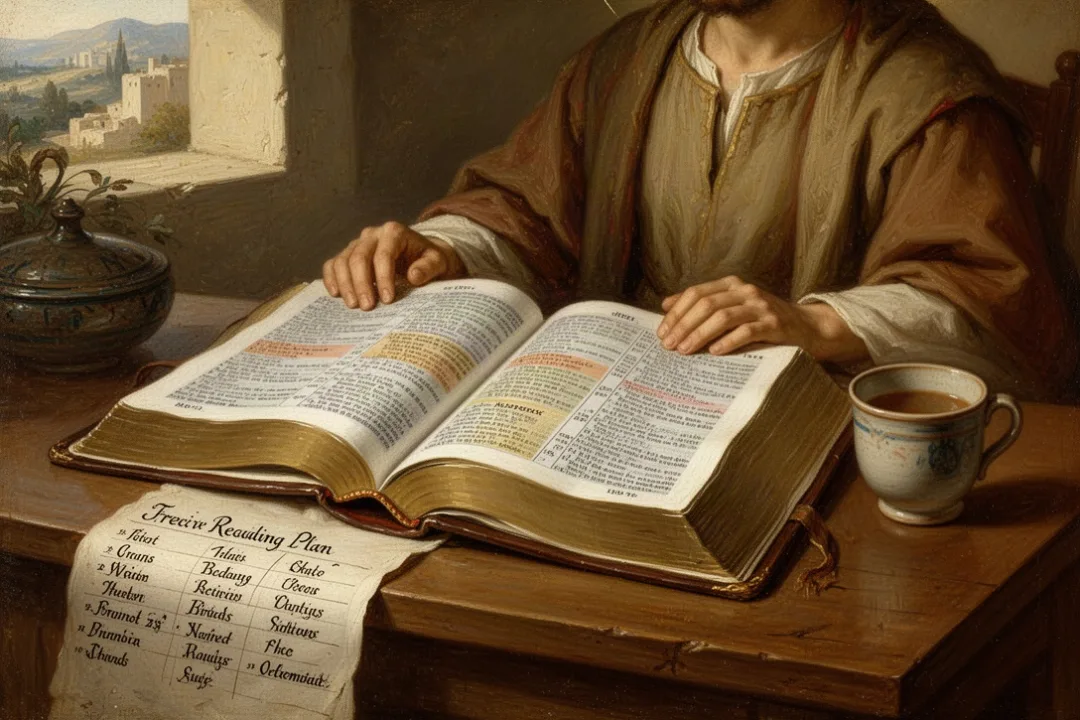
For a full reading plan: divide the 66 books into manageable daily portions and keep a record of the books, chapters, and questions that require further study.
When a book feels difficult, identify its genre, audience, historical setting, and main purpose before focusing on individual verses. A prophetic vision, a proverb, a courtroom speech, and a personal letter use different forms of communication. That basic context can prevent a familiar line from being separated from the larger message of the book.
A good table of contents remains useful even with a Bible app. It shows the Bible’s broad movement from creation and covenant through Israel’s history, wisdom, prophecy, Jesus’ ministry, the early church, and Christian hope. Once you know the major sections, the individual books become easier to locate and remember.
Frequently asked questions
How many books are in the Bible?
The standard Protestant Bible contains 66 books: 39 in the Old Testament and 27 in the New Testament. Catholic Bibles usually contain 73 books, and Orthodox Bibles may contain a somewhat different total depending on the tradition and edition. The difference comes from which ancient Jewish writings each Christian tradition recognizes as part of its biblical canon.
What is the shortest book of the Bible?
In many English translations, 2 John is the shortest book by word count. 3 John and Philemon are also very short. The exact number of words can vary because translations make different choices about wording, contractions, headings, and verse formatting, so “shortest” may be measured differently across editions.
Which book of the Bible should I read first?
Mark is a direct starting point if you want a concise account of Jesus’ ministry. Luke followed by Acts provides a connected narrative about Jesus and the early church. Genesis is another useful beginning because it introduces creation, humanity, the patriarchs, and themes that recur throughout the rest of the Bible.
Are the books of the Bible arranged chronologically?
No. They are generally grouped by type, such as law, history, poetry, prophecy, Gospels, and letters. Some books overlap historically, and many prophets lived during periods described in the historical books. The New Testament letters are also arranged largely by category and length rather than by the exact dates when they were written.





Leave a Reply