Free Bible lessons by mail: how to request and use them
Free Bible lessons by mail: how to request and use them
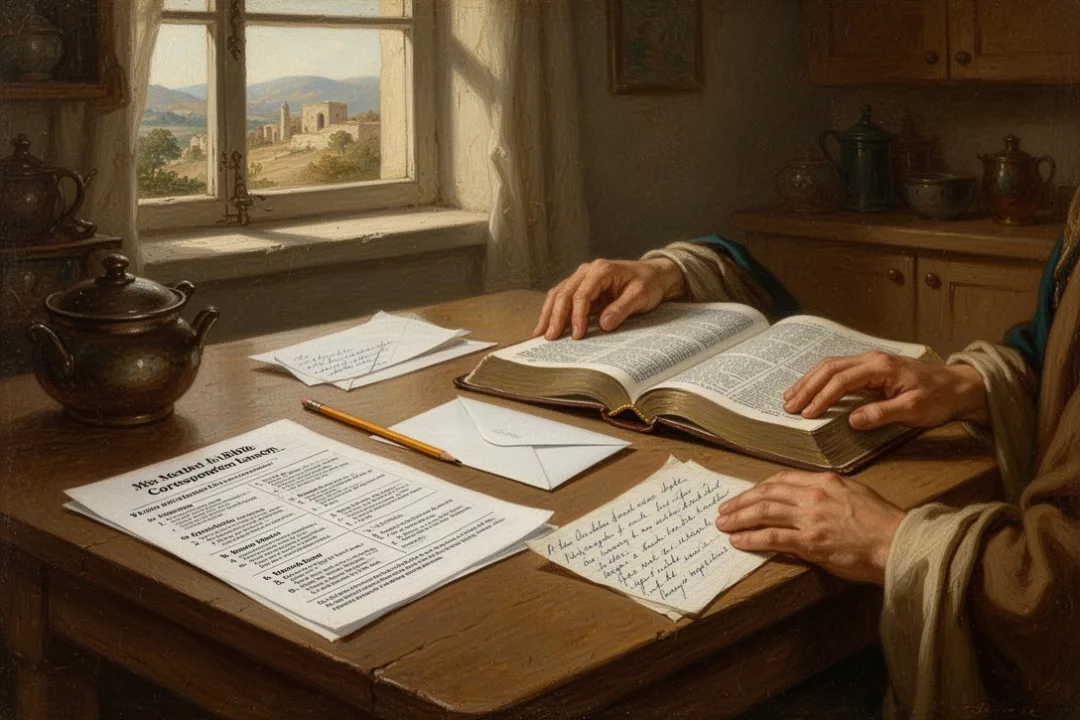
Free Bible lessons by mail are usually available from churches, Bible correspondence ministries, and Christian teaching organizations. You typically request a printed lesson series online, by phone, or with a mailed form; the lessons are then sent to your address at no charge or for a voluntary donation.
Most courses arrive one lesson at a time or as a small packet. You read the teaching, look up Bible references, complete questions, and either keep the answer sheet or mail it back for review. Before signing up, check whether postage, grading, and personal follow-up are included at no cost.
A correspondence course normally has a clear sequence rather than a single booklet. Early lessons may explain how to read the Bible, identify its main sections, and understand its central themes. Later lessons often address prayer, faith, Jesus, Christian living, the church, and the relationship between the Old and New Testaments.
Printed lessons commonly contain a short explanation followed by questions. Some ask you to select an answer from the lesson, while others invite a written response. A separate answer sheet may be returned to a volunteer or teacher, who sends the next lesson and sometimes includes comments.
The exact teaching depends on the organization behind the course. Some materials are designed for broad Christian audiences, while others reflect a particular denomination or congregation. Look for a statement of beliefs, a description of the lesson topics, and a clear explanation of what happens after you submit your work.
Before you enroll: “Free” may mean the lessons themselves cost nothing, while mailing charges, optional donations, or overseas delivery rules vary. Read the request page carefully and ask about every charge before providing payment information.
How to request a Bible correspondence course by mail
You can usually find a course by searching for phrases such as free Bible lessons mailed to your home, “Bible correspondence course,” or “Bible study lessons by mail.” A trustworthy provider should explain who produces the lessons, how your information is used, and whether you must join a church or make a donation.
Choose the type of course you want. Decide whether you prefer a general introduction to the Bible, a study centered on Jesus, a family course, a beginner series, or lessons focused on a specific book.
Review the provider. Read its statement of faith, contact information, privacy policy, and mailing terms. A real organization should give you more than a form asking for your address.
Confirm the cost. Check whether the course, return postage, grading, and future lessons are free. If donations are requested, verify that they are optional rather than required.
Submit only the information needed. Many providers need your name and mailing address. Do not provide your Social Security number, bank login, or unnecessary financial details to request Bible lessons.
Watch for the first packet. Delivery time depends on the provider and your location. International mail can take substantially longer than domestic delivery.
Complete one lesson at a time. Set aside a regular period to read the passages, write your answers, and record questions you want to investigate further.
Return the work as directed. Some ministries ask for an answer sheet, while others let you continue independently. Follow the instructions included with the lesson.
If a website does not clearly say how to request printed lessons, contact the organization directly. You can ask whether the materials are still being mailed, how often new lessons are sent, and whether a local church or volunteer will contact you.
How to choose lessons that match your goals
The best course is not necessarily the longest one. Choose materials that match the question you are trying to answer and the amount of time you can realistically give to study. A concise series can be more useful than a large packet that remains unfinished.
For Bible basics: Choose lessons that explain the Bible’s structure, major themes, historical setting, and different literary forms.
For learning about Jesus: Look for a course that uses the four Gospels and explains Jesus’ teachings, death, resurrection, and significance in Christian belief.
For personal faith: Select lessons covering prayer, repentance, trust in God, forgiveness, worship, and daily conduct.
For children or families: Check the recommended age, reading level, illustrations, parental guidance, and treatment of difficult subjects.
For a focused study: Request a series on a particular book, such as the Gospel of John, Psalms, Proverbs, Romans, or another book of interest.
For comparing traditions: Read the provider’s doctrinal statement so you understand how it interprets baptism, salvation, church leadership, spiritual gifts, and other disputed subjects.
Some courses are primarily devotional, meaning they emphasize reflection and personal application. Others are more instructional and ask you to examine context, repeated themes, and differences between passages. Neither format is automatically better; the right choice depends on whether you want encouragement, background, or a more systematic study.
What happens after you mail back your answers
Many correspondence ministries use volunteers to review completed lessons. A reviewer may mark answers, explain a question, or recommend a Bible passage for further reading. The next lesson may arrive only after the previous one is returned, or the full series may be mailed in stages.
Feedback can be helpful, but it is not the same as formal theological training. A reviewer may represent the beliefs of one church or organization, and responses can vary in depth. Treat comments as a starting point for study, then compare them with the biblical context and, when appropriate, with respected resources from more than one tradition.
You are not required to accept personal contact simply because you requested a course. If you prefer independent study, ask whether you can receive printed materials without telephone calls, home visits, or regular email messages. A reputable provider should respect a reasonable request about communication.
“Test everything; hold fast to what is good” is the principle expressed in 1 Thessalonians 5:21. Applied to correspondence lessons, it means reading carefully, asking questions, and examining claims rather than accepting every explanation automatically.
How to study each mailed lesson effectively
Begin with the lesson’s stated purpose. Knowing whether you are studying prayer, the identity of Jesus, or the role of the church helps you distinguish the main point from supporting details. Keep the lesson, answer sheet, and a Bible together so you can review your work later.
Read the lesson once without writing. Get the overall argument before trying to answer individual questions.
Look up every reference. Read several verses before and after a cited passage when possible. Context can change how a sentence is understood.
Mark unfamiliar words and ideas. Write down questions about names, places, customs, or theological terms instead of skipping them.
Answer from the text first. Separate what the passage says from what you already believe or have heard elsewhere.
Write a brief personal response. Note how the lesson affects your understanding, habits, prayers, or relationships.
Review before mailing. Check that you answered every question and kept a copy or photograph of your responses.
Keep a simple study notebook with the lesson title, Bible references, new vocabulary, and unanswered questions. This makes it easier to see connections across the series. It also gives you a record if a mailed answer sheet is delayed or lost.
Use a Bible translation that you can understand while consulting another translation when a passage seems unclear. Since wording differs among translations, focus on the meaning of the passage in context rather than treating one English wording as the only possible expression.
How denomination and teaching style affect the course
“Bible-based” does not mean every organization interprets every topic in the same way. Churches differ on baptism, communion, spiritual gifts, church government, predestination, women’s roles, the Sabbath, and the relationship between faith and works. A printed course may present one position confidently without explaining that other Christian traditions disagree.
That does not automatically make the course unsuitable. It does mean you should know what you are receiving. Find the organization’s name, location, leadership, and statement of beliefs before you begin, especially if the lessons invite you to join a congregation or make a public profession of faith.
For a balanced study, you can use a general introductory course first and then consult resources from different traditions on disputed topics. Ask the provider how it distinguishes direct biblical teaching from its denomination’s interpretation. Clear answers are a sign of a more transparent ministry.
How to spot a reliable free lesson provider
A legitimate provider should make its purpose easy to understand. Its website or printed form should identify the organization, give a working contact method, describe the course, and explain how your information will be handled. The content should be offered without pressure to send money immediately.
Clear identity: The organization uses a consistent name and provides a physical mailing address or verifiable contact details.
Transparent teaching: It identifies its Christian tradition or explains its theological position.
Specific terms: The provider states what is free and whether donations, postage, or return envelopes are optional.
Respect for privacy: It explains whether your address will be shared, sold, or used for additional mailings.
Reasonable communication: It does not demand immediate decisions, repeated payments, or access to private accounts.
Useful lesson information: You can see the intended audience, approximate lesson length, and topics before committing.
Be cautious if a form uses urgent religious language to pressure you into donating, asks for sensitive financial information, or refuses to identify the ministry behind the lessons. You should also be wary of materials that promise guaranteed healing, financial success, or special spiritual status in exchange for money.
Privacy and safety when requesting lessons
A mailing address is personal information, even when it is the only detail needed for delivery. Before submitting it, check whether the organization has a privacy statement. If you live with someone who may not understand why religious mail is arriving, consider whether a trusted postal address or a digital option would be safer and more convenient.
Use a separate email address if you want to limit promotional messages. Do not send copies of identification documents or financial records. If the provider asks for a donation, use a familiar payment method and verify that the payment page belongs to the organization you intended to contact.
You can also ask the ministry to stop future mailings. Keep the original request confirmation and any reference number so customer service can locate your record. If unwanted material continues, follow the provider’s opt-out process and consider contacting your postal service about available mail preferences.
Privacy tip: Requesting Bible lessons should not require a confession of personal problems, a church membership commitment, or financial account access. Share only what is necessary to receive the materials.
What to do if mail delivery is slow or incomplete
Printed courses can be delayed by incorrect addresses, seasonal mail volume, international customs procedures, or a provider’s limited distribution schedule. Wait the period stated by the organization before requesting a replacement, then confirm that the address was entered correctly.
If only part of a packet arrives, contact the provider and name the missing lesson or answer sheet. Keep the envelope until the issue is resolved; the postmark or mailing label may help the organization investigate. Do not pay a second time for a supposedly free replacement until you understand the provider’s policy.
People outside the United States may face extra restrictions. Some ministries mail internationally, while others provide printed materials only within certain countries. Ask about language availability, delivery costs, local customs rules, and whether a downloadable version can be used if international postage is unavailable.
When online or local study may be a better fit
Mail is useful when you want a physical workbook, need a low-bandwidth option, or prefer a slower pace. It also gives you time to write thoughtful answers without attending a scheduled class. For people who have limited internet access, mailed lessons can make Bible study more accessible.
An online course may be more practical when you want immediate delivery, audio content, searchable references, or faster feedback. A local church or library study group can provide conversation and accountability that a correspondence course cannot. You can combine formats: use printed lessons for private study and discuss questions with a trusted pastor, teacher, or group.
Choose a setting that lets you ask honest questions without pressure. A healthy study environment welcomes careful reading and acknowledges uncertainty where Christians interpret a passage differently.
Questions to ask before you start
Writing down your questions before requesting lessons can help you select the right series. Consider what you hope to understand and what kind of support you want after each lesson.
Do I want a general introduction or a detailed study of one Bible book?
Am I comfortable receiving lessons from a particular denomination?
Do I want my answers reviewed, or would I rather study privately?
Can I receive mail safely at my current address?
Will I need lessons in another language or a larger-print format?
What will I do if I disagree with an explanation?
Disagreement does not mean the study has failed. Record the point of difference, read the surrounding context, and compare several responsible interpretations. If a lesson raises a serious personal or theological concern, discuss it with someone you trust rather than feeling obligated to accept the provider’s answer.
How to continue after the final lesson
When the course ends, review your notebook and list the subjects you understand better and those that still need attention. You might continue with a book-by-book study, a course on Christian doctrine, or a practical series about prayer and discipleship.
Ask the original provider whether it offers an advanced series, but do not assume you must enroll in every course. You can also use a public library, a reputable Bible study resource, or a local congregation that clearly explains its beliefs and welcomes questions.
A useful next step is to choose one Bible book and read it repeatedly rather than moving immediately to another packet. Note its audience, setting, repeated words, major sections, and central message. That habit turns a free mailed course into an ongoing pattern of careful, independent study.
Frequently asked questions
Are free Bible lessons by mail really free?
Often, the study materials are provided without a required purchase, but policies differ. Some ministries cover postage and grading, while others ask for optional donations or charge for international delivery. Confirm the full cost before enrolling, including return postage and replacement lessons. You should never need to provide sensitive financial information simply to request a free course.
Do I have to join a church after completing the lessons?
No reputable correspondence course should require a church membership commitment just to receive or finish the lessons. However, the material may encourage participation in a particular congregation. Read the provider’s terms and beliefs first, and ask whether follow-up calls, visits, or mailings can be declined.
Can I request Bible lessons without giving my phone number?
Many providers need only a name and mailing address for printed delivery. A phone number may be optional, but practices differ. Leave it blank when possible, or contact the organization and ask whether the lessons can be mailed without telephone follow-up. Review the privacy policy before submitting your information.
What if I disagree with an answer in the lesson?
Treat the disagreement as a reason to investigate, not as a reason to stop studying. Read the entire biblical passage in context, consult another reputable interpretation, and write down the exact point at issue. You may also ask a qualified pastor or teacher how different Christian traditions understand that subject.









Leave a Reply