Free Bible study lessons for meaningful daily study
Free Bible study lessons for meaningful daily study
You may have a Bible, a few quiet minutes, and a sincere question, but still wonder where to begin. Free Bible study lessons can give you a clear path without requiring expensive workbooks, complicated software, or formal training. The most useful lessons help you read a passage carefully, understand its setting, and respond to its message in a practical way.
You can study alone, with family, or in a small group. Start with a manageable passage, use a reliable translation, and ask a few focused questions rather than trying to explain every detail at once. A simple plan followed consistently usually produces more lasting understanding than an ambitious schedule abandoned after a week.
Simple starting point: Read one short passage twice, write down what it says, identify its main idea, and choose one truthful response. Good Bible study begins with attention, not with having every answer.
A well-designed lesson does more than provide a list of verses. It gives you a specific passage, questions that direct your attention, background that clarifies meaning, and a practical way to apply what you have learned. Some lessons are designed for a single sitting, while others develop a theme across several weeks.
Most useful lessons contain several basic parts:
A reading assignment: One paragraph, chapter, or connected group of passages.
Observation questions: Prompts about people, actions, repeated words, commands, contrasts, and consequences.
Interpretation questions: Questions about the passage’s purpose, setting, and central message.
Application prompts: Opportunities to consider how the teaching affects your choices, relationships, priorities, or faith.
Prayer or reflection: A short response that helps you move from information to practice.
Free lessons may come as downloadable worksheets, reading plans, audio studies, video sessions, church handouts, or online guides. The format matters less than the quality of the questions and the faithfulness of the explanation. A short lesson that helps you read the text responsibly is more valuable than a long lesson filled with unsupported opinions.
How to choose a free Bible study lesson that fits your needs
Begin with your purpose. You might want to understand a particular book, learn about the life of Jesus, strengthen your prayer life, prepare for a group discussion, or explore a question about Christian belief. Your purpose determines the best starting point, so choose lessons that match your current need rather than downloading everything you find.
For a first study, a Gospel such as Mark or Luke can provide a clear narrative of Jesus’ ministry. If you want practical instruction, a short study in James or selected sections of Proverbs may be appropriate. If you are looking for encouragement during hardship, choose passages that address hope, endurance, lament, or God’s presence rather than relying on isolated inspirational quotations.
Check whether a lesson clearly identifies its biblical text and separates the wording of Scripture from the writer’s explanation. A responsible resource should not make a verse support a meaning that ignores the surrounding paragraph or the book’s wider message.
Look for lessons with the following qualities:
Clear scope: You know exactly what to read and how long the study is likely to take.
Context: The lesson explains relevant historical, literary, or cultural details without overwhelming you.
Open questions: Prompts encourage you to examine the text instead of merely agreeing with the author.
Balanced application: The lesson connects faith with real life without promising that every problem has an immediate solution.
Respect for different traditions: Doctrinal conclusions are identified honestly instead of being presented as the only possible reading when Christians disagree.
Pay attention to the intended audience. A lesson written for children may use valuable ideas but not provide enough detail for adults. A seminary-level study may be accurate but unnecessarily difficult for someone beginning a personal reading habit. The right resource is one that challenges you enough to grow while remaining clear enough to use.
How to use a free Bible study lesson step by step
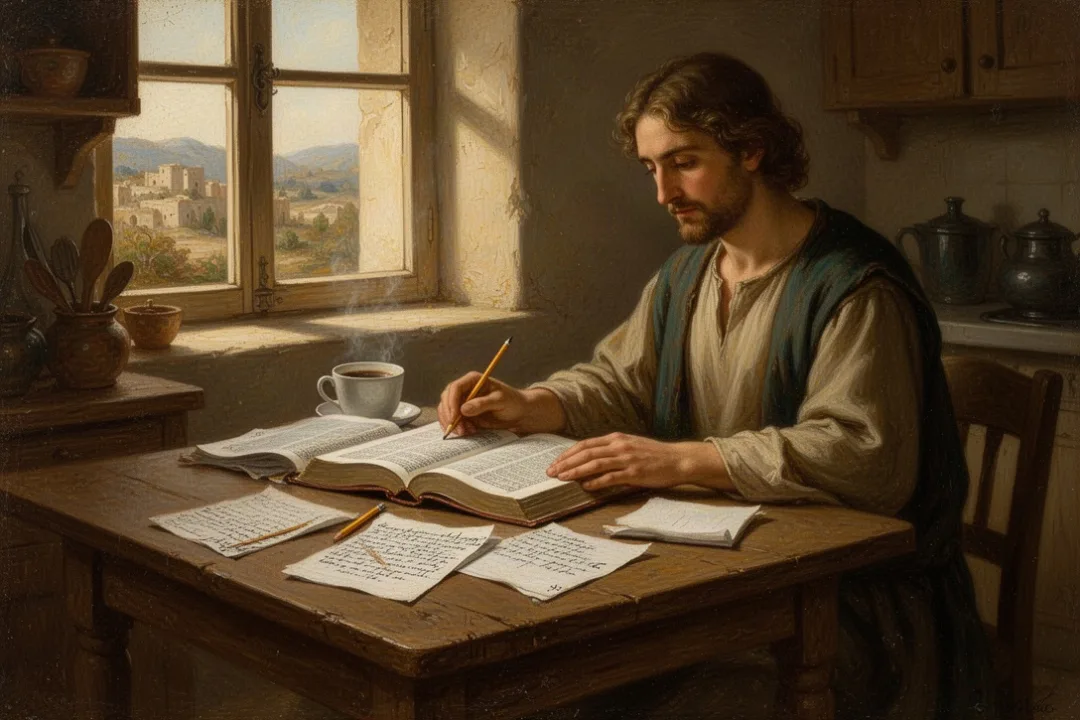
Set aside a regular time and remove as many distractions as possible. You do not need an elaborate setup: a Bible, a notebook, and a dependable source for background information are enough. If your schedule is unpredictable, choose a realistic minimum, such as fifteen minutes three times a week.
Read the passage before consulting explanations
Read the assigned text slowly at least twice. On the first reading, follow the main movement of the passage. On the second, mark repeated ideas, surprising details, commands, questions, emotional changes, and connections between people.
Write down what you notice before reading a commentary or watching a video. This protects you from simply repeating someone else’s interpretation and helps you recognize which questions need further investigation.
Identify the passage’s setting and structure
Ask who is speaking, who is listening, what problem or event is being addressed, and what happens immediately before and after the passage. A command may be given to a particular audience in a particular situation, while a narrative may show a response without directly commanding every reader to copy it.
Notice how the passage is organized. It may move from a problem to a response, from a question to an answer, or from an event to an explanation. Structure often reveals emphasis more reliably than a single memorable phrase.
State the central idea in your own words
Try to summarize the passage in one or two sentences without using vague language. Instead of writing, “This passage is about faith,” explain what it teaches about faith, who needs to hear it, and what difference it makes.
If you cannot summarize the main point, return to the text and identify the most important action, claim, warning, promise, or contrast. A precise summary gives the rest of your study a firm foundation.
Use the lesson questions carefully
Answer observation questions from the passage itself. For interpretation questions, consider the immediate context, the book’s purpose, and any relevant historical information. For application questions, name a specific response rather than writing a general intention such as “I should do better.”
Helpful application may involve a conversation you need to have, a habit you need to change, a person you need to forgive, a truth you need to remember, or a form of service you need to pursue. Application should be specific, honest, and connected to the passage.
Pray and record one next step
End by writing a brief prayer or reflection based on what you studied. Then record one next step for the coming day or week. This might be asking for wisdom before a difficult decision, practicing patience in a particular relationship, or reviewing the passage when anxiety returns.
Do not measure the value of a study only by how much information you collected. A lesson can be successful when one important truth becomes clearer and leads to a faithful response.
Free Bible study lesson ideas for different goals
You can build your own lessons from these themes or use them as search terms when looking for no-cost study guides. Each topic works best when you read several connected passages instead of collecting unrelated verses.
Understanding who Jesus is
Read selected scenes from one Gospel, such as Jesus calling disciples, teaching crowds, healing people, confronting religious leaders, and speaking with individuals. Ask what each scene reveals about Jesus’ authority, compassion, priorities, and relationship with God.
Compare similar events only after understanding each account on its own. The goal is not to force every detail into a single presentation, but to notice the emphasis and purpose of each Gospel writer.
Learning how to pray
Study prayers and teachings about prayer in passages such as Matthew 6, Luke 11, Psalms of lament, and prayers found in Acts and the letters. Pay attention to what people ask for, what they confess, how they respond to suffering, and how they acknowledge God.
Create a simple prayer pattern from your observations: praise, confession, gratitude, requests, and intercession. Keep the structure flexible so it supports honest prayer rather than turning prayer into a performance.
Growing in wisdom and character
Use selected passages from Proverbs, James, Galatians, Ephesians, and the teachings of Jesus. Study one quality at a time, such as patience, humility, self-control, generosity, truthful speech, or courage.
Ask what the quality looks like in ordinary situations. Then identify its opposite, the pressures that make it difficult, and one practice that can help you grow. Character studies are most useful when they move beyond definitions and address speech, work, money, conflict, and relationships.
Exploring the Bible’s story of redemption
Read representative passages from creation, human rebellion, God’s covenant promises, Israel’s history, the ministry of Jesus, the cross and resurrection, the growth of the church, and the promised renewal of creation. Connect each passage to the larger story without treating every verse as an isolated prediction.
This approach helps you see recurring themes such as God’s holiness, human sin, grace, covenant, restoration, and hope. It also prevents a study of one biblical character from becoming detached from the Bible’s broader message.
Studying relationships and conflict
Examine passages about listening, anger, reconciliation, correction, friendship, marriage, community, and caring for vulnerable people. Consider both the speaker’s responsibility and the other person’s dignity.
Write down what the passage asks you to do, what it warns you to avoid, and where wisdom is needed. Biblical reconciliation does not mean ignoring abuse, removing appropriate boundaries, or pretending that harm did not occur. Application should include truth, accountability, and safety.
Free tools that can strengthen your Bible study
A free lesson becomes more useful when paired with a few dependable tools. Many readers use a digital Bible app, a printed Bible, a cross-reference system, a Bible dictionary, and a notebook. You do not need every available feature; choose tools that help you understand the text rather than interrupting your concentration.
Reading two reputable translations can clarify wording, especially when a sentence feels difficult. Compare translations after you have formed your initial observations, and remember that differences in wording do not automatically indicate differences in meaning.
A Bible dictionary or introductory guide can explain names, places, customs, and literary forms. A commentary can help with difficult passages, but consult it after reading the text yourself. Treat any individual explanation as a resource to evaluate, not as a replacement for careful reading.
Digital tools may offer search functions, audio readings, maps, reading plans, and note-taking features. These are helpful for locating related passages and reviewing previous studies. They can also encourage shallow browsing, so decide what passage you will study before opening a large collection of links.
Check the context: A cross-reference can show that two passages use similar words without proving that they mean exactly the same thing. Read the surrounding paragraphs and ask whether the connection is based on shared language, shared theme, or a direct argument.
Common mistakes that weaken Bible study
Free resources are valuable, but no worksheet can remove the need for sound judgment. The following habits often produce confident conclusions that the passage itself does not support.
Taking a verse out of context: A sentence may sound universal when the surrounding passage addresses a specific event, audience, or problem.
Starting with a preferred answer: If you decide what a passage must say before reading it, you may overlook details that challenge your assumptions.
Confusing description with instruction: A biblical narrative may report an action without presenting it as a model to follow.
Building a doctrine on one difficult line: Compare the passage with clearer teaching elsewhere and consider the whole book.
Ignoring genre: Poetry, wisdom writing, prophecy, narrative, letters, and apocalyptic visions communicate in different ways.
Using application as self-improvement only: Christian study includes obedience and character, but it also involves understanding God, grace, worship, community, and hope.
Letting a study guide do all the thinking: Read the biblical text first and explain your observations in your own words.
Expecting immediate emotional results: Some passages comfort you quickly; others require patient reflection and may raise difficult questions.
Another common mistake is confusing familiarity with understanding. You may have heard a story many times and still miss its setting, repeated themes, or uncomfortable implications. Read familiar passages as carefully as unfamiliar ones.
How to create your own free Bible study lesson
You can write a useful one-page lesson with a Bible, a notebook, and a few well-formed questions. Choose a passage that is small enough to read carefully. A paragraph, short story, prayer, or section of teaching is usually easier to study than an entire book in one sitting.
Choose the passage: Select a connected section with a recognizable beginning and end.
Read it several times: Read silently, read aloud, and consider listening to an audio version if available.
Record observations: List people, places, actions, repeated terms, commands, promises, contrasts, and questions.
Research the setting: Use a reliable introduction or reference tool to clarify background that affects interpretation.
Write the main point: State what the passage communicates to its original audience and what principle remains relevant.
Create questions: Include observation, interpretation, and application questions.
Check your conclusions: Compare your interpretation with the surrounding chapter and related teaching.
Choose a response: End with one practical action, prayer, or conversation.
For a group, prepare questions that invite discussion rather than questions with only one obvious answer. Ask members what they observed before asking what they think it means. This order keeps the conversation anchored in the text and gives quieter participants a natural opportunity to contribute.
For children or teenagers, shorten the reading and use concrete questions. Ask what happened, how a person felt, what choice was made, and what the story shows about God. Avoid turning every lesson into a moral slogan; young readers also need help noticing God’s character and the passage’s larger message.
How to build a sustainable weekly study routine
Choose a rhythm you can maintain during an ordinary week, not an ideal week. Two or three focused sessions may be more realistic than promising an hour every morning. Put the time on your calendar, keep your materials in one place, and decide the next passage before ending each session.
A weekly pattern might look like this:
First session: Read the passage and record observations.
Second session: Review context and answer interpretation questions.
Third session: Consider application, pray, and discuss the passage with someone else.
Leave room for missed days without treating them as failure. Resume with the next scheduled session rather than trying to complete every missed assignment at once. Consistency grows when the routine is forgiving enough to survive travel, illness, work changes, and family responsibilities.
Keep a record of passages studied, questions that remain open, and insights you want to revisit. Over time, this notebook becomes a useful map of your learning. It can also help you notice repeated themes and areas where you need further study.
How to evaluate difficult interpretations and online resources
When a lesson makes a strong claim, ask how the writer reached it. Does the explanation consider the whole passage? Does it acknowledge uncertainty where responsible interpreters disagree? Does it use historical information carefully, or does it make dramatic claims without evidence?
Compare significant interpretations with more than one trustworthy resource, especially when the issue affects doctrine, ethics, or personal decisions. A disagreement between sources does not always mean one is careless; Christians may share confidence in Scripture while differing about translation, tradition, or the best interpretation of a difficult text.
Be cautious with lessons that promise secret meanings, reduce every passage to a personal success formula, or use fear to pressure you into immediate decisions. Sound Bible study may challenge you, but it should not depend on manipulation. It should lead to greater truthfulness, humility, love, and faithfulness.
Also consider the author’s qualifications and perspective. A free resource can be excellent without being produced by a large organization, while a polished presentation can still contain weak reasoning. Evaluate the content by its handling of Scripture, clarity of argument, and honesty about evidence.
Questions to bring to every Bible study session
A short set of recurring questions can keep your study focused. You do not need to answer every question for every passage; choose the ones that fit the text.
What does the passage clearly say?
Who is involved, and what does each person want or do?
What words, ideas, or actions are repeated?
What comes before and after this section?
What problem, promise, command, or hope appears here?
What does the passage reveal about God and people?
How would the original audience have understood the situation?
What interpretation is supported by the text, and what remains uncertain?
How should this shape my beliefs, choices, relationships, or prayers?
What is one specific response I can make this week?
These questions work for personal study, family worship, and small groups. They also help you distinguish what the text says from what you assume, prefer, or have heard elsewhere. That distinction is one of the most valuable skills a Bible student can develop.
Making free Bible study lessons useful for group discussion
Before a group meets, ask everyone to read the same passage and write one observation and one question. This small preparation step gives the gathering a shared starting point and reduces the chance that one person’s interpretation will dominate immediately.
A leader can begin by asking what participants noticed, then organize the answers around the passage’s structure. Save difficult application questions for after the group understands the text. If the conversation moves toward speculation, return to specific words, actions, and claims in the passage.
Make room for honest disagreement while keeping the conversation respectful. Not every question must be settled in one meeting. Sometimes the most responsible outcome is to identify what is clear, name what remains uncertain, and agree to consult additional resources before reaching a conclusion.
End with a practical response that does not pressure people to disclose private information. Participants can choose a personal action, a prayer focus, or a way to serve someone. A healthy group values truth, humility, confidentiality, and care alongside good discussion.
Frequently asked questions
Are free Bible study lessons suitable for beginners?
Yes. Choose lessons with a short reading, clear explanations, and straightforward observation questions. Beginners often benefit from studying one Gospel or a short New Testament letter rather than starting with a complex subject. A lesson should help you understand the passage itself, not require extensive prior knowledge or specialized theological vocabulary.
How long should a free Bible study lesson take?
A focused lesson can take 15 to 30 minutes, while a group study may take an hour or more. The ideal length depends on the passage and your schedule. It is better to study a small section carefully and return consistently than to rush through several chapters without understanding their context or main message.
Can I use free online Bible studies from different Christian traditions?
You can, but read with awareness of the resource’s theological perspective. Compare strong claims with the biblical passage and, when needed, with another reputable source. Pay particular attention to whether the lesson distinguishes direct teaching from interpretation. Learning how traditions differ can be helpful when the discussion remains respectful and evidence-based.
What should I do when a Bible passage is difficult to understand?
First, reread the surrounding section and identify what is clear. Then check the book’s setting, genre, and purpose using a dependable Bible reference. Compare several translations and consult more than one thoughtful explanation. Record the question rather than forcing an answer. Some passages become clearer with time, broader reading, and careful discussion.










Leave a Reply