You can use these free printable Catholic Bible study lessons for personal prayer, family Scripture time, or a parish discussion group. Each lesson includes a passage, Catholic context, reflection questions, and a simple prayer response that you can copy into a document and print.
The lessons are designed for about 30 to 45 minutes. They work with a Bible, a notebook, and a quiet place to read. Catholic participants can also use the Sunday readings, the Catechism, and the Church’s liturgical calendar to connect Scripture with the life of faith.
What each printable Catholic Bible study lesson includes
A useful worksheet should guide you toward the biblical text rather than replace it. Before beginning, read the complete passage in a Catholic Bible, such as the New American Bible Revised Edition, the Revised Standard Version Catholic Edition, or another approved Catholic translation.
Each lesson below follows four movements: read, understand, reflect, and respond. This keeps the study grounded in the passage while leaving room for prayer and personal application.
Passage: the biblical text to read slowly, preferably twice.
Setting: basic information about the people, place, and situation.
Catholic connection: a link to the sacraments, liturgy, moral life, prayer, or Church teaching.
Study questions: questions that begin with the words of the passage before moving toward personal reflection.
Prayer response: one concrete way to answer God through prayer or action.
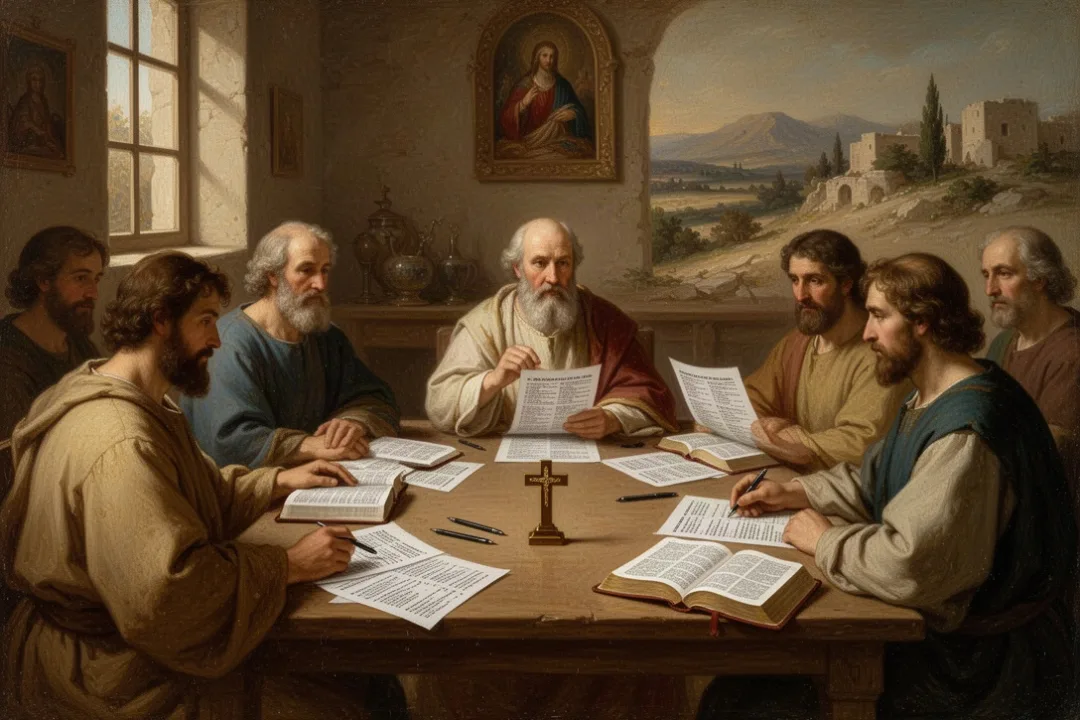
Print one copy for each participant, or print a single copy for a group leader. Leave space beneath each question for handwritten observations. Writing down a word, repeated image, command, promise, or change in a character can reveal details that are easy to miss during a quick reading.
Keep the Bible open: A study guide is a companion, not a substitute for Scripture. Let the actual passage answer the first questions before consulting notes or commentaries.
Six free printable lessons for personal or group study
Lesson 1: Jesus calls the disciples
Read: Mark 1:14-20. This passage presents Jesus beginning his public ministry and calling Simon, Andrew, James, and John. Notice the urgency of the invitation, the ordinary setting, and the fishermen’s immediate response.
Setting: Jesus appears in Galilee after John the Baptist has been arrested. He announces that God’s reign is drawing near and calls people to repentance and belief. The first disciples encounter him while doing regular work, not during a religious ceremony.
Catholic connection: Christian discipleship begins with Christ’s initiative. The Church’s vocation is not only for priests, religious brothers, or religious sisters. Through Baptism, every Catholic is called to follow Jesus and participate in his mission according to his or her state in life.
What does Jesus announce before calling the fishermen?
What details show the cost or seriousness of their decision?
What might “leaving the nets” mean for a Catholic today?
Which responsibility, habit, or attachment makes it difficult for you to respond to Christ?
Prayer response: Ask Jesus to show you one faithful step you can take this week. It might involve returning to prayer, reconciling with someone, serving a neighbor, or accepting a responsibility that love requires.
Lesson 2: The Good Samaritan and merciful love
Read: Luke 10:25-37. The parable begins with a question about inheriting eternal life and ends with a command to act mercifully. Pay attention to who notices the wounded man, who crosses the road, and who provides practical care.
Setting: The questioner wants to define the limits of his responsibility by asking who counts as his neighbor. Jesus answers with a story rather than a narrow definition. The outsider becomes the example of loving action, while religious status alone does not guarantee compassion.
Catholic connection: Mercy includes both compassion and concrete action. The corporal works of mercy—such as feeding the hungry, visiting the sick, sheltering the homeless, and caring for prisoners—give visible form to love of neighbor. The parable also challenges prejudice and indifference.
Which characters see the injured man, and how does each respond?
What risks, resources, and time does the Samaritan give?
Why might Jesus have chosen a Samaritan as the compassionate person?
Where do you encounter people whose needs are easy to overlook?
Prayer response: Choose one work of mercy that fits your circumstances. Make the response specific: call a lonely relative, bring food to someone who is ill, give time to a local ministry, or offer patient attention to a person who is often ignored.
Lesson 3: The Beatitudes and Christian happiness
Read: Matthew 5:1-12. Jesus describes the blessedness of people who are poor in spirit, meek, merciful, pure in heart, and committed to peace and righteousness. Read the passage slowly, noticing both the present promise and the future hope.
Setting: The Beatitudes open the Sermon on the Mount. Jesus is not presenting a plan for gaining popularity or comfort. He reveals the values of the Kingdom of God, where dependence on God, mercy, holiness, and endurance matter more than status.
Catholic connection: The Beatitudes describe the shape of Christian holiness. They do not praise suffering for its own sake. Instead, they promise God’s presence and ultimate fulfillment to people who remain faithful while practicing mercy, seeking justice, making peace, and enduring opposition.
Which Beatitude seems most attractive to you? Why?
Which one challenges your current priorities?
How are the Beatitudes connected to Jesus’ own life?
What would peacemaking look like in one relationship this week?
Prayer response: Select one Beatitude as a focus for seven days. Write it at the top of your worksheet, then record one situation each day in which you practiced mercy, humility, purity of heart, peacemaking, or faithfulness.
Lesson 4: The Last Supper and the Eucharist
Read: 1 Corinthians 11:23-29 and Luke 22:14-20. Paul describes the tradition he received concerning the Lord’s Supper, while Luke places the Eucharistic words within the meal Jesus shares with his apostles before his Passion.
Setting: The Christian community at Corinth is divided and careless in its shared meal. Paul reminds them that the Eucharist cannot be separated from reverence, self-examination, and concern for other members of the Body of Christ.
Catholic connection: The Eucharist is the source and summit of Christian life. Catholics believe that the Mass makes present sacramentally the one sacrifice of Christ and nourishes the Church with his real presence. The passage also shows that receiving Communion calls for a life shaped by unity and charity.
What does Paul say he received and handed on?
What attitudes does the Corinthian situation reveal?
How should participation in Mass affect your treatment of other people?
What does a sincere examination of conscience involve before receiving Communion?
Prayer response: Before your next Mass, spend a few minutes asking God for a more attentive heart. Consider one relationship that needs forgiveness, one person who needs your care, and one grace you want to receive through the Eucharist.
Lesson 5: Mary’s faith and the Annunciation
Read: Luke 1:26-38. The angel announces God’s plan to Mary, and she responds with trust even though the future is not fully explained. Notice the movement from fear, to listening, to a free answer.
Setting: Mary lives in Nazareth, a small Galilean town, and receives a vocation that will affect the history of salvation. The passage emphasizes God’s grace, the work of the Holy Spirit, the identity of Jesus, and Mary’s willing cooperation.
Catholic connection: Catholics honor Mary because of her unique role as the Mother of Jesus, not as a rival to God. Her “yes” shows the meaning of faithful cooperation with grace. Catholic prayer asks Mary to pray for us and lead us toward her Son.
What does the angel say about the child Mary will bear?
What does Mary ask before giving her response?
How does the passage show both divine initiative and human freedom?
Where might God be asking you to trust before you have every answer?
Prayer response: Pray one decade of the Rosary slowly, using the Annunciation as the mystery for meditation. Ask for Mary’s intercession as you bring one fear, decision, or area of uncertainty to Christ.
Lesson 6: The road to Emmaus and recognizing Christ
Read: Luke 24:13-35. Two disciples leave Jerusalem discouraged after Jesus’ death. Along the road, a stranger explains the Scriptures to them; later, they recognize him in the breaking of the bread and return to the community.
Setting: The disciples have heard reports of the empty tomb but do not yet understand what has happened. Jesus meets them in their confusion, listens to their account, interprets the Scriptures, and gradually leads them from disappointment to faith.
Catholic connection: The passage brings together Scripture, Eucharist, and the Church. Catholics encounter Christ through the Liturgy of the Word and the Liturgy of the Eucharist, then are sent back into the community to witness to what they have received.
What hopes had the disciples placed in Jesus?
How does Jesus respond to their confusion?
At what moment do they recognize him?
How does their behavior change after recognizing Christ?
Prayer response: Bring one disappointment to prayer without trying to hide it. Ask Christ to walk with you, open your understanding through Scripture, and show you how to return to Christian community with renewed hope.
How to use a printable lesson in 30 to 45 minutes
A predictable rhythm helps a group remain focused. The goal is not to answer every possible question or finish a large amount of reading. The goal is to listen carefully to God’s Word and respond faithfully.
Prepare for two minutes: Put away distractions, light a candle if appropriate, and invite the Holy Spirit to guide the time.
Read for five minutes: Read the passage aloud, then read it silently. A second reader may read it from another approved Catholic translation.
Observe for ten minutes: Mark repeated words, commands, questions, contrasts, promises, and changes in the scene.
Discuss for fifteen minutes: Begin with what the text says. Move next to what it means in its setting, then ask how it speaks to Christian life.
Pray for five minutes: Offer one praise, one request, one area of repentance, and one decision for the week.
For a group, establish a few simple guidelines. Participants should be free to share without being pressured, and personal stories should be treated with discretion. Keep the conversation connected to the biblical passage rather than allowing one person’s experience to dominate the meeting.
Use the reference to find the answer in the passage.
Distinguish between what the text clearly says and what you are inferring.
Allow silence after a question; thoughtful answers may take time.
Disagree respectfully, especially when discussing personal application.
Ask a priest, deacon, or qualified catechist about questions involving doctrine or sacramental practice.
A leader can close by asking each participant to name one word from the passage and one action for the coming week. This creates a natural bridge between Bible study and discipleship without turning the meeting into a test.
How to read Scripture with a Catholic perspective
Catholic Bible study respects the literary meaning of a passage while also reading it within the whole story of salvation. A verse should not be isolated from its paragraph, its book, or the unity of Scripture. The Old Testament prepares for Christ, and the New Testament announces his fulfillment of God’s promises.
The Catholic approach also reads the Bible within Sacred Tradition and the teaching of the Church. This does not limit personal prayer. It protects readers from treating a private interpretation as the only possible meaning, especially when a passage concerns the Trinity, the sacraments, Mary, moral teaching, or the Church.
Four questions that keep study balanced
What does the passage say? Identify its words, structure, speakers, actions, and setting.
What did it mean in its original context? Consider the audience, historical situation, genre, and purpose of the biblical book.
How does it fit the whole of Scripture? Look for connections to creation, covenant, sin, redemption, Christ, the Church, and eternal life.
How does the Church live this truth? Consider the Mass, sacraments, prayer, moral action, service, and the writings of recognized Christian teachers.
Genre matters. A psalm uses poetry, a parable uses a story to reveal a truth, wisdom literature often presents observations about faithful living, and a letter addresses particular communities. Reading every sentence as if it were the same kind of writing can produce confusion.
When a passage seems difficult, begin with a reliable Catholic study Bible or commentary. Compare the passage with related references, consult the Catechism when appropriate, and ask a knowledgeable Church leader. Avoid building a major belief on one unclear line separated from the rest of Scripture.
For Catholic groups: Treat questions about doctrine as invitations to investigate, not as contests to win. A humble answer such as “I need to check that with a trusted Catholic source” is better than confident speculation.
A blank printable worksheet for any Bible passage
You can copy the following prompts into a word-processing document, enlarge the spacing, and print one sheet for each participant. Choose a passage of manageable length; a short paragraph studied carefully is usually more fruitful than several chapters read quickly.
Read and observe
Bible reference:
Date and place of study:
What words or ideas are repeated?
Who is speaking, and who is listening?
What problem, need, promise, or command appears?
What changes from the beginning of the passage to the end?
Understand and connect
What is the main point of the passage?
What does this passage reveal about God?
What does it reveal about human weakness or faithfulness?
How does it point toward Jesus Christ or the life of the Church?
Does it connect with a sacrament, feast, prayer, work of mercy, or moral responsibility?
Pray and respond
What should I praise God for after reading this passage?
What do I need to confess, change, or place in God’s hands?
What grace should I ask for?
What specific action will I take before the next study?
What short phrase from the passage will I carry into prayer?
End the worksheet with a brief prayer in your own words. You might thank God for a truth you noticed, ask forgiveness for a neglected duty, or pray for someone mentioned during the discussion. The response should be specific enough to practice and realistic enough to remember.
Ways to adapt the lessons for families, teens, and parish groups
Families often need shorter sessions than adult study groups. Read the passage aloud, ask children to identify what happened, and invite everyone to name one person who needs prayer. A child may respond through a drawing, a simple sentence, or an act of service rather than a long verbal discussion.
For teenagers, include questions about decisions, friendships, pressure, identity, and compassion. Ask where a biblical character’s choices resemble situations young people face now, while avoiding the assumption that every passage must provide an immediate solution to a modern problem.
Parish groups can connect lessons with the liturgical year. Use passages about the Incarnation during Advent and Christmas, repentance during Lent, the Resurrection during Easter, and the Holy Spirit or the Church around Pentecost. The Sunday readings can provide a shared starting point for parish ministries and small groups.
For a family: use one passage, two questions, and one shared prayer.
For teens: add a practical case study or journal prompt.
For adults: include historical context and links to Catholic teaching.
For a parish ministry: finish with a service commitment related to the passage.
For personal study: repeat the same passage over several days and record new observations.
Keep printed pages accessible in a Bible, folder, or prayer journal. Over time, your notes can show recurring themes in your spiritual life: a need for forgiveness, a call to patience, a growing desire for service, or a deeper awareness of God’s presence in ordinary responsibilities.
Free printable lessons are most helpful when they lead to regular contact with Scripture, participation in the sacraments, and love of neighbor. Read attentively, pray honestly, seek sound Catholic guidance, and let each study produce one faithful response.
Frequently asked questions
Can I use these Catholic Bible study lessons without a group?
Yes. Read the passage aloud or silently, answer the questions in a notebook, and finish with prayer. Personal study can be especially fruitful when you return to the same passage on several days. If a question concerns Catholic doctrine, compare your interpretation with the Catechism or ask a priest, deacon, or qualified catechist for guidance.
Which Catholic Bible should I use with printable lessons?
Use an approved Catholic translation that you can understand comfortably. Common options in the United States include the New American Bible Revised Edition and the Revised Standard Version Catholic Edition. The lesson references remain useful with other Catholic Bibles, although wording, headings, and verse numbering may vary slightly.
How long should a Catholic Bible study meeting last?
A focused meeting usually takes 30 to 45 minutes, including reading, discussion, and prayer. A family session may take 15 to 20 minutes, while a parish group with background explanation may need an hour. Choose a length the group can sustain consistently rather than trying to cover too much material.
Is it acceptable for Catholics to interpret the Bible personally?
Catholics are encouraged to read and pray with Scripture personally. Personal interpretation should remain connected to the passage’s context, the unity of the Bible, Sacred Tradition, and the Church’s teaching authority. When a passage raises a question about doctrine or morality, use reliable Catholic resources instead of relying only on an individual impression.






Leave a Reply