Genesis 37 commentary: Joseph, jealousy, and providence
Genesis 37 commentary: Joseph, jealousy, and providence
Genesis 37 begins Joseph’s story by showing how favoritism, resentment, and unchecked speech can fracture a family. The chapter does not present Joseph’s suffering as simple or accidental; it brings together his father’s partiality, his brothers’ hatred, Joseph’s dreams, and a series of human choices that lead to his sale into slavery.
The chapter is often treated as the beginning of the Joseph narrative, which continues through Genesis 50. Yet Genesis 37 also stands on its own as a carefully shaped account of family conflict. It asks how people respond when one person appears favored, when dreams suggest an unsettling future, and when anger becomes stronger than compassion.
Joseph is introduced as a seventeen-year-old shepherd who works with some of his brothers, the sons of Bilhah and Zilpah. The text also reports that Joseph brings his father a troubling account of their behavior. It does not explain every detail of that report, so readers should avoid assuming more than the passage says. Joseph may have been acting responsibly, but his role also contributes to tension among the brothers.
Jacob, Joseph’s father, clearly loves him more than the other sons. The reason is given: Joseph is the son of Jacob’s old age and the firstborn son of Rachel, the woman Jacob loved deeply. Jacob’s earlier family history already includes competition between wives, parental favoritism, and strained sibling relationships. Genesis 37 shows those old patterns producing another generation of conflict.
Jacob gives Joseph a special garment. The Hebrew description is difficult to define with complete precision, so translations differ in how they describe it. It may have been a long or distinctive robe, perhaps one associated with status or exemption from ordinary labor. Whatever its exact appearance, the garment functions in the story as a visible sign that Joseph occupies a privileged place.
The brothers recognize that favoritism, and their response is severe. They hate Joseph and cannot speak to him peacefully. The problem is not merely that they dislike his clothing. The garment confirms what they already perceive: their father has set Joseph apart, and Joseph has become a symbol of unequal treatment within the household.
Central observation: Genesis 37 does not blame only one person for the family’s collapse. Jacob’s favoritism, Joseph’s communication, and the brothers’ hatred all matter, even though the brothers remain responsible for their violent actions.
Joseph’s dreams reveal ambition, destiny, and misunderstanding
Joseph dreams that he and his brothers are binding sheaves in a field. His sheaf rises and stands upright, while the others gather around it and bow down. Joseph tells the dream to his brothers, who understand its implied meaning: he appears to be destined for authority over them.
The brothers respond with an obvious question about Joseph’s imagined rule. Their reaction shows that they hear the dream not as a private religious experience but as a threat to the family’s existing order. The dream intensifies their hatred because it seems to confirm the status Joseph’s garment already represents.
Joseph then has another dream involving the sun, moon, and eleven stars bowing before him. He tells it to both his brothers and his father. Jacob rebukes him and asks whether the family is really expected to bow before him. The imagery appears to include Joseph’s parents, although the later story raises interpretive questions because Rachel has already died by this point.
That detail reminds readers that biblical dreams do not always function as straightforward timetables. The second dream reinforces the first dream’s central idea—Joseph will occupy an elevated position—but it does not explain precisely how every image will be fulfilled. Biblical narrative often leaves some elements unresolved or reshaped by later events.
Jacob reacts with both correction and reflection. He rebukes Joseph, yet he also keeps the matter in mind. The brothers respond with greater hostility, while Jacob appears to consider whether the dream might contain meaning. The differing responses are important: the same words produce resentment in the brothers, rebuke in Jacob, and private reflection in the father.
The chapter does not state directly whether Joseph shares his dreams out of arrogance, innocence, excitement, or a mixture of motives. A wise reading should preserve that uncertainty. Joseph is not presented as a flawless hero, but neither does the text say that his dreams are false merely because his manner of sharing them is socially provocative.
The family’s old pattern of favoritism repeats itself
Genesis has already shown the damage caused when parents favor one child over another. Isaac favored Esau, Rebekah favored Jacob, and Jacob’s own relationship with Rachel and Leah created lasting competition. Genesis 37 demonstrates that unresolved family patterns can move from one generation to the next.
Jacob’s favoritism is especially painful because he knows what sibling rivalry can do. He had deceived Isaac while pretending to be Esau, fled from Esau’s anger, and lived through rivalry between Rachel and Leah. Yet knowledge of past harm does not automatically prevent people from repeating it. Jacob’s special treatment of Joseph gives the brothers a reason to feel excluded, even though it does not justify their later conduct.
The chapter therefore offers a sober picture of partiality within families. Affection itself is not wrong, and parents may have different relationships with different children. The danger comes when affection becomes public favoritism, when one child receives symbolic honor at the expense of others, and when the family never addresses the resentment that follows.
Joseph’s brothers also have a responsibility that the chapter does not minimize. Their pain is understandable, but their response becomes morally destructive. They move from silence, to hatred, to a plan for murder, and finally to human trafficking and deception. Genesis 37 distinguishes between the legitimacy of their grievance and the illegitimacy of their chosen response.
Joseph’s trip to Dothan turns hostility into violence
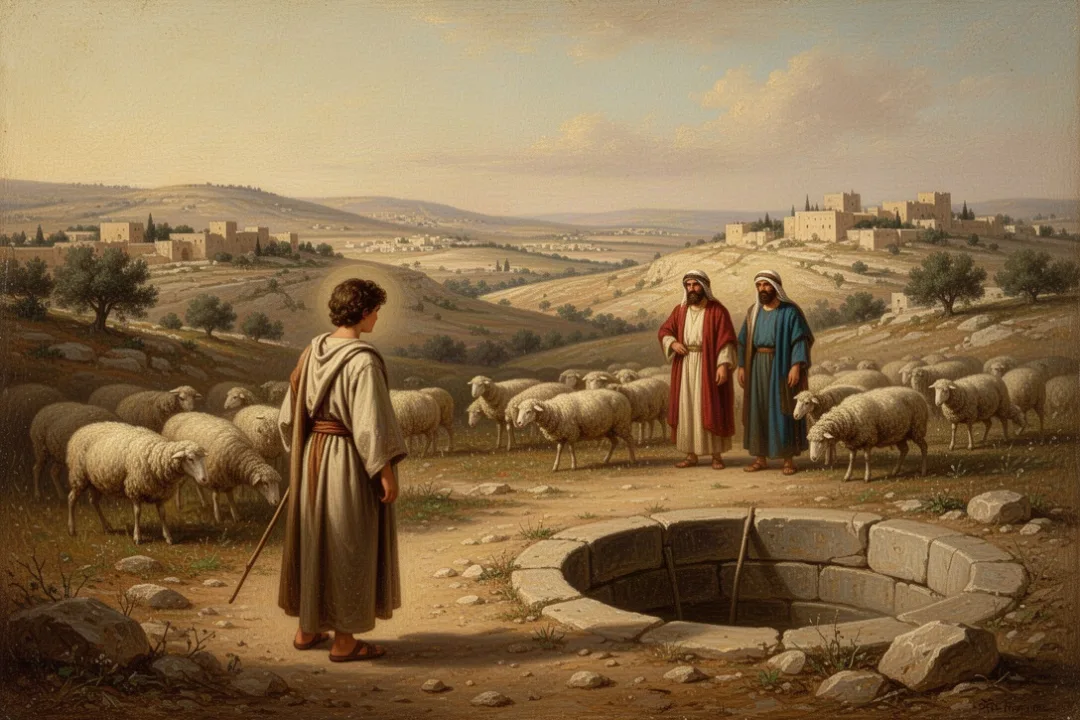
Jacob sends Joseph to check on his brothers and the flocks near Shechem. Joseph does not find them there. A man encounters him wandering in the countryside and tells him that the brothers have moved to Dothan. The unnamed man’s brief role advances the plot, but the text does not explain his identity or suggest that readers must assign him a supernatural status.
When the brothers see Joseph approaching from a distance, they recognize him by his distinctive garment. Before he reaches them, they plot to kill him and throw his body into a pit. They plan to claim that a wild animal devoured him, thereby turning Joseph’s own garment into evidence for their lie.
The brothers’ language about Joseph as “the dreamer” reveals how they have reduced him to one disliked feature. They do not use his name. Instead, they label him by the dreams that offended them, as though destroying the dreamer could eliminate the future the dreams suggested.
Reuben intervenes. He urges them not to kill Joseph and proposes that they place him in a pit in the wilderness. The narrative explains that Reuben intends to rescue Joseph later and return him to Jacob. His intervention is morally significant, but it is also limited. He does not openly confront the brothers before the plot develops, and he is absent when the decisive sale takes place.
Reuben’s conduct shows that partial resistance to evil may prevent one form of harm without ending the danger. He is better than the brothers who want murder, but his plan does not secure Joseph’s safety. The chapter does not portray every character in simple categories of hero and villain.
When Joseph arrives, the brothers strip him of the special garment and throw him into an empty pit. The detail that the pit has no water makes the danger concrete. Joseph is not placed in a symbolic location only; he is abandoned in a dry cistern while the brothers sit down to eat.
That meal is one of the chapter’s most disturbing details. The brothers can eat while Joseph is in danger nearby. Their ability to continue ordinary life shows how resentment has weakened their empathy. Violence often becomes easier when a person has first been turned into a label, a problem, or an enemy rather than seen as a brother.
Judah’s proposal changes the form of the crime
Judah notices a caravan traveling toward Egypt. The traders are associated with Ishmaelites, and later descriptions also refer to Midianites. The narrative’s wording has produced discussion because the groups are named in different ways. The central point is clear even if every detail of the caravan’s identity is not: Joseph is removed from the pit and sold to passing merchants traveling south.
Judah argues that killing Joseph would gain the brothers nothing because he is their brother and their own flesh. His proposal sounds less violent than murder, but it is not compassionate. He turns Joseph into a commodity and seeks profit or practical advantage from the situation. Rejecting murder does not make exploitation righteous.
The brothers sell Joseph for silver. The exact amount and the transaction’s mechanics are less important than the act itself: a family member becomes the object of a commercial exchange. Joseph loses his freedom and is taken toward Egypt, while the brothers retain the ability to return home and control the story their father will hear.
Judah’s decision also becomes important for the larger Genesis narrative. In later chapters, Judah develops into a central figure whose conduct toward family responsibility changes significantly. Genesis 37 does not excuse his action, but it begins a character arc in which he will eventually face the consequences of his choices and speak differently about a brother’s life.
The torn garment makes Jacob believe Joseph is dead
The brothers take Joseph’s garment, dip it in goat’s blood, and send it to Jacob. They do not explicitly state that Joseph is dead. Instead, they ask their father to identify the garment and allow him to reach the conclusion they want. The deception is carefully designed to make Jacob believe that a wild animal has killed his beloved son.
The same garment that displayed Jacob’s favoritism now becomes an instrument of deception. It has moved from symbolizing Joseph’s favored status to supporting the false story of his death. This repeated use of the garment gives the chapter strong narrative unity and shows how visible symbols can be manipulated to conceal the truth.
Jacob tears his clothes, puts on mourning clothes, and refuses consolation. His grief is not temporary or mild. He says that he will mourn Joseph for the rest of his life and descends into the world of the dead in his sorrow. The language communicates a father who believes that the relationship he treasured has been permanently destroyed.
Jacob’s grief also exposes the long-term cost of the brothers’ lie. They may have removed Joseph from the household, but they cannot remove the consequences from Jacob’s life. Their deed damages the entire family. The brothers gain Joseph’s absence, yet the household loses peace, trust, and emotional stability.
The final scene shifts to Joseph in Egypt, where he is sold to Potiphar, an official connected with Pharaoh. The chapter ends without immediate rescue or explanation. The reader knows Joseph is alive, but Jacob does not. That dramatic irony creates tension while preparing for the next stage of the story.
God’s providence appears without excusing human wrongdoing
Genesis 37 does not frequently pause to explain God’s actions. God is not shown speaking directly to Joseph in the chapter, and no miracle interrupts the brothers’ plot. Yet the chapter is part of a larger narrative in which Joseph’s suffering becomes connected to the preservation of his family during famine.
This creates an important theological distinction. Later purpose does not erase present evil. The brothers act from jealousy and hatred; Judah proposes a profitable sale; the deception of Jacob causes real grief. The fact that God can bring good through these events does not mean the brothers’ intentions were good or that their actions should be imitated.
Readers sometimes use the language of providence too quickly and accidentally minimize suffering. Genesis 37 resists that shortcut. Joseph is genuinely endangered, Jacob genuinely mourns, and the brothers genuinely commit wrong. Providence is not permission, and a meaningful outcome does not make every step in the process morally acceptable.
At the same time, the chapter refuses to treat violence as the final word. The caravan’s arrival, Joseph’s survival, and his transfer to Egypt place him on a path the brothers did not understand. The narrative’s larger pattern suggests that human schemes can be absorbed into a purpose greater than the schemes themselves, even when the people involved cannot see that purpose at the time.
Reading principle: Keep two truths together: Genesis 37 presents real human responsibility, and the wider Joseph story presents God working through circumstances the characters did not control.
Practical tips for reading Genesis 37 carefully
Genesis 37 invites theological reflection, but it also rewards careful attention to narrative details. These practices can help you avoid flattening the chapter into a simple lesson about jealousy.
Read the whole chapter before judging one character. Joseph, Jacob, Reuben, Judah, and the other brothers each contribute something different to the conflict.
Separate explanation from justification. The brothers’ resentment has understandable roots, but their violence and deception remain wrong.
Notice repeated objects and actions. Joseph’s garment, the pit, the blood, and the journey to Egypt connect separate scenes.
Distinguish what the text states from what it leaves open. The chapter does not tell you exactly how Joseph felt when he shared the dreams or give every detail of the caravan’s identity.
Read dreams in their narrative setting. The dreams point toward future authority, but they do not give a complete schedule of events.
Do not treat providence as an excuse for abuse. Later good does not make the brothers’ actions acceptable.
Track the characters’ words. The brothers call Joseph “the dreamer,” Judah calls him their brother while proposing his sale, and Jacob’s response reveals the depth of his attachment.
Several common mistakes can also distort the chapter’s meaning. One is to make Joseph either a perfect innocent or a proud troublemaker. The text gives enough information to see that he may have lacked social wisdom, but it does not make him responsible for his brothers’ decision to sell him.
Another mistake is to treat Jacob’s grief as the only emotional response that matters. Joseph’s experience is largely hidden from the reader in Genesis 37, but his forced removal and loss of freedom are central to the chapter. The brothers’ inner resentment matters too, because the narrative traces how unaddressed anger becomes cruelty.
Genesis 37’s central themes for faith and life
Favoritism can become structurally destructive. Jacob’s private affection becomes public inequality, and the special garment makes that inequality visible. Families, churches, workplaces, and other communities can create similar wounds when praise, access, responsibility, or trust are consistently concentrated around one person without honest communication.
Resentment narrows moral vision. The brothers no longer see Joseph as a sibling whose life has value. They see him as a threat to their dignity and future. Once that reduction takes place, choices that would previously have seemed unthinkable become easier to discuss.
Speech can intensify conflict. Joseph’s dreams may be true, but the way they are communicated affects how others receive them. The chapter does not condemn truthful speech, yet it shows that truth, timing, humility, and consideration for others can matter greatly in relationships.
Partial courage has limits. Reuben’s intervention prevents immediate murder, but it does not produce justice. Judah changes the plan, but his alternative is still exploitative. Good intentions that are delayed, indirect, or incomplete may reduce harm without resolving the underlying danger.
Deception spreads suffering. The brothers’ lie does not end when Joseph leaves. It reaches Jacob, shapes the family’s future, and establishes a false reality that will eventually need to be confronted. Hidden wrongdoing often affects people who were not present when the original decision was made.
God’s purposes may be hidden during suffering. Genesis 37 does not offer Joseph an immediate explanation. The chapter leaves him in Egypt and Jacob in grief. For readers of faith, that silence is part of the message: trust in providence is not the same as possessing a clear explanation for every painful event.
How Genesis 37 prepares the rest of Joseph’s story
The chapter establishes the tensions that later scenes will develop. Joseph has dreams of authority, but he is first stripped of authority and sold. He is marked as favored, but he becomes a powerless slave. His brothers want to silence the future he represents, yet their actions move him toward the place where that future will begin to unfold.
The chapter also introduces the contrast between appearance and reality. Jacob sees blood on a garment and believes Joseph is dead. The brothers believe they have removed Joseph from their lives. Joseph appears to be abandoned, yet the larger narrative shows that his story is not over.
Finally, Genesis 37 prepares readers to watch for changes in character. Jacob will have to face the consequences of favoritism. The brothers will later encounter the moral weight of what they did. Judah will be tested in relation to another vulnerable brother. Joseph will have to decide how to respond when the people who harmed him come under his authority.
For that reason, Genesis 37 is more than a story about a colorful garment or a memorable dream. It is the opening movement of a sustained examination of family sin, suffering, responsibility, forgiveness, and providence. Its warning is direct: favoritism and resentment can destroy relationships long before anyone admits that a crisis exists. Its hope is quieter but equally significant: the worst decisions in the story do not prevent God from continuing the story.
Frequently asked questions
Was Joseph wrong to tell his brothers about his dreams?
Genesis 37 does not directly condemn Joseph for sharing the dreams, and the later narrative treats them as significant. However, the chapter leaves room to question his judgment and sensitivity. His brothers already resented his favored position, so the way he communicated the dreams may have intensified the conflict. The text supports caution rather than a simple verdict that Joseph was either arrogant or entirely blameless.
Why did Jacob favor Joseph over his other sons?
Jacob loved Joseph because he was the son of Rachel and was born to him in his old age. Rachel had been Jacob’s especially beloved wife, so Joseph carried emotional significance for him. Jacob’s favoritism also reflects the family’s repeated pattern of preferring one child over another. Genesis 37 presents that preference as a major cause of resentment, not as a healthy model of parenting.
Did Joseph’s brothers intend to murder him?
Several brothers initially planned to kill Joseph, throw his body into a pit, and claim that an animal had devoured him. Reuben opposed the killing and hoped to rescue Joseph later. Judah then proposed selling him to passing traders instead. The change in plan spared Joseph’s life, but it did not make the brothers’ action acceptable; selling him still involved exploitation, betrayal, and the loss of his freedom.
What does the pit represent in Genesis 37?
The pit is first a literal empty cistern in the wilderness, but it also marks Joseph’s sudden descent from favored son to helpless captive. He is stripped of his garment, separated from his family, and left without control over his future. The pit emphasizes the seriousness of the brothers’ rejection while also preparing for the surprising reversal that follows as Joseph is carried to Egypt rather than killed.









Leave a Reply