Genesis chapter 30: Family rivalry, faith, and Jacob’s work
Genesis chapter 30: Family rivalry, faith, and Jacob’s work
Have you ever wondered why a Bible chapter would spend so much time on family conflict, childbearing, livestock, and arguments over wages? Genesis chapter 30 brings all of those subjects together because it shows how God’s promises unfold inside a deeply complicated household. The chapter is not a simple success story. It includes jealousy, bargaining, surrogate motherhood, questionable customs, hard labor, and competing attempts to control the future.
The chapter continues Jacob’s life in Paddan-aram, where he has been working for his uncle Laban. Jacob has two wives, Leah and Rachel, as well as children born through their servant women, Bilhah and Zilpah. Genesis 30 records more births, the beginning of Rachel’s motherhood, and a major change in Jacob’s relationship with Laban.
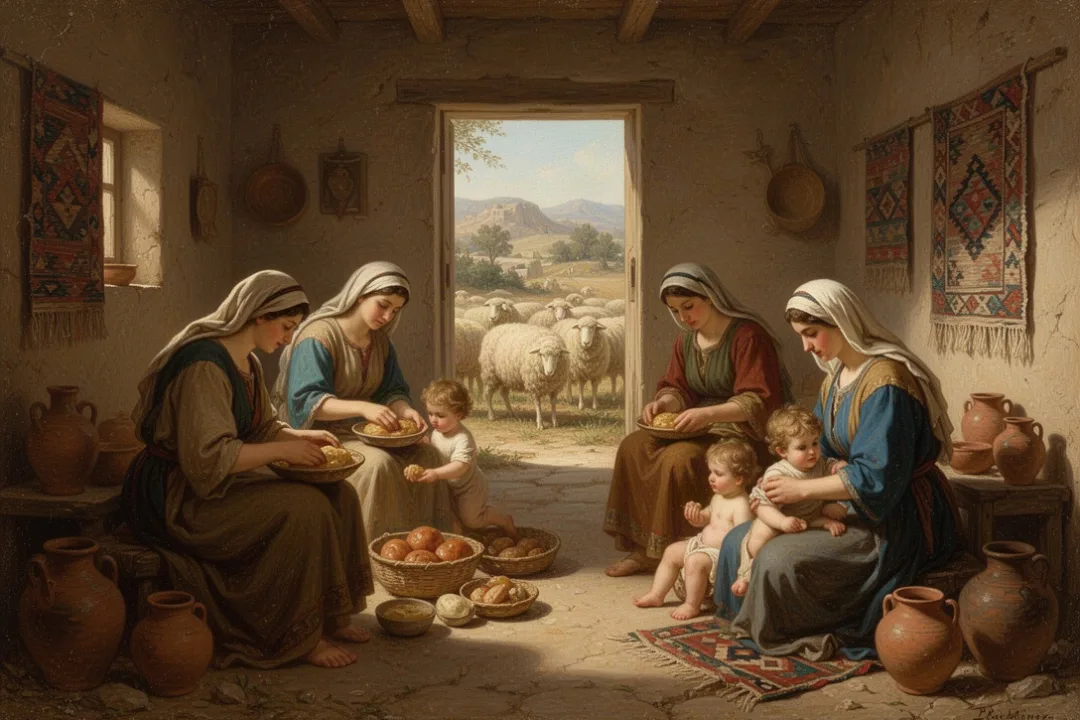
Genesis 30 opens with Rachel’s distress over being unable to have children. She demands that Jacob give her children, and Jacob responds angrily that he cannot take God’s place. Rachel then gives her servant Bilhah to Jacob, following a custom in which a wife could seek children through a servant. Bilhah bears Dan and Naphtali.
Leah, who has already borne sons but now seems to have stopped conceiving for a time, responds by giving her servant Zilpah to Jacob. Zilpah bears Gad and Asher. The chapter therefore presents a widening household in which the wives use their servants to compete for status and children.
The conflict continues when Reuben finds mandrakes in the fields during wheat harvest. Rachel asks Leah for some, apparently associating the plants with fertility. Leah objects that Rachel has already taken her husband, but the two women bargain: Rachel receives the mandrakes, and Leah spends the night with Jacob.
Leah then conceives and gives birth to Issachar, followed by Zebulun and a daughter named Dinah. The narrative later says that God remembers Rachel, listens to her, and enables her to conceive. She gives birth to Joseph. His name reflects Rachel’s hope for another son.
After Joseph’s birth, Jacob asks Laban to let him return to his homeland with his wives and children. Laban acknowledges that his household has prospered because of Jacob’s presence, so Jacob agrees to remain under a new wage arrangement. Jacob will receive livestock with unusual markings, including speckled, spotted, and dark animals.
The final part describes Jacob’s breeding practices. He places peeled branches near watering places when stronger animals mate, and the flocks produce marked offspring. Jacob separates the stronger animals from the weaker ones, becoming increasingly wealthy while Laban’s household loses some of its former advantage.
Why Rachel and Leah compete over children
The rivalry between Rachel and Leah is one of the chapter’s central themes. Genesis 29 has already explained that Jacob loved Rachel more than Leah, while Leah had children and Rachel did not. Genesis 30 shows how that imbalance affects everyone in the household. Children become signs of acceptance, security, and honor rather than simply gifts to be received with peace.
Rachel’s opening words reveal intense emotional pain. She sees childlessness as unbearable and asks Jacob to give her children. Jacob’s angry response shows that he feels unable to solve the problem, but his answer does not comfort Rachel. The couple is dealing with grief, resentment, and pressure without communicating in a healthy way.
Rachel’s decision to give Bilhah to Jacob follows a recognizable ancient practice, but the story does not present the arrangement as emotionally harmless. Bilhah becomes a means through which Rachel seeks a family identity. When Bilhah bears Dan and Naphtali, Rachel interprets the births as a form of vindication and struggle.
Leah answers by giving Zilpah to Jacob. Her action mirrors Rachel’s, turning the family into a contest. The names given to the children often express the mothers’ feelings: victory, wrestling, good fortune, or happiness. These names preserve the emotional atmosphere of the household as the family expands.
A useful reading principle: Genesis often reports human actions without approving them. The fact that a custom appears in the story does not mean the narrative presents it as an ideal model for family life.
The chapter also shows how people can measure their worth through outcomes they cannot fully control. Rachel has Jacob’s affection but lacks children for much of the story. Leah has children but feels less loved. Neither woman experiences the household as secure. Their rivalry is painful because both are seeking something legitimate—love, dignity, belonging, and a future—but pursuing it through competition.
What the mandrakes reveal about desire and control
The mandrakes episode is brief, but it adds important detail to the chapter’s portrayal of fertility and human planning. Reuben finds the plants during harvest, and Rachel wants them. The story does not explicitly say that mandrakes possess magical power. Instead, Rachel’s request reflects an ancient belief that certain plants might be associated with fertility or sexual desire.
Leah’s response is bitter. She asks whether taking her husband is not enough, and Rachel answers by offering Jacob’s company in exchange for the plants. Their conversation shows that Jacob’s household is shaped by transactions. Affection, access, children, and fertility are all treated as things that can be negotiated.
Leah conceives after Jacob spends the night with her, but the text does not claim that the mandrakes caused her pregnancy. Later, Rachel also conceives, but the narrative credits God with remembering her and opening her womb. That contrast matters: the chapter allows readers to see human attempts at control while emphasizing that childbirth ultimately remains beyond human command.
Rachel’s first son is Joseph. His birth changes her position in the family, but it does not erase the earlier pain. Rachel names him in a way that expresses both gratitude and continued longing for another son. Her desire remains mixed: she celebrates what she has received while still asking for more.
How Genesis 30 builds the family of Israel
Genesis 30 lists several children who will become ancestors of Israel’s tribes. The chapter names Dan, Naphtali, Gad, Asher, Issachar, Zebulun, Dinah, and Joseph. Along with the sons named in Genesis 29, these births establish the family line that will shape the rest of Genesis and the later biblical story.
The chapter does not present the family’s growth as calm or orderly. The sons are born amid competition between Leah and Rachel, and four different women are involved in the household’s childbearing: Leah, Rachel, Bilhah, and Zilpah. That complexity can be uncomfortable, but it is part of the narrative’s honesty about the family from which Israel emerges.
Dinah receives only a brief mention here, although she becomes central to Genesis 34. Her inclusion reminds readers that the list is not limited to sons. It also shows that the biblical genealogical record can mention a daughter even when the surrounding culture places greater emphasis on male heirs.
Several names in this chapter are connected to the mothers’ interpretations of their circumstances. Naming is not merely a way to identify a child; it is a form of testimony. The names preserve memories of struggle, competition, divine attention, and personal hope.
Dan and Naphtali are born through Bilhah and connected with Rachel’s struggle for recognition.
Gad and Asher are born through Zilpah and associated with Leah’s sense of fortune and happiness.
Issachar and Zebulun are born to Leah after the mandrakes bargain and reflect her experience of receiving children.
Dinah is named as Leah’s daughter.
Joseph is Rachel’s first son and the child whose birth follows the statement that God remembered her.
Genesis 30 therefore connects private family emotions with a much larger story. The people involved do not know everything their children will become, but the reader can see that these births are laying the foundation for the tribes and narratives that follow.
What “God remembered Rachel” means
When Genesis says that God remembered Rachel, it does not mean that God had literally forgotten her. In biblical language, God’s remembering often means that God turns toward a person with purposeful action. Rachel’s suffering has been seen, and her situation changes.
This wording is significant because the chapter has spent so much time describing human competition and fertility strategies. Rachel has used Bilhah, sought mandrakes, and endured Leah’s taunts. None of these efforts gives her the final control she wants. The narrative places her conception within God’s action rather than crediting a plant, a bargain, or a household scheme.
That emphasis does not make Rachel’s earlier pain insignificant. The text does not shame her for wanting children or reduce her distress to a lack of faith. Instead, it holds two truths together: Rachel has acted out of desperation, and her eventual pregnancy is described as a divine gift.
Readers should also avoid turning this passage into a formula that promises pregnancy to everyone who prays or waits. Genesis 30 is a particular account within a larger biblical story, not a guarantee about reproductive outcomes. Its language can speak to people who feel overlooked, but it should not be used to blame those who remain childless.
Why Jacob negotiates wages with Laban
After Joseph’s birth, Jacob asks to leave and return to his homeland. He has served Laban for many years, first for Rachel and then for Leah, and he now has a large household. Jacob’s request is reasonable within the story: he wants to establish his own household rather than remain permanently dependent on his uncle.
Laban admits that he has benefited from Jacob’s work. He has recognized that his prosperity is connected with Jacob’s presence, so he asks Jacob to name his desired wages. This acknowledgment does not erase the earlier deception in which Laban gave Leah to Jacob instead of Rachel, but it sets up a new negotiation.
Jacob proposes that his wages consist of animals with unusual markings. In the ancient Near Eastern setting, flocks were commonly dominated by animals of more typical coloring, while spotted, speckled, or dark animals could be treated as a distinct portion. Jacob’s proposal appears modest, but the arrangement becomes more complicated as the chapter continues.
The text says that Laban removes many of the marked animals and places them under the care of his sons, creating distance between Jacob and the animals that would form his wages. Jacob is left tending the remaining flock. This detail suggests that Laban is still trying to protect his own advantage, even after offering Jacob the opportunity to name his payment.
How to understand Jacob’s breeding practices
Jacob places peeled branches of certain trees in front of the animals at the watering troughs. The story says that the animals mate near the branches and produce marked offspring. Jacob also separates the stronger animals from the weaker ones and uses the method especially when the stronger animals are mating.
Modern readers may ask whether the branches could biologically produce the results described. The passage should first be read as an ancient narrative about Jacob’s prosperity and his conflict with Laban, not as a modern genetics lesson. The text presents Jacob’s actions as part of the story’s explanation for his increasing wealth, while the next chapter gives a fuller account of Jacob’s understanding of what happened.
Genesis 31 later says that God has seen Laban’s treatment of Jacob and has acted on Jacob’s behalf. That later explanation prevents the breeding scene from being reduced to human technique alone. Jacob works, plans, and uses the knowledge available to him, but the narrative ultimately attributes his deliverance and prosperity to God’s providence.
At the same time, the chapter does not portray Jacob as passive. He pays attention to the flocks, recognizes patterns, separates animals, and takes practical steps. His story holds together two ideas that are often separated: trusting God and acting with alertness in an unfair situation.
Read the animal-breeding scene in context: Its main purpose is to show Jacob gaining independence from Laban and receiving justice after years of unequal treatment, not to provide a repeatable method for breeding livestock.
Practical reading tips and common mistakes
Genesis 30 contains unfamiliar customs and many names, so it helps to read it with a clear set of questions. Pay attention to who is speaking, whose servant is involved, and whether the text is describing an action or approving it.
Do not treat every recorded action as a moral command. Surrogate childbearing, rivalry, and bargaining appear in the narrative, but their presence does not make them ideal behavior.
Track the women’s perspectives. Rachel and Leah are not interchangeable. Their words, names, and choices reveal different forms of pain and hope.
Notice the repeated emphasis on God’s action. The chapter presents human schemes, but it also says that God gives children and later protects Jacob’s prosperity.
Do not read the mandrakes as guaranteed fertility medicine. The story includes an ancient belief without making the plants the decisive cause of Rachel’s pregnancy.
Separate the narrative from modern genetics. Jacob’s branches belong to the story’s ancient explanation of livestock increase, not a scientific model to reproduce today.
Read Genesis 30 with chapters 29 and 31. The previous chapter explains the marriages and early births, while the next chapter clarifies Jacob’s conflict with Laban.
Do not miss the economic dimension. The final section is about labor, wages, exploitation, and Jacob’s movement toward independence as much as it is about animals.
These reading habits help prevent two opposite errors. One mistake is to excuse everything because the chapter is part of the Bible. The other is to dismiss the passage because its customs are unfamiliar. A careful reading lets the story remain challenging while still recognizing its theological and historical setting.
What Genesis chapter 30 teaches about family conflict
The chapter shows that a family can grow outwardly while suffering inwardly. Jacob’s household gains children, animals, and wealth, yet the relationships remain strained. More children do not automatically heal favoritism, and material success does not remove resentment.
Rachel and Leah both attempt to secure love and significance through competition. Their struggle is not merely personal jealousy; it is connected to the vulnerability of women in their social setting. Marriage, motherhood, and household status affect their security, so each woman feels pressure to prove her value.
Jacob also contributes to the conflict. His earlier preference for Rachel creates an unequal emotional environment, and his angry response to Rachel does not offer wise leadership. Later, his negotiations with Laban show that he has learned to protect his interests, but his family life remains shaped by years of rivalry.
The story offers no quick solution to these tensions. Instead, it shows God working through a flawed family without pretending that the flaws do not matter. That distinction is useful for readers who wonder whether divine purposes can continue amid broken relationships. Genesis 30 answers through narrative rather than theory: God’s work is not stopped by human disorder, but human disorder still causes real pain.
How Genesis 30 connects work, justice, and providence
Jacob’s relationship with Laban introduces another form of conflict: an employer and worker negotiating after years of unequal treatment. Jacob has contributed to Laban’s prosperity, yet he has not received the freedom or security he wants. His request for wages is a move toward independence.
Laban’s question about payment sounds generous, but the arrangement quickly becomes a contest. Laban removes the animals that would benefit Jacob, while Jacob uses selective breeding practices to increase his own portion. Both men act strategically, and neither appears completely transparent.
The narrative does not present wealth as proof that every action is righteous. Jacob’s prosperity is part of God’s provision, but the story also prepares for later confrontation. Material increase does not settle the moral question of how the two men have treated one another.
For modern readers, this section can raise practical questions about work. A person may need to recognize unfair conditions, negotiate clearly, document agreements, and plan for independence. Trust in God does not require accepting indefinite exploitation or refusing to use sound judgment.
Genesis 30 also warns against assuming that success has only one explanation. Jacob works skillfully, Laban’s choices affect the flocks, and the biblical narrative attributes the larger outcome to God’s care. The chapter’s view of providence includes human effort without making human effort sovereign.
Questions Genesis chapter 30 leaves open
The chapter does not resolve every emotional or ethical question. It does not tell readers whether Rachel and Leah ever reach peace, whether Jacob recognizes the full damage caused by favoritism, or how each servant woman experiences her role in the household. The silence invites careful reflection rather than easy answers.
It also leaves open the relationship between Jacob’s technique and divine action. The story gives concrete details about branches, mating, and flock separation, but the broader account in Genesis 31 makes clear that Jacob understands his increase as connected to God’s intervention. Readers do not need to choose between a simplistic miracle story and a simplistic technique story.
Most of all, Genesis 30 leaves readers with a realistic picture of promise unfolding through imperfect people. The family that will become Israel is not formed through ideal circumstances. Its story includes longing, rivalry, labor, deception, and unexpected provision. Those tensions are not side details; they are part of what the chapter wants readers to see.
How to apply the chapter without misusing it
Genesis 30 can encourage compassion for people carrying private grief, especially those who feel judged by family expectations or reproductive struggles. Rachel’s story should lead to empathy, not simplistic advice. A person’s worth is not measured by the number of children, the approval of a spouse, or visible prosperity.
The chapter can also sharpen awareness of favoritism and competition. When a household treats love or security as scarce resources, people may begin to bargain, compare themselves, and use others to obtain what they need. Naming that pattern is often the first step toward changing it.
Finally, Jacob’s work with Laban offers a balanced view of faith and responsibility. You can seek God’s help while making careful plans, asking for fair treatment, and preparing to leave an unhealthy arrangement. Genesis 30 does not portray wisdom as passivity; it shows a person working within difficult circumstances while trusting that the final outcome is not controlled by human power alone.
Frequently asked questions
Who are the children born in Genesis chapter 30?
Genesis 30 names children born through Bilhah, Zilpah, Leah, and Rachel. Bilhah bears Dan and Naphtali, while Zilpah bears Gad and Asher. Leah later bears Issachar, Zebulun, and Dinah. Rachel gives birth to Joseph. These children become part of the family line associated with the tribes of Israel, although the chapter also emphasizes the rivalry and pain surrounding their births.
What were the mandrakes in Genesis 30?
Mandrakes were plants known in the ancient region and associated by some people with fertility or sexual desire. Reuben finds them during the wheat harvest, and Rachel asks Leah for them. The passage does not establish that mandrakes caused pregnancy. Their role is mainly literary: they show how fertility, marriage, and rivalry become subjects of bargaining within Jacob’s household.
Why did Jacob use peeled branches with the sheep?
Jacob used peeled branches near the watering places during mating, and the narrative connects this practice with the birth of marked animals. The passage reflects an ancient account of animal breeding rather than modern genetics. Its larger purpose is to explain Jacob’s growing wealth and independence from Laban. Genesis 31 also places Jacob’s success within God’s providential care.
What is the main message of Genesis chapter 30?
Genesis 30 shows God’s purposes continuing through a deeply troubled family and an unfair work relationship. The chapter explores infertility, jealousy, surrogate motherhood, favoritism, labor, wealth, and divine providence. It does not present every human action as an example to copy. Instead, it portrays flawed people pursuing security while God remains active within circumstances they cannot fully control.










Leave a Reply