When people hear “Gog and Magog,” they often wonder whether the Bible is naming a modern country, a future political leader, or a symbolic enemy of God. The answer depends on which biblical passage you are reading. In the clearest Old Testament references, Gog is a ruler and Magog is the land or people connected with him. In Revelation, the names describe a vast final rebellion against God.
The most detailed account appears in Ezekiel 38–39. Gog leads a coalition of nations against God’s people, but God defeats the invading force and demonstrates his holiness. Revelation 20:7–10 uses “Gog and Magog” differently, presenting them as a worldwide gathering of nations influenced by Satan after a period described as a thousand years.
Because the passages use prophetic imagery and do not identify Gog with a modern person by name, Christians have reached different conclusions about his identity and timing. The strongest common theme is not a prediction about one specific present-day nation. It is the Bible’s portrayal of human rebellion, divine judgment, and God’s final victory.
The names occur in several biblical settings, and each reference contributes something different. Reading them together helps prevent a single verse from being treated as a complete definition.
1 Chronicles 5:4: Gog appears as the name of a descendant of Joel in a genealogy. This person is not the prophetic ruler in Ezekiel.
Ezekiel 38–39: Gog is called the chief ruler of Meshech and Tubal, and Magog is associated with his territory or people. Gog leads an attack against restored Israel.
Revelation 20:7–10: Gog and Magog represent nations from the four corners of the earth that gather for a final assault against God’s people.
Genesis 10:2 and 1 Chronicles 1:5: Magog is listed among the sons of Japheth. These genealogical references do not explain the later prophecy in full, but they connect the name with an ancient people group in the biblical world.
These references should not be flattened into one identical character. The Gog in 1 Chronicles is a genealogical name, while Ezekiel’s Gog is a prophetic ruler. Revelation draws on Ezekiel’s language but reshapes it for its own vision of the end.
Reading tip: Start with the passage in its own setting. Ask who is speaking, whom the prophecy addresses, and whether the text presents Gog as a person, a ruler, a people, or a symbolic name.
What Gog means in Ezekiel 38 and 39
Ezekiel 38 opens with a divine message against Gog, described as the chief ruler of Meshech and Tubal in the land of Magog. The wording differs among English translations because the underlying Hebrew expression is difficult to interpret. Some translations treat the phrase as a title, while others render it as a place or regional designation.
The passage then names a coalition connected with Gog. Persia, Cush, Put, Gomer, and Beth-togarmah appear among the allies or associated peoples. These names refer to regions known in the ancient Near Eastern world, although their exact boundaries and modern equivalents cannot be established with certainty.
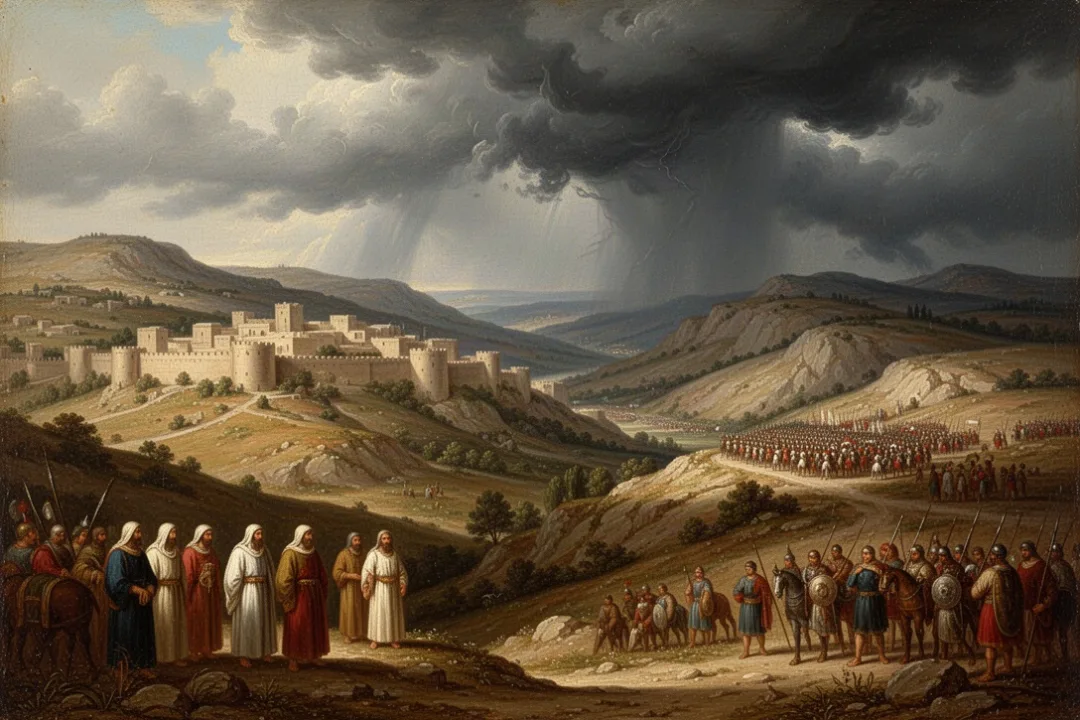
Gog’s forces come against a people who have been gathered from other nations and are living in apparent security. The prophecy describes the invasion using dramatic images: a great army, weapons, clouds, an earthquake, confusion among the attackers, disease, and judgment from heaven. The details emphasize that Gog’s defeat comes from God, not from Israel’s military strength.
Ezekiel 39 continues the judgment scene and describes the disposal of the defeated armies. The text uses extended prophetic imagery to portray the scale of the destruction. It also describes a period of clearing the land and burying the dead, showing how extensive the invading force is within the vision.
The purpose of the prophecy is stated repeatedly: the nations will know that the Lord is holy, and Israel will recognize that God has acted on its behalf. Ezekiel’s central concern is therefore theological. Gog is not presented merely as an interesting code for identifying a future headline. He becomes the instrument and symbol of a hostile power that God overrules.
What Magog means in the biblical text
Magog is used in more than one way. In Genesis 10:2, Magog is listed as one of Japheth’s sons. In Ezekiel 38–39, “the land of Magog” is connected with Gog and the military coalition. In Revelation 20, “Gog and Magog” refers to nations gathered from the earth.
The Bible does not provide enough information to map Magog confidently onto one modern nation. Ancient geographical names sometimes changed meaning over time, and the boundaries of many biblical regions remain debated. A proposed identification may be historically interesting without being certain.
Some interpreters connect Magog with peoples north of Israel because Ezekiel repeatedly describes the invading army as coming from the far north. Others have proposed connections with ancient groups known from Greek, Persian, or Near Eastern sources. These suggestions should be held carefully, since the biblical text does not give a modern map or a direct translation of Magog into a current country.
In Revelation, the phrase has an even broader scope. Gog and Magog are not described as one recognizable nation. They are nations from the four corners of the earth, gathered in numbers compared with the sand of the sea. This language points toward a worldwide rebellion rather than a narrow regional conflict.
How to read the Gog prophecy step by step
A careful reading can follow the movement of the prophecy rather than beginning with speculation about modern geography. The following steps provide a useful framework.
Identify the passage. Ezekiel 38–39 and Revelation 20 are the primary prophetic texts. Do not assume that every mention of Gog describes the same event in exactly the same way.
Observe the characters. In Ezekiel, Gog is a ruler connected with Magog and several allied peoples. In Revelation, Gog and Magog function as a collective name for rebellious nations.
Notice the target. Ezekiel describes an attack against God’s people in the land. Revelation describes the nations surrounding the camp of the saints and the beloved city.
Follow the source of victory. In both passages, the rebels do not win. God’s judgment ends the threat, making divine authority the focus.
Separate description from interpretation. The text gives symbols, names, and actions. Later interpreters may add views about chronology, geography, or current events, but those additions should not be confused with explicit statements in the passage.
Look for the stated purpose. Ezekiel emphasizes that the nations will know the Lord. Revelation emphasizes the defeat of Satan and the judgment of evil.
This method keeps the main message in view while allowing room for legitimate differences about details. It also helps you avoid forcing every ancient name into a modern political prediction.
How Ezekiel’s Gog differs from Revelation’s Gog and Magog
Ezekiel and Revelation clearly share imagery, but they are not identical accounts. Revelation frequently echoes earlier biblical books, sometimes using an earlier image to describe a later or more universal reality. The relationship between the passages is therefore one of thematic reuse and development, not simple duplication.
Ezekiel presents a named ruler and military coalition
In Ezekiel, Gog receives a divine summons to attack. His strategy appears ambitious: he sees a vulnerable land and gathers a large alliance. Yet the prophecy also portrays God as directing the circumstances toward judgment. Gog believes he is acting according to his own plan, while the larger narrative shows that God remains sovereign over the event.
The attack occurs against the background of Israel’s restoration. Earlier parts of Ezekiel describe judgment, renewal, the return of God’s people, and the promise of spiritual cleansing. Gog’s assault threatens that restored community, but the threat becomes an occasion for God to reveal his holiness before the nations.
Revelation presents a global final uprising
Revelation 20 places Gog and Magog after the period in which Satan is restrained. When Satan is released, he deceives the nations and gathers them for war. They surround the community of God’s people, but fire from heaven consumes them, and the devil is then cast into the lake of fire.
The scale is much broader than Ezekiel’s named coalition. Revelation uses “Gog and Magog” as a familiar prophetic label for the final concentration of opposition to God. The emphasis is not on identifying a particular ethnic group. It is on the universal reach of deception and the certainty of judgment.
The shared message is more important than a perfect one-to-one match
Both passages depict enemies who appear numerous and threatening. Both show God intervening decisively. Both end with the defeat of evil and public recognition of God’s authority. Those shared features explain why Revelation uses Ezekiel’s names even while expanding their meaning.
Important distinction: Revelation’s use of “Gog and Magog” does not automatically mean that every detail of Ezekiel 38–39 must occur again in precisely the same form.
Who might Gog be according to major interpretations?
Interpretations of Gog generally fall into several broad categories. None should be presented as certain when the text leaves room for debate.
Gog as a historical ruler or ancient enemy
Some readers understand Gog as a figure connected with an ancient people known to Israel or its neighbors. This approach gives priority to Ezekiel’s original setting and to the historical meaning of the names in the ancient Near East. It may treat the prophecy as describing an enemy in the prophet’s world, an idealized enemy from that world, or a future event expressed through familiar ancient names.
A historical approach can take the passage seriously without claiming that every detail has already been identified in surviving records. Ancient sources are incomplete, and prophetic language can portray events in ways that are not equivalent to a modern historical report.
Gog as a future end-times leader
Many Christians read Ezekiel 38–39 as a prophecy of a future invasion. In this view, Gog is a future ruler or power, and Magog refers to the territory or peoples under his authority. Some connect the event with the tribulation, the return of Christ, or another stage in their end-times timeline.
Even within this view, Christians disagree about when the invasion occurs and how it relates to other prophetic passages. Some place it before a future period of peace, some during that period, and others near the final judgment. The Bible does not provide a universally accepted chart that resolves all of these arrangements.
Gog as a symbolic name for organized evil
Other interpreters see Gog as a symbolic representation of the nations and powers that oppose God. This reading pays close attention to the prophecy’s repeated theological purpose: God’s holiness is revealed, his people are defended, and the nations learn that he is Lord.
The symbolic interpretation does not necessarily deny that Ezekiel may draw on real historical peoples. It argues that the names also serve a larger purpose. Gog can represent the recurring pattern of proud human power gathering against God and eventually collapsing under divine judgment.
Gog as a label for a modern nation
Some popular interpretations identify Gog with a current country, often based on a proposed connection between the names in Ezekiel and modern place names. These claims frequently appear in discussions of international politics and Middle Eastern conflicts.
Such identifications remain speculative. Similar-sounding words do not prove that two places are the same, and Ezekiel’s ancient geography cannot be transferred to a modern map without argument. Current events may remind readers of biblical themes, but they do not by themselves establish that a prophecy has been fulfilled or is unfolding.
Why Russia is often connected with Gog
Russia is often linked with Gog because some interpreters understand Ezekiel’s phrase about the “chief prince” as a reference to a place resembling “Russia,” and because the invasion is described as coming from the north. This interpretation became especially influential in some modern prophecy teaching.
The linguistic argument is disputed. The Hebrew terms in Ezekiel do not provide a clear, universally accepted identification of Russia, and the word resemblance depends on a particular translation or interpretation. The northern direction also cannot settle the question, since it may refer to a route or region viewed from Israel rather than a modern national boundary.
That does not mean modern nations are irrelevant to biblical study. Governments and military powers can display the same pride, violence, and opposition condemned by the prophets. The safer conclusion is that Russia cannot be identified as Gog with certainty from the biblical text.
Readers should be cautious whenever a prophecy teacher claims that a current war, alliance, or leader proves a specific interpretation. Biblical prophecy should shape moral and spiritual judgment; it should not be used as a tool for confident predictions that the passage itself does not make.
What Ezekiel’s prophecy teaches about God and evil
The Gog passages contain several themes that remain clear even when questions of timing and geography remain unsettled.
God is sovereign over hostile powers. Gog appears to act freely and aggressively, but the prophecy never presents him as outside God’s authority.
Military strength cannot guarantee victory. The invading army is large and well organized, yet its size becomes irrelevant when God judges it.
God defends his people for the sake of his name. The repeated emphasis on holiness means that the conflict reveals who God is, not merely who wins a battle.
Deception and pride have limits. Revelation depicts the nations as deceived and gathered for rebellion, but their apparent power ends quickly before divine judgment.
Judgment includes public recognition. The nations are brought to acknowledge the Lord’s authority, even though the texts differ about how that recognition unfolds.
These themes are more stable than attempts to assign a particular modern name to Gog. They also fit the larger prophetic witness, in which nations may boast of power while God holds them accountable for violence, arrogance, and oppression.
Common mistakes when interpreting Gog biblical prophecy
Gog passages are often misunderstood because readers begin with a current event or a preferred end-times system and then work backward. Several habits can make interpretation less reliable.
Confusing Gog with Satan
In Ezekiel, Gog is a ruler or hostile power. In Revelation 20, Satan deceives the nations and gathers them under the name Gog and Magog. The texts connect the rebellion with Satan in Revelation, but Gog is not simply another name for Satan in every passage.
Treating every occurrence as the same event
The genealogical Gog in 1 Chronicles is not automatically the same individual as Ezekiel’s prophetic Gog. Likewise, Revelation adapts Ezekiel’s imagery in a new literary and theological context. Shared names do not erase differences in setting, scope, or purpose.
Assuming a modern map is hidden in every ancient name
Biblical place names can have complex histories. A proposed connection needs more than a similar sound. It should account for the ancient language, geography, historical evidence, and the passage’s literary context.
Using prophecy to set dates
Neither Ezekiel 38–39 nor Revelation 20 authorizes readers to calculate a date for the end. Attempts to identify an exact year or announce that a particular headline proves the final battle have repeatedly gone beyond what the text says.
Ignoring the surrounding chapters
Ezekiel’s Gog prophecy follows major promises about restoration, cleansing, and renewed relationship with God. Revelation’s account appears within a sequence involving Satan, resurrection, judgment, and the final defeat of evil. Reading only the battle imagery can obscure the message that surrounds it.
How the Gog passages relate to Christian hope
For many Christian readers, Ezekiel 38–39 and Revelation 20 are difficult passages because they contain war, death, and severe judgment. Yet they are not written to glorify destruction. Their purpose is to assure God’s people that evil will not have the final word.
Ezekiel places the defeat of Gog within the restoration of Israel and the public display of God’s holiness. Revelation places the defeat of Gog and Magog near the final judgment and the removal of Satan. In both settings, the apparent strength of the enemy is temporary.
This hope does not require certainty about every prophetic timetable. A reader can affirm the central promise—that God judges evil and preserves his purposes—while remaining cautious about disputed identifications. Such caution is not a rejection of prophecy. It is a way of respecting what the text says and what it leaves unresolved.
Questions to ask when studying Ezekiel 38–39
A focused study benefits from practical questions. They keep attention on the passage instead of allowing speculation to dominate.
What does the passage explicitly say about Gog, Magog, and the allied peoples?
How does the description of Israel’s restoration in earlier chapters shape the invasion prophecy?
Which details are geographical, and which are clearly symbolic or highly poetic?
What reasons does the text give for God’s judgment?
How often does the passage say that the nations will recognize the Lord?
How does Revelation reuse Ezekiel’s names while changing the scale and setting?
What claims about modern countries depend on assumptions rather than direct biblical statements?
Comparing several reputable Bible translations can reveal where wording is uncertain, especially in the description of Gog’s title or position. A Bible dictionary or commentary can provide historical background, but no secondary source should replace close reading of the biblical passage itself.
What “Gog biblical” means in plain language
If you are searching for a short definition, Gog is a hostile ruler or symbolic enemy in biblical prophecy, while Magog is the land, people, or collective name associated with that enemy. Ezekiel describes Gog leading a massive attack against God’s restored people. Revelation uses Gog and Magog for the nations that join the last rebellion against God.
The Bible does not clearly identify Gog as a specific modern country or leader. Christians disagree about whether Ezekiel’s prophecy refers mainly to an ancient enemy, a future event, a symbolic pattern, or several layers of meaning. What the passages state most clearly is that rebellious powers gather against God, God judges them, and his holiness and authority are ultimately revealed.
That central message provides a sound foundation for further study. It allows you to take the prophecy seriously without turning uncertain geographical theories into established fact.
Frequently asked questions
Is Gog a person or a country in the Bible?
In Ezekiel 38–39, Gog is presented as a ruler associated with the land or people of Magog, not simply as a country. Revelation 20 uses “Gog and Magog” collectively for rebellious nations from across the earth. The biblical wording therefore supports a person or leader in Ezekiel and a symbolic collective designation in Revelation.
Does the Bible say Gog is Russia?
No. Some interpreters connect Gog with Russia because of a disputed reading of Ezekiel’s titles and the reference to an army coming from the north. The Hebrew wording does not identify Russia by name, and the proposed connection is not accepted by all scholars or Christian traditions. It should be treated as an interpretation, not a direct biblical statement.
Are Gog and Magog the same as Armageddon?
They are related to end-times themes but are not described as identical terms in every passage. Gog and Magog appear in Ezekiel and Revelation, while Armageddon is named in Revelation 16 as the place associated with a gathering for battle. Some theological systems connect these events, but the Bible does not present a single universally agreed timeline joining every detail.
What is the main lesson of the Gog prophecy?
The main lesson is that hostile powers cannot overcome God’s purposes. Ezekiel emphasizes God’s holiness and his defense of his people, while Revelation emphasizes the final defeat of Satan and rebellious nations. The passages encourage trust in divine justice and caution readers against treating uncertain predictions about modern politics as settled biblical interpretation.





Leave a Reply