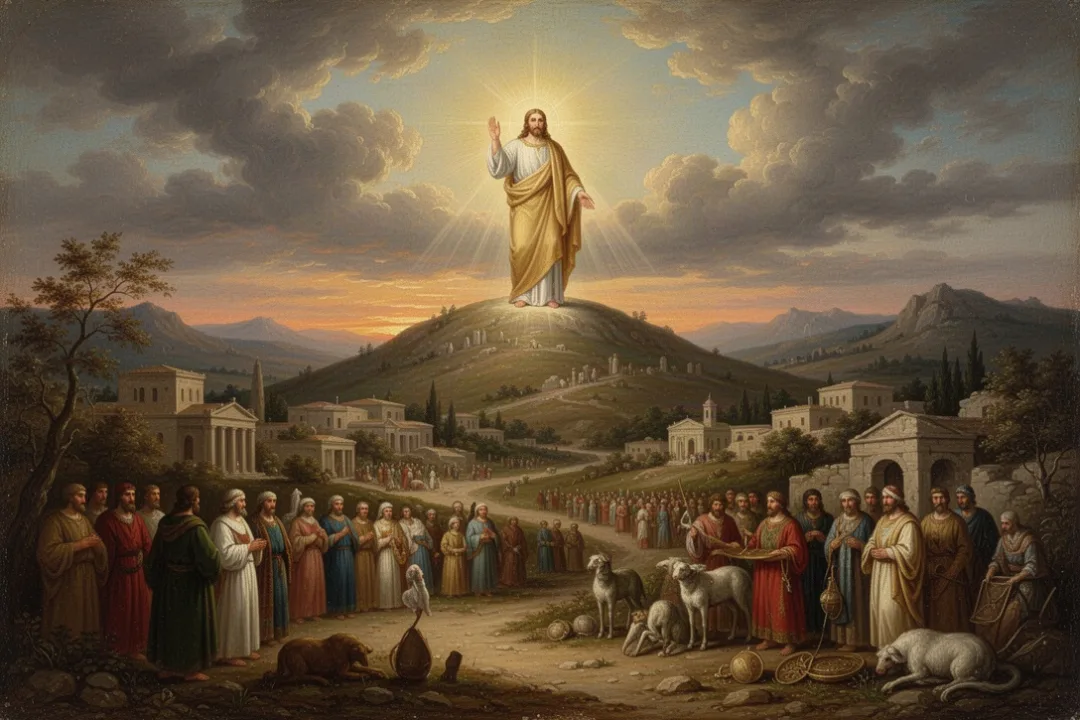
The 1,000-year reign of Christ refers to the period described in Revelation 20 when Christ reigns while Satan is restrained. Christians agree that the passage points to Christ’s authority and ultimate victory, but they differ over whether the thousand years are a future literal kingdom, a symbolic present age, or a period connected with Christ’s return.
What Revelation 20 says about Christ’s thousand-year reign
The main biblical passage about the millennium is Revelation 20:1–10. John describes an angel binding Satan and confining him so that he cannot deceive the nations in the same way. The passage then presents people reigning with Christ for a thousand years before Satan is released for a brief period.
After the release, Satan gathers opposition against God’s people, but the rebellion ends in judgment. The passage then moves to the final judgment, including the judgment before the great white throne. Revelation 20 therefore connects the millennium with several major themes: Christ’s reign, Satan’s restraint, the resurrection of believers, a final rebellion, and God’s decisive judgment.
The text does not explain every detail of the millennium. It does not clearly describe its geography, political structure, daily life, or exact relationship to every prophecy in the Old Testament. Those unanswered questions are why Christians have developed several interpretations while still affirming the authority of Scripture.
The central certainty: Whatever view someone takes of the millennium’s timing or symbolism, Revelation 20 presents Jesus as the victorious King, Satan as a defeated enemy, and God’s judgment as final.
How the main events are arranged in Revelation 20
A straightforward reading of the chapter follows a sequence of events. The details are debated, but the passage itself gives readers a useful framework for understanding the discussion.
Satan is bound. An angel seizes Satan, chains him, and confines him in the abyss so he cannot deceive the nations for the specified period.
Christ’s people reign. John sees those who belong to Christ reigning with him during the thousand years. The passage especially emphasizes faithful witnesses and those who refused to worship the beast.
The thousand years end. Satan is released for a short time after his confinement.
A final rebellion occurs. Satan deceives the nations and gathers them against God’s people, represented by the names Gog and Magog.
The rebellion is defeated. Fire from heaven consumes the gathered enemies, and Satan is thrown into the lake of fire.
The final judgment takes place. The dead stand before God, and the dead are judged according to what is recorded. Those not found in the book of life face the lake of fire.
One of the central interpretive questions is whether these events follow Christ’s return in a future earthly kingdom or describe realities that began through Christ’s death, resurrection, ascension, and present reign. The answer depends largely on how a reader understands the thousand years and the symbolic style of Revelation.
What “a thousand years” may mean
The number one thousand can be read in more than one way. Some Christians understand it as a precise period of one thousand calendar years. Others see it as a symbolic number representing a complete, extensive, or divinely appointed period.
Revelation uses vivid images throughout the book, including beasts, horns, lamps, seals, and dragons. Because of that symbolic setting, many interpreters ask whether the thousand years should also be read symbolically. At the same time, the fact that a passage contains symbols does not automatically mean every number is figurative.
The meaning of the number cannot be settled by arithmetic alone. It must be considered alongside the chapter’s language about resurrection, reigning, Satan’s deception, Christ’s return, and the final judgment. Different Christian traditions weigh these connections differently.
The most responsible interpretations distinguish between what Revelation 20 states directly and what readers infer by combining it with other biblical passages. The chapter directly speaks of a thousand years, but it does not directly use the later theological labels commonly applied to the different views.
Three major Christian views of the millennium
Christian interpretations of the 1,000-year reign are commonly grouped into premillennialism, amillennialism, and postmillennialism. These labels describe the relationship between Christ’s return and the millennium.
Premillennialism places Christ’s return before the millennium
Premillennialism teaches that Christ returns before the thousand-year reign. In many premillennial explanations, Jesus returns publicly and triumphantly, defeats his enemies, binds Satan, raises or gathers his people, and then reigns with them during a future kingdom period.
Many premillennialists expect this reign to involve a real kingdom on earth, although they differ about its precise features. Some connect it with Old Testament promises about Israel, Jerusalem, the nations, justice, peace, and the restoration of creation. Others place less emphasis on a detailed political or geographical reconstruction and focus mainly on Christ’s direct rule.
Premillennialism often reads Revelation 19 and 20 as consecutive events: Christ appears as the conquering King in chapter 19, and the millennium follows in chapter 20. Supporters see this sequence as a natural reading of the text, especially because Revelation 20 mentions a resurrection and reign after the events associated with Christ’s victory.
Premillennial views are not identical. Historic premillennialism generally expects the church to experience tribulation before Christ’s return. Some other premillennial systems distinguish between different stages of Christ’s coming and give a more detailed account of end-time events. These differences should not be treated as though every premillennial Christian holds the same timeline.
Amillennialism understands the millennium symbolically
Amillennialism does not mean that believers deny Christ’s reign. The name means that there is no separate future millennium understood as a literal earthly kingdom following Christ’s return. Amillennial interpreters generally see the thousand years as a symbolic description of the present period between Christ’s first coming and his second coming.
In this view, Jesus already reigns through his resurrection, ascension, and authority over all things. The saints share in that reign spiritually, and Satan is restrained in a particular sense: he cannot prevent the spread of the gospel among the nations or stop God from gathering his people.
Amillennial interpreters commonly understand the resurrection of Revelation 20:4–6 in a spiritual or heavenly sense, though explanations differ. The final resurrection, judgment, and renewal of creation occur when Christ returns. The release of Satan near the end represents a final intensification of evil before Christ’s decisive victory.
This interpretation gives special attention to the symbolic character of Revelation and to passages that describe Christ’s kingdom as already present. It also emphasizes the “already and not yet” pattern of Christian hope: Christ is reigning now, but his reign will be openly and completely revealed at his return.
Postmillennialism places Christ’s return after the millennium
Postmillennialism teaches that Christ returns after the millennium. In this view, the thousand years usually represent a long period in which the gospel has widespread influence and Christ’s rule is reflected in the faithfulness and transformation of societies, though not necessarily in perfect or sinless conditions.
Postmillennial interpreters differ over how literal the thousand years are. Some treat the number symbolically, while others have expected a more specific future period. What unites the view is the belief that the gospel’s progress precedes Christ’s return and that the millennium is followed by the final resurrection and judgment.
This perspective does not necessarily claim that the world becomes free from every problem before Jesus returns. It generally expects opposition and sin to remain, but it sees the church’s witness and the gospel’s influence as increasing substantially under Christ’s providential rule.
How the millennium relates to Christ’s return
The timing of Christ’s return is the main difference among the three views. Premillennialism places it before the millennium, postmillennialism places it after the millennium, and amillennialism identifies the present church age with the symbolic millennium, followed by Christ’s return and final judgment.
Premillennialism: Christ returns, then reigns during a future millennium.
Amillennialism: Christ reigns now in the symbolic millennium, then returns for the final judgment.
Postmillennialism: the gospel’s millennial triumph precedes Christ’s return.
All three positions affirm that Christ will return, the dead will be raised, evil will be judged, and God’s people will receive everlasting life. The disagreement concerns the structure and timing of the events leading to that final state.
Revelation should also be read with care because the book does not always present visions as a simple chronological timeline. Some interpreters understand chapters 19 and 20 as consecutive scenes. Others see them as different visions that revisit the same broad period from different angles.
What Satan’s binding means in the different interpretations
Satan’s binding is one of the most debated features of Revelation 20. The passage says that he is confined so he cannot deceive the nations during the thousand years. The key question is whether this restriction is complete in every sense or limited to a particular kind of deception.
Premillennial interpreters usually understand the binding as a future event after Christ returns. Satan remains active before that point, but he is removed from the world’s affairs during the future kingdom. This helps explain how the millennium can involve Christ’s direct rule while still leading to a final rebellion after Satan’s release.
Amillennial interpreters generally see Satan’s binding as beginning with Christ’s first coming, especially through Jesus’ victory over sin, death, and demonic powers. Satan remains dangerous and active, but his ability to keep the nations in total spiritual darkness is restricted. The gospel can therefore reach people from every nation.
Postmillennial interpreters also commonly connect Satan’s restraint with the advance of the gospel. His activity is real, but God limits it so that the church can bear witness and the nations can be discipled. The eventual release of Satan is interpreted as a final outbreak of opposition before Christ’s return.
These views show why the phrase “Satan is bound” should not be treated as though it has only one obvious meaning. The text describes a real divine restriction, but interpreters disagree about its timing and scope.
Who reigns with Christ during the thousand years
Revelation 20 identifies those reigning with Christ as people who remained faithful to him, including those who suffered because of their testimony and refused allegiance to the beast. The emphasis is on faithful endurance, not political power or personal achievement.
Premillennial interpretations often understand these reigners as resurrected believers sharing in Christ’s future kingdom. Depending on the particular system, some interpreters also distinguish between glorified believers and people who enter the kingdom in ordinary mortal bodies.
Amillennial interpretations commonly understand the reign as the present heavenly reign of departed believers with Christ, joined to the church’s spiritual participation in his kingdom on earth. The focus is less on a future political administration and more on the victory and life believers possess in union with Christ.
Postmillennial interpretations often describe the reign through the church’s growing influence under Christ’s authority. Believers do not replace Christ as King; they serve as his witnesses and representatives while he governs from heaven.
In every major view, reigning with Christ is connected with belonging to him. Revelation does not present the millennium as a reward for self-appointed rulers. It presents faithful people sharing in the victory of the Lamb.
Why the resurrection language matters
Revelation 20 uses resurrection language when describing those who reign with Christ and later when describing the dead before the final judgment. This creates an important interpretive question: does the chapter describe one resurrection in two stages, or two different resurrections separated by the millennium?
Premillennialists commonly see two bodily resurrections: the resurrection of believers before or at the beginning of the millennium, followed by the resurrection of the wicked at its end. They connect this reading with the passage’s apparent distinction between the “first resurrection” and the later judgment of the dead.
Amillennialists generally understand the first resurrection in a spiritual or heavenly way and expect one general bodily resurrection when Christ returns. They point to other passages that appear to present the resurrection and judgment as closely connected events.
Postmillennialists may also expect one general resurrection at the end, though particular interpreters differ in how they explain the first resurrection in Revelation 20. This issue shows that a person’s view of the millennium usually depends on how Revelation 20 is harmonized with broader biblical teaching.
A careful reader should avoid building an entire end-times system on one phrase isolated from the rest of Scripture. The resurrection is central to Christian hope, but the exact sequence remains a matter of interpretation among faithful Christians.
How Old Testament kingdom promises are connected to the millennium
Many discussions of the millennium turn to Old Testament passages about a coming king, restored worship, justice, peace, Israel, Jerusalem, the nations, and a renewed creation. Interpreters agree that these promises point to God’s saving purposes, but they disagree about how and when they are fulfilled.
Premillennialists often expect many kingdom prophecies to receive a future, earthly fulfillment during Christ’s reign. They may distinguish between promises made specifically to Israel and promises applied to the church through Christ.
Amillennialists generally see the Old Testament kingdom promises fulfilled through Christ, his church, and the final renewal of creation. Some promises have a present spiritual fulfillment and a future complete fulfillment, rather than belonging to a separate intermediate kingdom.
Postmillennialists often expect the promises to be realized progressively through the gospel’s influence in history, followed by their full completion in the eternal state. As with the other views, the details vary among theologians and church traditions.
These differences arise partly from distinct approaches to biblical prophecy. Some interpreters emphasize a more direct relationship between Israel’s national promises and a future kingdom. Others emphasize how the New Testament applies Israel’s Scriptures to Jesus and the multinational people of God.
What the 1,000-year reign teaches about Christian hope
The millennium is not merely a subject for constructing an end-times chart. It reinforces the conviction that Jesus reigns over history, even when evil appears powerful. Revelation presents the future as governed by God’s purpose rather than by the strength of empires, persecutors, or spiritual enemies.
The passage also encourages faithfulness under pressure. The people who reign with Christ are described as those who endured opposition and refused false worship. Their hope rests on Christ’s victory, not on immediate comfort or public recognition.
The millennium also shows that Satan’s power is limited. Whether the binding is understood as present or future, Satan is never presented as an equal opponent to God. His activity is permitted only within boundaries set by divine authority, and his final defeat is certain.
Finally, Revelation 20 points beyond the millennium to the final judgment and the renewal God promises elsewhere in Scripture. The ultimate Christian hope is not simply a particular thousand-year period but life with God in a fully restored creation.
A sound approach to disagreement: Hold firmly to Christ’s return, resurrection, judgment, and eternal kingdom while treating disputed timelines with humility. A confident faith does not require pretending that every interpretive question has one universally accepted answer.
How to study the millennium without forcing the text
Because Revelation combines visions, symbols, Old Testament imagery, and promises about the future, readers benefit from a disciplined approach. The goal is not to avoid interpretation but to distinguish the text’s clear claims from conclusions built by connecting many passages.
Read Revelation 19–22 together. The surrounding visions clarify the movement from Christ’s victory to judgment and the renewed creation.
Identify direct statements. Mark what the passage explicitly says about Satan, the thousand years, reigning, resurrection, and judgment.
Notice symbolic images. Ask how beasts, chains, the abyss, fire, and the book of life function within Revelation’s style.
Compare related passages. Study texts about Christ’s return, resurrection, the kingdom, and final judgment without assuming they all provide identical timelines.
Separate major doctrines from disputed details. Christ’s victory and return are central; the precise order of intermediate events is debated.
Read within the church. Consider how historic Christian communities have interpreted the passage, while testing every view by Scripture.
It is also wise to recognize the limits of end-times charts. A chart can show how a particular interpretation arranges the events, but it cannot remove the literary and theological questions raised by the biblical text.
Common misunderstandings about the millennium
One misunderstanding is that all Christians who believe in a future kingdom share one detailed prophetic system. Premillennial Christians themselves disagree about tribulation, Israel, the church, resurrection timing, and the relationship between different events.
Another misunderstanding is that amillennialism teaches that Christ does not reign. It actually emphasizes Christ’s present reign, though it does not expect a separate future thousand-year political kingdom after his return.
A third misunderstanding is that postmillennialism necessarily teaches human progress will solve the world’s problems. Historic postmillennial views depend on Christ’s authority and the gospel’s work, not merely on education, politics, technology, or social improvement.
It is also mistaken to assume that every symbol in Revelation must be either entirely literal or entirely figurative. A vision can communicate real events through symbolic imagery. The question is how each image functions in its literary and biblical context.
Finally, the millennium should not become a reason to ignore ordinary Christian obedience. Revelation directs believers toward worship, endurance, truth, holiness, and loyalty to Jesus. Speculation about dates or sequences cannot replace those responsibilities.
What Christians can affirm across the different views
Despite their disagreements, the major interpretations share several convictions. These shared beliefs form the heart of Christian teaching about the future.
Jesus is the rightful King. His authority is greater than every earthly ruler and spiritual enemy.
Christ will return. His coming will bring decisive judgment and the open revelation of his victory.
The dead will be raised. Christian hope includes bodily resurrection, not merely the survival of an invisible soul.
Satan will be defeated. Evil may be active for a time, but it will not endure forever.
God will judge justly. Revelation presents judgment as morally serious and fully under God’s authority.
God’s people will reign with Christ. Their future is participation in his kingdom, not separation from him.
Creation will be renewed. The biblical hope reaches beyond temporary history to life with God in the restored creation.
The 1,000-year reign of Christ therefore belongs within a larger message: God has acted in Christ, Christ reigns over the present, evil has a limit, and God’s purposes will reach their appointed end. Christians may disagree about the millennium’s exact form while looking toward the same King and the same final hope.
Frequently asked questions
Is the 1,000-year reign of Christ mentioned anywhere besides Revelation 20?
Revelation 20 is the only biblical passage that explicitly describes a thousand-year reign. Other passages discuss Christ’s kingdom, resurrection, judgment, and future rule, but they do not use the phrase “thousand years.” Interpreters connect those passages to Revelation 20 in different ways, which is why the broader biblical context matters without providing a single uncontested timeline.
Does the millennium happen before or after the final judgment?
The answer depends on the interpretation. Premillennialists generally place a future millennium before the final judgment. Amillennialists and many postmillennialists connect the millennium with the present age or a period before Christ’s return, followed by the final resurrection and judgment. Revelation 20 itself places final judgment after Satan’s last rebellion.
Will people still sin during Christ’s 1,000-year reign?
Christian views answer this differently. Some premillennial interpretations include glorified believers alongside mortal people who can still rebel, explaining the final uprising after Satan’s release. Other interpretations understand the millennium symbolically and place the remaining conflict within the present age. Revelation clearly teaches a final defeat of evil, but it does not describe every condition of daily life during the millennium.
Does your view of the millennium determine whether you are a Christian?
No. Christians who hold premillennial, amillennial, and postmillennial views can all affirm the central truths of the faith: Jesus is Lord, he died and rose again, he will return, the dead will be raised, and God will judge evil. The millennium is a significant doctrine, but it is not the foundation of salvation.








Leave a Reply