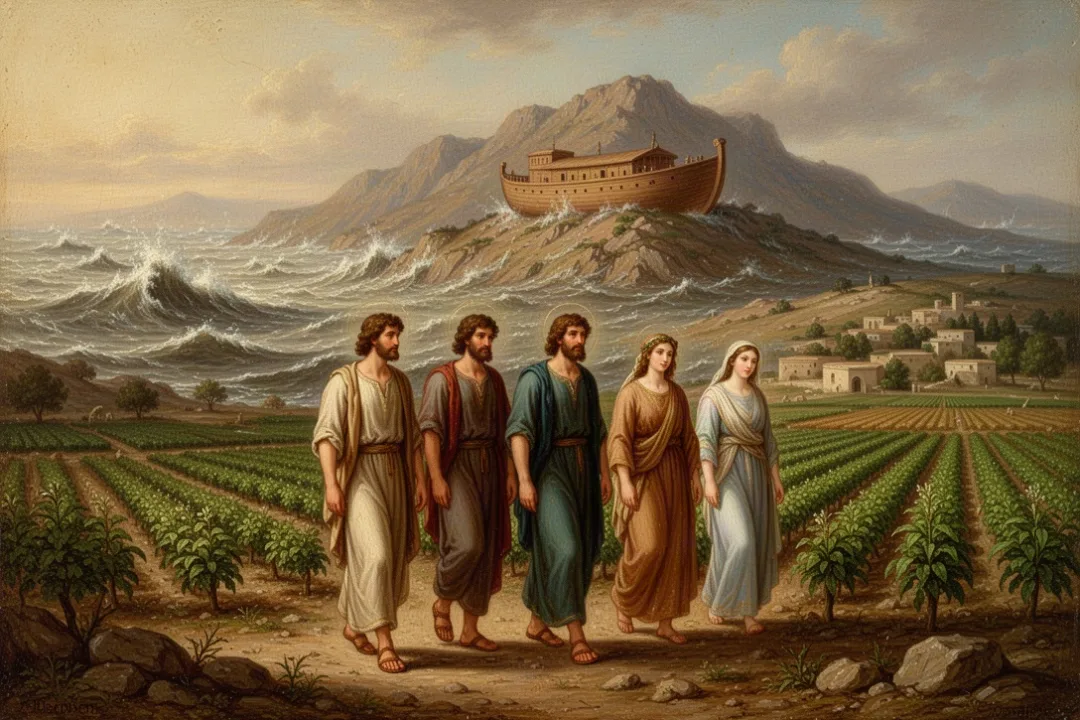
If you have ever wondered who continued Noah’s family after the flood, the Bible gives a direct answer: Noah had three sons, named Shem, Ham, and Japheth. They and their wives entered the ark with Noah and his wife, forming the surviving human family described in Genesis.
Their names appear before the flood in Genesis 5:32 and Genesis 6:10, and their families receive the most detailed attention in Genesis 10. The biblical account is not simply a list of names. It connects each son with later peoples, territories, and nations, while also describing a serious family event involving Noah and his sons after the flood.
Genesis presents Noah as the father of Shem, Ham, and Japheth. The three sons are mentioned together when Noah’s family is introduced as entering the ark, and again when God’s judgment through the flood has ended. Their wives are also included in the ark narrative, although the Bible does not give their names.
The order of the names is usually Shem, Ham, and Japheth, but the passages do not necessarily establish their birth order in a simple way. Genesis gives information about Noah’s age when he began having sons, and later refers to one son as the younger or youngest in connection with the incident after the flood. Translators and commentators have discussed how those details fit together.
For that reason, it is safer to identify the sons by name rather than make a confident claim about which one was oldest. The central fact is clear: all three sons survived the flood with Noah, their mother, and their wives.
Shem is connected with the line that leads to Abraham and the people of Israel.
Ham is associated in Genesis 10 with Canaan, Egypt, Cush, and various neighboring peoples.
Japheth is associated with several peoples and regions located broadly to the north and west of the ancient Near East.
These associations come especially from Genesis 10, often called the Table of Nations. The chapter groups descendants by families, languages, lands, and nations. It is a theological and ancestral account, not a modern population study or a complete list of every nation known today.
The direct answer: Noah’s sons were Shem, Ham, and Japheth. Genesis says they entered the ark with their wives, and their descendants became the families and nations described after the flood.
What happened to Noah’s sons during the flood?
Before the flood, Noah is instructed to bring his family into the ark. Genesis identifies his wife, his three sons, and the wives of his sons as the people who went with him. The account does not describe the sons as builders, leaders, or speakers during the ark’s construction; it simply records that they were part of Noah’s household and were preserved through the judgment.
The sons therefore had a role that was both practical and symbolic. Practically, they were members of the family that entered the ark. Symbolically, their survival meant that human life would continue through Noah’s family after the floodwaters receded.
When the ark came to rest and the family left it, the family received the same command to be fruitful and multiply. Genesis then describes Noah as a farmer who planted a vineyard. This detail moves the story from rescue to the difficult work of rebuilding ordinary life: cultivating land, producing food, and establishing a future for the next generation.
The Bible does not provide a separate biography for each son during the flood. There are no extended speeches from Shem, Ham, or Japheth in the ark narrative, and no account of how each man personally responded to the flood. Their importance becomes clearer through what happens after the family leaves the ark.
Why Noah blessed Shem and Japheth after the flood
Genesis 9 describes a troubling event involving Noah and his sons. After drinking wine, Noah became uncovered inside his tent. Ham, identified as the father of Canaan, saw his father’s nakedness and told his two brothers. Shem and Japheth responded by walking backward with a garment so they would not look at their father, covering him while preserving his dignity.
When Noah learned what had happened, he pronounced a statement concerning Canaan, Ham’s son, and then spoke blessings involving Shem and Japheth. Shem is associated with a special relationship to the Lord, while Japheth is described as being enlarged or given room and as dwelling in the tents of Shem. The wording can sound unfamiliar because it comes from an ancient setting and has been translated in different ways.
A crucial detail is often missed: Noah does not curse Ham by name. The declaration is directed at Canaan. Genesis does not explicitly explain why Canaan receives this pronouncement rather than Ham, and readers should avoid adding explanations that the passage itself does not provide.
This story has sometimes been misused to defend racial hierarchy, slavery, or the claim that people of African descent were divinely cursed. Those conclusions do not follow from the text. The passage names Canaan, not an entire modern racial group, and its setting concerns ancient family and national relationships. It cannot legitimately be used to justify racism or enslavement.
The story also highlights differences in the brothers’ conduct. Ham reports what he saw, while Shem and Japheth deliberately avoid looking and cover Noah. The narrative presents their actions as a contrast in how family members respond to a parent’s humiliation, although it does not give every cultural or legal detail behind the event.
Genesis links the post-flood family story to the descendants of Shem, Ham, and Japheth, but it does not provide a basis for assigning moral worth to modern ethnic groups.
Which descendants came from each of Noah’s sons?
Genesis 10 traces the descendants of Noah’s sons in separate family lines. The chapter uses names that can refer to individuals, clans, regions, or peoples, and the relationships between those categories are not always explained in modern terms. Its purpose is to show how the nations spread out across the earth after the flood.
Shem’s descendants in Genesis
Shem’s line receives special attention because Genesis later follows it toward Terah and Abraham. Genesis 10 names several of Shem’s descendants, including Elam, Asshur, Arpachshad, Lud, and Aram. The list continues through later generations and includes Eber, from whom the term “Hebrew” is traditionally connected.
Genesis 11 follows Shem’s family line through a genealogy that leads to Terah and his sons, including Abram, later called Abraham. This makes Shem’s line particularly significant for the biblical story of Israel, the covenant with Abraham, and the history of the Hebrew people.
Shem should not be treated as the “father of every Asian people” in the way some older charts have claimed. The biblical text identifies particular ancient peoples and territories, but it does not offer a precise modern ethnic map. Similar-looking modern names also do not automatically prove a direct historical connection.
Ham’s descendants in Genesis
Genesis 10 identifies Ham as the father of Cush, Mizraim, Put, and Canaan. Mizraim is widely understood as the Hebrew name associated with Egypt. Cush is commonly connected with regions south of Egypt, though the exact geographic boundaries discussed by ancient sources are not identical to modern national borders.
Ham’s descendants include several important ancient peoples and kingdoms. The chapter mentions Nimrod, who is presented as a powerful figure and associated with kingdoms such as Babel, Erech, Akkad, and Calneh in the land of Shinar. It also lists peoples connected with Canaan, including groups that appear elsewhere in the Old Testament.
The phrase “sons of Ham” therefore covers a range of ancient family and national relationships. It should not be reduced to a single modern racial category. Biblical genealogies often organize peoples according to ancestry, geography, political identity, and theological significance rather than using the racial classifications familiar today.
Japheth’s descendants in Genesis
Genesis 10 names Japheth’s sons as Gomer, Magog, Madai, Javan, Tubal, Meshech, and Tiras. The chapter also names several descendants of Gomer and Javan. These names are associated by many interpreters with peoples or regions north and west of the ancient Near East, although some identifications remain debated.
Javan is commonly connected with Greek-speaking peoples in later biblical and historical contexts. Other names have been associated with areas around Anatolia, the Black Sea, or nearby regions. Such connections can be useful when studying the ancient world, but they should be stated cautiously because ancient geographic identifications are not always certain.
Genesis 10 ends by emphasizing that the families of Noah’s sons spread into different lands and nations, each according to its language and clan. The passage is less concerned with giving a modern-style population census than with explaining the biblical understanding of humanity’s distribution after the flood.
Shem’s line: Elam, Asshur, Aram, Eber, and the family line that leads to Abraham.
Ham’s line: Cush, Mizraim, Put, Canaan, and peoples connected with Egypt and Canaan.
Japheth’s line: Gomer, Magog, Madai, Javan, Tubal, Meshech, Tiras, and their associated peoples.
How the Tower of Babel fits into the family story
Genesis 10 and Genesis 11 are closely connected, but they present the spread of humanity in different ways. Genesis 10 lists the nations that came from Noah’s sons. Genesis 11 then describes the building of a city and tower at Babel, followed by the confusion of human language and the scattering of people across the earth.
Readers sometimes wonder whether the order creates a contradiction. One explanation is that Genesis 10 gives a broad account of the nations, while Genesis 11 returns to an earlier event to explain why those nations came to speak different languages and live in separate places. The text is not arranged like a modern chronological encyclopedia.
The family of Noah is therefore presented as the common ancestral household behind the post-flood nations. Shem, Ham, and Japheth represent branching family lines, while Babel explains a major change in how those families were divided by language and geography.
This connection also helps explain why Genesis 10 repeats the idea that peoples were organized by clans, languages, lands, and nations. The chapter is describing both ancestry and the development of distinct communities. It does not claim that every later population can be assigned neatly to one of the three sons using modern national borders.
What Noah’s sons teach readers about ancestry and responsibility
The account of Noah’s sons is about more than identifying three names. It explores how a family survives catastrophe, how descendants become distinct peoples, and how human behavior continues to be morally significant after divine rescue. The sons are preserved together, but their later actions and family lines are described differently.
The story also warns against using biblical genealogy as a tool for ranking people. Genesis gives Shem, Ham, and Japheth different places in the narrative, yet it does not say that one modern ethnicity is inherently superior to another. Ancestry in the Bible carries historical and theological meaning, not a license for prejudice.
For Christian and Jewish readers, Shem’s line becomes especially important because it leads into the stories of Abraham, Isaac, Jacob, and Israel. Ham’s line helps frame the biblical relationships among Israel, Egypt, Canaan, and other neighboring peoples. Japheth’s line broadens the picture to include nations beyond the central biblical homeland.
The most reliable way to read the passage is to keep its claims within their setting. Noah had three sons; their families survived the flood; Genesis 10 connects them with ancient peoples; and Genesis 9 describes a difficult episode involving Noah, Ham, Canaan, Shem, and Japheth. Claims that go beyond those points should be identified as later interpretation rather than presented as explicit biblical teaching.
When studying the names: distinguish what Genesis directly says from later traditions about geography, ethnicity, and modern nations. The biblical text gives ancient family and people groups, not a complete map of today’s populations.
Frequently asked questions
Did Noah have any children besides Shem, Ham, and Japheth?
Genesis names only three sons of Noah: Shem, Ham, and Japheth. It does not mention additional sons or daughters. Noah’s wife and the wives of his three sons are included in the ark account, but their names are not supplied. Because the biblical narrative focuses on the family lines that develop after the flood, it is best not to assume children that the text does not identify.
Which of Noah’s sons was the ancestor of Abraham?
Abraham descended from Shem. Genesis 10 lists Shem’s family line, and Genesis 11 follows that line through several generations to Terah and Abram, later called Abraham. This genealogy is significant because the later biblical story connects Abraham with God’s covenant and traces the ancestry of the people of Israel through him.
Did Ham’s descendants become all African people?
The Bible does not make that claim. Genesis connects Ham with Cush, Mizraim, Put, and Canaan, which refer to particular ancient peoples and regions. Those associations cannot be expanded into a complete classification of modern Africans or any other racial group. The so-called curse of Ham is also inaccurately named: Genesis directs the pronouncement toward Canaan, not Ham.
Were Shem, Ham, and Japheth triplets?
Scripture does not say that Noah’s sons were triplets. Genesis names them together, but naming order does not prove that they were born at the same time or even establish their exact birth order. The text gives limited information about Noah’s age and the sons’ family circumstances, so their precise ages and spacing cannot be determined from the biblical account.








Leave a Reply