Habakkuk in the Bible is a short prophetic book about a difficult question: how can a good and just God allow violence, oppression, and injustice to continue? Habakkuk brings that complaint directly to God, receives an unsettling answer, and gradually moves from confusion to confident trust.
The book has three chapters. It begins with Habakkuk questioning God, continues with God’s response and a series of judgments against pride and exploitation, and ends with a prayer that expresses faith even when crops fail, animals disappear, and ordinary sources of security collapse.
Habakkuk is one of the Twelve Minor Prophets in the Old Testament. “Minor” refers to the length of the book, not the importance of its message. Unlike many prophets who primarily speak to the people on God’s behalf, Habakkuk records a sustained conversation in which he speaks to God about the suffering he sees.
The prophet’s first complaint concerns violence and injustice among his own people. He sees wrongdoing, conflict, and the failure of justice, yet God appears silent. God then tells Habakkuk that he is raising up the Babylonians, also called the Chaldeans, as an instrument of judgment. That answer creates a second problem: the Babylonians are even more violent and ruthless than the people they will judge.
Habakkuk does not receive a simple explanation for every tragedy. Instead, he learns that God sees the injustice of powerful nations, will judge arrogant violence, and calls his people to live by faithful dependence while waiting for God’s purposes to unfold.
Central message: Habakkuk shows that faithful trust does not require pretending that evil is acceptable. The prophet questions God honestly, waits for God’s answer, and chooses worship before his circumstances improve.
Historical setting behind Habakkuk’s questions
The book does not give a precise date or identify Habakkuk’s hometown, family, or occupation. Many scholars place its setting near the end of the seventh century BC, when the Babylonian Empire was becoming a major power and the Assyrian Empire was declining. The exact historical details remain debated, so the book should be read with appropriate care rather than built around a date that Scripture does not state.
Habakkuk’s world was marked by political upheaval and military threat. Nations rose and fell, rulers used force to expand their power, and ordinary people suffered under injustice. The prophet’s words fit a period when Judah faced internal corruption as well as the danger of foreign invasion.
The Babylonian army is not presented as morally good. God’s use of Babylon for judgment does not mean Babylon’s cruelty is approved. One of the book’s central tensions is that God can use a powerful nation for a particular purpose and still hold that nation accountable for its pride, violence, and abuse of others.
How the three chapters of Habakkuk unfold
You can follow the book as a movement through three stages: complaint, response, and worship. Each stage adds something important to the prophet’s relationship with God.
Habakkuk 1:1–4 — The first complaint: Habakkuk asks why God seems to tolerate violence, injustice, and the breakdown of justice in Judah.
Habakkuk 1:5–11 — God’s first answer: God announces that the Babylonians are being raised up as a force of judgment. Their speed, strength, and military confidence make them frightening.
Habakkuk 1:12–2:1 — The second complaint: Habakkuk asks how a holy God can use a nation more wicked than Judah to punish wrongdoing. He takes his place as a watchman, waiting for God’s reply.
Habakkuk 2:2–5 — The vision and the call to wait: God tells Habakkuk to record the vision clearly and wait for its appointed time. The proud person is contrasted with the righteous person who lives by faithfulness.
Habakkuk 2:6–20 — Five woes against injustice: The book condemns exploitation, greed, bloodshed, dishonesty, drunkenness, and idolatry. The oppressor will not escape accountability.
Habakkuk 3 — The prayer of trust: Habakkuk remembers God’s power, asks for mercy, and declares that he will rejoice in God even when the land produces no food and the herds are gone.
This structure matters because Habakkuk does not move from trouble directly to easy optimism. He moves through honest lament, a deeper understanding of divine justice, patient waiting, and a deliberate act of faith.
Why Habakkuk begins by questioning God
Habakkuk’s opening prayer is not a detached philosophical question. He is responding to real suffering. He sees wrongdoing and wants to know why God does not intervene. His complaint includes the apparent triumph of violence, the presence of oppression, and the failure of justice to protect the vulnerable.
The prophet’s language shows that lament can be an expression of faith. He directs his questions to God rather than abandoning God. That distinction is significant: Habakkuk believes that God is able to hear, judge, and act, even though the timing and method of God’s action confuse him.
The book also challenges the assumption that spiritual maturity means never feeling troubled. Habakkuk does not disguise his distress with polished religious language. He brings his confusion into prayer and remains engaged with God while waiting for an answer.
What God’s answer about Babylon means
God’s first answer is surprising because it does not promise an immediate restoration of peace. Instead, God points to the Babylonians, a nation known for military power, speed, and conquest. They will bring judgment against Judah’s wrongdoing, but their methods and motives are themselves morally corrupt.
This answer reveals a difficult biblical pattern: God’s judgment may involve human powers whose conduct God later judges. The fact that Babylon serves a role in God’s larger purpose does not make Babylon righteous. Scripture repeatedly distinguishes between God’s sovereign use of events and the moral responsibility of the people who commit evil.
Habakkuk is disturbed precisely because he understands God’s character. He knows that God is too pure to approve of evil, so he cannot accept the idea that the wicked will simply consume those who are less wicked without eventually facing judgment themselves.
For modern readers, this passage warns against simplistic explanations of political disaster. Not every successful nation is righteous, and not every defeat proves that the defeated people were uniquely evil. Habakkuk leaves room for both divine sovereignty and human accountability.
What the watchman position teaches about waiting
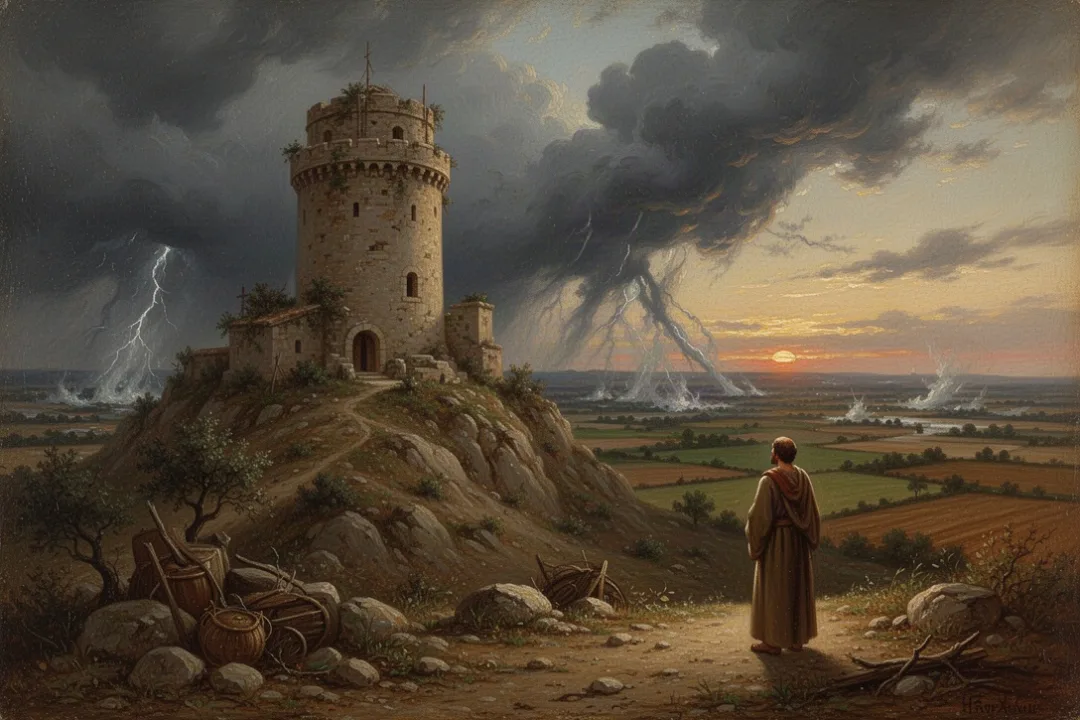
At the end of his second complaint, Habakkuk describes himself as a watchman standing at his station and waiting to see what God will say. The image suggests alertness, patience, and expectation. He is not walking away from the question, but neither is he trying to force an answer through impatience.
God tells him to write the vision plainly so that it can be preserved and understood. The vision has an appointed time, which means that its fulfillment may not be immediate. The instruction to wait does not deny the seriousness of the crisis; it places the crisis within a larger timetable that Habakkuk cannot control.
Waiting in Habakkuk is therefore not passive indifference. It means remaining faithful while the outcome is still unseen. The prophet is asked to trust that the vision will reach its proper time, even when present circumstances seem to contradict God’s justice.
Practical insight: Biblical waiting is not the same as ignoring injustice. Habakkuk waits for God while continuing to name evil accurately and refusing to call oppression acceptable.
What “the righteous will live by faith” means in Habakkuk
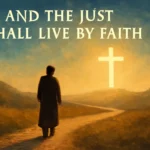
Habakkuk 2:4 contrasts the proud person with the righteous person. The proud person is inwardly distorted by self-confidence and dependence on personal power. The righteous person lives by faith, or faithfulness—a phrase that points to steadfast trust in God rather than reliance on strength, status, or immediate results.
The verse is quoted or echoed in the New Testament in Romans 1:17, Galatians 3:11, and Hebrews 10:38. In those contexts, it becomes important to the New Testament’s teaching about faith and righteousness. In Habakkuk’s original setting, the statement speaks to people living amid violence and uncertainty: the faithful person remains loyal to God while the proud seem to prosper.
Faith here is not a guarantee that danger will disappear quickly. It is not positive thinking, denial, or confidence that everything will happen according to a preferred schedule. It is a way of living grounded in trust, allegiance, and endurance when God’s promised justice has not yet become visible.
How the five woes expose the sins of Babylon
Habakkuk 2 contains five announcements of judgment, often called woes. They speak against patterns of wrongdoing that are especially visible in imperial power, but their principles apply more broadly to individuals, institutions, and nations.
Exploitation for personal gain: The first woe condemns those who accumulate what belongs to others and build security through plunder. Wealth gained by oppression does not create permanent safety.
Building through bloodshed: The second woe addresses those who establish cities, houses, or political systems through violence and injustice. A structure supported by harm carries moral guilt even if it appears impressive.
Humiliating and abusing others: The third woe condemns leaders who disgrace their neighbors and expose their vulnerability for their own advantage. Power used to degrade others will be turned against the abuser.
Using intoxication and domination: The fourth woe addresses the corruption of others through drunkenness, coercion, and humiliation. It shows that abuse is not limited to warfare or economics.
Trusting idols and human construction: The fifth woe contrasts lifeless images with the living God. An idol cannot speak, teach, or save, while God remains present and sovereign.
These woes show that God’s judgment is not arbitrary. The powerful nation is condemned for identifiable actions: taking, killing, humiliating, intoxicating, and worshiping what it has made. Habakkuk presents justice as morally serious and publicly visible.
Why Habakkuk says the earth will recognize God’s glory
In the middle of the woes, Habakkuk points toward a future in which knowledge of God’s glory fills the earth. The statement stands against Babylon’s claims to greatness. Human empires may fill the earth with fear, monuments, and military reputation, but their power is temporary and cannot replace God’s authority.
The contrast is between human domination and God’s rightful rule. Babylon attempts to make its name permanent through conquest. Habakkuk declares that the lasting reality will not be the empire’s reputation but the recognition of God’s glory.
This hope does not minimize present suffering. It gives suffering a framework in which violent power is not the final word. The book asks readers to judge greatness by God’s standards rather than by territory, wealth, military strength, or public influence.
What Habakkuk teaches about idols and silence
The final woe in chapter 2 turns from political violence to idolatry. A carved image may be covered with precious metal and carefully shaped by human hands, but it remains incapable of giving guidance or life. Habakkuk contrasts this silent object with the Lord, who is present in his holy temple.
The command for all the earth to be silent before God expresses awe and accountability. Silence here is not evidence that God is absent. It is the proper response to the living God, whose judgment exposes the emptiness of human claims to ultimate control.
The passage also asks where you place your confidence. Idolatry can involve physical images, but it can also include absolute trust in money, political power, reputation, technology, or personal competence. Anything treated as a substitute for God eventually proves unable to carry the weight placed on it.
How Habakkuk 3 changes from complaint to worship
Chapter 3 is a prayer or hymn that recalls God’s powerful acts. Habakkuk describes God as coming in majesty and bringing judgment against evil. The imagery is poetic and dramatic, drawing on the language of storms, mountains, rivers, and cosmic upheaval to portray God as the true ruler over creation and nations.
The prophet asks God to remember mercy while acting in judgment. That request is important because Habakkuk does not want justice separated from compassion. He has seen the damage caused by evil, but he also recognizes that people need mercy when God confronts sin.
The chapter’s emotional movement is gradual. Habakkuk says he hears about God’s work and trembles; he anticipates trouble and feels fear. Yet fear does not have the final word. He chooses to wait quietly for the day of trouble that will come upon the invading nation.
Why the ending of Habakkuk is so significant
The final lines describe a severe agricultural crisis: no fig tree blossom, no fruit on the vines, no harvest from the fields, no sheep in the fold, and no cattle in the stalls. These are not small inconveniences. They represent the loss of food, income, stability, and the normal signs of life in an agrarian society.
Even in that situation, Habakkuk declares that he will rejoice in God and find strength in the Lord. His joy is not based on favorable circumstances. It is based on God’s identity and faithfulness. The ending does not say that the crisis has already ended; it shows the prophet choosing trust before visible restoration.
This does not require a person to enjoy suffering or deny grief. Habakkuk has already expressed fear and sorrow openly. His final faith is stronger because it has passed through honest questioning rather than avoiding it.
Practical lessons from Habakkuk for difficult seasons
Habakkuk offers a pattern for responding when you see injustice or face circumstances you cannot fix. The pattern does not produce instant answers, but it can help you remain truthful, attentive, and grounded.
Name the wrong clearly. Habakkuk identifies violence, injustice, oppression, and corruption instead of using vague language that hides the damage.
Bring the complaint to God. Prayer can include grief, confusion, and difficult questions. Speaking honestly before God is different from declaring that injustice does not matter.
Listen for correction. Habakkuk’s questions are sincere, but he still allows God to challenge his assumptions about timing and judgment.
Separate God’s purposes from human pride. A person or nation may appear successful for a time without being righteous or secure.
Wait without surrendering your convictions. Waiting means remaining faithful while trusting that God’s justice has an appointed time.
Reject substitute sources of security. Wealth, influence, military strength, and status cannot provide the ultimate safety that people often seek from them.
Practice worship that includes reality. Habakkuk praises God without pretending the harvest is abundant or the threat is gone.
How Habakkuk speaks to unanswered prayer
Many readers come to Habakkuk because they have prayed about injustice, illness, violence, loss, or fear and have not seen the change they hoped for. The book does not promise that every question will receive a detailed explanation. It does show that unanswered prayer is not necessarily ignored prayer.
Habakkuk’s first answer leads to another question, which means that spiritual understanding can develop in stages. Sometimes the answer to one prayer reveals a deeper problem rather than solving the original concern immediately. The prophet is invited to keep listening as he learns that God’s justice includes both Judah’s wrongdoing and Babylon’s later accountability.
The book also protects you from two unhelpful responses. You do not have to conclude that God is indifferent simply because judgment is delayed, and you do not have to claim certainty about why every painful event occurs. Habakkuk supports humble trust without shallow explanations.
Where Habakkuk connects with the rest of the Bible
Habakkuk’s emphasis on faithfulness during waiting connects with several major biblical themes. The Psalms frequently give people words for lament, while Job explores questions about suffering and divine wisdom. The prophets repeatedly condemn exploitation and announce that proud nations will face judgment.
The New Testament’s use of Habakkuk 2:4 places the passage within its teaching about faith. Romans emphasizes the righteousness that comes through faith, Galatians contrasts faith with reliance on works of the law, and Hebrews uses the verse while encouraging endurance as God’s promise awaits fulfillment.
Habakkuk also fits the broader biblical pattern in which God opposes pride and exalts faithful dependence. Its message is not that believers will avoid trouble. It is that trouble does not have authority to define God’s character, and temporary power does not overturn God’s justice.
Questions to ask when studying Habakkuk
A careful reading becomes more useful when you ask specific questions of each chapter. These questions help connect the prophet’s ancient setting with your own spiritual and ethical reflection.
What forms of violence or injustice does Habakkuk identify?
What does the prophet assume about God’s character when he complains?
Why is God’s answer about Babylon difficult for Habakkuk to accept?
How do the five woes describe the behavior of oppressive power?
What does faithful living look like when the promised outcome is delayed?
Which sources of security might compete with trust in God?
How does the final prayer hold fear, loss, worship, and hope together?
Read as a whole, Habakkuk is not merely a book about one prophet’s private struggle. It is a biblical witness to the tension between present injustice and promised judgment. It gives you permission to ask hard questions, calls you to reject pride and exploitation, and directs you toward a faith that remains rooted in God when circumstances provide no easy reassurance.
Frequently asked questions
Who was Habakkuk in the Bible?
Habakkuk was a prophet who spoke to God about violence, injustice, and the rise of Babylon. Scripture gives few personal details about him, so most of what can be known comes from his book. Unlike prophets who mainly deliver messages to a nation, Habakkuk records a conversation in which he questions God and receives a response about judgment, waiting, and faithful living.
What is the main verse in Habakkuk?
Habakkuk 2:4 is often treated as the book’s central verse because it contrasts pride with faithful living. Its message is that the righteous person remains dependent on God rather than trusting human power or immediate results. The verse is also important in the New Testament, where Romans, Galatians, and Hebrews refer to it in their teaching about faith.
Was Habakkuk written before or after the Babylonian exile?
Habakkuk appears to address the rise of Babylon before the destruction of Jerusalem and the exile, although the book does not provide an exact date. Many scholars place it near the end of the seventh century BC. Since the text gives limited historical information, the safest conclusion is that it reflects a period when Babylon threatened Judah and God’s people faced severe political and moral crisis.
What can Christians learn from Habakkuk today?
Christians can learn that honest lament and genuine faith can exist together. Habakkuk names injustice, questions God’s timing, waits for divine justice, and ultimately trusts God despite severe loss. The book also warns against pride, exploitation, idolatry, and confidence in political or material power. Its final prayer encourages worship that does not depend entirely on favorable circumstances.






Leave a Reply