Mephibosheth was the son of Jonathan and grandson of King Saul, whom David protected and welcomed because of his covenant with Jonathan. His story appears mainly in 2 Samuel and combines political danger, disability, loyalty, kindness, betrayal, and restoration.
Mephibosheth was born into Israel’s former royal family, but his life changed when Saul and Jonathan died in battle. He became physically disabled as a child, lost his family’s power, and lived away from the royal court. Years later, David searched for him and gave him a permanent place at the king’s table.
Mephibosheth was Jonathan’s son and Saul’s grandson. Jonathan was David’s close friend, even though Saul viewed David as a threat to his throne. Jonathan repeatedly protected David and made a covenant of friendship with him, as described in 1 Samuel 18 and 20.
That family connection made Mephibosheth politically vulnerable. In the ancient Near East, a new king could regard members of a former royal house as potential rivals. David had become king after Saul’s death, so Mephibosheth might reasonably have feared that David would eliminate Saul’s descendants to secure the throne.
Mephibosheth’s original name was Merib-baal, according to 1 Chronicles 8:34 and 9:40. The name “Mephibosheth” is used in the accounts in 2 Samuel. The exact meaning and reason for the change are discussed by Bible scholars, but the identity is clear: these references concern Jonathan’s son.
Do not confuse two men with the same name. The Mephibosheth in David’s story was Jonathan’s son. Second Samuel 21:8 also mentions another Mephibosheth, identified as a son of Saul and Rizpah. They are different people.
How Mephibosheth became disabled as a child
Mephibosheth’s childhood is described briefly in 2 Samuel 4:4. When news came that Saul and Jonathan had died at Mount Gilboa, his nurse picked him up and fled. During the escape, he was dropped, and the injury left him disabled in both feet.
The account does not describe the medical details, and it does not say that Mephibosheth caused the accident. It presents his disability as the result of a sudden flight from danger. The loss of his father and grandfather, followed by permanent physical impairment, placed him in an especially vulnerable position.
Second Samuel later says that he lived in Lo-debar, in the house of a man named Machir son of Ammiel. Lo-debar was in the region east of the Jordan River. The text does not provide enough information to determine whether Mephibosheth lived there in poverty, in hiding, or under the protection of a loyal supporter.
His disability should not be treated as a symbol of moral failure. The narrative does not blame him for it. Instead, it shows how a child caught in a violent political transition became dependent on others and largely disappeared from public life.
What David did for Mephibosheth, step by step
David’s treatment of Mephibosheth unfolds in a sequence that reveals both his promise to Jonathan and his approach to kingship.
David remembered Jonathan. After his kingdom was established, David asked whether anyone remained from Saul’s family to whom he could show kindness for Jonathan’s sake.
David located Mephibosheth. A former servant of Saul named Ziba told David about Jonathan’s son living in Lo-debar.
Mephibosheth came before the king. He bowed before David and approached him with the caution expected of someone from a defeated royal family.
David removed his fear. David told him not to be afraid and promised to show him kindness because of Jonathan.
David restored Saul’s land. The king gave Mephibosheth the property that had belonged to Saul.
David provided ongoing support. Ziba and his household were assigned to work the land for Mephibosheth’s benefit.
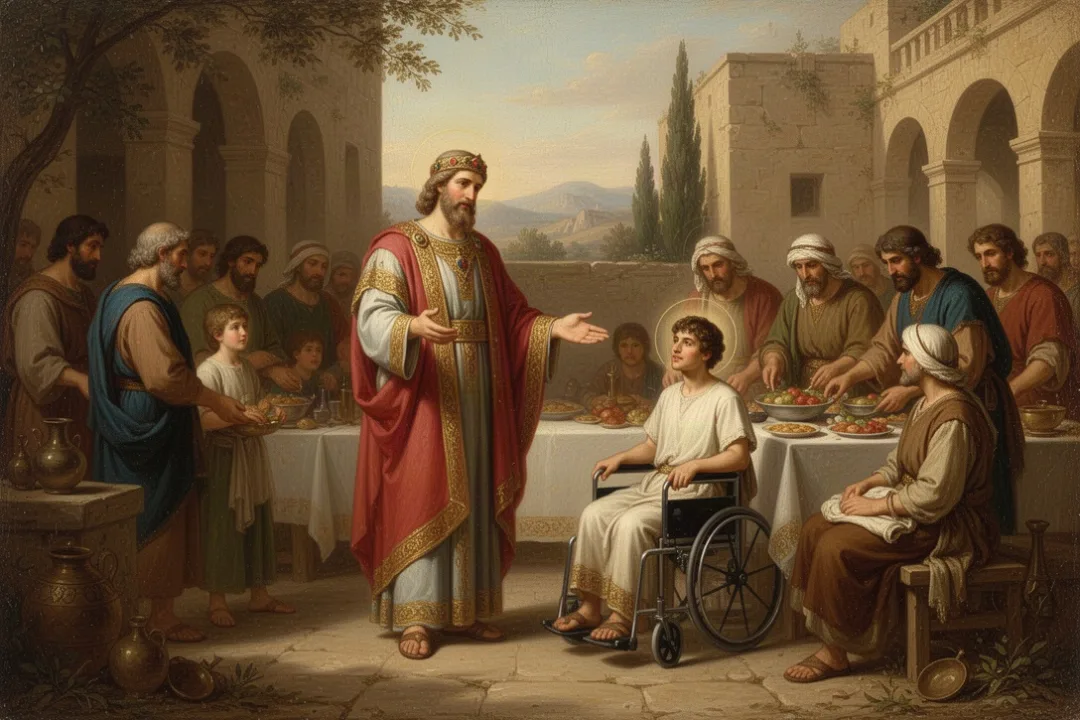
David gave him a place at the royal table. Mephibosheth was invited to eat regularly with the king’s sons, just as a member of the royal household would.
These actions are recorded in 2 Samuel 9. The chapter repeatedly emphasizes that David acted “for the sake of Jonathan”, meaning that his kindness was grounded in a covenant rather than in Mephibosheth’s influence, wealth, or usefulness.
Why David searched for Jonathan’s son
David’s decision came from his covenant with Jonathan. In 1 Samuel 20, Jonathan asked David to show loyal love to his family after David became king. David agreed, and Jonathan’s request remained significant long after Jonathan’s death.
David did not seek Mephibosheth because Mephibosheth could help him politically. The young man had no army, public office, or evident authority. David sought him because faithfulness to a promise mattered more than political convenience.
In that setting, the offer was surprising. A king might have treated a surviving descendant of Saul as a rival. Instead, David restored family property and gave Mephibosheth access to the royal table. The gesture transformed him from an isolated survivor into someone publicly accepted by the reigning king.
David’s kindness to Mephibosheth was not based on what Mephibosheth could give the king, but on a promise David had made to Jonathan.
The story also shows that kindness can include practical help. David did not merely express sympathy. He provided land, workers, food, protection, and a continuing relationship with the royal household.
What happened when Mephibosheth met David
When Mephibosheth was brought to David, he bowed and identified himself as the king’s servant. His response reflects humility and perhaps fear. He may have expected punishment because he belonged to Saul’s family, but David immediately told him not to be afraid.
David then gave him several assurances. He promised to restore all the land that had belonged to Saul and said Mephibosheth would eat at the king’s table continually. David also treated him as part of Jonathan’s family rather than as an enemy from Saul’s house.
Mephibosheth asked why David would show kindness to someone he described as a dead dog. The language is a strong expression of his low social position and unworthiness in his own eyes. It may also show how little power he believed he possessed before the king.
The description of his physical condition appears again in the chapter: he was disabled in both feet. This detail helps explain why Ziba and his household were assigned responsibility for farming the land. It also underscores that Mephibosheth’s place at the table did not depend on military ability or physical strength.
Second Samuel 9 says that Mephibosheth had a young son named Mica. The chapter ends by emphasizing that he lived in Jerusalem and ate at David’s table, while Ziba managed the property with his many sons and servants.
How Ziba affected Mephibosheth’s story
Ziba was a servant connected with Saul’s household. He first helped David locate Mephibosheth, and David then assigned him responsibility for cultivating Saul’s former land. The arrangement placed Ziba in a position of practical authority over the property.
The relationship became complicated during Absalom’s rebellion. David fled Jerusalem when Absalom attempted to seize the throne. As David was leaving, Ziba met him with supplies and claimed that Mephibosheth had stayed in Jerusalem because he expected to regain his grandfather’s kingdom.
David accepted Ziba’s report and transferred Mephibosheth’s property to Ziba, as recorded in 2 Samuel 16:1–4. The narrative does not stop to confirm whether Ziba’s accusation was true. This uncertainty becomes significant when Mephibosheth later meets David.
After Absalom’s defeat, Mephibosheth came down to meet the king. Second Samuel 19:24 says that he had not cared for his feet, trimmed his beard, or washed his clothes from the day David left until the king returned safely. These details suggest grief, mourning, or distress over David’s exile.
Mephibosheth told David that Ziba had deceived him. According to his account, he had wanted to prepare a donkey and travel with David, but his disability prevented him from doing so. He also said that Ziba had slandered him to the king.
Mephibosheth’s words are not presented as a modern courtroom transcript, and the text does not explicitly tell readers which man was completely truthful. His unkempt appearance supports his claim that he had been mourning David’s departure, but readers must still interpret the competing statements carefully.
What Mephibosheth’s response to David reveals
When David offered to divide the land between Mephibosheth and Ziba, Mephibosheth responded that Ziba could take all of it. He said he was simply grateful that the king had returned safely.
This answer can be understood in several related ways. It may express genuine loyalty to David, resignation after a painful dispute, or a refusal to fight over property while the king’s safety mattered more to him. The text does not explain his inner motives in detail, so it is best not to make his response more certain than the passage allows.
What is clear is that Mephibosheth did not present himself as someone determined to seize power. His words directly challenge the earlier image of a man waiting to claim Saul’s throne. Instead, he focused on his relationship with David and the king’s safe return.
David’s final ruling was limited: he told Mephibosheth and Ziba to divide the land. The decision may seem abrupt, especially after Mephibosheth’s explanation. It reflects the pressure of a restored but unsettled kingdom, where David had to make quick decisions amid competing claims.
Read the Ziba episode with care. Second Samuel presents Ziba’s accusation and Mephibosheth’s denial, but it does not offer a simple narrator’s verdict. The safest conclusion is that Mephibosheth remained loyal to David, while the precise truth about Ziba’s report is left partly unresolved.
How Mephibosheth was protected during the famine
Mephibosheth appears again in 2 Samuel 21. During David’s reign, a famine lasted for three years. David sought God’s explanation and learned that the crisis was connected with Saul’s bloodguilt against the Gibeonites.
The Gibeonites requested that seven male descendants of Saul be handed over for execution. David agreed to their request, but he spared Mephibosheth, Jonathan’s son, because of the oath David and Jonathan had made before the Lord.
This passage is difficult because it concerns an act of collective punishment and a famine connected with earlier wrongdoing. It should not be used to suggest that Mephibosheth had committed the offense himself. The text specifically distinguishes him from the descendants who were surrendered and highlights David’s prior oath as the reason for his protection.
His preservation in 2 Samuel 21 confirms the seriousness of David’s promise to Jonathan. Even in a national crisis involving Saul’s family, David remembered the covenant and refused to hand over Jonathan’s son.
What the Bible teaches through Mephibosheth’s story
Mephibosheth’s story offers several themes, but each should be grounded in the actual narrative rather than turned into a vague inspirational slogan.
Covenant loyalty can outlast a political regime. David kept his promise to Jonathan after Jonathan and Saul were dead and Saul’s dynasty had ended.
Kindness can restore dignity. David gave Mephibosheth more than survival. He restored property and welcomed him to the royal table.
Disability does not erase a person’s identity or value. The story names Mephibosheth’s disability without treating him as morally defective or socially worthless.
Powerful people must evaluate accusations carefully. David acted on Ziba’s report before hearing Mephibosheth’s side, and the later account complicates the first judgment.
Gratitude and loyalty may matter more than material advantage. Mephibosheth was willing to surrender the land rather than treat property as more important than David’s return.
Political conflict affects vulnerable people. Mephibosheth suffered because of wars and royal succession struggles in which he had little or no control.
The story also presents a contrast between social status and personal security. Mephibosheth was born into a royal family, yet he became dependent and hidden after the deaths of Saul and Jonathan. David’s favor gave him public belonging again, but that security remained connected to the king’s decisions.
What “eating at the king’s table” meant
The repeated statement that Mephibosheth ate at David’s table is more than a note about meals. In the biblical account, sharing the king’s table communicates acceptance, protection, and continued provision. Mephibosheth was not merely given a one-time gift and sent away.
He was treated as someone with an enduring place in the royal household. The phrase also reverses his social situation. The man who had lived in Lo-debar and feared the king was now publicly connected with the king’s family.
It would be inaccurate to say that Mephibosheth became king or regained Saul’s throne. David remained king, and Mephibosheth’s position was one of protected belonging rather than royal succession. The land restored to him did not make him a political ruler.
Some Christian readers connect this scene with broader biblical themes of grace and welcome. That connection can be meaningful as a theological reflection, but the immediate story is specifically about David’s covenant with Jonathan and his treatment of Jonathan’s disabled son.
Where to read about Mephibosheth in the Bible
The most useful passages are concentrated in 2 Samuel, with supporting references in 1 Samuel and 1 Chronicles.
2 Samuel 4:4: explains Mephibosheth’s childhood injury after Saul and Jonathan died.
2 Samuel 9: describes David finding him, restoring Saul’s land, and inviting him to the royal table.
2 Samuel 16:1–4: records Ziba’s accusation during David’s flight from Absalom.
2 Samuel 19:24–30: gives Mephibosheth’s response after David returns to Jerusalem.
2 Samuel 21:7: records that David spared him during the famine because of the oath to Jonathan.
1 Samuel 20: provides the background of David and Jonathan’s covenant.
1 Chronicles 8:34 and 9:40: identify Jonathan’s son by the name Merib-baal and list his family connection.
Reading these passages together helps prevent two common mistakes. First, Mephibosheth was not a rival king attempting to take David’s throne. Second, he was not the same person as the other Mephibosheth mentioned in 2 Samuel 21:8.
Why Mephibosheth remains significant
Mephibosheth matters because his life shows what happened to an ordinary person caught between royal families and national conflict. He was the son of a beloved prince, the grandson of a failed king, a child injured during a hurried escape, and an adult dependent on the protection of others.
His story also gives a detailed picture of David’s covenant loyalty. David used royal authority to protect someone who might otherwise have been viewed as a threat. At the same time, the dispute with Ziba shows that even a generous arrangement could become vulnerable to misinformation and political pressure.
The Bible does not give Mephibosheth many speeches or describe his entire life. Yet the details it preserves are enough to show a man whose identity was not reduced to his disability, his family’s defeat, or the accusations made against him. He remained Jonathan’s son, David’s protected guest, and a person whose life was shaped by a promise made before he could control its consequences.
Frequently asked questions
Was Mephibosheth the son of Saul or Jonathan?
The main Mephibosheth in David’s story was Jonathan’s son and Saul’s grandson. Second Samuel 21:8 mentions another man named Mephibosheth, identified as a son of Saul and Rizpah. These are two different people, which explains why some readers encounter apparently conflicting family descriptions.
Why was Mephibosheth disabled?
According to 2 Samuel 4:4, his nurse dropped him while fleeing after news that Saul and Jonathan had died. The injury left him disabled in both feet. The passage does not treat his disability as punishment or moral failure; it presents it as the result of a traumatic childhood accident.
Did Mephibosheth betray David during Absalom’s rebellion?
The Bible records conflicting claims. Ziba told David that Mephibosheth stayed in Jerusalem hoping to reclaim Saul’s kingdom, while Mephibosheth later said Ziba had deceived him and that he had wanted to follow David. The narrative does not clearly settle every detail, though Mephibosheth expressed loyalty when David returned.
Why did David spare Mephibosheth during the famine?
David spared him because of the covenant oath he had made with Jonathan. During the famine described in 2 Samuel 21, other descendants of Saul were handed over to the Gibeonites, but Mephibosheth was protected. The passage emphasizes David’s continuing commitment to his promise rather than Mephibosheth’s political power.









Leave a Reply