King Saul died in battle against the Philistines on Mount Gilboa after years of disobedience, fear, and conflict with David. Wounded and surrounded, he fell on his own sword when his armor-bearer would not kill him; an Amalekite later reported a different version of his death to David.
Before that tragic end, Saul had been chosen as Israel’s first king, won important victories, and showed moments of courage. His story in 1 Samuel moves from promise to rejection: Saul repeatedly refused to follow God’s instructions, became consumed with David as a rival, and eventually sought guidance from a medium when he could no longer receive direction through accepted means.
Saul came from the tribe of Benjamin and was the son of Kish. The biblical narrative first presents him as physically impressive and unusually tall, but his early behavior also suggests modesty and uncertainty. When Samuel privately anointed him, Saul initially struggled to see himself as someone who could lead Israel.
Israel had asked for a king who could lead its armies and provide a visible national ruler. God directed the prophet Samuel to Saul, and the people publicly accepted him at Mizpah. Saul’s kingship began during a period when Israel faced pressure from surrounding enemies, especially the Philistines and Ammonites.
His first major public success came when he rescued the people of Jabesh-gilead from the Ammonite king Nahash. Saul gathered Israel’s forces, defeated the attackers, and gained broad support. That victory showed why many Israelites believed a strong king could protect the nation.
Saul also defeated enemies in several campaigns, including the Philistines, Moabites, Ammonites, Edomites, and Amalekites. His reign was not a story of constant failure. He possessed military ability, could rally the tribes, and sometimes acted decisively when Israel faced danger.
The central issue was not that Saul lacked talent. His downfall came from repeatedly placing his own judgment, fear, or reputation above the instructions he had received from God.
Why God rejected Saul as king
Saul’s first major failure involved a sacrifice at Gilgal. Samuel had told him to wait for his arrival, but as the army became anxious and some soldiers began to leave, Saul offered the sacrifice himself. Samuel arrived soon afterward and rebuked Saul for acting impatiently instead of obeying.
This episode revealed a pattern that became more serious later. Saul was under pressure, but his response was to take religious and royal authority into his own hands. The problem was not simply that he wanted to encourage the army; he disregarded a direct instruction because he feared losing control of the situation.
The decisive rejection came after Saul’s campaign against the Amalekites. God had commanded Saul to carry out judgment against Amalek, but Saul spared Agag, the Amalekite king, and kept the best animals and other valuable possessions. Saul later claimed that the animals had been preserved for sacrifice.
Samuel answered that obedience mattered more than religious performance. Saul’s explanation also exposed his concern for public approval: he admitted that he feared the people and listened to them. Samuel then announced that God had rejected Saul as king and would give the kingdom to another.
Saul confessed his sin, but his response remained mixed. He wanted forgiveness, yet he also asked Samuel to honor him before Israel’s elders and the people. The narrative therefore shows a distinction between admitting wrongdoing and fully changing the attitude that produced it.
Samuel’s rejection of Saul did not mean Saul immediately stopped ruling. He continued as king for years, while David was privately anointed as his future successor. This created a long period in which Saul still occupied the throne, but God’s favor had shifted away from his dynasty.
How David’s success changed Saul’s behavior
David entered Saul’s story as a young man who served in the royal court and became known for courage. After David defeated Goliath, the women of Israel celebrated both men, but their song credited David with greater military success. Saul became angry and suspicious instead of grateful for David’s victory.
Saul’s jealousy soon became dangerous. While David played music to calm Saul’s troubled spirit, Saul threw a spear at him. David escaped, and Saul later attempted to use marriage, military assignments, and intermediaries to place David in danger.
The biblical account describes Saul as troubled by a harmful or distressing spirit after God’s Spirit had departed from him. Readers understand that language in different ways, but the story clearly portrays Saul’s inner instability, violent impulses, and growing inability to govern his emotions.
David repeatedly demonstrated loyalty to Saul even while fleeing for his life. Jonathan, Saul’s son and David’s close friend, defended David and tried to persuade his father that David had done nothing deserving death. Saul sometimes responded with remorse, but his change rarely lasted.
At one point, Saul pursued David into the wilderness of En-gedi. David secretly cut off part of Saul’s robe but refused to kill him, even though his companions believed God had delivered Saul into David’s hands. David then showed the piece of cloth and explained that he had spared the king.
Saul acknowledged David’s righteousness and recognized that David would eventually become king. Yet this admission did not end the pursuit. Saul later continued searching for David, and David again spared him at a camp near the hill of Hachilah by taking Saul’s spear and water jar while he slept.
These encounters are central to the story because they contrast Saul’s suspicion with David’s restraint. David was not portrayed as perfect, but he refused to seize the throne by murdering the Lord’s anointed king. Saul, meanwhile, could recognize the truth about David and still return to his destructive behavior.
What happened when Saul consulted the medium at Endor
Near the end of his reign, Saul faced a large Philistine army at Shunem. He was terrified and sought guidance from God, but he received no answer through dreams, priests, or prophets. In desperation, he asked his servants to find a woman who practiced communication with the dead.
Saul had previously removed mediums and spiritists from the land, following the religious law of Israel. His decision to seek one therefore involved more than fear; it was another act of contradiction. He knew the practice was forbidden, yet he turned to it when normal sources of guidance did not give him the answer he wanted.
Disguised so that she would not recognize him, Saul visited the medium at Endor. He asked her to bring up Samuel, who had already died. The woman became frightened when Samuel appeared, and Saul asked what he should do about the Philistine threat.
Samuel’s message was judgment rather than reassurance. He reminded Saul that the kingdom had been taken from him because he had disobeyed God. He also told Saul that Israel would be defeated and that Saul and his sons would die the next day.
The account does not present Endor as a successful solution to Saul’s problem. Instead, the scene emphasizes that desperation did not erase the consequences of his earlier choices. Saul sought information, but the message he received confirmed the judgment already announced through Samuel.
After hearing the message, Saul collapsed in fear and had no strength because he had not eaten. The medium and his servants urged him to take food. He eventually ate and left that night, returning to the battlefield without a promise of victory.
How Saul died at Mount Gilboa
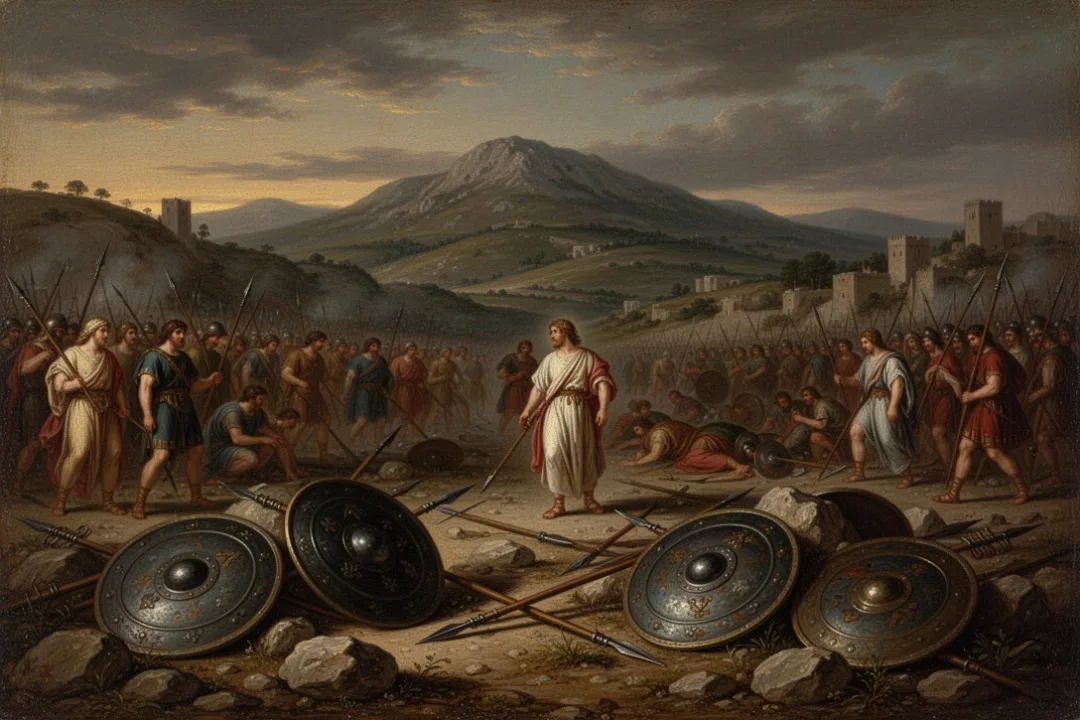
The Philistines fought Israel on Mount Gilboa, and the Israelite army suffered a devastating defeat. Saul’s sons Jonathan, Abinadab, and Malchishua were killed. Jonathan’s death was especially significant because he had been David’s loyal friend and Saul’s natural heir.
Saul was badly wounded by Philistine archers. Fearing that the Philistines would capture, abuse, and publicly dishonor him, Saul asked his armor-bearer to kill him. The armor-bearer refused because he was afraid, so Saul took his own sword and fell on it.
When the armor-bearer saw that Saul was dead, he also died by his own sword. The next day, Philistine soldiers found Saul’s body and the bodies of his sons. They removed Saul’s head, fastened his body to the wall of Beth-shan, and displayed his armor in a temple.
Men from Jabesh-gilead later recovered the bodies. They traveled through the night, removed Saul’s body and the bodies of his sons from Beth-shan, brought them to Jabesh, and burned them. They then buried the remains and mourned and fasted for seven days.
The people of Jabesh-gilead had reason to remember Saul’s earlier help. He had rescued them from the Ammonites at the beginning of his reign. Their actions at his death show that Saul’s legacy included genuine acts of courage and loyalty, even though his reign ended in disaster.
Why 1 Samuel 31 and 2 Samuel 1 describe Saul’s death differently
In 1 Samuel 31, Saul dies after falling on his own sword when his armor-bearer refuses to kill him. In 2 Samuel 1, an Amalekite comes to David and claims that he found Saul leaning on his spear and killed him at Saul’s request.
Many readers see the Amalekite’s account as a lie or an attempt to gain a reward. He may have assumed that David would be pleased to hear that Saul, his rival, was dead. Instead, David treated the report as an admission of guilt and ordered the man’s execution for claiming to have killed the Lord’s anointed king.
The Amalekite’s story does not need to replace the account in 1 Samuel. It appears in a later report brought to David, while 1 Samuel gives the narrative of the battle and Saul’s death. The two passages are best read with attention to the different settings and speakers.
David’s response is also revealing. He did not celebrate Saul’s death or use it to justify violence. He mourned Saul and Jonathan, composed a lament for them, and ordered Judah to learn it. His grief recognized Saul’s position as king while honoring Jonathan’s friendship and courage.
What Saul’s story means about leadership and obedience
Saul’s story does not teach that every mistake automatically destroys a person’s usefulness. He made poor decisions under pressure, but his deeper problem was a persistent pattern of partial obedience. He repeatedly acted first, defended himself afterward, and showed greater concern for immediate circumstances than for God’s command.
His treatment of David illustrates how fear can distort leadership. David’s success should have strengthened Israel and the royal household, but Saul interpreted it as a personal threat. Once Saul believed David endangered his position, evidence of David’s loyalty could not permanently overcome his suspicion.
Saul also demonstrates the danger of confusing public recognition with genuine repentance. He admitted wrongdoing more than once, but he often focused on how he appeared before the people. His words of regret did not consistently lead to changed conduct.
The account presents David’s rise alongside Saul’s decline, but the two men should not be reduced to a simple contrast between a perfect person and a bad one. David later committed serious sins of his own. The distinction emphasized in Saul’s story is that David accepted correction and returned to God, while Saul repeatedly resisted correction and protected his own position.
Saul’s death also shows how unresolved choices can accumulate. Fear led to impatience, impatience to disobedience, disobedience to rejection, and rejection to suspicion and violence. By the time he consulted the medium at Endor, he was seeking an emergency answer after years of refusing the guidance he had already received.
Saul’s tragedy is gradual rather than sudden. The Bible traces his collapse through repeated decisions, making his story a warning about what happens when fear, pride, and self-protection become habitual.
Common mistakes when reading Saul’s story
Assuming Saul was always evil. He began with humility, received divine appointment, defended Israel, and experienced real military success.
Reducing his rejection to one isolated incident. The conflict includes multiple acts of disobedience, especially at Gilgal and during the campaign against Amalek.
Calling David Saul’s immediate replacement. David was anointed before Saul’s death, but he did not take the throne at once. A period of conflict and divided allegiance followed.
Ignoring Jonathan’s role. Jonathan’s loyalty to David, courage in battle, and death at Mount Gilboa are essential parts of the story.
Treating the medium at Endor as a model for guidance. Saul’s visit was an act of desperation and disobedience, not an approved religious practice.
Assuming the Amalekite’s report is unquestionably factual. His version differs from 1 Samuel’s account and may have been fabricated to influence David.
Confusing King Saul with Saul of Tarsus. These are different biblical figures separated by many generations and known for very different stories.
Where to read the complete account of King Saul
Most of Saul’s story appears in 1 Samuel 8–31. The early chapters cover Israel’s request for a king, Saul’s anointing, his first victories, and the failures that lead to his rejection. The middle and later chapters focus heavily on Saul’s pursuit of David.
Read 1 Samuel 15 for the campaign against Amalek and Samuel’s announcement that Saul has been rejected. Read 1 Samuel 18–27 for Saul’s jealousy, his attempts to kill David, and David’s repeated acts of restraint.
For the final crisis, read 1 Samuel 28–31. These chapters include the visit to the medium at Endor, the Philistine battle, the deaths of Saul and his sons, and the recovery of their bodies from Beth-shan.
Then read 2 Samuel 1 for the Amalekite’s report and David’s lament. The opening chapters of 2 Samuel continue the political transition after Saul’s death and show how David responded to the end of Saul’s reign.
How Saul differs from Saul of Tarsus
The New Testament also names a man called Saul, often identified as Saul of Tarsus. He is not the first king of Israel. He was a Jewish man and Roman citizen who persecuted followers of Jesus before experiencing a dramatic encounter with the risen Christ.
After that encounter, Saul became a Christian missionary and is more commonly known as Paul. Acts records his conversion and ministry, while several New Testament letters are traditionally associated with Paul. His story moves from opposing the church to proclaiming Jesus among Jews and Gentiles.
The two Sauls therefore have different time periods, roles, and endings. King Saul died at Mount Gilboa during Israel’s war with the Philistines; Saul of Tarsus became Paul and continued serving as an apostle and missionary.
What happened to Saul in one clear timeline
Saul was chosen and anointed as Israel’s first king after the nation asked for a king.
He gained public support by rescuing Jabesh-gilead and won several military victories.
He disobeyed Samuel’s instructions at Gilgal by offering a sacrifice instead of waiting.
He spared Agag and kept valuable animals after the campaign against Amalek.
Samuel announced that God had rejected Saul and would give the kingdom to another.
David became popular after defeating Goliath, and Saul began treating him as a dangerous rival.
Saul pursued David repeatedly, although David spared Saul’s life on more than one occasion.
Facing the Philistines and receiving no answer through accepted channels, Saul consulted the medium at Endor.
Saul’s army was defeated at Mount Gilboa, and Jonathan and Saul’s other sons were killed.
Wounded and fearing capture, Saul fell on his own sword; the Philistines later displayed his body until it was recovered by men from Jabesh-gilead.
King Saul’s life ended with military defeat, but the Bible treats the defeat as the final stage of a longer spiritual and personal decline. He had been given authority, opportunity, and victories, yet he repeatedly allowed fear and self-interest to govern his decisions. His story remains a detailed account of how leadership without faithful obedience can collapse from the inside.
Frequently asked questions
Was Saul forgiven after he disobeyed God?
Saul expressed regret and asked Samuel to forgive him, but the biblical account does not present his repentance as producing a lasting change in behavior. God’s rejection of Saul as king remained in place. The story emphasizes that sorrow over consequences is not always the same as a transformed heart, especially when a person continues protecting reputation and authority.
Did David kill King Saul?
No. David had opportunities to kill Saul but refused to do so because he respected Saul’s position as the Lord’s anointed king. David’s followers encouraged him to act, yet he restrained them. Saul died during the battle with the Philistines at Mount Gilboa, according to the main account in 1 Samuel.
Why did Saul try to kill David?
Saul became jealous after David’s military victories and growing popularity. He feared that David would replace him and eventually take the kingdom, even though David repeatedly showed loyalty and spared Saul’s life. Saul’s suspicion intensified as his emotional instability and fear of losing power shaped the way he interpreted David’s actions.
What lesson does Saul’s life teach Christians?
Saul’s life warns against partial obedience, pride, fear-driven decisions, and concern for public approval. His story also shows that holding a position of authority does not guarantee faithfulness. Readers can see the importance of accepting correction, seeking guidance before a crisis, and allowing genuine repentance to produce changed conduct rather than merely admitting fault.












Leave a Reply