A good Catholic Bible study online should do more than help you read a chapter each day. It should connect Scripture with the teaching of the Catholic Church, provide trustworthy guidance, and give you a realistic way to pray and learn consistently. You can choose from self-paced courses, live parish groups, video lessons, audio studies, and guided reading plans.
The best option depends on what you need. A newcomer may want a clear explanation of the Bible’s structure and basic Catholic beliefs, while an experienced reader may prefer a detailed study of a particular book. Before enrolling, check who teaches the course, what materials it uses, how Scripture is interpreted, and whether the schedule suits your life.
Catholic Bible study begins with the conviction that Scripture is the word of God, received and interpreted within the life of the Church. That means a sound course should explain biblical passages in their historical and literary context while also showing how they relate to the whole of Christian faith.
The Catholic approach does not treat the Bible as an isolated book for private interpretation alone. Scripture, Sacred Tradition, and the teaching authority of the Church work together. A well-designed online program should make that relationship understandable rather than presenting Catholic teaching as a collection of unrelated rules.
Look for a course that regularly connects biblical themes with the Catechism of the Catholic Church, the liturgy, the sacraments, and the lives of the saints. These connections help you see how Scripture is prayed and lived, not merely analyzed.
Faithful interpretation: Lessons should respect the meaning of the biblical text and the Church’s understanding of revelation.
Context: The course should discuss authorship, audience, genre, historical setting, and the purpose of each passage where those details are relevant.
Prayer: Sessions should include a way to read Scripture prayerfully, such as lectio divina or guided reflection.
Connection to worship: The material may relate readings to the Mass, the liturgical year, or the sacraments.
Practical application: You should leave with a question to consider, a virtue to practice, or a concrete way to respond.
A course does not have to be highly academic to be reliable. Clear explanations, carefully chosen resources, and respectful treatment of difficult passages often matter more than technical vocabulary. At the same time, a program that makes sweeping claims without identifying its sources deserves caution.
Good standard: Choose a study that helps you read the Bible more carefully, pray more honestly, and understand Catholic teaching more clearly. Entertainment value and production quality are secondary.
Which online format fits your schedule and learning style
Online Catholic Bible studies come in several formats, and each has different strengths. Selecting the right format can determine whether you continue beyond the first few sessions. Consider how much structure, interaction, and flexibility you need before you register.
Self-paced Catholic Bible courses
Self-paced courses usually combine recorded lessons, reading assignments, study questions, and downloadable materials. They work well if your schedule changes often or you prefer to pause and review difficult explanations. You can also spend more time on a challenging book, such as Romans or Revelation, without holding back a group.
The main limitation is accountability. Without a meeting or personal commitment, it can be easy to postpone the next lesson. Set a regular time, keep a notebook, and divide longer assignments into smaller sessions. A modest plan you follow is more useful than an ambitious schedule you abandon.
Live online Bible study groups
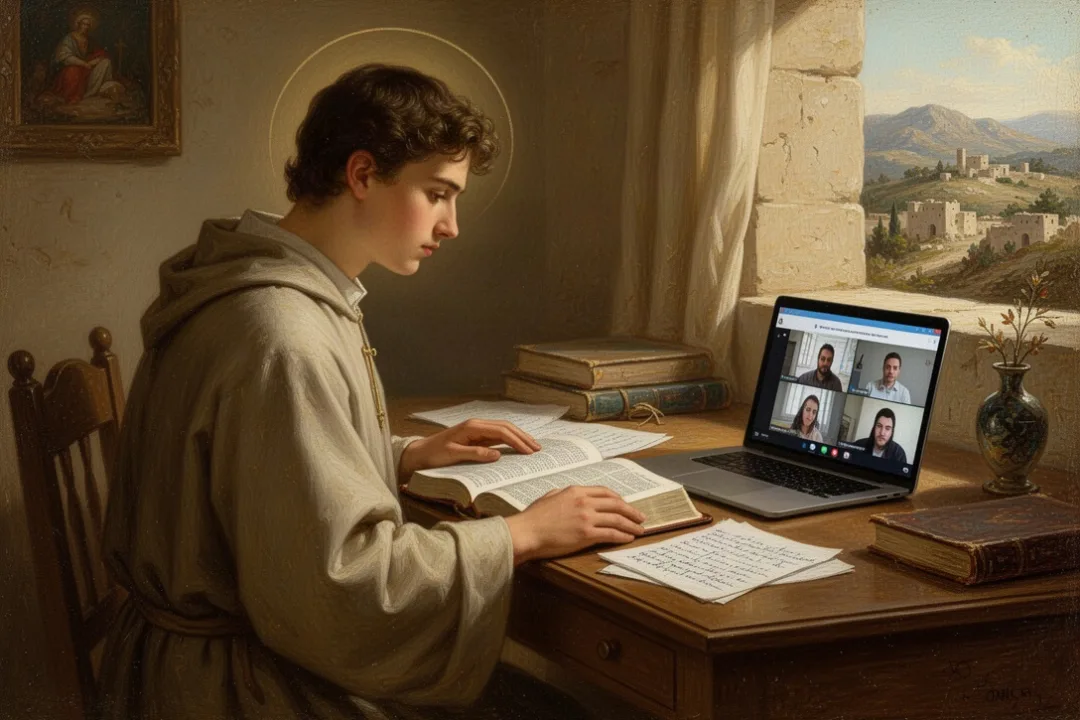
Live groups meet through video conferencing at a fixed time. They offer community and accountability, which can make a major difference when you are trying to develop a regular habit. A good facilitator keeps the discussion focused on the text and makes room for different levels of experience.
Ask whether the group welcomes questions, how large it is, and whether participants receive reading questions in advance. You may also want to know if sessions are recorded for members who occasionally miss a meeting. A group that depends entirely on spontaneous discussion may be less suitable if you prefer preparation and careful reflection.
Parish and diocesan online studies
Many parishes, dioceses, and Catholic ministries offer online studies connected with a local faith community. These groups can help you build relationships with other Catholics and may provide opportunities for prayer, service, or participation in parish life.
Local programs vary widely in depth and organization. Ask for a description of the curriculum, the leader’s experience, and the expected time commitment. If the study is based on a commercial workbook or outside video series, find out how the group will use it and whether questions will be discussed during each meeting.
Video, audio, and podcast-based studies
Video lessons can make complex topics easier to follow, especially when maps, timelines, artwork, or diagrams are used. Audio studies and podcasts are convenient for listening during a commute or a walk, although they usually offer less opportunity for direct discussion.
Use these resources as part of a reading plan rather than as a replacement for Scripture. A polished presentation can create the impression that you understand a passage before you have actually read it carefully. Read the assigned biblical text first, then use the lesson to clarify and deepen your understanding.
How to evaluate the teacher, curriculum, and Catholic sources
The person or organization leading a study matters as much as the format. You do not need a famous speaker or a long academic biography, but you should be able to identify the teacher’s background and the basis for the material. Look for evidence of familiarity with Scripture, Catholic theology, and the Church’s interpretive tradition.
A trustworthy program normally identifies its main resources. These might include a Catholic Bible edition, the Catechism, documents from the Church, writings of recognized saints, and reputable biblical scholarship. The presence of sources does not guarantee perfection, but vague claims and unsupported certainty should make you cautious.
Pay attention to how the teacher handles passages that are difficult, disputed, or culturally unfamiliar. Responsible instruction acknowledges complexity and distinguishes between what the text clearly says, what the Church teaches, and what is a reasonable scholarly opinion. It does not force every passage into a simplistic lesson.
Is the instructor’s Catholic background or institutional affiliation clear?
Does the study identify its Bible translation and supplemental resources?
Does it distinguish official Church teaching from the teacher’s personal interpretation?
Are difficult passages addressed honestly rather than ignored?
Does the material respect the unity of the entire Bible?
Are questions and discussion prompts connected to specific passages?
Are claims about history, doctrine, or authorship presented with appropriate care?
The Bible edition used by the course also deserves attention. Catholics may read several approved translations in English, and wording differs between editions. If a lesson refers to a particular phrase, use the translation named by the teacher or compare it with another Catholic edition when needed.
Reading a Catholic edition can make it easier to follow the course’s notes and references. You do not need to own every translation. One reliable Catholic Bible, a notebook, and access to the assigned supplemental material are usually enough to begin.
Check the boundaries: A Catholic label by itself does not explain a course’s quality. Read the description, preview a lesson if available, and verify that the teaching is consistent with Scripture and the Catholic faith.
How to study the Bible online with a Catholic method
An online course becomes more fruitful when you use a consistent method. Begin with the biblical passage itself before reading comments or watching the lesson. This allows you to notice the language, structure, repeated ideas, and questions that the text raises for you.
Many Catholics use lectio divina, a prayerful way of reading Scripture traditionally associated with four movements: reading, meditation, prayer, and contemplation. These movements are not a rigid formula. They offer a simple pattern for receiving the text as prayer while still respecting its meaning.
Read: Read the passage slowly at least once, and then read it again. Notice who is speaking, what changes, and which words or images are repeated.
Meditate: Consider what the passage meant in its original setting and what it reveals about God, human beings, sin, mercy, or discipleship.
Pray: Respond to God in your own words. You might ask for wisdom, repentance, courage, gratitude, or greater trust.
Contemplate: Remain quietly with one truth from the passage rather than trying to solve every question in one sitting.
Act: Choose a specific response, such as apologizing, practicing patience, helping someone in need, or returning to prayer at a set time.
This method does not replace careful study. Prayerful reading should be informed by the passage’s context, genre, and relationship to the rest of Scripture. A parable, a psalm, a prophetic oracle, a letter, and a historical narrative require different kinds of attention.
A practical weekly routine for online study
A weekly routine can keep your study focused without making it burdensome. Reserve one longer session for reading and the lesson, then use shorter sessions for prayer and review. If you belong to a live group, complete the reading before the meeting so that discussion can move beyond first impressions.
First session: Read the passage and write down two observations and one question.
Second session: Watch or listen to the lesson, checking each major point against the text.
Third session: Read a related section of the Catechism or another Catholic resource supplied by the course.
Fourth session: Pray with the passage and write a brief personal response.
Group session: Share one insight, listen carefully, and record a question for further study.
Avoid turning every study session into a search for a personal message. Scripture can challenge your assumptions, correct your behavior, and reveal truths that are not immediately comforting. The goal is not to make the text say whatever you already feel; it is to allow the text to form your mind and heart within the faith of the Church.
Keep a simple study notebook with the passage, date, observations, questions, and prayer. Over time, this record can show recurring themes and help you return to earlier questions. It also gives you something concrete to bring to a group discussion or a conversation with a priest, deacon, or qualified teacher.
What to study first and how to choose a reading plan
Your first book of the Bible should match your purpose. If you want to learn more about Jesus, one of the Gospels is a natural starting point. If you want to understand the early Church and the spread of the Christian mission, Acts provides a connected narrative after the Gospel accounts.
Some readers begin with a broad survey of the Bible before studying individual books. This can explain the covenant story, major biblical eras, literary genres, and the relationship between the Old and New Testaments. A survey is especially useful if unfamiliar names, places, and historical events make reading feel disconnected.
Others prefer a focused study. A course on Genesis may explore creation, human freedom, covenant, and the origins of Israel’s story. A study of the Psalms can develop prayer through praise, lament, thanksgiving, repentance, and trust. A course on one of Paul’s letters may examine Christian identity, grace, community life, and moral responsibility.
When choosing a plan, ask how much reading it assigns each week. A course that covers a large amount of material may offer breadth but leave little time for reflection. A slower program can provide more room for questions, cross-references, and prayer.
Consider these starting points according to your goal:
Learning about Jesus: Choose a Gospel study that explains the setting, structure, and central themes of the selected Gospel.
Building a prayer habit: Consider the Psalms or a course that combines short passages with lectio divina.
Understanding Catholic worship: Look for a study that connects Scripture with the Mass and the liturgical year.
Exploring the Old Testament: Choose a program that explains covenant, law, prophecy, wisdom literature, and salvation history.
Strengthening theological knowledge: Select a study that uses the Catechism and introduces responsible biblical interpretation.
Preparing for group discussion: Choose a course with written questions, assigned readings, and a predictable meeting schedule.
Do not feel required to read the Bible from Genesis through Revelation without guidance. The Bible is a library of many books written in different periods and forms. A thoughtful sequence can give you the context needed to appreciate books that might otherwise seem difficult or unrelated.
How to make an online Bible group safe, respectful, and productive
Online discussion works best when participants know what kind of conversation to expect. The group should welcome sincere questions without allowing one person to dominate. Personal experiences can enrich discussion, but they should not replace attention to the biblical text or become a test of someone’s faith.
Before joining, ask whether the group has a moderator, a code of conduct, and a process for handling disagreement. A Catholic study should make room for uncertainty and growth while remaining clear about the difference between Church teaching and individual opinion.
Read the assigned passage before the meeting.
Bring one question that comes directly from the text.
Use “I” statements when describing your response or experience.
Allow other participants time to speak.
Ask for clarification before challenging someone’s interpretation.
Refer disputed doctrinal questions to the Catechism or a qualified Catholic teacher.
Protect personal information and avoid sharing someone else’s story outside the group.
A group leader should guide the conversation back to Scripture when discussion becomes vague or political. The leader does not need to have an answer to every question. A responsible response may be to identify what is known, name what remains uncertain, and suggest a reliable resource for further study.
Privacy also matters in online settings. Avoid posting personal contact details in public discussion areas, and review the platform’s recording and membership policies. If a group asks for money, personal information, or commitment beyond what was advertised, pause and seek clarification before continuing.
Finally, allow online study to support rather than replace the sacramental and communal life of the Church. Scripture study can deepen your participation in the Mass, strengthen personal prayer, and help you recognize Christ’s call to serve others. It is most fruitful when learning leads to worship, conversion, and charity.
Frequently asked questions
Is an online Catholic Bible study suitable for someone who is new to Christianity?
Yes. Choose a beginner-friendly program that explains the Bible’s structure, basic Catholic beliefs, and unfamiliar terms instead of assuming prior knowledge. A Gospel study or broad introduction can provide a manageable starting point. If possible, select a course with a live discussion option so you can ask questions and hear how other Catholics approach Scripture.
Do I need a special Catholic Bible for an online study?
You should use a Catholic edition if the course is designed around Catholic teaching, particularly when it discusses the complete biblical canon or connects passages with liturgy. Follow the translation named in the course when quotations or wording matter. You can compare editions, but using one consistent Bible will make assignments easier to follow.
How much time should I set aside each week?
Many people can begin with two or three focused sessions of roughly 20 to 45 minutes, depending on the assignment. A live group may require additional meeting time. Reading the passage before viewing a lesson is usually more valuable than rushing through extensive supplementary material, so choose a plan you can maintain over several weeks.
Can an online Bible study replace attending Mass or joining a parish?
No. Online study can deepen your understanding of Scripture and help you prepare for fuller participation in parish life, but it does not replace the Eucharistic celebration, the sacraments, or personal relationships within the Church. Use it as a supplement to worship, prayer, pastoral guidance, and service in your local Catholic community.





Leave a Reply