Joel in the Bible: Who He Was and What His Book Means
Joel in the Bible: Who He Was and What His Book Means
If you have opened the Bible and wondered where to begin with Joel in the Bible, the short answer is this: Joel was a prophet whose message moves from disaster and repentance to restoration, God’s Spirit, and final judgment. His book is brief, but it addresses questions that still feel familiar: What does suffering mean? How should people respond to a crisis? Can devastation be reversed?
The name Joel means “Yahweh is God,” or “the Lord is God.” The prophet is identified as Joel son of Pethuel in Joel 1:1, but Scripture gives no further biography about him. The book is therefore known mainly through its message rather than through details about his family, occupation, travels, or time in public ministry.
Who Joel was and where his book appears in the Bible
Joel is one of the Minor Prophets, a Christian designation referring to the shorter prophetic books, not to lesser importance. His book comes after Hosea and before Amos in the Old Testament arrangement used by most Christian Bibles. In the Hebrew Bible, Joel belongs among the Twelve Prophets, a collection of shorter prophetic writings.
The Bible does not provide a firm date for Joel’s ministry. Unlike some prophets, Joel does not name a reigning king or describe a clearly dated political event. As a result, interpreters place the book in different periods, including an earlier time before the exile or a later period after the Babylonian exile. The message remains understandable even where the historical setting is debated.
Joel’s prophecy appears to address the people of Judah, especially Jerusalem and the temple community. The book refers to priests, worship, fasting, offerings, and the “day of the Lord.” Its setting seems closely connected to a severe agricultural disaster, but Joel uses that disaster to speak about spiritual accountability and God’s future action.
Key idea: Joel’s book does not treat disaster as a subject for speculation alone. It calls God’s people to return to him sincerely, trust his mercy, and live with awareness that God will judge evil and restore what has been damaged.
How to read the book of Joel step by step
A helpful way to understand Joel is to follow the movement of the book rather than treating each image as an isolated prediction. The prophecy develops through several connected stages.
Recognize the crisis. Joel begins with an extraordinary invasion of locusts and its effect on the land, crops, worship, and daily life.
Listen for the warning. The disaster becomes a sign pointing toward the “day of the Lord,” a time when God acts decisively in judgment.
Respond with genuine repentance. Joel calls the community to return to God with the heart, not merely through outward religious performance.
Look for restoration. The prophecy describes God’s compassion, renewed harvests, and the removal of shame.
Expect the Spirit’s work. Joel announces that God will pour out his Spirit broadly across age, gender, and social status.
Understand final justice. The book closes with judgment on nations that have harmed God’s people and with security for Judah and Jerusalem.
This progression explains why Joel can sound severe in one paragraph and hopeful in the next. Warning and mercy are not competing messages in the book. The warning exposes the seriousness of sin, while mercy shows that repentance can lead to renewal.
What the locust plague means in Joel 1
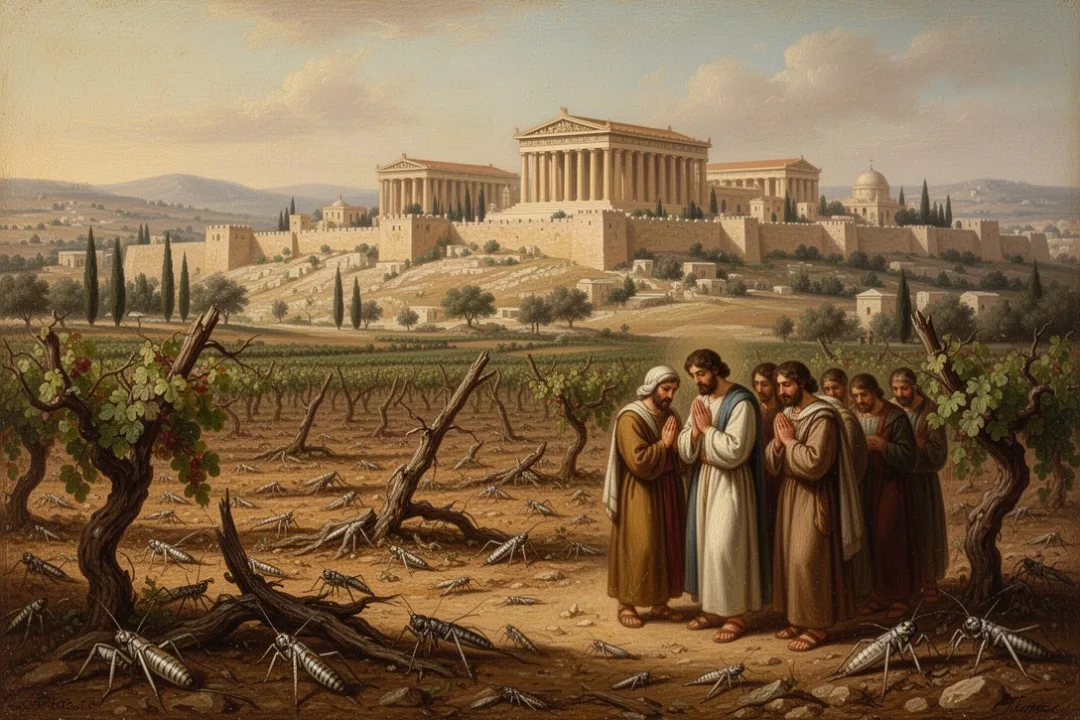
Joel opens with a catastrophe that has affected every generation and social group. Locusts have consumed crops, damaged vines and trees, and left the land unable to provide its usual food and offerings. Joel tells older people to remember the event and teach it to their children, presenting the disaster as something so unusual that it must not be forgotten.
The damage is described in practical terms. Farmers have lost grain, wine, and oil. Priests cannot offer the normal grain and drink offerings at the temple. Joy has withered, because the agricultural collapse has reached both household life and public worship. Joel is not describing an abstract problem; he is showing how a natural calamity can touch food, work, worship, and community identity at the same time.
Joel repeatedly calls people to mourn, fast, and cry out to God. The response is communal rather than private. Elders, priests, farmers, and the wider population are all drawn into the crisis. The prophet’s point is not that only one class of people has failed or that only one group needs God’s help.
Some readers understand the locusts as literal insects, while others see them as symbolic of an invading army. The book’s descriptions can support discussion of both possibilities, especially because Joel later uses army-like language. It is wise not to force every detail into a modern prediction. The clearest point is that an overwhelming force has stripped the land and revealed human helplessness.
Why Joel compares the disaster with the day of the Lord
Joel 1 presents the locust plague as a warning that the day of the Lord is near. In prophetic language, this phrase refers to a time when God intervenes openly to judge, rescue, or both. It is not simply a reference to one ordinary calendar day. Depending on the passage, it can describe an imminent crisis, a future act of judgment, or the larger pattern of God bringing history to account.
The locust disaster gives the people a visible picture of what divine judgment can feel like: sudden, comprehensive, and beyond human control. Joel does not say that every hardship can be decoded as a direct punishment. Instead, he uses the crisis as a summons to take God seriously and examine the community’s relationship with him.
What Joel 2 teaches about repentance
Joel 2 intensifies the warning and calls the people to return to God. The central appeal is for heartfelt repentance, not a performance designed to impress observers. Joel describes fasting, weeping, and mourning, but the inward change matters more than the outward signs.
The prophet’s call is communal. He mentions elders, children, infants, newly married couples, priests, and ministers. Even people whose ordinary responsibilities might excuse them from public participation are summoned. The message is that every part of the community has a place in turning back to God.
Joel also appeals to God’s character. He presents God as gracious, compassionate, patient, and abundant in faithful love. The possibility of forgiveness is not based on the people’s ability to repair everything themselves. It rests on God’s willingness to show mercy when people return sincerely.
Joel’s call is not merely “feel bad about sin.” It is a summons to turn back to God with the whole person.
Joel 2:13 is often remembered because it emphasizes that God looks for an inward return rather than torn clothing alone. The verse should be understood by reference rather than by reproducing a particular Bible translation. Its meaning is that external mourning has value only when it expresses a genuine change of heart.
How biblical repentance differs from regret
Regret focuses mainly on the pain caused by an action or on the consequences that follow. Biblical repentance goes further: it acknowledges wrongdoing, turns toward God, and accepts a changed direction. Joel’s appeal includes emotional grief, but it is not limited to emotion.
Joel’s community is also encouraged to gather for prayer and fasting. This shows that repentance can have both personal and public dimensions. A person may need to confess privately, while a congregation or nation may need to acknowledge shared failure and seek God together.
Confession names the problem honestly rather than hiding it.
Humility recognizes dependence on God instead of claiming self-sufficiency.
Changed direction turns away from destructive behavior and toward obedience.
Hope trusts that God’s mercy is greater than the community’s present ruin.
How Joel describes restoration after judgment
After the call to repentance, Joel presents a striking change in tone. God responds with compassion and promises to address the losses caused by the disaster. The land can again produce grain, wine, and oil. The people can eat, be satisfied, and praise God instead of living under constant shame.
The promise to restore the years consumed by locusts is one of Joel’s most familiar ideas. It does not necessarily mean that every lost opportunity or painful event will be erased in exactly its former form. The promise expresses God’s ability to bring renewal after devastation and to provide a future when the present seems permanently ruined.
Joel connects material restoration with restored worship. The renewed harvest is not merely an economic recovery. It enables offerings, gratitude, and public recognition that God has acted. In the book’s world, food, land, worship, and communal joy are closely connected.
The people are also promised freedom from disgrace among the nations. Shame is a recurring consequence of defeat and loss, especially when neighboring peoples interpret suffering as proof that Judah’s God cannot save. Joel answers that humiliation will not have the final word.
Read the restoration promise carefully: Joel offers hope grounded in God’s character, not a guarantee that every believer will recover every possession or avoid future suffering. Restoration may include provision, spiritual renewal, justice, and renewed fellowship with God.
What Joel means by the outpouring of the Spirit
Joel 2:28-32 contains the book’s most widely recognized promise. God says, in substance, that he will pour out his Spirit on all kinds of people. Sons and daughters will prophesy, older people will receive meaningful dreams, and younger people will see visions. The promise breaks through limitations based on age, gender, and social position.
The wording emphasizes broad access to God’s presence and revelation. In earlier biblical narratives, the Spirit often comes upon particular leaders for particular tasks. Joel points toward a time when the Spirit’s activity will be experienced across the community rather than being limited to a small group.
The passage also mentions servants, both male and female. That detail matters because it widens the promise beyond social elites. Joel presents God as able to speak and work through people whose status would not normally give them public authority.
How the New Testament uses Joel’s prophecy
In Acts 2, Peter interprets the coming of the Holy Spirit at Pentecost through Joel’s prophecy. He explains the extraordinary events surrounding the disciples as connected to God’s promise to pour out the Spirit. Peter’s speech does not treat Joel as irrelevant history; it presents the prophecy as reaching a significant stage of fulfillment through Jesus and the formation of the early church.
Christians differ on how to describe the timing and completeness of that fulfillment. Some see Joel’s words as fulfilled in a decisive way at Pentecost while also awaiting a future completion. Others emphasize that the Spirit’s outpouring marks the beginning of a new era that will continue until the final day of the Lord.
Romans 10:13 also echoes Joel 2:32 by teaching that everyone who calls on the Lord will be saved. The New Testament applies Joel’s invitation broadly, emphasizing that salvation is available to all who turn to God in faith. The central movement remains the same: God judges evil, offers mercy, and calls people to rely on him.
What the signs in the heavens mean in Joel
Joel describes wonders in the sky, including changes involving the sun, moon, and celestial signs, before the day of the Lord. These images communicate that the coming event will affect more than private religious experience. God’s action will be public, cosmic, and impossible to dismiss as an ordinary human development.
Prophetic writing often uses dramatic cosmic imagery to describe world-changing judgment. Readers should therefore avoid treating every image as a simple prediction of a specific astronomical event. The main theological force is that God’s authority extends over creation and history, and no political power stands beyond his accountability.
At the same time, Joel’s warning includes a promise of rescue. Those who call on the Lord will find a way of deliverance. The passage holds judgment and salvation together: the day of the Lord is terrifying for those who resist God, but it provides hope for those who seek him.
What Joel teaches about the nations and final justice
Joel 3 turns toward the nations that have harmed Judah. The prophecy refers to the scattering of God’s people, the taking of land, and the selling of people into slavery. The exact historical events behind these references are debated, but the moral issue is clear: powerful nations are not free to exploit vulnerable people without answer.
God summons the nations to judgment in the Valley of Jehoshaphat, a name associated with the idea that the Lord judges. The imagery of a harvest and a winepress portrays evil as ripe for judgment. Joel is not offering a timetable that readers can calculate. He is declaring that injustice has a limit and that God will ultimately confront those who profit from violence.
The prophecy also uses agricultural images to describe the abundance of the restored land. Mountains drip with wine, hills produce milk, and a spring flows from the temple. These pictures communicate fertility, life, and divine presence. The point is not merely that Judah will have more crops; the land will become a place where God’s blessing is experienced after a season of destruction.
Why Joel’s message includes both Judah and the nations
Joel does not present God’s justice as favoritism without moral standards. Judah itself is called to repent, and the nations are judged for their violence and exploitation. The book’s framework is consistent: God is concerned with the conduct of every people, and no community can claim immunity from accountability.
The closing vision of Joel presents Judah as secure because God dwells among his people. This does not erase the earlier crisis. It shows the intended destination of the prophecy: a community restored to worship, protected from its enemies, and living in the awareness of God’s presence.
How Joel in the Bible connects with other prophets
Joel shares themes with several other prophetic books. Amos also speaks about the day of the Lord and warns that religious activity cannot replace justice and obedience. Isaiah describes judgment, restoration, and the future blessing of God’s people. Ezekiel presents promises involving renewal, cleansing, and the work of God’s Spirit.
Joel’s particular contribution is the way it links a local agricultural disaster with a wider prophetic horizon. A crisis in the fields becomes a prompt to consider the day of the Lord. The book then moves from fasting and repentance to renewed harvest, the Spirit’s outpouring, and final justice.
The book also helps readers see that biblical prophecy is not simply a collection of predictions. Prophets addressed real communities facing real threats. Their messages called people to respond in the present while also pointing toward God’s larger purposes for history.
What Joel’s message means for readers today
Joel offers practical spiritual lessons without giving permission to assign a specific divine explanation to every disaster. The book encourages careful reflection, humility, communal prayer, and confidence in God’s mercy. It also reminds readers that spiritual renewal is not detached from public life, work, food, justice, or the treatment of vulnerable people.
Do not ignore a crisis. Hardship can expose dependence, injustice, and weaknesses that normal routines conceal.
Do not confuse outward religion with repentance. Joel values fasting and public worship when they express a changed heart.
Seek God together. The prophet repeatedly addresses the whole community, not only isolated individuals.
Leave room for hope. Ruin may be real without being the final word.
Expect God to work through many kinds of people. Joel’s Spirit promise includes young and old, women and men, and people across social divisions.
Take justice seriously. God’s concern includes exploitation, violence, displacement, and the abuse of power.
Joel can also help someone who feels that past failure has permanently defined the future. The book does not minimize loss or pretend that restoration is automatic. Instead, it presents a God who can meet people in devastation, call them back, and create a renewed future through mercy.
Common questions about Joel’s historical setting
Was Joel a priest or a farmer?
The Bible does not say. Joel’s familiarity with temple worship and agricultural life shows that he understood both, but it does not prove his occupation. He may have lived close to Jerusalem’s worshiping community, yet the text identifies him only as Joel son of Pethuel.
Was the locust invasion literal or symbolic?
The book may draw from a real locust disaster while also using the event as prophetic imagery. The language allows readers to see the insects as a present crisis and as a picture of a larger invading force. The book’s central message does not depend on settling every detail of that question.
Why is Joel called a minor prophet?
“Minor” refers to the length of the book, not its value or authority. Joel is short compared with Isaiah or Jeremiah, but it contains major themes: repentance, the day of the Lord, restoration, the Holy Spirit, salvation, and judgment of the nations.
Where to find the main ideas in Joel
The book is only three chapters in many English Bibles, making it possible to read in one sitting. These references provide a useful path through its major themes:
Joel 1:1-20: the locust disaster, agricultural loss, mourning, and the call to cry out to God.
Joel 2:1-11: the approaching day of the Lord and its terrifying imagery.
Joel 2:12-17: the call to return to God through sincere repentance and communal fasting.
Joel 2:18-27: God’s compassion, restored harvests, and the removal of shame.
Joel 2:28-32: the outpouring of the Spirit and the promise of salvation for those who call on the Lord.
Joel 3:1-21: judgment of the nations, restoration of Judah, and God’s abiding presence with his people.
Reading Joel with these movements in mind prevents the familiar promise about the Spirit from being separated from the repentance and restoration that surround it. The book’s message is unified: God confronts evil, invites people to return, restores what he chooses to restore, and remains faithful to his people.
Frequently asked questions
Did Joel write the entire book that bears his name?
The book identifies Joel as its prophetic source, but the Bible does not describe how the material was recorded, edited, or preserved. As with several prophetic books, the safest statement is that it presents Joel’s message to Judah. The text itself gives very little information about his personal life or the process by which the prophecy reached its final written form.
Does Joel predict the end of the world?
Joel describes the “day of the Lord,” which includes divine judgment, cosmic signs, salvation, and the defeat of evil. Christians interpret its fulfillment in different ways. Some emphasize events connected with Jesus and Pentecost, while others expect a future completion. Joel clearly points beyond one local crisis to God’s ultimate accountability of humanity.
What does “I will restore the years” mean?
Joel 2:25 expresses God’s promise to respond compassionately after the devastation caused by the locusts. It does not promise that every loss will be returned in its original form or on a particular schedule. The emphasis is that God can renew a ruined community, restore worship and provision, and give hope where loss once seemed permanent.
Why is Joel quoted in Acts 2?
Peter uses Joel’s promise about God pouring out his Spirit on all kinds of people to explain what happened at Pentecost. The prophecy’s language about sons, daughters, young people, older people, and servants highlights the broad reach of the Spirit. Peter presents the event as a major fulfillment of Joel’s promise and connects it with salvation through the Lord.








Leave a Reply