When you read a short biblical book about disaster, you may wonder whether Joel is describing one historical catastrophe or using a crisis to speak about something larger. The book of Joel is about repentance, God’s coming judgment, restoration, and hope. It begins with a devastating plague of locusts, but its message reaches beyond damaged crops and empty fields.
Joel presents the disaster as a warning connected to “the day of the Lord”—a decisive time when God judges evil and acts to rescue his people. The prophet calls Judah to return to God sincerely, not merely through outward religious actions. He then promises renewed land, restored worship, and the future outpouring of God’s Spirit.
The book is only three chapters in most modern English Bibles, yet it covers several major themes. Joel moves from immediate suffering to national repentance, from promised agricultural abundance to spiritual renewal, and from God’s dealings with Judah to judgment on hostile nations.
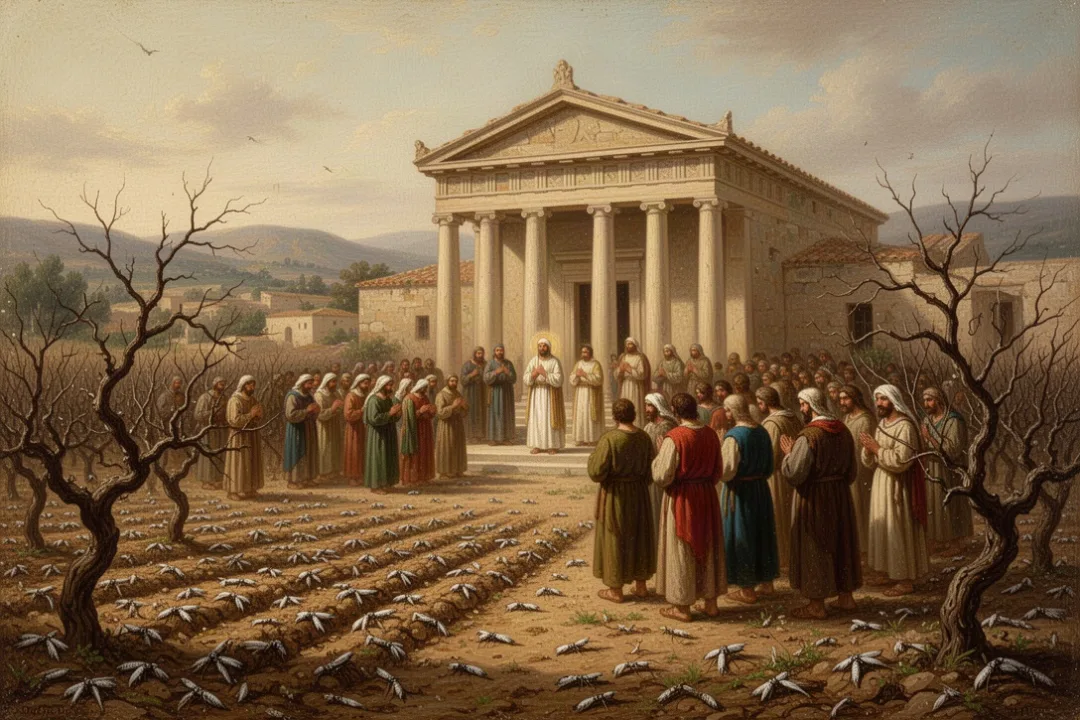
Joel opens by addressing a calamity that has affected the entire community. Swarms of locusts have consumed the land, stripping fields, vineyards, trees, and grain. The devastation has also damaged the food and drink offerings associated with worship, so the crisis is both economic and religious.
Joel does not treat the plague as a private inconvenience. He describes it as an event that touches older people, children, farmers, priests, and everyone who depends on the land. He tells the community to remember the disaster and pass the account to future generations, suggesting that its scale is extraordinary.
The opening imagery is vivid because Joel wants the people to recognize the seriousness of what has happened. Crops have failed, animals have no pasture, and normal celebrations have been interrupted. The language conveys a society whose ordinary sources of food, income, and worship have been shaken at the same time.
Farmers face the loss of grain, fruit, and future harvests.
Priests see the temple offerings reduced or stopped.
Families experience hunger and uncertainty.
The whole community is forced to consider its relationship with God.
The locusts may refer to a literal invasion, but Joel describes them with language that also resembles a military force. They advance in an organized way, overwhelm defenses, and leave destruction behind them. Some readers understand the locusts primarily as an actual plague; others see the imagery as pointing toward an approaching army or an end-time judgment. The text allows the natural disaster and its symbolic meaning to stand closely together.
The central movement: Joel does not present disaster as the final word. The plague creates an urgent summons to seek God, and that summons leads to promises of mercy and renewal.
Joel’s first response is not to offer a technical explanation of the insects. He calls for lament and communal action. The priests are told to gather the people, sanctify a fast, and call an assembly. This shows that biblical repentance in Joel is not merely an individual feeling; it involves the whole covenant community.
The disaster also introduces Joel’s use of the day of the Lord. In the Old Testament, this phrase can refer to a particular historical act of divine judgment, but it can also point toward a future and universal reckoning. In Joel, the locust plague is so frightening that it functions as a preview or warning of a greater day still to come.
Why Joel calls the people to return to God
After describing the devastation, Joel urges the people to return to God with all their hearts. The appeal emphasizes fasting, weeping, and mourning, but the prophet also makes clear that external actions are not enough. God seeks a genuine change of heart rather than a public performance of sorrow.
This is one of the book’s most important ideas: repentance means turning back to God. It includes grief over wrongdoing, but it is more than emotional distress caused by painful circumstances. Joel’s audience must recognize God’s authority, reject false security, and renew its dependence on him.
The prophet grounds this appeal in God’s character. He portrays God as gracious, compassionate, patient, and rich in faithful love. Joel also says that God may relent from sending calamity, not because the people can force his hand with religious gestures, but because divine mercy is part of who God is.
That does not mean Joel treats sin lightly. The urgency of his language shows that judgment is real and that the community cannot assume that religious identity will protect it from consequences. The appropriate response to crisis is neither denial nor despair. It is to seek God honestly and ask for mercy.
Joel calls for a sacred gathering that includes the elders, children, infants, newly married couples, priests, and the wider population. The list is deliberately broad. It pictures a community in which no age group and no social role is outside the need for repentance or the possibility of restoration.
Joel’s message is not simply “feel bad about the disaster”; it is “return to God, because his mercy is greater than your ruin.”
The priests are instructed to stand between the entryway and the altar and plead for God’s people. Their concern is not limited to private suffering. They fear that the nations may mock Judah and ask where its God is. In Joel, the community’s restoration matters because it concerns both God’s reputation and the well-being of his people.
For readers today, this section distinguishes repentance from bargaining. A person may turn toward God only because a crisis has become unbearable, but Joel presses beyond emergency relief. The deeper question is whether the crisis exposes misplaced trust, hardened habits, or an unwillingness to listen to God.
Joel does not give a formula promising that every disaster will immediately end after someone prays. Instead, he teaches that honest return to God is the proper response when people recognize their dependence and need. The promise rests in God’s compassion, not in a mechanical religious transaction.
What Joel promises after repentance and judgment
Joel’s message shifts from devastation to restoration. The land that has been stripped bare will again produce grain, wine, and oil. The promise answers the specific losses described at the beginning of the book: fields will recover, worship will be supplied, and the people will no longer live under the same shame.
The language of restoration is intentionally abundant. God promises to repay the years associated with the consuming locusts and to provide enough food for his people to be satisfied. The promise is not merely that Judah will survive. It is that the community will recognize God’s generous care and praise him for it.
Joel also promises that God’s people will no longer be a reproach among the nations. This addresses the shame created by devastation and by the question of whether Judah’s God can protect or restore his people. Their renewal becomes a public sign that God has not abandoned them.
Restoration in Joel includes more than improved circumstances. The people are brought back into a right relationship with God. The repeated emphasis on knowing that God is present among them shows that the central gift is not simply a successful harvest but the renewed presence of God.
Material restoration: crops, food, and agricultural productivity return.
Religious restoration: offerings and praise can again be brought before God.
Social restoration: shame and public disgrace are removed.
Relational restoration: the people know God as present among them.
These promises should not be reduced to a guarantee of personal wealth. Joel speaks to a covenant people recovering from a national crisis, and his language belongs to that setting. The broader principle is that God can bring renewal out of devastation, but the form and timing of that renewal are not presented as a simple promise of prosperity in every individual situation.
The section also contains a striking promise about God’s Spirit. Joel says that God will pour out his Spirit on all kinds of people: sons and daughters, older and younger people, and male and female servants. They will receive prophetic dreams, visions, and declarations.
This promise expands access to divine communication. God’s Spirit is not described as limited to a king, priest, or small group of recognized prophets. Age, gender, and social status do not exclude people from God’s promised spiritual activity.
The New Testament connects this passage with the events described at Pentecost in Acts 2. Peter explains the disciples’ experience through Joel’s prophecy, presenting the outpouring of the Spirit as part of God’s promised work in the last days. Christians therefore often read Joel 2:28-32 as an important anticipation of the Holy Spirit’s public and widespread activity.
Joel’s prophecy also mentions cosmic signs before the day of the Lord: changes involving the sun, moon, and sky. The point is not to provide a timetable for predicting dates. The imagery communicates that God’s decisive intervention will affect the whole created order and will not be a minor local event.
Read the restoration carefully: Joel joins physical renewal with spiritual renewal. The promise includes food and fruitful land, but it reaches its climax in God’s presence and the outpouring of his Spirit.
What “the day of the Lord” means in the book of Joel
The phrase the day of the Lord appears repeatedly in Joel and provides the book’s main structure. It describes a time when God acts with unusual directness in judgment and salvation. The day is frightening for those who oppose God, yet it offers refuge to those who call on him.
At the start of the book, Joel asks whether the locust disaster is already a day of the Lord or a warning that a greater day is approaching. The invading creatures are described in such overwhelming terms that the natural crisis becomes a picture of an even more severe reckoning.
The day of the Lord is therefore both near and future in Joel’s presentation. It is near because the people are already experiencing a crisis that demands a response. It is future because the prophet later describes cosmic signs, deliverance in Zion, and judgment among the nations.
This pattern appears elsewhere in the prophetic books. A historical event can serve as a smaller example of God’s final justice. Joel uses the immediate plague to awaken the people, then broadens the vision so that the whole world comes under God’s authority.
Joel says that everyone who calls on the Lord’s name will be saved. In context, this promise is connected with deliverance in Zion and Jerusalem, but the wording is broad enough to stress God’s willingness to rescue those who seek him. Acts 2 quotes and applies this part of Joel’s prophecy in its explanation of the gospel and the Spirit’s coming.
The promise of refuge does not remove the seriousness of judgment. Joel’s message is not that everyone will automatically be safe regardless of how they respond. It is that God provides a real place of refuge for those who turn to him, even when the surrounding circumstances are terrifying.
Readers sometimes use Joel’s images to calculate the date of the end of the world. The book does not authorize that approach. Its purpose is ethical and spiritual: it urges people to recognize God’s authority, repent, remain faithful, and trust his promise of salvation rather than satisfy curiosity about a calendar.
How Joel describes judgment on the nations and hope for God’s people
The final major movement of Joel focuses on the nations that have harmed or exploited Judah. The prophet describes God gathering the nations for judgment in the valley associated with Jehoshaphat. The name can be understood as connected with the idea that God judges, while the passage’s main concern is the certainty and fairness of divine judgment.
The nations are accused of treating God’s people as merchandise, scattering them, taking people captive, and profaning what belongs to God. Joel does not present international violence as morally neutral. Political power, military success, and economic gain do not place nations beyond accountability.
The imagery of a harvest returns, but its meaning changes. Earlier, the harvest represented food and restoration; now it pictures the gathering of nations for judgment. The language of an overflowing winepress communicates that evil has reached its appointed limit and that God will act against it.
Joel also uses cosmic imagery to portray the day of judgment. The sun and moon become dark, and the stars lose their brightness. This language is not meant to function like a modern scientific report. It signals a world-changing event in which ordinary structures of security and power are brought under God’s rule.
At the same time, Joel portrays God as a refuge for his people and a stronghold for Israel. The closing vision describes Jerusalem as secure and the land as fruitful. A spring flows from the house of the Lord, symbolizing life and blessing coming from God’s presence.
The ending holds together two truths that Joel refuses to separate:
God judges oppression and violence, even when powerful nations appear untouchable.
God protects and restores his people, giving them life, holiness, and a secure relationship with him.
Joel’s final emphasis is not on national pride or revenge. The desired outcome is that people will know the Lord is their God, present in Zion. The hope of the book is therefore theological before it is political: God is faithful, evil will not have the last word, and his people will not be abandoned.
How to read Joel’s message today
Joel speaks especially clearly to communities facing loss. Its opening scenes recognize that disasters can affect food, work, worship, family life, and public confidence all at once. The book does not pretend that pain is small, and it does not rush past grief to offer a shallow positive message.
At the same time, Joel warns against interpreting every hardship with certainty. The prophet’s message belongs to a particular covenant setting, and modern readers should be cautious about claiming that a specific earthquake, storm, recession, illness, or political event is definitely a divine judgment. Joel invites serious reflection without giving permission for careless pronouncements.
The book offers several durable lessons. God’s mercy is a reason to repent, not an excuse to delay. Public worship matters, but outward ceremony must be joined to an honest heart. Restoration may involve practical needs, yet the deepest restoration is renewed fellowship with God.
Joel also gives dignity to people who might otherwise be overlooked. The promise of the Spirit includes young and old, women and men, and people from low social positions. In the book’s vision of God’s future, divine activity is not restricted to an elite class.
For Christians, Joel has a particularly strong connection with Acts 2. The early church understood the Spirit’s arrival at Pentecost in light of Joel’s promise. That connection makes Joel important for understanding the biblical pattern in which God brings salvation, pours out his Spirit, and calls people from every background to respond.
A careful reading can follow this sequence:
Observe the crisis: identify what the locust plague destroys and how widely it affects the community.
Listen to the summons: notice Joel’s repeated calls to gather, fast, mourn, and return to God.
Study the promise: trace the movement from restored land to restored worship and the outpouring of the Spirit.
Consider the day of the Lord: distinguish immediate warning from future judgment without trying to set dates.
Read the ending: see how judgment on the nations and refuge for God’s people complete the book’s message.
So, what is the book of Joel about? It is about a people awakened by catastrophe and called back to God. It announces that the day of the Lord brings judgment, but it also promises that those who turn to God will find mercy, restoration, refuge, and the life-giving presence of his Spirit.
Frequently asked questions
Is the locust plague in Joel literal or symbolic?
Joel may be describing a real locust invasion while also using it as a picture of a larger judgment. The text emphasizes the physical destruction of crops, but its military imagery and connection with the day of the Lord give the disaster symbolic force. It is best to recognize both dimensions rather than insisting that it must be only literal or only figurative.
Was Joel written before or after the Babylonian exile?
The book does not identify its date clearly, and scholars propose different periods. Joel names no king and provides few historical markers, so a precise date cannot be established with confidence. The book’s central message does not depend on settling that question: it addresses communal disaster, repentance, restoration, and God’s judgment of the nations.
What does Joel say about the Holy Spirit?
Joel promises a future time when God will pour out his Spirit broadly across the community. Sons and daughters, older and younger people, and male and female servants will receive spiritual revelation. Acts 2 uses this promise to interpret the Spirit’s coming at Pentecost, making Joel an important Old Testament passage for Christian teaching about the Holy Spirit.
What is the main lesson of Joel?
Joel teaches that disaster should lead people to seek God sincerely rather than rely on outward religious behavior or human security. It also insists that judgment and hope belong together: God opposes evil, yet offers mercy, restoration, refuge, and renewed spiritual life to those who turn to him.







Leave a Reply