Lamentations Bible study: grief, judgment, and hope
Lamentations Bible study: grief, judgment, and hope
A helpful Lamentations Bible study should hold two truths together: Jerusalem’s destruction was devastating, and faith can still speak honestly in the middle of devastation. The book gives you language for grief, examines the consequences of rebellion and violence, and points toward God’s mercy without pretending that suffering is easy.
Read Lamentations slowly, preferably one chapter at a time. Pay attention to who is speaking, what has been lost, how the people understand the catastrophe, and where the poems turn toward God. The book is not a quick explanation of suffering; it is a carefully shaped collection of prayers and laments from the aftermath of Jerusalem’s fall.
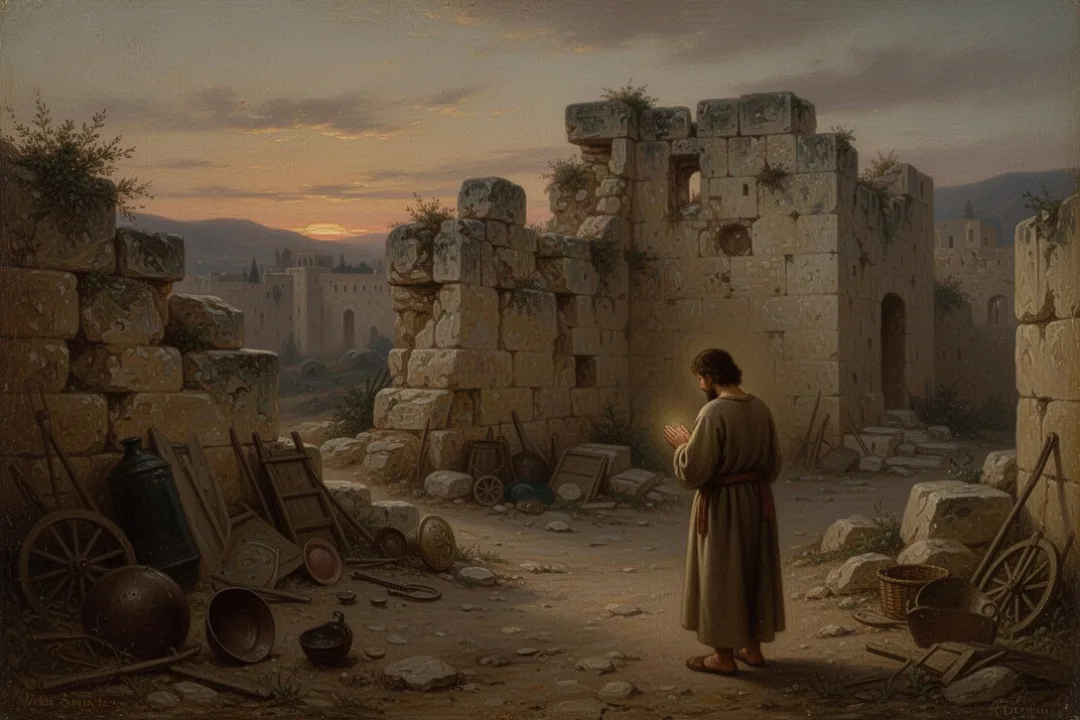
Lamentations reflects the destruction of Jerusalem and the temple by the Babylonian army in the sixth century BC. The city had been besieged, conquered, and left in ruins. Many people died, others were taken into exile, and the survivors faced hunger, displacement, political collapse, and the loss of the place where they had worshiped God.
The book does not name its author. Jewish and Christian traditions have often connected it with Jeremiah, the prophet who warned Jerusalem before its fall and witnessed the surrounding crisis. The Hebrew text itself is anonymous, so it is best to describe Jeremiah as a traditional association rather than an established fact.
Lamentations belongs with the Bible’s wisdom about grief because it does more than record historical events. It gives poetic form to communal sorrow. The speakers mourn a city, a people, a sanctuary, a social order, and the apparent withdrawal of God’s protection. Their grief is personal, public, theological, and political at the same time.
The poems assume that Jerusalem’s disaster did not happen without warning. Earlier prophetic books describe persistent injustice, idolatry, oppression, and refusal to listen to God. Lamentations therefore speaks about judgment as well as pain. Yet judgment does not make suffering emotionally simple. The poems still describe starvation, humiliation, bereavement, and fear with disturbing directness.
Reading principle: Do not treat Lamentations as a denial of suffering or as a simple formula for explaining every tragedy. It is a faithful act of grief that asks hard questions while remaining turned toward God.
The book also helps modern readers distinguish between recognizing moral consequences and blaming victims. Lamentations reflects an ancient covenant framework in which the community understands national disaster in relation to its relationship with God. That perspective should not be used carelessly to claim that a particular person’s illness, loss, or disaster proves personal guilt.
How the five chapters are organized
Lamentations contains five poems, one for each chapter. Their poetic design gives order to experiences that feel chaotic. Several chapters use an alphabetic acrostic, with lines beginning according to the sequence of the Hebrew alphabet. In the original language, this structure creates a sense of completeness: the poets are expressing grief from beginning to end.
Chapter 1 presents a deserted city
The first poem portrays Jerusalem as a woman sitting alone after the city’s collapse. She once had prominence, population, and dignity; now she is isolated, dishonored, and surrounded by enemies. The image of a personified city allows the poem to move between public destruction and intimate sorrow.
Chapter 1 also draws attention to the absence of comfort. Jerusalem’s friends and allies have failed her, and her inhabitants have been carried away. The city speaks of her distress before God, asking that her suffering be seen rather than ignored.
The chapter includes confession of wrongdoing, but it does not reduce the entire poem to confession. The city is both a guilty community under judgment and a suffering community in need of compassion. That tension is central to the book’s honesty.
Chapter 2 describes divine judgment and social collapse
The second poem focuses more directly on God’s action in the catastrophe. It uses strong images to describe the destruction of the city, its defenses, its worship, and its leadership. The language is difficult because the poem refuses to portray the event as merely a political defeat; it interprets the disaster as an act permitted or carried out within divine judgment.
At the same time, the poem depicts children fainting from hunger, mothers overwhelmed by desperation, and prophets failing to provide a truthful vision. The suffering of ordinary people remains visible. The poem closes with an appeal for God to notice the anguish and respond.
Chapter 3 gives one sufferer a voice
Chapter 3 is the longest and most personal poem. A single speaker describes affliction, confinement, fear, and the feeling of being shut away from peace. His words show what it is like when suffering seems to shape every part of a person’s identity.
In the middle of this darkness, the speaker deliberately calls something to mind: God’s steadfast love and compassion have not come to an end. The famous hope of this chapter does not erase the preceding pain. It appears inside the lament, as an act of memory and trust when visible circumstances offer little reassurance.
The speaker then waits quietly for God’s salvation and urges the community to examine its ways. He also appeals to God as the one who sees injustice and pleads for judgment against persecutors. Hope in Lamentations is therefore not passive optimism. It includes waiting, self-examination, prayer, and confidence that evil does not escape God’s notice.
Chapter 4 contrasts former honor with present hunger
The fourth poem compares Jerusalem’s earlier splendor with its current degradation. People who once lived with privilege now face hunger and humiliation. Leaders, nobles, and children all appear in the poem, showing how completely the city’s social world has been overturned.
The chapter makes clear that the siege created conditions of extreme deprivation. Its images are painful because they show how war attacks the bonds that normally protect family and community. The poem also criticizes leaders and religious figures who failed in their responsibilities.
Chapter 5 becomes a communal prayer
The final chapter changes the formal pattern. It contains the same number of lines as the Hebrew alphabet but does not follow the alphabetic sequence. That disruption may fit the poem’s emotional movement: the people are still praying, but the world they knew has lost its former order.
The community asks God to remember what has happened. It names loss of land, power, dignity, labor, and security. The prayer ends by appealing to God’s enduring kingship while also asking for restoration. The ending is not a neatly resolved celebration. It leaves the reader with dependence, uncertainty, and a request for renewal.
Chapter 1: Jerusalem mourns as a deserted and dishonored city.
Chapter 2: The poem interprets destruction as judgment and cries for God’s attention.
Chapter 3: An afflicted speaker moves from despair toward remembered mercy.
Chapter 4: The city’s former glory is contrasted with hunger and humiliation.
Chapter 5: The surviving community prays for remembrance and restoration.
The major themes to trace during study
Lament gives grief a faithful vocabulary
Lament is not the same as complaining without purpose. In Scripture, lament usually brings pain directly before God. It names what happened, describes how the sufferer feels, asks questions, confesses what needs to be confessed, and requests divine action.
Lamentations gives permission to say that suffering is unbearable, that God seems distant, and that injustice must be addressed. The speakers do not protect God from difficult questions by pretending to feel peaceful. Their prayers show that honest sorrow can remain an expression of faith.
This matters for personal and communal prayer. People grieving a death, war, abuse, displacement, or prolonged illness may not be helped by quick religious explanations. Lamentations offers a different response: sit with the truth, speak it carefully, and continue directing the words toward God.
Judgment and responsibility are taken seriously
Lamentations does not present Jerusalem’s fall as random. The poems acknowledge that the community has sinned and that its leaders have failed. This recognition distinguishes biblical lament from a version of grief that refuses every question of responsibility.
Still, the book does not encourage shallow accusations. Its references to guilt belong to a specific historical and covenant setting. They cannot be turned into a universal rule that every suffering person is receiving punishment for a particular sin.
During study, ask two separate questions: What does the text say about Jerusalem’s responsibility? And what does the text say about God’s response to people who suffer within that judgment? Keeping those questions separate prevents moral reflection from becoming cruelty toward the wounded.
God’s presence can feel hidden
One of Lamentations’ hardest features is the way it speaks about God as the source or agent of destruction. The book does not offer a sentimental picture of divine activity. It wrestles with the belief that Jerusalem’s defeat occurred under God’s sovereignty, even while the survivors experienced abandonment.
That tension appears throughout the Bible. God’s people can confess divine rule and still ask why God is silent. Lamentations does not resolve the tension by giving a complete explanation. Instead, it shows a community bringing its confusion to the God it still addresses.
Chapter 3’s movement toward hope should therefore be read carefully. The speaker remembers God’s compassion, but he does not claim that the ruins are imaginary. Hope grows alongside grief, not by pretending grief has disappeared.
Memory becomes an act of resistance
The poems preserve memories that might otherwise be ignored: hunger, violence, shame, abandoned worship, broken leadership, and the suffering of children. Naming these realities resists both denial and historical amnesia.
The repeated appeals for God to remember do not suggest that God lacks information. They ask God to act on behalf of people whose lives appear forgotten. For the community, prayer becomes a way of declaring that its losses matter and that injustice should not have the final word.
Hope rests on God’s character
The central hope of Lamentations is not based on favorable circumstances. The city has not yet been rebuilt when the speaker remembers God’s mercy. The people do not possess political security when they appeal to God’s faithfulness. Their confidence rests on who God is.
That hope includes several convictions: God’s compassion is not exhausted, God remains attentive to injustice, God’s judgment is not arbitrary, and restoration can still be requested. The poems do not promise an immediate change in circumstances, but they keep prayer possible.
A useful distinction: Biblical hope is not the demand that you feel positive. It is the choice to address God truthfully while refusing to declare that suffering, injustice, or death has ultimate authority.
Questions for a careful Lamentations Bible study
Good study questions should draw you into the text rather than push you toward a predetermined answer. Begin by observing repeated words, images, speakers, and changes in tone. Then consider how each poem understands the relationship between the city’s sin, its suffering, and God’s character.
Who is speaking? Is the voice an individual, the city, the community, or an observer? Does the speaker’s perspective change?
What has been lost? List the losses involving people, worship, food, land, leadership, reputation, and security.
Where does the poem address God? Note whether the prayer asks for comfort, remembrance, justice, forgiveness, restoration, or judgment.
How does the poem describe responsibility? Distinguish the failures of the people, rulers, prophets, enemies, and other groups.
Where does the emotional tone change? Look for movement from description to confession, from accusation to petition, or from despair to hope.
What remains unresolved? Avoid forcing an ending that the poem itself does not provide.
Pay attention to the book’s use of poetic imagery. Jerusalem is portrayed as a widow, a grieving mother, and a person whose suffering is publicly visible. These images are not decorative. They help readers feel the social and emotional dimensions of a national catastrophe.
Notice also the role of hunger. Food insecurity appears not as a minor hardship but as a sign that the city’s basic structures have failed. Hunger exposes the vulnerability of children, the desperation of parents, and the collapse of normal moral expectations.
Another useful observation concerns the city’s relationships. Allies disappoint Jerusalem, enemies exploit her weakness, leaders fail to protect the people, and survivors feel abandoned. The book shows that disaster damages trust as well as buildings. A study that focuses only on theology may miss this important account of social breakdown.
Compare the five chapters without treating them as interchangeable. Chapter 1 emphasizes the city’s isolation. Chapter 2 stresses judgment and destruction. Chapter 3 offers an individual voice and the clearest movement toward hope. Chapter 4 examines the human cost of siege and failed leadership. Chapter 5 gathers the survivors into a prayer that remains unresolved.
A practical plan for reading Lamentations today
You can study the book in five days or read it in one sitting before returning to each chapter. Since the poems are short compared with many biblical books, a slow pace is more helpful than trying to cover a large amount of material. Read from more than one reliable translation if possible, especially where poetic images or repeated terms are difficult.
Read one chapter aloud. Hearing the poetry can make repetition, rhythm, and emotional shifts easier to notice.
Mark the losses. Write down each person, place, practice, or source of security that has been removed.
Circle the direct addresses to God. Observe what the speakers ask God to see, remember, forgive, judge, or restore.
Separate observation from interpretation. First record what the poem says; then consider what it may mean.
Read the surrounding historical books. Jeremiah and 2 Kings provide context for Jerusalem’s fall, though they should not replace close reading of Lamentations itself.
End with a truthful prayer. Include grief, confession where appropriate, requests for justice, and any hope you can honestly express.
For group study, invite participants to name the emotional effect of a passage before asking them to explain it. Someone may notice fear, anger, shame, numbness, or compassion. Such responses can open careful conversation about how biblical poetry communicates experiences that ordinary explanations cannot contain.
Leaders should avoid pressuring grieving people to identify a hidden sin or produce immediate optimism. Lamentations allows extended sorrow. A group can honor that pattern by listening without interrupting, refusing simplistic blame, and allowing silence when the text evokes pain.
The book can also shape prayers for communities affected by war, natural disaster, displacement, abuse, or institutional failure. Use its themes responsibly: pray for those who suffer, confess communal wrongdoing when it is real, ask for protection and justice, and seek practical ways to support people whose needs are visible.
For Christian readers, Lamentations may be read alongside the wider biblical witness about suffering, mercy, judgment, and redemption. For Jewish readers and others, it remains a profound collection of communal mourning rooted in the destruction of Jerusalem. In either setting, its value lies partly in its refusal to make grief tidy.
What Lamentations teaches about hope and prayer
Lamentations teaches that prayer does not require emotional certainty. The speakers can accuse, confess, plead, remember, and wait. Their faith is not measured by how calm they sound but by the fact that they continue to bring the crisis before God.
It also teaches that hope may be fragile. The movement in chapter 3 toward God’s compassion is real, but the book does not end with every question answered. The final prayer still asks God to restore the people. Unfinished prayer is still prayer, and incomplete hope is still different from despair.
The book’s treatment of justice is equally significant. It refuses to separate spiritual life from public suffering. Broken walls, failed leaders, hunger, violence, exile, and worship all belong in the community’s prayer. Faithful response therefore includes concern for people’s physical safety, social dignity, and material needs.
Finally, Lamentations teaches that remembering mercy does not dishonor those who are hurting. The speaker in chapter 3 does not move from grief to easy cheerfulness. He chooses to remember God’s character precisely because his circumstances are so bleak. That movement can guide your own prayer: tell the truth about the ruins, then ask what remains true about God.
Frequently asked questions
Who wrote the book of Lamentations?
The book does not identify its author by name. Jewish and Christian tradition has often associated it with Jeremiah because of his ministry before and during Jerusalem’s destruction, but the Hebrew text does not establish that attribution. A careful study can acknowledge the traditional connection while treating the authorship as uncertain.
Why is Lamentations so painful to read?
Lamentations describes war, starvation, death, exile, shame, and the collapse of family and community life. Its poetry is intentionally direct because it preserves the experience of survivors rather than softening it. The difficult language can help readers recognize that biblical faith makes room for trauma, anger, grief, and questions about God.
What is the main message of Lamentations 3?
Lamentations 3 shows an afflicted person speaking honestly about suffering before deliberately remembering God’s compassion and faithfulness. Its hope does not deny the ruins or promise instant restoration. Instead, it teaches that trust may arise through recalling God’s character, waiting for mercy, seeking justice, and continuing to pray.
How should Christians apply Lamentations to personal suffering?
Apply it first by allowing honest lament rather than demanding quick positivity. You can name losses, ask God to see injustice, confess personal or communal wrongdoing when appropriate, and remember God’s mercy without blaming yourself for every hardship. The book also encourages practical compassion for people facing grief, displacement, poverty, violence, or institutional failure.







Leave a Reply