Matthew 25:31-46 commentary: The sheep and the goats
Matthew 25:31-46 commentary: The sheep and the goats
Matthew 25:31-46 presents the final judgment as a scene in which the Son of Man comes in glory, gathers the nations, and separates people as a shepherd separates sheep from goats. The passage’s central message is that mercy toward people in need reveals how a person has responded to Christ. Jesus identifies himself with the hungry, thirsty, displaced, poorly clothed, sick, and imprisoned.
The passage does not treat compassion as a minor virtue or an optional expression of faith. It makes practical love a decisive sign of belonging to the King. At the same time, Christians interpret the relationship between salvation, faith, and good works in different ways, so the passage should be read alongside the wider teaching of the New Testament rather than used as an isolated formula.
Jesus describes the Son of Man arriving with the glory and authority associated with a king. He is accompanied by angels and sits on his throne, signaling that the scene concerns universal judgment, not a private evaluation of one group. All nations are gathered before him, and he divides them into two groups.
The first group is compared with sheep, animals commonly associated with the shepherd’s flock. They are placed at the king’s right hand, a position representing approval and honor. The second group is compared with goats and placed at his left. The imagery is simple, but the outcome is permanent and severe.
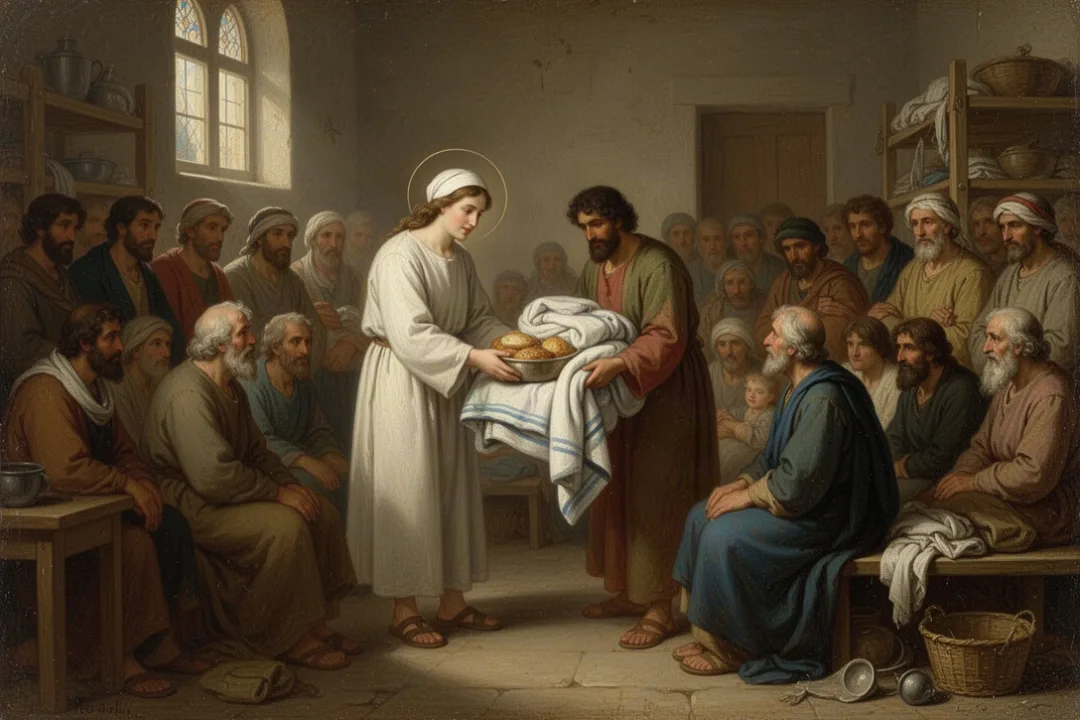
The king welcomes those at his right hand into the kingdom prepared for them. His reason is expressed through a series of ordinary acts: they fed him when he was hungry, gave him drink when he was thirsty, welcomed him as a stranger, clothed him, cared for him when he was sick, and visited him in prison.
The righteous are surprised. They do not remember seeing the king in those conditions, so they ask when they performed these acts for him. The king answers that whatever they did for one of the least of his brothers and sisters, they did for him.
The people at the left hand receive the opposite verdict. Their failure is not described as violence or dramatic rebellion. They simply did not provide mercy when they encountered human need. They also ask when they saw the king hungry, thirsty, displaced, poorly clothed, sick, or imprisoned, and the answer is that their neglect of the least was neglect of him.
The passage ends with two contrasting destinations: one group enters eternal life, while the other faces eternal punishment. The language underscores the seriousness of moral response and the finality of God’s judgment.
Central idea: In Matthew 25, service to vulnerable people is not merely service performed for someone else. Jesus presents it as a response made directly to him.
Why Jesus uses sheep, goats, and a shepherd
The image of a shepherd separating sheep from goats would have been familiar in an agricultural society. Sheep and goats could graze together, yet they were not identical animals and might be separated for practical reasons. That everyday picture gives Jesus a vivid way to describe a distinction that may not be obvious before judgment.
The comparison also fits the larger biblical use of shepherd imagery. Israel’s Scriptures often portray God as the shepherd of his people and criticize leaders who exploit or neglect those entrusted to their care. Jesus’ scene draws on that background while presenting himself as the authoritative judge.
The king’s identity is crucial. He does not merely reward people for being generally pleasant or charitable. The acts of mercy matter because the king has made himself present among the vulnerable. By associating himself with them, Jesus gives their treatment a significance that reaches beyond social respectability or public reputation.
The sheep and goats should not be reduced to personality types. The passage is not teaching that some people are naturally gentle while others are naturally difficult. The separation concerns how people respond to need and what that response discloses about their relationship to the king.
The two groups are also surprised by the judgment. The righteous do not present a list of achievements and claim credit. The condemned do not defend themselves by pointing to an openly hostile campaign against the poor. Both groups discover that their daily conduct carried a deeper meaning than they understood.
What “the least of these” means
The phrase commonly translated as “the least of these” has received several interpretations. Some readers understand it as a broad reference to any person experiencing serious need. Others argue that “my brothers and sisters” points particularly to Jesus’ disciples, missionaries, or representatives who suffer because of their allegiance to him.
The immediate list includes basic human vulnerabilities: hunger, thirst, displacement, inadequate clothing, illness, and imprisonment. That list naturally supports an application to people who lack essential care. It also echoes Jesus’ wider concern for marginalized people, outsiders, and those who are easily ignored.
The possible reference to Jesus’ brothers or sisters should not be dismissed. Matthew sometimes uses family language for those who do God’s will or belong to Jesus’ community. In that reading, nations are judged partly by how they receive Christ’s messengers and vulnerable followers.
Even so, a narrower interpretation should not be used to avoid compassion for other suffering people. The passage clearly establishes that vulnerable human beings must not be treated as invisible. Whether one emphasizes disciples in particular or needy people more generally, the ethical force remains: those who claim to honor Jesus must take concrete responsibility for people in distress.
Several features help guide a careful reading:
The needs are physical and social: food, water, clothing, welcome, medical care, and visitation are practical forms of love.
The people are dependent or exposed: illness, imprisonment, displacement, and poverty can remove a person’s social power.
The acts are personal: the passage speaks of seeing, visiting, welcoming, feeding, and giving rather than merely approving good policies in theory.
The king identifies with the vulnerable: the person in need is not an interruption to spiritual life but a place where loyalty to Jesus becomes visible.
This does not mean every need can be solved by one individual. Wise compassion may involve churches, charities, public services, medical professionals, legal advocates, and trusted community organizations. The command is not reckless involvement; it is a refusal to let convenience or indifference define your response.
How mercy relates to faith and salvation
One of the most difficult questions in Matthew 25:31-46 is whether people are accepted by God because of their acts of mercy. The righteous are welcomed because they cared for those in need, while the other group is condemned because it did not. That emphasis must be taken seriously rather than softened into a vague appeal to kindness.
At the same time, the passage should be read with Jesus’ broader teaching and the New Testament’s wider witness. Scripture also presents salvation as God’s gracious work, calls people to trust Christ, and describes good works as the fruit of a transformed life. Christian traditions explain the relationship in different terms, but many agree that genuine faith cannot remain indifferent to suffering.
A useful distinction is between the basis of salvation and the evidence of allegiance. Matthew 25 focuses on the evidence revealed at judgment. The acts of mercy do not function as a public relations campaign designed to persuade the king. They expose whether a person’s life has been oriented toward the king’s values.
The righteous are not portrayed as purchasing the kingdom through charitable transactions. They act naturally enough that they do not recognize their service as a way of earning status. Their mercy appears to flow from an identity already aligned with God’s purposes.
The goats, by contrast, may not think of themselves as cruel. Their failure is passive, but it is still morally serious. They see—or could have seen—human need and choose not to respond. In this passage, indifference is not morally neutral when help is possible and the vulnerable are being neglected.
That warning challenges several shallow approaches to religion. A person may speak correctly about Jesus, participate in religious activities, or hold respected beliefs while remaining unmoved by suffering. Matthew 25 insists that devotion must become visible in the way people use their time, possessions, attention, and influence.
Important balance: Matthew 25 does not encourage people to earn God’s favor through isolated charitable acts. It calls for a life whose allegiance to Christ is demonstrated through consistent, costly, and practical mercy.
What Matthew 25:31-46 teaches about Christian responsibility
The passage makes compassion concrete. It does not leave mercy at the level of warm feelings or general concern. Feeding the hungry, welcoming the stranger, clothing the poorly equipped, caring for the sick, and visiting prisoners all require attention to actual people and actual conditions.
That practical emphasis can shape both personal habits and church life. A congregation may ask whether its programs serve people who are easy to welcome or those whose needs are more complicated. Individuals may consider whom they regularly overlook: a lonely neighbor, a struggling family, an immigrant with limited support, a hospitalized person, or someone returning from incarceration.
Care must also be offered with dignity. The people described in the passage are not projects whose value depends on their usefulness, gratitude, or ability to improve quickly. Because Jesus identifies himself with them, they must be treated as persons worthy of respect, not as problems to manage.
Practical obedience can include many forms:
Providing food, water, clothing, transportation, or emergency assistance when someone lacks basic necessities.
Supporting trustworthy ministries that serve people experiencing homelessness, poverty, illness, migration, or incarceration.
Visiting or contacting people who are isolated because of illness, age, imprisonment, or displacement.
Learning how local systems work so that compassion includes appropriate referrals, advocacy, and follow-through.
Examining personal habits of consumption, prejudice, and convenience that may contribute to the neglect of vulnerable people.
Not every person can meet every need. Healthy service includes boundaries, discernment, and cooperation. You can show mercy without pretending to be a doctor, counselor, lawyer, social worker, or emergency responder. Sometimes the most responsible action is to connect a person with qualified help and remain present rather than making promises you cannot keep.
The passage also raises questions about structural responsibility. Matthew 25 describes direct encounters, but the needs it names can be intensified by unjust systems, exploitation, war, discrimination, unaffordable care, and lack of housing. Personal kindness and public responsibility should not be treated as enemies. Mercy may require both immediate help and sustained work for conditions that reduce preventable suffering.
How the passage fits Matthew 24–25
Matthew 25:31-46 comes after two parables about readiness: the wise and foolish bridesmaids and the servants entrusted with talents. Those passages address waiting for the master’s return and using what has been entrusted wisely. The sheep-and-goats scene brings that teaching into a final courtroom setting.
The surrounding chapters focus on the coming of the Son of Man, the uncertainty of the timing, and the need for faithful conduct while waiting. Jesus does not tell his followers to calculate the date or withdraw from ordinary responsibility. He tells them to remain watchful, dependable, and compassionate.
The three sections together correct different forms of unfaithfulness. The foolish bridesmaids are unprepared. The unfaithful servant treats the master’s absence as permission for neglect. The goats fail to recognize the king in people who need care. In each case, the problem is not a lack of information alone; it is a failure to live according to the master’s character.
This context explains why the passage is more than a general lesson about generosity. It concerns readiness for Christ’s return. Faithful waiting is active rather than passive. It includes responsible stewardship, perseverance, and attention to people whom society can ignore.
The passage also prevents a narrow definition of spiritual success. A person may desire dramatic signs of faith, but Jesus points to ordinary actions that are easy to overlook: a meal, a drink, a welcome, a garment, a visit, or sustained care. These actions may appear small to observers while carrying great significance before God.
Questions the passage raises for readers today
Matthew 25:31-46 asks more than whether you occasionally perform a generous act. It asks what your patterns reveal about the kind of person you are becoming. Do you notice suffering only when it is visible and convenient, or do you make room in your life for people whose needs are persistent and difficult?
It also asks how you define “neighbor.” The vulnerable people in the passage are not described as members of a preferred social group. They are identified by their circumstances. Their need comes before their status, background, political opinions, or ability to repay the kindness.
Another question concerns attention. Modern life can expose you to an overwhelming number of crises, and constant exposure can lead to helplessness or compassion fatigue. The answer is not to attempt everything. Choose specific, sustainable practices of mercy, share responsibility with others, and keep real people rather than abstract causes at the center.
The passage finally asks whether your view of Jesus includes the people he places before you. Christian service is not a way to gain superiority over those receiving help. It is a meeting with people whom the King honors. That perspective can produce humility, patience, and respect alongside generosity.
A faithful response may begin with a modest but definite plan:
Identify one area of need in your community that you can understand and address responsibly.
Learn from people directly affected rather than relying only on assumptions or distant commentary.
Choose a practical action you can sustain, such as regular volunteering, giving, visiting, or advocacy.
Work with trusted organizations and accept guidance from people with relevant training.
Review your motives and methods so that your help protects dignity and does not create unnecessary dependence or harm.
Matthew 25 does not permit a comfortable separation between loving Christ and responding to vulnerable people. The King is encountered where need is real, mercy is costly, and the overlooked person stands before you. His judgment exposes whether your faith has become a life of attentive love.
Frequently asked questions
Is Matthew 25:31-46 teaching salvation by good works?
The passage places unmistakable weight on acts of mercy, but it should not be isolated from the Bible’s teaching about God’s grace and faith. Many Christian interpreters understand the deeds as evidence of genuine allegiance rather than payments that purchase salvation. The text’s warning is that a claimed relationship with Christ is empty when it produces no practical concern for vulnerable people.
Who are “the least of these” in Matthew 25?
Christians and scholars differ. Some understand the phrase broadly as people facing hunger, displacement, illness, poverty, or imprisonment. Others emphasize Jesus’ disciples or representatives who suffer because of their mission. Both readings recognize that Jesus identifies himself with people who are vulnerable and insists that they must not be ignored or treated without dignity.
Does this passage require Christians to help every person who asks?
It calls Christians to active compassion, not to unlimited or unsafe availability. Responsible help can include direct assistance, referral to qualified services, financial support, advocacy, and partnership with established organizations. Boundaries and discernment are compatible with mercy. The central issue is whether inconvenience, prejudice, or indifference has become an excuse for refusing all responsibility.
Why are the righteous surprised by their acts of service?
Their surprise suggests that they were not performing mercy as a calculated way to impress the king. Their actions had become part of their character and daily faithfulness. The scene also reveals that people may underestimate the spiritual significance of ordinary kindness. Jesus teaches that care given to vulnerable people is recognized by him, even when no public reward follows.











Leave a Reply