Philemon summary: purpose, context, and main themes
Philemon summary: purpose, context, and main themes
Have you ever needed to repair a relationship after someone caused serious trouble, but the right response involved more than simply saying “forgive”? Philemon presents that kind of situation in a short personal letter from Paul. Its central request is that Philemon welcome Onesimus, a formerly enslaved man who had become connected with Paul, not merely as property or a subordinate, but as a beloved brother in Christ.
The letter is only 25 verses long, yet it raises difficult questions about authority, debt, reconciliation, social status, and Christian responsibility. A useful Philemon summary must therefore do more than retell the plot. It should explain who the people are, why Paul writes, what he asks Philemon to do, and how the letter’s message relates to slavery and human dignity.
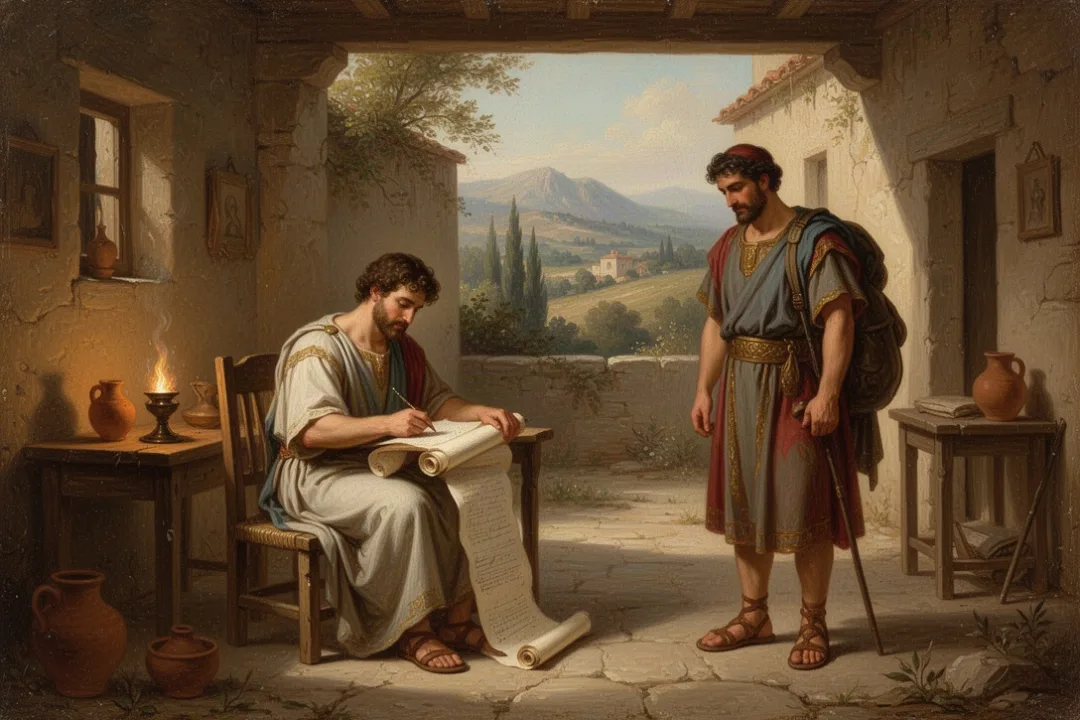
Philemon is traditionally understood as a letter written by the apostle Paul, with Timothy mentioned alongside him at the opening. Paul writes while imprisoned, although the letter does not identify the exact location. Scholars have proposed several settings, including Rome, Caesarea, and Ephesus, so it is safer to focus on the letter’s stated circumstances rather than insist on one location.
The recipient is Philemon, a Christian whom Paul describes as a fellow worker. The greeting also names Apphia and Archippus, along with the church meeting in Philemon’s home. This suggests that the letter was personal but not entirely private. Paul addresses a household and a Christian community that could observe, influence, and perhaps participate in the response to Onesimus.
Onesimus is the person at the heart of the letter. He is described as someone who had previously been “useless” to Philemon but had become useful to both Philemon and Paul. The wording may involve a play on Onesimus’s name, which is related to the idea of being useful, but the more important point is the change in his relationship with Paul and his identity within the Christian community.
The letter does not spell out every detail of what happened. Onesimus may have run away, may have caused financial loss, or may have become separated from Philemon under circumstances the text leaves unstated. Paul refers to a possible debt and asks Philemon to charge it to him, but readers should avoid treating uncertain details as established facts.
Central idea: Paul asks Philemon to receive Onesimus with the same welcome he would give Paul. The request turns a private conflict into a test of whether Christian faith changes relationships involving power, status, and debt.
Paul’s purpose is not to write a general teaching document about church administration. It is a carefully worded appeal on behalf of one person. Yet the personal nature of the letter makes its ethical force stronger: the gospel is being applied to a real relationship with legal, economic, and social consequences.
What happens in the letter to Philemon
The letter begins with a greeting and a prayer of thanksgiving. Paul praises Philemon’s love and faith, especially his care for fellow believers. This opening is more than polite encouragement. By reminding Philemon of the qualities he already displays, Paul establishes the character that should guide his response to Onesimus.
Paul then explains his affection for Onesimus. He says that Onesimus became like a son to him during imprisonment, indicating that Paul had played a significant role in his spiritual life. Paul would have preferred to keep Onesimus nearby because Onesimus could have served him on Philemon’s behalf, but he does not want to act without Philemon’s willing consent.
That detail reveals a major feature of Paul’s appeal: he does not treat Christian love as forced compliance. Paul has authority as an apostle and could potentially command Philemon to act. Instead, he appeals to love and asks Philemon to choose the response that reflects his faith.
Paul’s central request is that Philemon receive Onesimus as more than a servant. He asks Philemon to welcome him as a brother in the Lord, a new relationship that carries spiritual and practical implications. The language does not erase the fact that Onesimus and Philemon occupy different social positions, but it places their shared identity in Christ at the center of the situation.
Paul also offers to cover any financial obligation. He tells Philemon to charge the debt to Paul’s account and reminds him that Philemon himself owes Paul a deeper spiritual debt. This statement is persuasive but not merely manipulative. Paul is presenting reconciliation as a responsibility he is willing to support with personal cost.
The letter closes with confidence that Philemon will do even more than Paul requests. Paul also mentions plans to visit, asks Philemon to prepare a guest room, and sends greetings from several coworkers. The ending keeps the request within the life of a wider Christian network. Philemon’s decision is personal, but it is not isolated from the community’s expectations.
The plot can be followed in a few clear movements:
Greeting and thanksgiving: Paul acknowledges Philemon’s faith, love, and service to believers.
Affection for Onesimus: Paul explains that Onesimus became spiritually dear to him while Paul was imprisoned.
The appeal: Paul asks Philemon to welcome Onesimus willingly and as a brother.
Responsibility for debt: Paul offers to repay what Onesimus may owe.
Confidence and greetings: Paul expects a generous response and points toward a future visit.
What the main themes of Philemon mean
Christian brotherhood challenges social status
The most prominent theme is the transformation of a relationship between a slaveholder and an enslaved person. Philemon’s social system gave him authority over Onesimus, while Onesimus had limited power to protect his own interests. Paul does not pretend that these differences do not exist. Instead, he insists that Onesimus’s identity as a Christian brother must shape how Philemon treats him.
Paul’s language is especially significant because he asks Philemon to receive Onesimus in the same way he would receive Paul. That request creates a standard of equal Christian welcome that presses against the normal assumptions of the household. If Philemon accepts the request fully, his relationship with Onesimus cannot remain unchanged, even if the letter does not provide a detailed legal program.
Readers should distinguish between the letter’s immediate situation and later arguments about slavery. Philemon does not contain a direct statement abolishing slavery, and it does not describe the legal status Onesimus would hold after returning. At the same time, the letter’s insistence on brotherhood, mutual welcome, and sacrificial responsibility undermines the idea that an enslaved person can be treated only as an economic possession.
Reconciliation requires action, not only sentiment
Paul does not ask Philemon merely to feel kindly toward Onesimus. He asks him to receive him, which implies a concrete change in how Onesimus is handled. The letter connects forgiveness with hospitality, restored fellowship, and willingness to absorb financial loss.
Paul also takes responsibility for practical repair. His offer to repay a debt models a form of reconciliation that recognizes harm rather than dismissing it. The letter does not establish that Onesimus was guilty of a specific offense, but it shows that unresolved obligations should be addressed honestly when relationships are restored.
This approach avoids two common mistakes. One is treating forgiveness as a demand that the harmed person ignore the past. The other is treating repayment or restitution as enough to restore a relationship by itself. Philemon holds both concerns together: material matters should be handled, and people should be welcomed into a renewed relationship.
Paul uses persuasion instead of coercion
Paul has a strong position. He is an apostle, he is older, and he is imprisoned for his ministry. He says he could command Philemon to do what is proper, but he chooses an appeal based on love. That choice shows Paul’s preference for willing Christian obedience over outward action produced only by pressure.
His method is neither passive nor weak. Paul carefully reminds Philemon of their partnership, points to the spiritual bond they share, explains his own affection for Onesimus, and makes himself financially accountable. He uses moral influence while still leaving Philemon responsible for his decision.
The letter therefore offers a model for difficult conversations. A person seeking reconciliation can speak clearly about what is right, acknowledge the other person’s strengths, offer practical help, and avoid using authority in a way that produces resentment or humiliation. Paul’s approach is relationally intelligent without becoming vague about his expectations.
The gospel changes personal identity
Onesimus is not presented simply as a problem to be returned. Paul describes him as someone whose life and identity have changed through his relationship with Christ. The contrast between his former status and his new spiritual identity is one reason the letter has such enduring significance.
Philemon, too, is being called to live from a changed identity. He is not only a person with rights within the household; he is a Christian brother who has received grace and is expected to extend grace. Paul’s appeal assumes that faith affects the way believers use power, interpret obligations, and respond to people who have wronged them.
This does not mean that every conflict disappears as soon as people become Christians. The letter assumes that damage, debt, and uncertainty may remain. Its claim is that these realities must now be addressed within a new framework of shared belonging and accountability.
How Philemon relates to slavery and freedom
Questions about slavery cannot be avoided when reading Philemon. The letter is connected to the Roman household system, in which enslaved people were legally controlled by others and could be bought, sold, punished, separated from family, or assigned demanding work. The exact circumstances of Onesimus remain uncertain, but his vulnerability is clear.
Some readers have argued that Paul’s request implies Onesimus should be freed. The wording does not state this directly, so that conclusion should be presented as an interpretation rather than a quotation from the text. Paul asks Philemon to welcome Onesimus as a brother and to treat him in a way that dramatically exceeds ordinary expectations, but he does not give an explicit legal command to manumit him.
Other readers emphasize the letter’s limited scope. Paul is addressing one personal case, not laying out a complete social policy. That observation is fair, but it should not be used to minimize the letter’s implications. Asking an enslaved person to be received as a beloved brother challenges a system built on permanent inequality and ownership.
The letter’s ambiguity has shaped its history. At times, it has been used to defend the continuation of slavery because it does not plainly demand abolition. At other times, Christian readers have viewed its call to brotherhood and mutual obligation as a seed of opposition to slavery. Responsible interpretation should acknowledge both the text’s silence on a direct abolition command and its serious challenge to reducing a human being to property.
A careful reading can keep several points in view:
Philemon reflects a real ancient power structure rather than a modern employer-employee relationship.
Onesimus’s dignity is affirmed through his new identity and his requested welcome as a brother.
The letter does not specify every legal outcome, so readers should not claim certainty about emancipation or continued enslavement.
Paul places moral pressure on the person with power, asking Philemon to act against the normal logic of status and ownership.
The gospel’s relational claims have social consequences, even when the letter addresses one household rather than an entire institution.
Reading caution: Philemon should never be used to excuse slavery or to demand that vulnerable people return to unsafe situations. Its appeal is directed toward the powerful person’s responsibility to offer justice, welcome, and changed treatment.
The letter also raises a broader question about Christian freedom. Freedom in Philemon is not presented as permission to protect one’s own interests at someone else’s expense. Paul’s example shows freedom being used to serve, advocate, accept cost, and seek restoration.
What Philemon teaches about relationships and conflict
Philemon begins with a problem that could easily remain hidden inside one household. Paul brings it into the light, but he does so with care. He names the people involved, describes the change he has seen in Onesimus, and asks Philemon to make a response that can withstand the attention of the Christian community.
One lesson is that reconciliation should be specific rather than abstract. Paul does not tell Philemon to become a more loving person in general. He asks him to welcome one particular individual and to reconsider the meaning of their relationship. Ethical commitments become credible when they affect named people and concrete decisions.
A second lesson is that advocacy can involve personal risk. Onesimus appears to have less social power than Philemon, while Paul is separated from both men by imprisonment and distance. Paul uses his own reputation and resources to stand between them, offering to bear financial responsibility if necessary.
A third lesson concerns the limits of reconciliation language. The letter assumes a relationship can be restored, but it does not provide a universal rule that every situation should end in immediate reunion. In modern settings involving abuse, exploitation, threats, or coercive control, safety and justice must come before pressure to reconcile.
Philemon also shows why public faith and private conduct cannot be separated completely. Philemon is known for refreshing believers, yet the letter tests whether that reputation extends to someone who may have caused inconvenience or loss. A person’s character is revealed not only by generosity toward welcomed guests, but also by how they treat people whose presence is difficult.
Paul’s approach gives readers several questions for handling conflict:
What facts are certain, and what details remain unknown? Avoid building a moral judgment on speculation.
Who has greater power in the relationship? The person with authority usually carries greater responsibility for preventing further harm.
What practical repair is needed? Apologies, repayment, changed boundaries, or protection may all matter.
What would genuine welcome look like? Good intentions should lead to observable treatment.
Can reconciliation happen safely and freely? No one should be forced into contact with someone who remains dangerous.
Why Philemon still matters for Christian readers
Philemon matters because it shows theology under pressure. Paul’s beliefs about Christ, grace, and the church are not discussed as detached ideas. They are tested by a strained relationship involving money, authority, reputation, and the treatment of a socially vulnerable person.
The letter also reminds readers that small documents can address large issues. It does not provide a full account of ancient slavery, a complete theory of forgiveness, or a detailed church policy. Instead, it places one difficult case before the reader and asks what faithfulness looks like when a person’s spiritual convictions collide with ordinary social privilege.
For churches, the letter offers a challenge to make fellowship more than a verbal claim. Calling people brothers and sisters has consequences for hospitality, economic responsibility, protection from exploitation, and the use of leadership. Christian community cannot be defined only by shared worship while ignoring unequal treatment in homes, workplaces, or institutions.
For individuals, Philemon asks whether you are willing to let another person’s changed life affect your view of them. It also asks whether you will use influence to support someone who has less power, rather than simply offering private sympathy. Paul’s action suggests that love sometimes requires mediation, financial risk, and a direct request to the person who can change the situation.
The letter’s final challenge is to read forgiveness alongside justice. Philemon does not portray grace as denial of loss or automatic restoration of trust. It presents grace as a new way of responding to another person, one that includes truth, responsibility, welcome, and a willingness to surrender the right to treat someone as permanently defined by their past.
A concise statement of the letter’s message would be: because Christ creates a new family, believers must allow that new identity to reshape relationships marked by debt, failure, and unequal power. Philemon leaves the final response unrecorded, which places the moral weight on Philemon—and on every reader who must decide what such a welcome requires in practice.
Frequently asked questions
Is Philemon a letter about forgiveness?
Forgiveness is central, but Philemon also addresses restitution, changed behavior, social status, and Christian fellowship. Paul asks Philemon to receive Onesimus differently, not simply to forget whatever happened. The letter therefore presents forgiveness as part of a broader process involving accountability and restored relationship. It does not provide enough information to determine every detail of the original conflict.
Was Onesimus definitely a runaway slave?
The text does not state all the circumstances. Onesimus may have run away, caused financial loss, or become separated from Philemon in another way. Because Paul refers to a possible debt and sends him back, many readers connect the case with a runaway enslaved person, but that interpretation should not be stated as an absolute fact.
Does Paul command Philemon to free Onesimus?
Paul does not explicitly use a command requiring emancipation. He appeals for Onesimus to be welcomed as a brother and offers to cover any debt, which places strong pressure on Philemon to change the relationship. The letter’s exact legal outcome is unstated, so claims that it directly orders freedom go beyond its wording.
What is the main lesson of Philemon?
The main lesson is that faith in Christ must reshape relationships involving power, debt, and past wrongdoing. Paul asks a powerful person to treat a vulnerable person as a beloved brother and supports that request with personal sacrifice. The letter links reconciliation with practical responsibility rather than reducing it to pleasant feelings or religious language.










Leave a Reply