Proverbs 31: Meaning, context, and practical lessons
Proverbs 31: Meaning, context, and practical lessons
Proverbs 31 contains two connected teachings: a mother’s advice to King Lemuel about responsible leadership, followed by a poetic portrait of a capable, honorable woman. The chapter emphasizes self-control, justice, diligent work, wise speech, generosity, and reverence for God rather than physical appearance or social status.
The famous woman of Proverbs 31 is not presented as a narrow standard that every woman must copy in every detail. She is a literary picture of wisdom expressed through ordinary responsibilities: managing resources, serving others, making sound decisions, speaking carefully, and honoring God. The chapter also gives men and communities a model for recognizing and valuing faithful character.
Proverbs 31 has two distinct sections. Verses 1–9 record the instruction of King Lemuel’s mother. Verses 10–31 form a carefully arranged poem describing an “excellent wife” or “capable woman,” depending on the translation. The Hebrew poem follows the alphabet from beginning to end, with each line beginning with successive letters.
That alphabetic design gives the final poem a sense of completeness. The writer is not describing one woman’s schedule minute by minute. Instead, the poem gathers many examples of wisdom and presents them as a full portrait of a life well lived.
Proverbs 31:1–9: a mother advises a king about self-control, justice, and advocacy for the vulnerable.
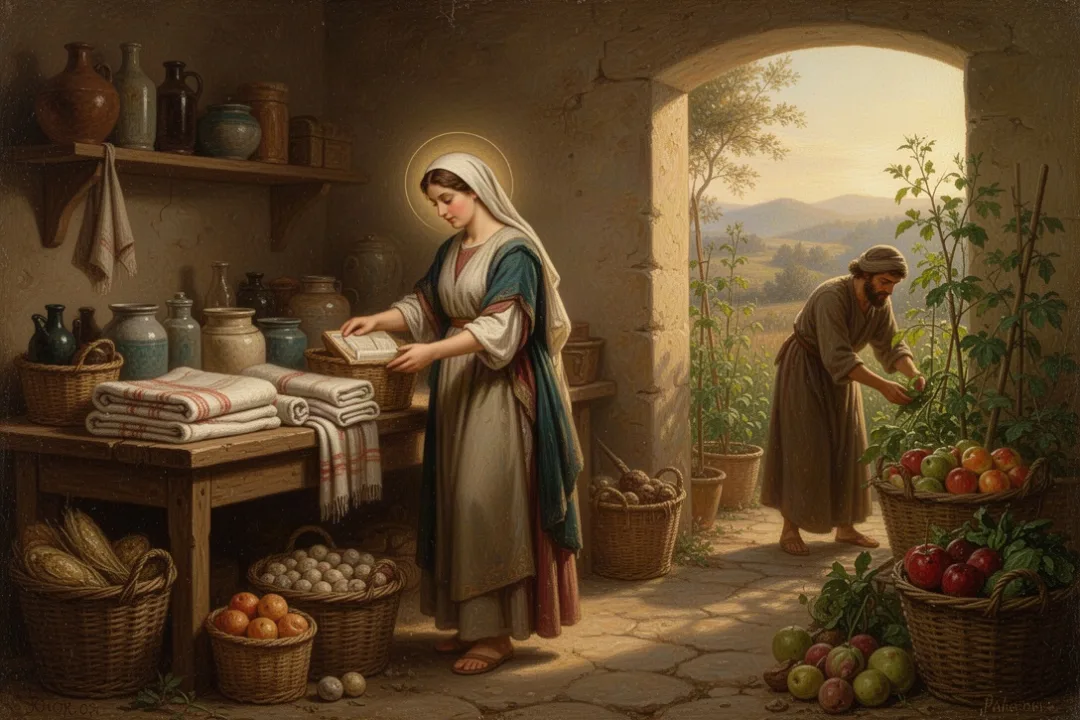
Proverbs 31:10–31: a poem praises a woman whose wisdom appears in her work, relationships, speech, and faith.
Proverbs 31:30: the poem places reverence for the Lord above charm and outward beauty.
Proverbs 31:31: the closing thought calls for her work to be recognized publicly.
Reading the chapter as a whole prevents a common mistake: treating the last 22 verses as a list of household chores while overlooking the political and ethical instruction in the first nine verses. Both sections are about wise responsibility. The king must use power justly, and the woman must use her abilities faithfully.
What Lemuel’s mother teaches about leadership
The chapter begins with a mother addressing her son, King Lemuel. The text does not give a certain historical identification for Lemuel, so the focus falls on the wisdom of the advice rather than on reconstructing his biography. A parent is urging a ruler to remember the moral dangers attached to authority.
Her first warning concerns sexual excess and the loss of strength that can follow uncontrolled desire. Proverbs often connects wise living with disciplined appetites. The point is not that marriage or attraction is inherently harmful; elsewhere, Proverbs presents faithful marital love positively. The warning is against behavior that weakens judgment and damages responsibility.
She next addresses alcohol. Proverbs 31:4–7 contrasts the dangers of rulers drinking to excess with the possible use of strong drink by people in deep distress. The passage does not offer a casual endorsement of intoxication. Its central concern is that a person responsible for legal decisions must remain clear-minded. A leader who cannot think clearly may forget the law or distort justice.
The most direct command comes in Proverbs 31:8–9. Lemuel is told to speak for people who cannot protect their own interests and to defend the rights of the poor and needy. This is a strong biblical picture of leadership: authority exists for service, not self-indulgence.
Leadership principle: Proverbs 31 measures power by how well it protects vulnerable people. Clear judgment, restraint, and a willingness to speak up matter more than prestige.
These verses broaden the chapter’s relevance. Proverbs 31 is not only about personal productivity or family management. It asks what people do with influence, money, education, professional authority, and public trust. The king’s responsibility is especially visible, but the principle applies wherever your decisions affect other people.
What “a capable woman” means in Proverbs 31
The poem opens with a question about finding a woman of great worth. Many English Bibles use phrases such as “excellent wife,” “virtuous woman,” or “woman of noble character.” The Hebrew expression can carry the sense of strength, ability, valor, and competence. It is not limited to quietness or domestic obedience.
The woman is trusted by her husband, but the poem does not define her only through his approval. She buys property, plants a vineyard, makes commercial goods, evaluates opportunities, and conducts transactions. She is active in the household economy and appears capable of making decisions with significant consequences.
That picture challenges the assumption that biblical womanhood in this chapter means passivity. The woman’s work is deeply connected to her household, but it is not confined to repetitive chores. She demonstrates initiative, commercial judgment, physical energy, planning, and generosity. Her household benefits from her leadership, and the wider community benefits from her kindness.
The poem also presents her as a person whose value is recognized over time. Her character is reliable, and her actions create trust. The husband’s confidence in her is not portrayed as control over her; it is a description of a partnership in which her wisdom strengthens the family’s well-being.
How the Proverbs 31 woman handles work and resources
Proverbs 31 gives unusual attention to the woman’s economic activity. She obtains materials, makes useful products, sells merchandise, considers a field, and plants a vineyard. These details show that her wisdom includes financial awareness and practical enterprise.
She does not work merely to accumulate wealth. The poem connects her productivity with the good of the people around her. Her household has clothing and provisions, and she also reaches out to the poor. Her work creates security without turning security into selfishness.
Several principles can be drawn from this portrait:
She plans ahead. The poem describes preparation for changing seasons and future needs rather than careless improvisation.
She evaluates opportunities. Before acquiring a field, she considers it and then invests in it.
She develops useful skills. Her work produces goods that serve her household and have value in the marketplace.
She accepts responsibility. The poem associates her strength with action, not merely good intentions.
She combines productivity with compassion. Her resources are not closed off from people experiencing poverty.
These observations should not be turned into a demand that every person own a business, work outside the home, or perform the same tasks. The poem uses the setting of an ancient household and agrarian economy. Its enduring emphasis is on faithful stewardship: use the abilities and resources available to you wisely, productively, and generously.
The chapter also treats physical labor with dignity. The woman works with her hands, prepares goods, plants, trades, and cares for others. There is no sharp division between spiritual value and practical work. In Proverbs, wisdom becomes visible through concrete choices.
Why preparation and diligence matter in the poem
The woman of Proverbs 31 prepares for the future. She provides clothing for changing weather, organizes household responsibilities, and rises early to distribute tasks. These images communicate foresight rather than anxiety. She does not assume that good outcomes happen automatically; she makes responsible preparations.
Diligence in Proverbs is not frantic busyness. It means steady attention to what needs to be done. The poem also says that she enjoys the results of her labor, suggesting that work and rest are not enemies. A wise person can be industrious without treating exhaustion as a badge of holiness.
Modern readers may need to resist comparing themselves with the poem’s compressed portrait. The text describes a complete ideal by presenting many areas of competence together. It is poetry, not a weekly timetable. One person may be strong in business, another in teaching, another in caregiving, another in public service. Faithfulness can look different across seasons of life.
A healthier application asks questions such as: Are you preparing responsibly? Do you keep promises? Do you use your skills to serve others? Are your spending and working habits consistent with your values? These questions preserve the poem’s moral purpose without creating an impossible performance standard.
What Proverbs 31 says about speech and wisdom
Near the end of the poem, the woman opens her mouth with wisdom, and the instruction of kindness is associated with her speech. The idea is not simply that she talks often or always sounds gentle. Her words are shaped by good judgment, truth, and concern for others.
Proverbs repeatedly treats speech as a moral force. Words can heal, deceive, inflame conflict, reveal character, or defend someone who is being mistreated. Proverbs 31 places wise instruction and kindness together, showing that truth does not require cruelty and kindness does not require dishonesty.
This part of the chapter applies in homes, workplaces, churches, friendships, and public conversations. A person may be highly productive yet damage others through contemptuous speech. The Proverbs 31 portrait joins competence with character. What the woman accomplishes matters, but so does the way she treats people while accomplishing it.
Practical questions can help apply this theme:
Do your words make important truths clearer or more confusing?
Can you correct someone without humiliating them?
Do you speak up when another person is being overlooked or exploited?
Are your private words consistent with the character you display publicly?
Do you listen long enough to understand before offering advice?
Wisdom is not merely information. In Proverbs 31, it is knowledge shaped into responsible speech and compassionate action.
How compassion appears alongside strength
The woman stretches out her hand to the poor and reaches out to those in need. This brief description prevents readers from reducing her strength to independence or financial success. Her capability is measured partly by her willingness to share what she has.
Her compassion is practical. She provides clothing, food, and assistance rather than expressing concern only in abstract terms. The wider book of Proverbs repeatedly condemns the exploitation of the poor and praises generosity. Proverbs 31 places that same concern inside a portrait of household leadership.
Compassion also gives the chapter a needed balance. Planning, buying, selling, and managing are valuable, but they can become self-serving if they are disconnected from mercy. The capable person in the poem does not treat vulnerable neighbors as obstacles or strangers. Wisdom notices need and responds to it.
For modern application, generosity may involve money, food, transportation, professional skills, advocacy, hospitality, or consistent attention to someone who is isolated. The form varies, but the principle remains: resources are entrusted for more than personal comfort.
What “the fear of the Lord” means in Proverbs 31
Proverbs 31:30 gives the poem’s clearest spiritual evaluation. Charm can mislead, and beauty does not last, but a woman who fears the Lord deserves praise. In Proverbs, “fear of the Lord” means reverent submission to God, not constant panic. It includes humility, moral seriousness, teachability, and a willingness to live according to God’s wisdom.
This statement does not claim that appearance or personal warmth have no value. It places them in the right order. Charm can be persuasive without being sincere, and beauty can receive attention without proving character. Neither one is a dependable foundation for trust.
The poem’s earlier qualities now come into focus. Her diligence, business judgment, kindness, preparation, and generosity are not presented as a strategy for earning God’s love. They are the outward expression of a life oriented toward God. Reverence is the foundation; conduct is the evidence.
This also protects the passage from being used as a purely secular productivity ideal. A person can be efficient, wealthy, admired, and still lack wisdom. Proverbs 31 praises work, but it does not worship work. It praises competence, but it does not make competence the source of human worth.
Common mistakes when interpreting Proverbs 31
Readers often approach this chapter with sincere intentions but draw conclusions that the poem itself does not require. These mistakes can burden women, excuse men from responsibility, or reduce a rich wisdom passage to a checklist.
Treating the poem as a daily schedule. The chapter gathers many qualities into a poetic portrait. It does not say that one person must complete every task every day.
Reducing the woman to domestic labor. She manages a household, but she also invests, trades, produces goods, plans, and advocates through generosity.
Using the passage to demand perfection. The poem celebrates wisdom, not flawless performance. Human limitations, illness, caregiving demands, and changing seasons of life matter.
Ignoring the first nine verses. The chapter begins with a direct call for rulers to practice justice and protect vulnerable people.
Reading “fear of the Lord” as terror alone. The phrase describes reverence and faithful obedience within Proverbs’ wisdom tradition.
Making the husband the hero. The husband trusts the woman because of her character, but the poem gives its sustained attention to her initiative and work.
Turning comparison into condemnation. The text should form wisdom and gratitude, not become a tool for shaming people whose circumstances differ.
These corrections make the chapter more, not less, demanding. Instead of asking whether someone has copied an ancient task list, they ask whether that person is trustworthy, just, generous, disciplined, and reverent toward God.
How to apply Proverbs 31 without creating an impossible standard
Application works best when you begin with principles rather than surface details. Ancient clothing, vineyards, household servants, and market practices do not map directly onto every modern life. The underlying values can still guide decisions in a home, workplace, congregation, or neighborhood.
Choose one area that needs attention instead of trying to imitate the entire poem at once. For example, you might improve financial planning, speak more carefully during conflict, create a realistic preparation habit, or give consistent support to a person in need.
These practical steps can help:
Identify your present responsibilities. List the people, work, resources, and decisions currently entrusted to you.
Separate faithfulness from comparison. Ask what wisdom requires in your circumstances, not what someone else appears to accomplish.
Make one concrete plan. Set a manageable action, such as reviewing a budget, preparing for a difficult conversation, or arranging regular generosity.
Include other people’s well-being. Consider who may be overlooked, underpaid, isolated, or unable to speak for themselves.
Review your motives. Ask whether your work is driven by service and stewardship or mainly by approval and status.
Accept limits. Rest, delegation, and asking for help can be wise responses rather than evidence of failure.
A church or family can apply the chapter collectively as well. Instead of praising one exceptionally busy person, a community can share burdens, honor different forms of work, provide practical support, and ensure that vulnerable people receive a voice. That approach better reflects the chapter’s concern for justice and mutual good.
How men and women can read the chapter together
Although the final poem focuses on a woman, its lessons are not addressed to women alone. Men can learn to recognize competence, trust character, share responsibility, and praise faithful work without treating a wife or mother as a resource that exists for everyone else.
The opening section directly addresses a male ruler and requires him to use power for justice. The whole chapter therefore resists a one-sided reading in which women serve while men receive. It presents mutual moral responsibility: people with authority must protect others, and people with ability must steward it well.
Families can discuss how decisions are made, how labor is divided, how money is handled, and how the needs of vulnerable people are addressed. Work that is unpaid or less visible should not be treated as less valuable. Nor should economic activity be used to avoid relational, spiritual, or caregiving duties.
The chapter’s closing praise also matters. Her work is to be recognized in the community, not hidden or assumed. Public gratitude can be a form of justice when it acknowledges labor that others have benefited from but failed to notice.
Why Proverbs 31 still speaks to ordinary life
Proverbs 31 brings together themes that appear throughout the book: disciplined desire, wise speech, honest work, compassion for the poor, careful planning, and reverence for God. Its memorable portrait gives those themes a human shape.
The chapter does not promise that wisdom eliminates hardship. The woman still works, plans, and responds to needs. Its promise is more grounded: a life shaped by wisdom can create trust, strengthen a household, serve a community, and earn lasting respect.
The final praise is not based on flawless appearance or constant productivity. It rests on character demonstrated over time. Proverbs 31 invites you to value what God values: integrity, courage, mercy, sound judgment, responsible work, and faithful reverence.
Read that way, the chapter becomes neither a burden nor a decorative compliment. It is a serious vision of people using strength for good, speaking for those who need help, caring for others, and letting their relationship with God shape the way they work and live.
Frequently asked questions
Is Proverbs 31 only about women?
No. The chapter includes a mother’s instruction to a king about self-control, justice, and defending vulnerable people. The final poem focuses on a capable woman, but its principles—wise leadership, diligent work, generosity, careful speech, and reverence for God—apply to everyone. Men can also learn how to honor and support the faithful work of women rather than treating it as invisible or automatically owed.
Does Proverbs 31 require women to work outside the home?
Proverbs 31 does not establish one required employment arrangement. Its woman participates in commerce and household management within an ancient economic setting. The enduring principle is responsible stewardship of available abilities and resources. Depending on a person’s season of life, that may involve paid work, caregiving, homemaking, education, ministry, business, or a combination of responsibilities.
What does the “fear of the Lord” mean in Proverbs 31?
It means reverence for God expressed through humility, obedience, moral seriousness, and willingness to receive wisdom. It does not primarily mean terror. In the chapter, reverence for God provides the foundation for the woman’s practical qualities, including her honesty, generosity, speech, work, and concern for others.
How can someone apply Proverbs 31 without feeling overwhelmed?
Focus on one principle at a time instead of trying to reproduce every detail in the poem. You might make a wise financial plan, improve your speech during conflict, prepare for a future responsibility, or help someone in need. Remember that Proverbs 31 is poetic and idealized, not a demand for constant productivity or perfection.







Leave a Reply