Have you ever wondered whether your background, past, or nationality makes you an outsider to God? Psalm 87 answers with a vision of belonging: Zion is presented as the city God loves, yet the psalm repeatedly names people from other nations as if they have been born there. Its message is not that God cares for only one place or people, but that his purposes in Zion reach beyond Israel to include the nations.
Only seven verses long, Psalm 87 is brief but unusually concentrated. It combines the language of a city hymn, a record of citizenship, and a joyful song about God’s presence. The psalm does not explain every detail of its historical setting, so some questions remain open. Its central picture, however, is clear: God establishes Zion, recognizes those who belong to him, and creates a community larger than human borders.
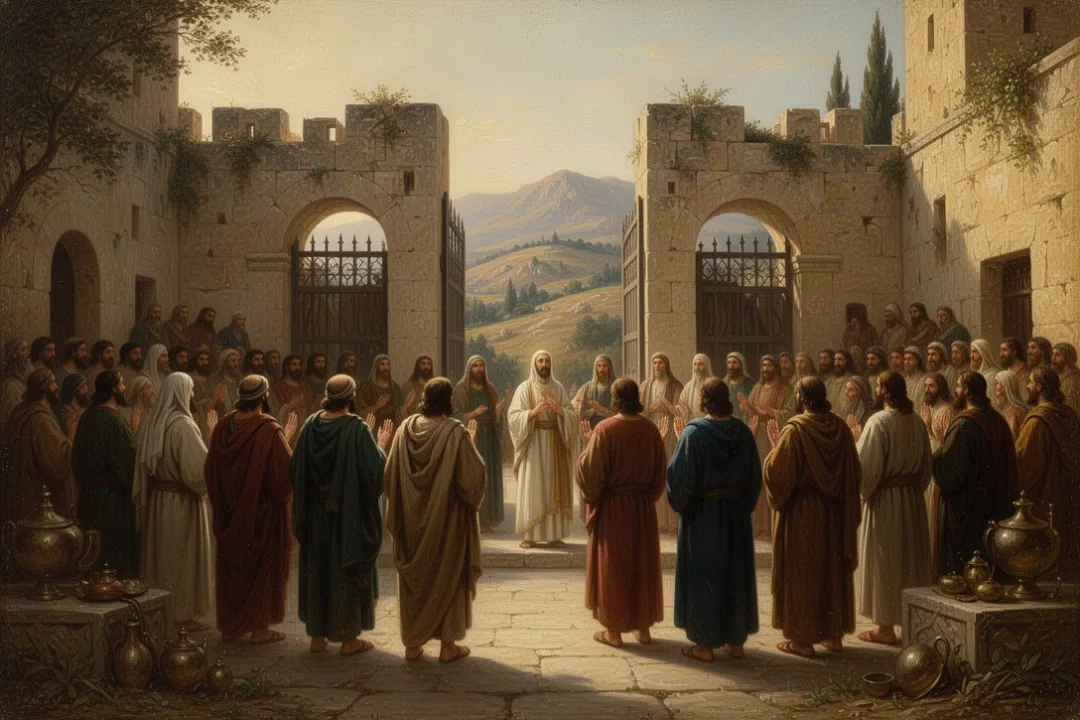
The psalm begins with the foundations of God’s city on the holy mountain. Zion is not described first through its walls, wealth, or military strength. Its significance comes from God’s deliberate choice and presence. The city is holy because it is associated with the Lord, not because its residents have made it impressive.
The opening verses emphasize that God loves Zion’s gates more than the dwellings connected with Jacob. “Jacob” refers to Israel, the covenant people, so the comparison may sound surprising: why would one city receive special praise even among all the places associated with Israel? The answer is that Zion represents the place of God’s dwelling. It stands for worship, covenant, and the relationship between God and his people.
In the ancient world, a city’s gates were more than entrances. They were places of public business, judgment, trade, security, and social identity. To speak of Zion’s gates is therefore to speak about life within God’s city. The psalm presents Zion as a place where God’s authority is recognized and where belonging is publicly acknowledged.
Psalm 87 does not treat the city as valuable merely because it is beautiful or historically important. Its glory comes from the Lord, who establishes it and speaks about it. This distinction matters for readers today. Sacred places can help people worship, remember, and gather, but no building creates God’s presence by its own power.
Central idea: Psalm 87 makes Zion significant because God chooses and establishes it. The city’s honor is rooted in divine presence, not human achievement or national pride.
Why Psalm 87 names Egypt, Babylon, Philistia, Tyre, and Cush
The psalm then turns from Zion to several nations: Rahab, Babylon, Philistia, Tyre, and Cush. “Rahab” here is a poetic name for Egypt, not the woman named Rahab in the book of Joshua. Babylon was a major imperial power, Philistia represented Israel’s historic rivals along the coast, Tyre was a prominent Phoenician city, and Cush generally referred to regions south of Egypt, often associated with Nubia or Ethiopia.
These names are carefully chosen. They represent distant peoples, neighboring cultures, political powers, and traditional enemies. Some were connected to painful memories in Israel’s history. By placing them beside Zion, the psalm creates a striking contrast between human divisions and God’s wider purpose.
The nations are not presented as military allies or political members of an earthly coalition. Instead, the Lord himself records them as belonging to Zion. The wording suggests an official register or civic record: God knows who belongs, and he is the one who makes the declaration. Their acceptance is not based on their ability to conquer the city or negotiate their way into it.
Psalm 87 does not erase the differences among the nations. Egypt remains Egypt, Babylon remains Babylon, and the other peoples retain their names. Yet their identity is now viewed in relation to God’s city. Belonging to Zion does not require pretending that every person has the same history. It means that God can gather people from different histories into one community under his care.
This is one reason the psalm has continued to speak to readers who feel separated from religious community. It challenges the assumption that God’s grace is limited to people with the right ancestry, language, birthplace, or past. The psalm’s vision is expansive without being vague: God knows the nations by name and welcomes them into a shared relationship with him.
Rahab: a poetic reference to Egypt, an ancient regional power.
Babylon: a symbol of a powerful empire and a significant force in Israel’s history.
Philistia: a neighboring people often remembered as an opponent of Israel.
Tyre: a wealthy Phoenician city known for trade and international connections.
Cush: a southern region associated with lands beyond Egypt.
The list also prevents the reader from reducing Zion to a narrow ethnic idea. The point is not simply that a few friendly neighbors may approach God. The psalm imagines the nations of the known world being recognized within God’s city.
How the repeated birth language changes the meaning of belonging
The heart of Psalm 87 is the repeated statement that a person was born in Zion. The striking feature is that this language is applied to people associated with foreign nations. They are not merely visitors, temporary guests, or outsiders receiving limited permission to enter. In the psalm’s poetic vision, they are counted as if they possess native status in the city of God.
That image would have sounded extraordinary. Birthplace usually determines a person’s earliest identity, family ties, and civic belonging. A person born in Egypt or Babylon could not literally be born in Zion. The psalm deliberately uses impossible or surprising language to show that God can give a new status that ordinary geography cannot provide.
The Lord is pictured as keeping a record of the peoples and registering each person with the declaration, “This one was born there,” as the verse is commonly understood. The force of the statement is not biological. It is a poetic announcement that God recognizes these people as fully belonging to Zion.
This does not mean the psalm treats conversion, faith, or worship as a casual change of paperwork. Instead, it emphasizes God’s authority to define membership. Human beings often sort one another according to family, class, nationality, denomination, or past behavior. Psalm 87 asks you to consider a different question: Whom does God recognize as belonging to his people?
The image also gives dignity to people who might expect second-class treatment. The nations are not described as tolerated at the edge of the city. They are counted among those who belong. Their place is not based on a lesser category of citizenship. The poem points toward full welcome rather than partial acceptance.
For personal reflection: If you feel defined by where you came from, Psalm 87 offers a different source of identity. God’s record can speak a deeper word about belonging than ancestry, reputation, or former exclusion.
For Christian readers, this theme can be considered alongside the New Testament’s teaching about people from every nation becoming one people through Christ. Psalm 87 itself does not mention Jesus or explain the later Christian doctrine of the church. Still, its vision of international inclusion has naturally invited Christians to read it as a foreshadowing of God’s welcome to the nations.
Jewish readers may hear the psalm within the broader hope that Zion will become a center of divine rule and worship for the nations. Both readings take seriously the same basic movement: the holy city is not a symbol of isolation but a place from which God’s blessing extends outward.
What the final verse means by springs, singers, and dancers
The final verse changes the atmosphere from official registration to celebration. Singers and dancers, or musicians and worshipers, are imagined declaring that all their springs are in Zion. The precise wording has been translated in different ways, but the image of springs or sources of life is central.
In a dry land, a spring is not a decorative feature. It provides water, refreshment, growth, and the possibility of settlement. To say that one’s springs are in Zion is to say that life and joy flow from God’s city. Zion is not only a place where people are listed; it is a place from which spiritual vitality comes.
The final verse also completes the psalm’s movement. It begins with foundations and ends with worship. It names the city’s origin in God, then names the nations that are welcomed, and finally pictures a community responding with joy. Belonging leads to praise, not merely to a change in status.
The singers do not celebrate their own importance. Their joy centers on the source from which they receive life. This guards against reading Psalm 87 as a claim that one community has earned superiority over every other group. Zion is honored because God is there, and the nations rejoice because God gives them a place among his people.
The language of springs can also speak to personal spiritual exhaustion. A person may have many sources of information, entertainment, achievement, or social approval and still feel inwardly dry. Psalm 87 directs attention toward God as the source of lasting life. Its answer is not a technique for producing constant happiness, but a vision of restored belonging and worship.
Foundations: God establishes the city.
Gates: God’s presence gives the city special significance.
Birth records: God defines and confirms belonging.
Springs: God provides the life and joy celebrated by the community.
How to read Psalm 87 when you feel like an outsider
Psalm 87 can be read as a communal hymn, but it also speaks directly to private fears. Many people carry the feeling that they are not religious enough, respectable enough, knowledgeable enough, or connected enough to belong. Others have experienced rejection because of family history, nationality, race, social class, or former mistakes.
The psalm does not pretend that exclusion is harmless. Its poetic reversal shows how radically God’s recognition can differ from human judgment. Those who seem far away are named, recorded, and welcomed. The outsiders are not invisible to God.
That does not mean every community that uses religious language is automatically safe or welcoming. Psalm 87’s vision should not be used to excuse discrimination, control, or exclusion. Rather, it gives a standard by which communities can examine themselves. If God’s city is pictured as a place where people from many nations receive genuine belonging, then worshipers should resist treating outsiders as permanently inferior.
You can use the psalm in prayer by moving through its main images:
Begin with God’s character. Thank God for being the one who establishes, recognizes, and gives life.
Name the places where you feel excluded. Bring fears about your background, reputation, or spiritual history into honest prayer.
Remember the nations. Pray for people and groups you tend to view as distant, unfamiliar, or opposed to your interests.
Receive God’s declaration. Ask for grace to believe that belonging comes from God’s welcome rather than from human approval.
End with gratitude. Let the image of springs lead you to thank God for the people, worship, mercy, and hope that sustain you.
Psalm 87 can also shape how you treat other people. Welcome is more than politeness at the door. It includes listening, sharing responsibility, making room for different histories, and refusing to reduce people to stereotypes. God’s record of belonging should influence the way his people recognize one another.
Why Psalm 87 still matters for worship and community
Psalm 87 offers a vision of worship that is both rooted and open. It is rooted in a particular place, Zion, and in the history of God’s relationship with Israel. At the same time, it refuses to let that particularity become a barrier that keeps the nations permanently outside.
This balance is useful for communities today. A congregation or faith community can have a real history, recognizable practices, and a strong sense of place without treating those features as proof that others are less welcome. Tradition can provide roots without becoming a wall.
The psalm also corrects two opposite mistakes. One mistake is to assume that only people with the right background can truly belong. The other is to act as though history and identity do not matter at all. Psalm 87 does neither. It names specific nations and places them within a specific sacred vision. Inclusion does not require erasing people’s stories.
For worship, the psalm encourages songs that celebrate God’s initiative rather than human status. For pastoral care, it offers language for people who fear rejection. For community life, it provides an image of a people gathered from many places and recognized equally by God.
Its seven verses also demonstrate how much meaning can be carried by a small poem. Psalm 87 does not answer every question about history, immigration, church membership, or social conflict. It does give a durable theological picture: God establishes a holy dwelling, gathers people from the nations, and becomes the source of their joy.
When you return to Psalm 87, pay attention to the movement from city to nations, from nations to names, and from names to celebration. The psalm’s hope is not simply that outsiders may stand near the gates. It is that God can make them fully at home, and that this shared belonging will become a reason for joyful worship.
Frequently asked questions
Who wrote Psalm 87?
Psalm 87 is associated with the “sons of Korah,” a group connected with worship and song in ancient Israel. The superscription identifies this tradition, but it does not provide enough information to establish the exact individual author or date. Its historical setting remains uncertain, so interpretations should focus on the poem’s imagery and theological message rather than an unverified biography.
What does Zion represent in Psalm 87?
Zion refers first to Jerusalem’s sacred hill and, by extension, to the city as the place associated with God’s presence, worship, and covenant purposes. In the psalm, Zion also becomes a theological symbol of God’s household. Its significance comes from God’s choice and presence, not from the city’s political power or physical features.
Is Rahab in Psalm 87 the same person mentioned in Joshua?
No. In Psalm 87, Rahab is a poetic name for Egypt, used in biblical poetry to represent that nation’s power and opposition. The Rahab in Joshua is an individual woman associated with Jericho. The shared name can be confusing, but the context in Psalm 87 clearly concerns nations rather than a person.
How can Psalm 87 encourage someone who feels excluded?
The psalm pictures God recognizing people from foreign nations as though they were born in Zion. That image challenges the belief that ancestry, birthplace, reputation, or former distance permanently determines belonging. It does not deny the reality of exclusion, but it proclaims that God’s welcome can give people a deeper identity and a genuine place among his people.






Leave a Reply