Revelation 4 begins a new section in John’s vision. Chapters 2 and 3 addressed seven churches in Asia Minor, offering encouragement, correction, and promises to communities facing spiritual pressure. After those messages, John is shown an open door in heaven and invited to see what must take place next.
The chapter does not begin by explaining world events in a straightforward timeline. Instead, it gives you a heavenly perspective before the seals, trumpets, judgments, and conflicts of later chapters appear. The first thing John sees is not chaos but a throne, emphasizing that God remains sovereign even when the earthly scene becomes frightening.
Revelation belongs to the biblical tradition of apocalyptic literature, a style that communicates through visions, symbols, dramatic contrasts, and heavenly scenes. Its images are meant to reveal spiritual reality, not simply provide a coded chart of modern political events. Revelation 4 should therefore be read alongside the rest of Scripture, especially passages such as Isaiah 6, Ezekiel 1, Daniel 7, and Exodus 19.
Central idea: Before Revelation shows the judgments that unfold on earth, it shows who occupies heaven’s throne and why all creation responds with worship.
What John sees when the heavenly vision opens
John says he sees an open door in heaven and hears a voice like the sound of a trumpet calling him upward. The voice tells him that he will be shown what must happen afterward. John is then described as being in the Spirit, marking a transition from the churches’ earthly circumstances to a vision of the heavenly court.
The open door is not presented as a physical doorway that a person could locate in the sky. It is a visionary invitation, giving John access to a reality hidden from ordinary sight. The scene resembles the prophetic call visions of the Old Testament, where God reveals his glory and commissions a messenger.
John’s attention immediately moves to the throne. He does not first describe a map of heaven, a list of future dates, or a military conflict. The throne establishes the chapter’s controlling image: God reigns. Everything else in the vision is arranged around that authority.
Revelation 4 broken down step by step
An open door appears in heaven. John receives access to a heavenly vision and is told that further events will be shown to him.
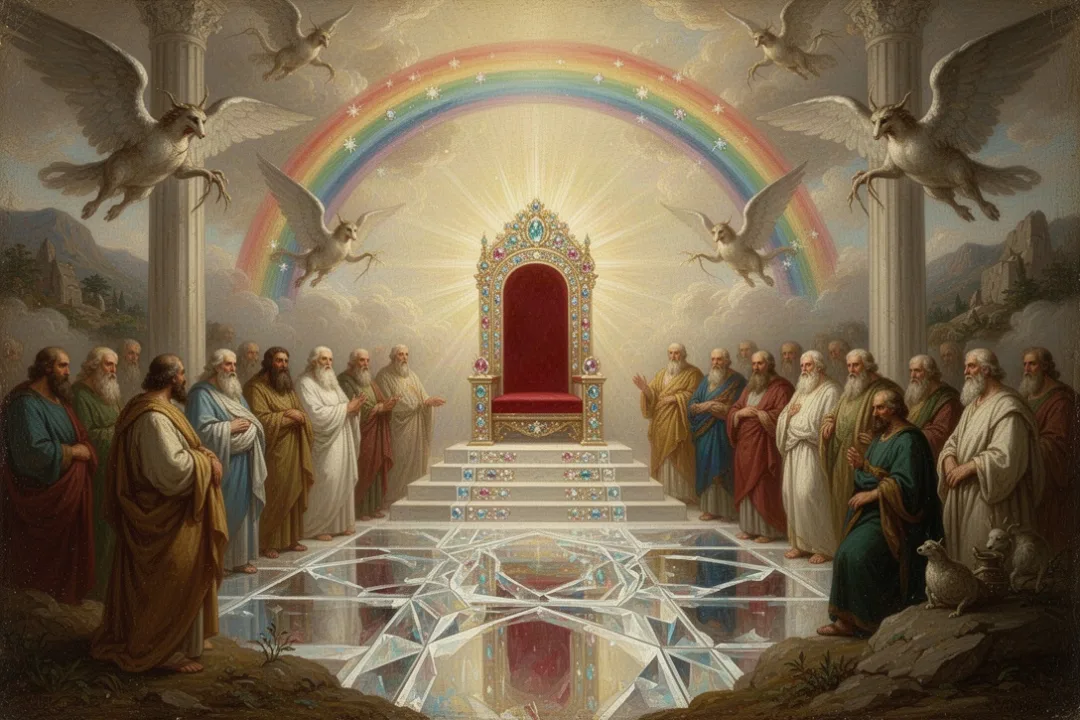
A throne stands at the center. The throne identifies God as the central ruler of the scene, although John describes the one seated there through brilliant, jewel-like imagery rather than a human portrait.
A rainbow surrounds the throne. Its appearance resembles an emerald, linking majesty with a reminder of covenant mercy and faithfulness.
Twenty-four elders sit on surrounding thrones. They wear white clothing and golden crowns, presenting a picture of honored heavenly attendants who nevertheless surrender their crowns before God.
Lightning, thunder, and burning lamps come from the throne. These signs communicate power, holiness, judgment, and divine presence.
A glasslike expanse appears before the throne. It resembles crystal and contributes to the overwhelming brightness and order of the heavenly court.
Four living creatures surround the throne. Their forms combine features associated with a lion, an ox, a human being, and an eagle in flight.
The living creatures praise God continually. Their worship focuses on God’s holiness, eternal existence, and sovereignty.
The elders join the worship. They fall before the one on the throne, cast their crowns down, and declare that God deserves glory, honor, and power because he created all things.
This sequence matters. Revelation 4 moves from God’s throne to the heavenly beings around it, then from their appearance to their worship. The chapter’s purpose is not merely to satisfy curiosity about heaven’s architecture. It directs the reader’s attention toward God’s character and rightful authority.
Why the throne is the central symbol
The word “throne” dominates the scene conceptually and repeatedly appears throughout Revelation. In the ancient world, a throne represented royal authority, judgment, and the right to rule. By placing the throne at the center of the vision, John presents God as the true king above rulers, empires, and spiritual powers.
The throne also gives the rest of Revelation its framework. Later chapters describe seals being opened, judgments taking place, evil powers rising, and earthly systems opposing God. Revelation 4 reminds the reader that these events do not mean God has lost control. The heavenly court remains established even when earthly history appears unstable.
John does not give a detailed physical description of God’s face or body. Instead, he uses the appearance of precious stones and surrounding light to communicate glory, beauty, holiness, and transcendence. The imagery acknowledges that God cannot be reduced to an ordinary visible object. What John sees is overwhelming brilliance around the one seated on the throne.
This focus can also shape Christian prayer and worship. The chapter begins with God, not with human anxiety. It presents worship as a response to who God is rather than as a performance designed to produce a particular feeling. The heavenly beings worship because divine holiness and creative authority deserve it.
What the rainbow around the throne means
A rainbow resembling an emerald surrounds the throne. The image is unusual because a rainbow is normally associated with many colors, while John emphasizes the green appearance of an emerald. The detail contributes to the scene’s beauty, but it may also recall the rainbow associated with God’s covenant after the flood in Genesis 9.
The connection should be handled carefully. Revelation 4 does not stop to explain the rainbow, so interpreters differ about how strongly the flood narrative should control its meaning. Still, the image can reasonably suggest that God’s authority is not separate from his faithfulness. The ruler on the throne is not an unpredictable force without moral character.
The rainbow also softens, without removing, the fearsome aspects of the vision. Lightning and thunder communicate power, while the surrounding rainbow suggests mercy, order, and covenant remembrance. Together, the images present a God whose holiness is formidable but whose rule is not arbitrary.
Who the twenty-four elders may represent
Twenty-four elders sit on thrones around God’s throne. They wear white garments and have golden crowns. Revelation 4 does not directly identify them, so several interpretations have developed in Christian teaching.
They may represent the whole people of God. Some interpreters connect the number twenty-four with the twelve tribes of Israel and the twelve apostles, especially in light of Revelation’s later emphasis on the unity of God’s redeemed people.
They may represent a heavenly priestly order. The number can recall the divisions of priests who served in Israel’s worship, although Revelation 4 itself does not explicitly make that connection.
They may be heavenly royal attendants. Their thrones, garments, and crowns fit the imagery of honored members of a divine court.
They may combine several biblical associations. Apocalyptic symbols can carry more than one layer of meaning, so the elders may evoke representative worship, priestly service, and heavenly authority at the same time.
Their exact identity is less clear than their action. They repeatedly fall before God, worship him, and surrender their crowns. Whatever status they possess, it is received and remains secondary to God’s rule.
The crowns are particularly meaningful. They symbolize honor or delegated authority, yet the elders do not cling to them. By placing the crowns before the throne, they acknowledge that all authority ultimately comes from God. Human or heavenly honor reaches its proper purpose when it points beyond itself.
What the lightning, thunder, and lamps communicate
Lightning flashes and thunder sounds from the throne. These details recall the manifestation of God at Mount Sinai, where thunder, lightning, cloud, and fire accompanied the giving of the law. Similar imagery also appears in prophetic visions of divine judgment and presence.
The signs communicate majesty and danger. God is not being presented as tame or ordinary. His presence has weight, and his authority includes the right to judge. Yet the scene is not uncontrolled violence. The lightning and thunder come from the throne, suggesting that even overwhelming power is ordered under divine rule.
Seven burning lamps stand before the throne, identified as the seven spirits of God. Revelation often uses the number seven to communicate fullness or completeness. The phrase may refer to the Holy Spirit in a symbolic sevenfold presentation, though Christian interpreters explain the wording in different ways.
The lamps connect the heavenly throne with illumination, holiness, and divine activity. Fire can purify, expose, and judge, while lamps provide light. The image suggests that nothing is hidden from God’s presence and that divine action proceeds from the throne.
How the crystal-like sea functions in the vision
Before the throne is something like a sea made of glass and resembling crystal. John is not necessarily describing ordinary water. He is using comparison to convey an expanse that is transparent, brilliant, and still.
In the ancient imagination, the sea could represent danger, disorder, or forces beyond human control. In Revelation 4, the sea is no longer threatening. It lies before the throne in a state of perfect calm and subordination. God’s rule extends over the forces that people fear.
The image may also recall the firmament or heavenly expanse described in Ezekiel’s vision. Its crystal quality adds to the sense that the throne room is filled with purity and light. The entire setting appears ordered, clean, and radiant rather than shadowed or chaotic.
Reading tip: Symbolic details in Revelation often work together. The crystal-like sea, burning lamps, thunder, jewels, and rainbow form one atmosphere of holiness and majesty rather than functioning as isolated predictions.
Who the four living creatures are
Four living creatures stand around the throne, one on each side. They are covered with eyes and have different appearances: one resembles a lion, another an ox, another has a humanlike appearance, and another resembles an eagle in flight.
The vision draws heavily from Isaiah 6 and Ezekiel 1 and 10. Isaiah saw heavenly beings near God’s throne proclaiming his holiness. Ezekiel saw living creatures with multiple features and wings in a vision connected with God’s glory. Revelation reshapes these earlier images for its own theological purpose.
The creatures are not described as ordinary animals or as human beings wearing animal costumes. They are symbolic heavenly beings associated with worship, watchfulness, and the created order. Their many eyes suggest alertness and perception. They do not appear limited by human blindness or ignorance.
The four faces may symbolize qualities found throughout creation. The lion can suggest strength and wild animals, the ox service and domesticated animals, the human face intelligent life, and the eagle the creatures of the sky. This interpretation sees the four beings as representing the whole created world before God.
Other interpreters connect the four creatures with the four Gospels, but that association belongs to a later Christian tradition rather than an explicit explanation in Revelation 4. The chapter itself emphasizes their position around the throne and their continual worship.
Why the living creatures repeat the holiness of God
The living creatures continually praise the one seated on the throne for being holy and for existing eternally. Their worship emphasizes three ideas: God’s holiness, God’s unique identity, and God’s eternal life.
Holiness means more than moral goodness, although it includes perfect goodness. It also refers to God’s complete otherness, purity, and separation from everything corrupt. In Revelation 4, holiness explains why the heavenly beings respond with reverence rather than casual familiarity.
The creatures’ worship also counters the claims of earthly rulers. Political leaders may demand titles, loyalty, and public honor, but only God is presented as eternally sovereign in the fullest sense. His reign does not depend on temporary success, military strength, or human approval.
Their continual praise does not mean that heaven is mechanically repetitive. It communicates that God’s holiness is always true and always worthy of recognition. No new crisis can make him less holy, and no earthly victory can make him more worthy than he already is.
Why the elders throw their crowns before God
After the living creatures praise God, the twenty-four elders fall down before him. They place their crowns before the throne and worship the eternal Creator. This is one of the chapter’s clearest pictures of humility before divine authority.
The elders do not deny that they have honor. They show that honor is not self-originated and does not give them independence from God. By returning their crowns, they acknowledge that every legitimate authority is derivative.
Their praise also identifies God as the Creator of all things. Creation is not presented as an accidental backdrop to salvation history. The existence of everything depends on God’s will. The elders therefore worship not only because God is powerful but because he is the source and sustainer of life.
This point becomes especially important as Revelation develops. The book will describe the exploitation of creation, the suffering of living beings, and the rebellion of human powers. Revelation 4 establishes that the world belongs first to its Creator, not to the rulers who try to possess it.
How Revelation 4 connects with Revelation 5
Revelation 4 and 5 form a closely connected throne-room scene. Chapter 4 emphasizes the Creator and the worship surrounding God’s throne. Chapter 5 introduces a scroll sealed with seven seals and focuses on the one who is worthy to open it.
This sequence provides a crucial interpretive balance. Revelation 4 answers the question, Who rules? Revelation 5 develops the question, Who can carry out God’s purposes? The throne establishes divine authority, while the next chapter presents the Lamb as worthy to receive the scroll and open its seals.
Reading chapter 4 by itself can make the vision seem detached from history. Reading it with chapter 5 shows its role in the larger narrative. The heavenly worship scene prepares you to understand later judgments as events that unfold under God’s authority and through the work of the Lamb.
What Revelation 4 says about worship
Worship in this chapter is centered on God’s identity and works. The living creatures praise his holiness and eternity. The elders praise his glory, honor, power, and role as Creator. The focus is not primarily on what worshipers want to receive but on who God is.
The scene also shows worship as communal. Different heavenly beings respond in harmony, and their praise leads others to worship. The elders do not compete for attention, and the living creatures do not seek to replace the one on the throne. Every participant directs attention toward God.
Revelation 4 can therefore challenge worship that makes human preference the center. Music, language, cultural style, and personal expression may vary, but the chapter’s fixed center is God’s holiness and authority. Worship is measured by the truth it proclaims, not only by the atmosphere it creates.
God is the source of worship’s direction: the heavenly beings respond to his character and creative work.
Worship includes reverence: falling before the throne shows that God is not treated as an ordinary peer.
Worship includes truth: the praise identifies God as holy, eternal, powerful, and Creator.
Worship includes surrender: the elders lay down their crowns rather than making status the center.
Worship is shared: the heavenly court praises God together rather than as isolated individuals.
How the chapter speaks to fear and uncertainty
Revelation 4 does not promise that troubling events will never occur. Instead, it places trouble within a larger reality. John is shown the throne before he is shown the seals and judgments, so readers know that frightening developments are not the highest authority.
That perspective can steady faith without minimizing suffering. The chapter does not call evil harmless, and it does not suggest that pain is imaginary. It declares that evil does not occupy the central throne. God’s authority remains primary even when his purposes are not immediately visible.
The imagery also corrects an earthbound understanding of power. Human institutions can appear permanent, and rulers can seem untouchable. Revelation 4 presents them as temporary in comparison with the eternal God. The chapter encourages faithfulness by relocating confidence from earthly stability to heavenly sovereignty.
Common mistakes when interpreting Revelation 4
Because the chapter uses dramatic images, readers can make the details carry more certainty than the text provides. A responsible interpretation respects both the symbols’ richness and their limits.
Do not treat every image as a literal architectural detail. John repeatedly uses comparisons such as “like” and “resembling” to describe what he sees.
Do not isolate the chapter from the Old Testament. Isaiah, Ezekiel, Daniel, Exodus, and Genesis help explain its symbolic vocabulary.
Do not make the elders’ identity more certain than the text allows. Several interpretations exist, and their worship is clearer than their exact classification.
Do not turn the chapter into a date-setting chart. Revelation 4 establishes heavenly authority; it does not provide a timetable for modern events.
Do not overlook the chapter’s worshipful purpose. The vision is intended to reveal God’s glory, not merely to satisfy speculation about heavenly beings.
Practical questions Revelation 4 raises for believers
The chapter invites reflection on where you locate authority. If your confidence depends entirely on political conditions, financial security, public approval, or personal control, Revelation 4 offers a different center. The throne in heaven represents a reality that does not shift with news, elections, markets, or human reputation.
It also raises a question about what you do with your own “crown.” Your crown may be a position, achievement, title, influence, or recognition. The elders’ example does not require rejecting every responsibility or honor. It calls you to recognize that your gifts and authority are accountable to God.
Finally, the chapter asks whether your view of God includes both holiness and mercy. The rainbow, throne, fire, thunder, living creatures, and worship together resist a shallow picture of God as either merely comforting or merely frightening. Revelation 4 presents a God whose purity, power, faithfulness, and creative authority belong together.
Key message of Revelation 4 for reading the rest of the book
Revelation 4 teaches you to read the visions that follow from heaven’s throne outward. The world may contain suffering, deception, injustice, and rebellion, but these do not define ultimate reality. God’s holiness and rule come first.
The chapter’s final emphasis is simple but profound: all creation exists because of God’s will and owes him glory. The heavenly beings do not worship an uncertain power struggling for control. They worship the eternal Creator, and their surrendered crowns show that every lesser authority finds its proper place beneath him.
That vision does not answer every question about the timing or symbolism of later chapters. It gives something more foundational: a trustworthy center for interpreting them. Before the seals are opened, before judgment unfolds, and before the Lamb takes the scroll, the throne stands firm.
Frequently asked questions
What is the main message of Revelation 4?
The main message is that God is sovereign, holy, eternal, and worthy of worship. John’s heavenly vision places God’s throne before the judgments and conflicts described later in Revelation. The chapter reassures readers that earthly instability does not mean divine authority has failed. Everything in the scene, including the elders and living creatures, responds to God’s rightful rule.
Who are the twenty-four elders in Revelation 4?
Revelation does not explicitly identify the twenty-four elders, so interpretations differ. They may represent God’s complete people, a heavenly priestly order, or honored attendants in the divine court. Their actions are clearer than their identity: they worship God, fall before the throne, and place their crowns before him as an acknowledgment that all authority belongs to God.
What do the four living creatures symbolize?
The four living creatures are heavenly beings associated with worship and watchfulness. Their forms resemble a lion, an ox, a human being, and an eagle, drawing on imagery from Isaiah and Ezekiel. They may represent the fullness of created life or the heavenly order surrounding God’s throne. Revelation emphasizes their praise rather than giving a complete explanation of their identity.
Is Revelation 4 describing a literal place in heaven?
Revelation 4 presents a genuine theological vision, but its details are communicated through symbolic comparisons. The throne, jewels, rainbow, lamps, crystal-like sea, and living creatures convey God’s glory, holiness, authority, and order. Readers should avoid treating every feature as a physical diagram while also taking seriously what the vision reveals about God’s character and reign.






Leave a Reply