The seven seals are a sequence of symbolic judgments and revelations in the Book of Revelation, opened by Jesus Christ, the Lamb, in chapters 5 through 8.
John’s vision presents a scroll held by God and sealed shut seven times. No one in heaven or on earth is initially worthy to open it, but the Lamb is worthy because of his sacrificial death. As each seal is opened, John sees a new scene: four riders, martyrs calling for justice, cosmic disturbances, and finally a dramatic silence in heaven.
The seals should not be treated as a simple prediction chart with one universally accepted interpretation. Christians have understood them as visions of events surrounding the first-century church, the entire course of history, the end times, or recurring patterns of human suffering and divine judgment. The text is certain about the Lamb’s authority, but some details remain debated.
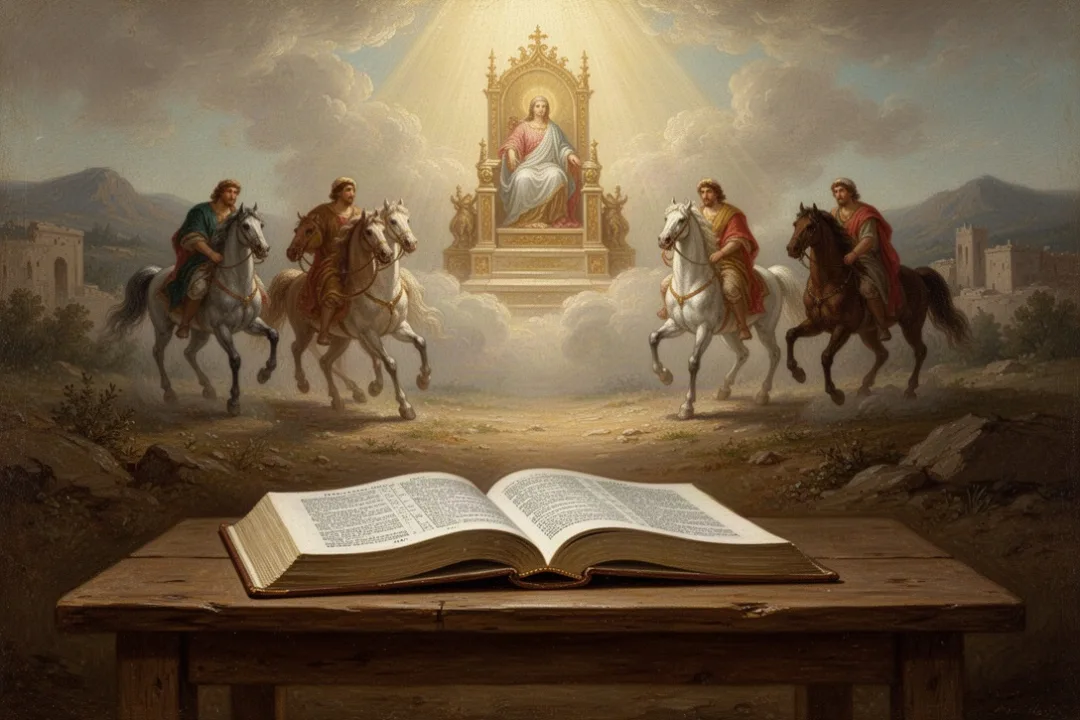
The vision begins in Revelation 4, where John is taken into the heavenly throne room. God sits on the throne, surrounded by worship, living creatures, elders, and angelic beings. In the next chapter, John sees a scroll in God’s right hand, written on both sides and secured with seven seals.
The scroll represents a divine plan that must be carried out. Its contents are not described in a straightforward list, so readers infer its meaning from what happens when the seals are opened. It may be understood as a record of judgment, a decree concerning history, or the full purpose of God for the world.
John begins to weep because no one is found worthy to open the scroll. One of the elders tells him that the Lion from Judah has conquered. John then sees not a lion but a Lamb standing as though slain. This contrast is central to Revelation: Christ conquers not merely through force, but through faithful suffering and self-giving sacrifice.
The central focus is the Lamb, not the disasters. The seals reveal judgment and suffering, but the vision first establishes that Jesus alone has authority to open the scroll and bring God’s purposes to completion.
The opening of the first six seals unfolds in Revelation 6. The seventh seal appears in Revelation 8:1 and leads into the next series of visions, the seven trumpets. This literary connection means the seals are not completely separate from the rest of the book; the seventh seal opens into another stage of Revelation’s imagery.
What happens when each seal is opened
The first seal: a rider on a white horse
When the first seal is opened, John sees a white horse. Its rider carries a bow, receives a crown, and goes out conquering and intending to conquer. The text does not identify the rider by name, which has led to several interpretations.
Some readers understand this rider as a symbol of military conquest or imperial expansion. Others connect the white horse with victory or with a positive figure who resembles Christ. Still others see the rider as deception, especially because the next three riders clearly bring destruction. The passage itself does not settle every question about the rider’s identity.
The first seal can reasonably be read as the beginning of a chain of events in which conquest produces instability, violence, and scarcity. In that reading, the rider represents the ambitions that drive nations into conflict. The white color may suggest victory, but it does not by itself prove that the rider is Christ.
The second seal: a rider who takes peace from the earth
The second seal reveals a fiery red horse. Its rider is permitted to take peace from the earth so that people kill one another, and he receives a large sword. The image moves from conquest to open violence.
The sword need not describe one particular weapon or battle. It symbolizes organized and widespread bloodshed. The removal of peace suggests more than isolated crime; it points to war, civil disorder, and the collapse of relationships between communities or nations.
The language of permission is significant. The rider does not act as an independent power outside God’s knowledge. Revelation repeatedly portrays destructive forces as real and terrifying while still placing them within limits established by God’s sovereignty.
The third seal: a rider who brings scarcity
The third seal shows a black horse. Its rider holds scales, instruments used to measure food and commodities. A voice announces unusually high prices for basic grain while making a distinction involving oil and wine.
The scene conveys economic pressure and food scarcity. Ordinary people may struggle to afford enough grain, while certain goods remain available or protected. Interpreters have therefore seen this seal as an image of famine, inflation, unequal access to necessities, or the economic consequences of war.
The exact meaning of the oil and wine reference is debated. It could indicate that scarcity is limited rather than total, or that luxury goods remain accessible while staple foods become expensive. Either way, the seal highlights the unequal effects of crisis: a shortage does not burden every person in the same way.
The fourth seal: death on a pale horse
The fourth seal introduces a pale or sickly-colored horse. Its rider is named Death, and Hades follows. They receive authority over a portion of the earth to kill through war, famine, plague, and wild animals.
This rider gathers the consequences of the previous seals into one grim picture. Conquest can lead to war; war can produce hunger; hunger and disorder can increase disease and death. The passage portrays mortality as both personal and social, affecting bodies, communities, and the natural environment.
The reference to a limited portion of the earth matters. The judgment is severe, but it is not described as unlimited destruction. Revelation uses fractions and boundaries to show that the forces of judgment operate under restraint, even when their effects are devastating.
The fifth seal: the testimony of the slain
The fifth seal changes the scene from earthly turmoil to a heavenly setting. John sees the souls of people who were killed because of their faithful witness. They call out to God, asking how long it will be before he judges those responsible and vindicates them.
These martyrs are given white robes and told to rest for a little longer until the full number of their fellow servants and believers who will suffer is complete. The response does not dismiss their pain or deny the need for justice. Instead, it presents their waiting as part of a divine timetable that has not yet reached its appointed end.
This seal speaks directly to Christians who wonder why evil appears to continue unchecked. The martyrs’ question is not portrayed as faithlessness. Their cry shows that biblical faith can include grief, protest, and a longing for justice while still turning toward God.
The white robes signify acceptance, purity, honor, and victory. In Revelation, victory does not always look like survival or political power. The martyrs have conquered by remaining faithful to Christ, even when that faithfulness costs them their lives.
The sixth seal: earthquake and cosmic upheaval
When the sixth seal is opened, the vision becomes cosmic. John describes a great earthquake, the darkening of the sun, the reddening of the moon, falling stars, and the movement of the sky and mountains. Kings, powerful people, soldiers, wealthy people, slaves, and free people all seek shelter.
These images echo prophetic language from the Old Testament, where earthquakes and changes in the heavens accompany the day of the Lord. The point is not necessarily to provide a modern scientific description. The language communicates that the established order is being shaken and that no social rank can shield anyone from divine judgment.
The people in the vision recognize that the day of judgment has arrived, but recognition does not equal repentance. They attempt to hide from the presence of the One on the throne and from the wrath of the Lamb. The phrase wrath of the Lamb is deliberately striking: the one known for sacrificial gentleness is also the appointed judge.
Some Christians read this seal as a literal end-time disturbance. Others see it as symbolic language for the collapse of political powers, social structures, or human confidence. Biblical prophetic writing often uses cosmic imagery to describe both historical upheavals and final judgment, so the passage can carry more than one level of meaning.
The seventh seal: silence in heaven
The seventh seal is opened at the beginning of Revelation 8. Instead of another rider or disaster, John sees silence in heaven for about half an hour. The sudden quiet contrasts with the songs, voices, thunder, and worship that fill the earlier throne-room scenes.
The silence may express awe before God’s judgment, suspense before the next vision, or mourning over what is about to occur. It creates a pause rather than offering a simple explanation. After the silence, seven angels receive seven trumpets, and the prayers of God’s people rise before him with incense.
For this reason, the seventh seal functions as a transition. It closes one sequence while introducing the trumpet judgments. The seals, trumpets, and bowls are often studied as separate series, but Revelation connects them through scenes, themes, and repeated patterns.
What the scroll and its seals represent
The sealed scroll is one of the most important symbols in the vision. It is not described as an ordinary book meant for casual reading. It carries the sense of an authoritative document whose contents concern God’s purposes for judgment, redemption, and history.
Several features shape its meaning:
Seven seals suggest completeness or fullness, not merely a random number of locks.
Writing on both sides indicates that the scroll contains a full and comprehensive decree.
The Lamb’s worthiness shows that authority belongs to Christ because of his faithful sacrifice and victory.
The opening of the seals reveals events progressively rather than all at once.
The heavenly setting places earthly suffering within a larger account of God’s sovereignty and justice.
Some interpreters connect the scroll with a title deed, a legal judgment, or a covenant document. These proposals can illuminate certain details, but no single background image explains every feature. The strongest shared point is that the scroll represents a divine plan that only the Lamb can put into effect.
How Christians interpret the seven seals
Interpretation depends partly on how a reader understands the entire Book of Revelation. Four broad approaches are often discussed, although many Christians combine elements from more than one.
Preterist interpretations focus on the first-century setting
A preterist reading emphasizes the original audience and the pressures facing Christians in the Roman world. The seals may reflect war, famine, persecution, and political upheaval that affected the first-century Mediterranean region or the Jewish people before and during the destruction of Jerusalem.
This approach takes seriously the historical setting of John’s churches. Revelation was first sent to real congregations dealing with fear, compromise, oppression, and economic pressure. It also recognizes that apocalyptic writing often speaks to immediate events through symbolic imagery.
Futurist interpretations place major events near the end of history
A futurist reading understands much of Revelation 6 and the chapters that follow as events still awaiting fulfillment. The four horsemen may represent future conquest, war, famine, and death, while the sixth seal may describe a final cosmic shaking before the return of Christ.
Futurists differ among themselves about the timing and sequence of these events. Some connect the seals with a tribulation period; others see them as a broad description of the last days. The text should not be forced into a detailed timetable when it does not provide one.
Historicist interpretations trace a long course of church history
A historicist approach sees the seals as symbols of successive periods or developments across the history of Christianity. The riders and judgments may be linked with imperial decline, wars, religious conflict, or other broad historical movements.
This method was influential in some earlier Protestant traditions, but proposed timelines have varied widely. The difficulty is that different interpreters have assigned the symbols to different events, often shaped by the concerns of their own era.
Idealist interpretations see recurring spiritual realities
An idealist, or symbolic, approach treats the seals as recurring patterns that characterize the age between Christ’s resurrection and final judgment. Conquest, war, scarcity, death, persecution, and divine vindication appear repeatedly throughout history.
This reading does not require the visions to be tied to one specific news event. It emphasizes how Revelation strengthens suffering believers and warns powerful societies that injustice will not have the last word.
These approaches do not have to be used as rigid labels. A reader may believe that the seals addressed first-century realities, reveal recurring patterns in history, and point toward a final judgment. Revelation’s symbolism is capable of historical depth without becoming a codebook for every current event.
Common mistakes when reading the seven seals
The seals have generated many confident predictions, but several habits can lead readers away from the text. Careful interpretation begins with the passage itself, its Old Testament imagery, and its purpose for the churches who first heard it.
Do not treat every horseman as an independently named character. Revelation identifies the fourth rider as Death, but it does not give all four riders personal names.
Do not assume the first rider is automatically Jesus. The white horse creates an association with victory, but the passage does not explicitly identify its rider as Christ.
Do not ignore the original audience. The vision was addressed to churches facing real pressure, not only to people living thousands of years later.
Do not turn symbols into a rigid calendar. The text gives a sequence of visions, but it does not supply dates for each seal.
Do not read the seals apart from the Lamb. The opening throne-room scene explains who controls the scroll and why that authority matters.
Do not use every disaster as proof that a particular seal has just opened. War, famine, and disease are recurring human experiences; matching a headline to a symbol is not the same as interpreting Revelation.
Do not overlook comfort and hope. The fifth seal honors faithful martyrs, and the larger book promises that evil, suffering, and death will face judgment.
A sound reading begins with context. Read Revelation 4–8 as a connected vision, compare its imagery with the Old Testament prophets, and distinguish what the text states from what a particular interpretation infers.
How the seven seals connect with the trumpets and bowls
Revelation presents three major sequences of judgment: the seven seals, the seven trumpets, and the seven bowls. They share themes such as environmental disruption, human rebellion, divine judgment, and the limited duration of suffering.
The relationship between the sequences is debated. The seventh seal introduces the seven trumpets, which suggests that one series unfolds from another. Some interpreters see a straightforward progression from seals to trumpets to bowls. Others see overlapping cycles that revisit the same period from different angles, each adding new details.
The imagery also intensifies. The seals include conquest, violence, scarcity, death, persecution, and cosmic disturbance. The trumpets bring judgments affecting the earth, sea, waters, skies, and human beings. The bowls portray the full outpouring of wrath shortly before the final defeat of evil.
Revelation’s structure may therefore be less like a modern timeline and more like a series of visions that deepen and repeat central truths. The reader is repeatedly shown that God sees suffering, limits evil, judges injustice, and will ultimately establish his reign.
What the seven seals mean for readers today
The seals challenge false security. Political power, wealth, military strength, and social status cannot finally protect people from judgment. The sixth seal deliberately places rulers and ordinary people together, showing that every human being is accountable before God.
They also give language to the realities that damage communities: aggressive ambition, war, economic inequality, hunger, disease, and death. Revelation does not present these conditions as meaningless accidents. At the same time, it does not encourage readers to identify every crisis with a specific prophetic timetable.
The fifth seal provides a particularly important perspective. The suffering of faithful people is seen in heaven, remembered by God, and connected with eventual justice. The martyrs are not forgotten simply because judgment has been delayed.
Finally, the seals direct attention to the Lamb’s authority. The Christian hope in Revelation is not confidence that believers can decode every event. It is confidence that history remains under Christ’s rule and that violence, oppression, and death will not be permanent.
How to study the seven seals carefully
A careful study can follow a few practical steps:
Read Revelation 4–8 together. The throne room, the scroll, the Lamb, the seals, and the trumpets form a connected movement.
Mark what the text directly says. Separate explicit details, such as the colors of the horses, from conclusions about their symbolic meaning.
Compare related prophetic passages. Revelation draws on images found throughout the Old Testament, including visions of judgment, cosmic upheaval, and restoration.
Ask what the first churches would have heard. Consider persecution, imperial power, war, hunger, and the cost of faithful witness.
Compare interpretations fairly. Preterist, futurist, historicist, and idealist readings each highlight different features and each face interpretive questions.
Keep the theological center in view. The worthiness of the Lamb is more certain than the identity of every symbol.
The seven seals are therefore best understood as a powerful vision of how Christ opens God’s plan for judgment and redemption. They portray the violence and suffering of a fallen world, the cost of faithful witness, the shaking of human power, and the certainty that God’s purposes will prevail.
Frequently asked questions
Are the seven seals the same as the seven trumpets?
No. The seven seals, seven trumpets, and seven bowls are distinct sequences in Revelation. However, they are connected: the seventh seal is opened in Revelation 8, and that scene introduces the seven angels with trumpets. Some interpreters see the sequences as consecutive stages, while others understand them as overlapping visions that portray judgment from different perspectives.
Are the four horsemen one of the seven seals?
Yes. The first four seals each introduce a rider on a different horse. Together, the riders symbolize conquest, violence, scarcity, and death, although Christians disagree about some details, especially the identity of the first rider. The fourth rider is explicitly associated with Death, while the other riders are described by their actions and effects.
Does Revelation say when the seven seals will happen?
Revelation does not provide a modern calendar or precise dates for the seals. Some readers place their fulfillment mainly in the first century, others expect a future fulfillment, and others see recurring patterns throughout history. The text emphasizes God’s authority and final justice more clearly than it establishes a detailed schedule.
Why is Jesus called the Lamb when he opens the seals?
The Lamb represents Jesus as the one who conquered through sacrificial death and faithful obedience. This title connects his authority with his suffering rather than with ordinary political or military power. Revelation presents him as both sacrificial and judicial: the Lamb is worthy to open the scroll and bring God’s purposes to completion.





Leave a Reply