Revelation Bible study: A clear guide to its message
Revelation Bible study: A clear guide to its message
Have you ever opened the Book of Revelation and wondered whether its visions describe current events, the distant future, or something you are meant to understand today? A helpful Revelation Bible study begins with a simple answer: Revelation reveals Jesus Christ, strengthens faithful endurance, and announces God’s final victory over evil. Its dramatic images matter, but they make better sense when you read them within the book’s pastoral purpose.
Revelation is not primarily a codebook for identifying headlines. It is a carefully shaped work of apocalyptic prophecy and Christian encouragement, written to churches facing pressure, compromise, suffering, and the seductions of imperial power. The book uses visions, symbols, songs, warnings, and promises to show reality from heaven’s perspective.
The title comes from the Greek word often translated as revelation or apocalypse, meaning an unveiling. The opening of the book presents it as a revelation given by God and communicated through Jesus Christ. It is therefore meant to disclose something, not merely conceal it.
Revelation combines several biblical forms. It contains letters to real churches, prophetic preaching, and apocalyptic visions. Those forms work together: the letters address immediate spiritual conditions, while the visions interpret those conditions within the larger conflict between the Lamb and the powers of evil.
The book was sent to seven churches in the Roman province of Asia, traditionally associated with locations in what is now western Turkey. The communities differed in their strengths and weaknesses, but they shared the challenge of remaining loyal to Christ in a culture shaped by political power, religious pressure, social status, and economic expectations.
Study principle: Before asking what a symbol might represent in your own time, ask what it communicated to the first readers. Original setting does not answer every interpretive question, but it gives the visions a necessary starting point.
How Revelation is organized from beginning to end
A clear structure helps you read Revelation without treating every image as an isolated prediction. The book moves through recurring scenes of worship, judgment, conflict, perseverance, and renewal. Its arrangement also contains repetition and overlap, so not every section should be forced into a simple chronological timeline.
Revelation 1: John introduces the revelation and describes a vision of the risen Christ among the seven lampstands.
Revelation 2–3: Jesus addresses the seven churches, praising faithfulness, confronting sin, and promising rewards to those who overcome.
Revelation 4–5: Heaven’s throne room centers on God’s sovereignty and the Lamb’s worthiness to open the scroll.
Revelation 6–11: Seals, trumpets, witnesses, and judgments portray upheaval while emphasizing God’s call to repentance and faithful testimony.
Revelation 12–14: A symbolic conflict reveals the dragon, the beasts, the Lamb, and the people who belong to God.
Revelation 15–18: Bowls of judgment and the fall of Babylon expose the corruption and arrogance of the world’s rebellious system.
Revelation 19–20: Christ’s victory, the defeat of evil, and final judgment receive concentrated attention.
Revelation 21–22: God makes all things new, bringing the holy city, restored creation, and unbroken fellowship with his people.
This outline gives you landmarks, but it does not settle every debate about the book’s chronology. Some interpreters read the visions mainly as events still future. Others see many scenes as symbolic descriptions of the early church’s conflict, recurring patterns throughout history, or a combination of these approaches.
What the seven churches teach about faithful discipleship
The letters in chapters 2 and 3 are among the most practical parts of Revelation. Each message is addressed to a particular congregation, yet the repeated call to hear what the Spirit says to the churches gives them continuing value. The churches are not treated as interchangeable. Jesus knows their circumstances, commendations, temptations, and spiritual dangers.
Several churches are commended for endurance, discernment, loyalty, or service. Others are confronted because they have lost their first love, tolerated destructive teaching, become spiritually dead, or grown complacent. One church considers itself prosperous and secure, but the message exposes its deeper poverty. These warnings show that outward success is not the same as spiritual health.
The letters also reveal that persecution is not the only threat to Christian faithfulness. Fear can pressure believers to deny Christ, but comfort can produce an equally serious kind of compromise. A congregation may remain active while losing love, defend correct teaching while becoming harsh, or enjoy material security while failing to recognize its need for God.
Each message points toward a promise for those who overcome. The promises use images such as life, hidden nourishment, authority, white clothing, a place in God’s temple, and a seat with Christ. They are not rewards for personal heroism detached from grace. They portray the future belonging of people who remain loyal to Jesus through testing.
Why the Lamb is central to Revelation
Revelation’s most important image is not the dragon, the beast, or the mysterious number. It is the Lamb. In chapter 5, John sees that no one appears worthy to open the scroll until the Lamb comes forward. The Lamb has the appearance of one who has been slain, yet stands alive, joining sacrificial death with resurrection victory.
This vision reshapes the meaning of power. The world often recognizes strength through violence, control, wealth, and public dominance. Revelation presents Jesus as victorious precisely through faithful suffering and self-giving love. His triumph does not resemble the beasts’ rule, even though it is more decisive and lasting.
The Lamb is worshiped because he has redeemed people from every nation. That worldwide community matters: Revelation does not present salvation as belonging to one ethnic group, empire, or privileged class. The redeemed sing, serve, and bear witness because Christ has made them a people for God.
When studying any difficult vision, ask how it relates to the Lamb. Does an interpretation make Jesus central, or does it turn attention almost entirely toward speculation? Does it encourage faithful witness, holiness, and hope? Those questions protect the study from becoming an exercise in decoding symbols while overlooking the book’s main subject.
How to understand symbols without forcing them
Revelation communicates through images that are often drawn from earlier Scripture. Lampstands, stars, a woman, a dragon, beasts, horns, bowls, seals, a river, a city, and precious stones all carry meaning within the book’s literary world. A symbol may point to a person, community, spiritual reality, political power, or repeated pattern of behavior.
Some symbols receive an explanation in the text itself. The seven lampstands are identified with the seven churches, and the stars are connected with the churches’ angels or messengers. In other places, the meaning is suggested by context rather than directly defined. The safest approach is to let Revelation explain as much as it can before consulting outside systems.
Numbers also contribute to the book’s symbolism. Seven commonly communicates fullness or completeness in biblical literature. Twelve can evoke the tribes of Israel and the apostles, while multiples of twelve can suggest the comprehensive people of God. Three and a half, expressed in several forms, often conveys a limited period of oppression rather than an endless reign.
The number 666 in Revelation 13 has generated many proposals. The passage links it with human wisdom, the beast, and the number of a person. Interpretations have connected it to ancient name-numbering practices and to broader ideas about human power falling short of divine completeness. Because the passage is difficult, confident claims that identify a modern individual or technology should be treated cautiously.
Old Testament background is essential. Revelation echoes themes from Daniel, Ezekiel, Isaiah, Zechariah, Exodus, the Psalms, and Genesis. These echoes do not always reproduce the earlier passages word for word; they reuse images and patterns to show continuity between God’s former acts and his promised future.
Read the immediate scene first. Observe what happens before and after the symbol.
Look for explanations inside Revelation. Repeated images may become clearer through comparison.
Check the Old Testament background. Ask what the earlier image meant in its original setting.
Notice contrasts. Revelation frequently places the Lamb against the dragon, the holy city against Babylon, and faithful worship against idolatrous allegiance.
Keep the symbol’s moral force. A beast is not merely a puzzle; it represents opposition to God and pressure to participate in rebellion.
How judgment, evil, and suffering function in the book
Revelation does not minimize suffering. Its scenes of war, famine, death, persecution, and cosmic disturbance are unsettling because the book takes human evil seriously. The martyrs under the altar cry out for justice, and the visions repeatedly show that God sees the violence endured by his people.
At the same time, the judgments are not presented as random explosions of divine anger. They reveal the consequences of rebellion, expose corrupt powers, and answer the cries of the oppressed. Several passages also show people refusing to repent despite severe judgments, emphasizing the hardness that can result when people worship power instead of God.
The dragon represents Satan as the accuser and enemy of God’s people. The beasts represent political and religious power when those powers demand allegiance that belongs to God. Babylon represents a wealthy, seductive, exploitative system that draws nations into immorality and false worship. These images can have historical reference while also describing recurring forms of evil.
Christians should read these judgments with humility. Revelation gives assurance that evil will not rule forever, but it does not authorize believers to enjoy another person’s destruction or to treat every opponent as the beast. The appropriate response is faithful resistance to evil, truthful witness, repentance, and trust in God’s justice.
What Babylon represents in Revelation
Babylon is one of the book’s most developed symbols. She is portrayed as a magnificent yet corrupt city that influences rulers, enriches merchants, and intoxicates nations. Her wealth is connected with exploitation, luxury, violence, and spiritual unfaithfulness. The imagery recalls ancient Babylon, but the symbol reaches beyond one ancient location.
For John’s first readers, the imagery would have resonated with the power and cultural dominance of Rome. Still, reducing Babylon to a single historical capital can miss the wider warning. Babylon describes any organized power that treats people as commodities, turns prosperity into an idol, and demands loyalty that conflicts with God’s kingdom.
The call for God’s people to leave Babylon is not necessarily a command to abandon ordinary society. It is a call to reject participation in its worship, injustice, pride, and moral corruption. A Christian household, church, or business may need to ask how its spending, leadership, ambition, and treatment of vulnerable people either resist or reinforce Babylon-like values.
Practical question: When a system benefits you, ask what hidden costs others may be carrying. Revelation’s warning against Babylon includes not only private immorality but also indifference to exploitation and the worship of wealth.
How different Christian interpretations read Revelation
Faithful Christians have used several broad approaches to interpret Revelation. A preterist approach emphasizes the book’s first-century setting and sees many visions as addressing events and pressures near the time of its original audience. A futurist approach expects substantial fulfillment in events still ahead of the church.
An historicist approach reads the visions as a broad outline of church history, though different interpreters have mapped the symbols onto history in very different ways. An idealist or symbolic approach sees Revelation as portraying recurring spiritual realities: the church’s witness, the world’s opposition, God’s judgment, and Christ’s final victory.
Many readers combine elements of these approaches. A vision may have addressed a first-century situation, reveal a repeated pattern across history, and point toward a final fulfillment. Revelation’s symbols often have this layered quality, which is one reason a single modern-events chart cannot exhaust their meaning.
When comparing interpretations, evaluate the method rather than merely the confidence of the teacher. Ask whether the approach respects the original audience, accounts for Old Testament imagery, reads symbols consistently, centers Christ, and explains the whole book rather than a few dramatic passages.
A practical method for a Revelation Bible study
Set aside enough time to read a complete section in one sitting. Revelation’s repeated images and contrasts are easier to recognize when you do not isolate every verse. A study group can read aloud, but participants should distinguish what the text says from what they infer.
Pray for wisdom and humility. The goal is faithful understanding, not winning an argument about timelines.
Read the passage several times. Mark repeated words, commands, promises, characters, locations, and responses.
Identify the audience and setting. Note whether the scene addresses a church, heavenly worshipers, the nations, rulers, or John himself.
Describe before interpreting. Write down what you can observe without assigning symbolic meanings too quickly.
Trace repeated themes. Look for worship, witness, endurance, deception, judgment, victory, and new creation.
Compare related passages. Read other places in Revelation where the same image or phrase appears.
Examine biblical echoes. Use cross-references or a Bible with notes, then read the earlier passage in context.
Ask what the first readers were being called to do. Identify the command, warning, encouragement, or promise.
Apply the passage carefully. Consider how it shapes worship, ethics, courage, church life, and hope.
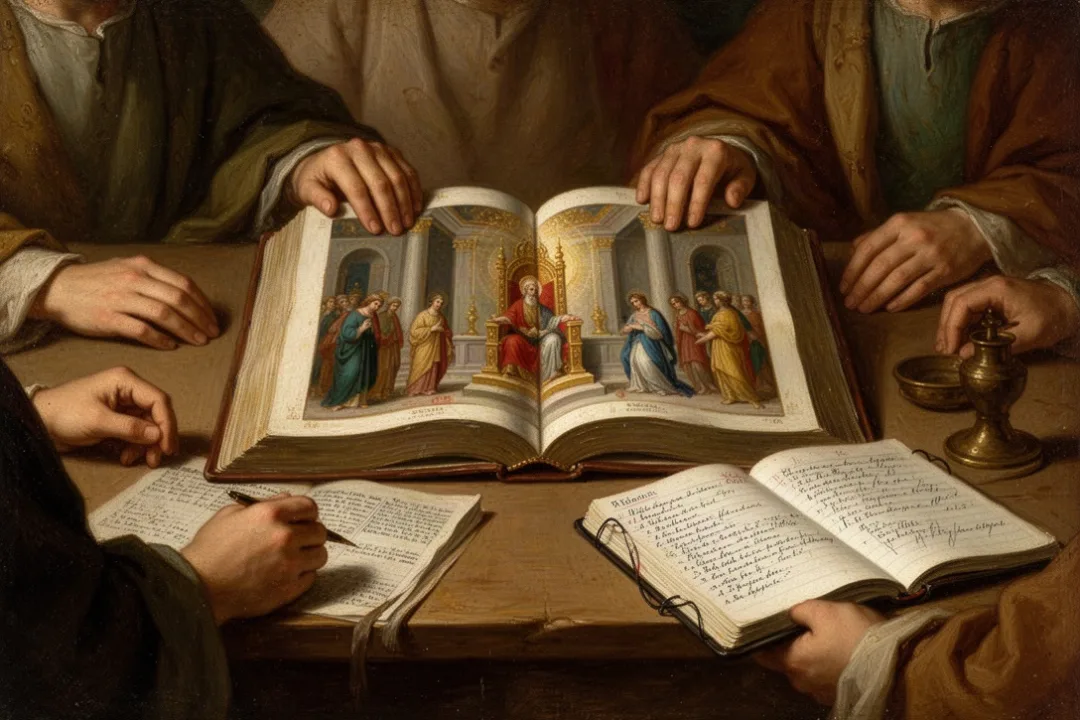
A useful notebook can have four columns: observation, interpretation, biblical connections, and response. This simple format keeps you from confusing a guess with a clear statement from the text. It also helps a group compare interpretations without turning every disagreement into a personal dispute.
Common mistakes that weaken Revelation Bible study
Reading the book only as a prediction chart: This can overshadow its letters, worship scenes, ethical warnings, and encouragement to suffering churches.
Ignoring the Old Testament: Many images become distorted when they are treated as modern inventions rather than biblical symbols.
Assigning every symbol one fixed meaning: An image can function differently depending on its scene and literary context.
Making current events the controlling lens: News may resemble biblical patterns, but resemblance alone does not prove fulfillment.
Assuming fear is the main intended response: Revelation contains warnings, yet it repeatedly calls God’s people to worship, endurance, and hope.
Turning uncertain interpretations into tests of faith: Christians can agree on Christ’s victory and the reality of judgment while disagreeing about detailed timelines.
Overlooking the churches: The opening messages confront ordinary failures such as lovelessness, compromise, spiritual apathy, and material pride.
Separating doctrine from conduct: Revelation connects what believers confess with how they resist idolatry, speak truth, endure pressure, and care about justice.
How Revelation forms Christian hope
The book’s hope is more substantial than escape from a damaged world. Revelation ends with new creation: a holy city, the presence of God, the end of death and mourning, and the restoration of life-giving abundance. Its final vision is not centered on disembodied existence but on God dwelling with his people in a renewed order of creation.
The image of the New Jerusalem gathers together themes from the whole Bible. The city has no temple because God and the Lamb are its temple. It needs no ordinary sun or lamp because divine glory gives it light. The river and tree of life recall Eden, but the closing vision presents restored access and healed nations rather than a garden lost through rebellion.
This hope changes how believers live before the final renewal. If God will remove death and injustice, Christians do not need to pretend that suffering is acceptable or that evil is permanent. If worship belongs to God alone, no government, market, leader, ideology, or cultural movement deserves ultimate trust.
Revelation therefore calls for patient endurance with active faithfulness. Its readers are not told to calculate dates and wait passively. They are called to remain loyal to Jesus, reject idolatry, speak truth, practice holiness, encourage one another, and worship the God who holds history in his hands.
Questions to carry into personal and group study
Good study questions move beyond “What does this symbol stand for?” Ask what the passage reveals about God, Jesus, evil, the church, suffering, worship, and hope. Ask which characters are faithful and which forms of pressure lead people away from God.
What does this passage show about the character and authority of Jesus?
Where do you see false worship, fear, compromise, or pressure to conform?
How are suffering believers encouraged or corrected?
What does the passage ask God’s people to do now?
Which Old Testament images help explain the scene?
How does this section contribute to the promise of Christ’s victory and renewed creation?
Does your interpretation produce humility, courage, holiness, and hope?
A group should make room for uncertainty while holding firmly to the book’s central message. Participants may disagree about the sequence of events or the identity of particular symbols, but they can still study the text together around its clear emphasis: Jesus is Lord, evil is judged, faithful witness matters, and God will dwell with his redeemed people.
Frequently asked questions
Is Revelation meant to be read literally or symbolically?
Revelation uses both literal and symbolic communication. The seven churches were real communities, while beasts, horns, lampstands, and the dragon carry symbolic meaning. Symbolic does not mean unreal; it means an image communicates a deeper reality. Read each passage in context, look for explanations within the book, and avoid assuming that every detail should be converted into a literal modern event.
What should I read before starting a Revelation Bible study?
Read the entire book once without stopping to solve every symbol. Then review Genesis, Exodus, Isaiah, Ezekiel, Daniel, Zechariah, and selected Psalms, since Revelation frequently echoes their imagery. A Bible edition with cross-references can help. Reading the letters to the seven churches closely is especially useful because they establish the book’s concerns about worship, endurance, compromise, and spiritual faithfulness.
Does Revelation identify specific modern countries or technologies?
Revelation does not provide a straightforward list of modern nations, inventions, or political leaders. Some readers connect its images with current events, but those connections remain interpretations rather than certain identifications. Begin with the first-century setting, the book’s biblical symbols, and its theological message. Treat claims about precise contemporary fulfillments with caution, especially when they depend on speculation or fear.
What is the main message of Revelation for Christians today?
The central message is that Jesus Christ is worthy, sovereign, and victorious even when evil appears powerful. Christians are called to reject idolatry and corrupt systems, remain faithful under pressure, worship God, and bear truthful witness. Revelation also promises that judgment will end evil and that God will renew creation and live with his people permanently.







Leave a Reply